/ THE SHORT ANSWER
- 01Sex-specific cells and differently connected shared cells are not the same finding.
- 02Connectivity differences require functional investigation.
- 03One reconstructed specimen does not describe an entire population.
/ dotSuper point of view
Small, specific circuit differences are experimentally interesting without becoming sweeping claims about brains or behavior.
Two kinds of difference worth separating
A sex-specific type is identified in one sex under the comparison.
A dimorphic type can be present in both while differing in structure or connections.
The project overview reports 262 sex-specific and 114 sexually dimorphic cell types, comprising 4.8% of the central brain in that analysis.
Those are results with a defined scope, not a statement that a fixed percentage explains every behavioral difference.
Cell classification and connectivity analysis answer narrower questions.
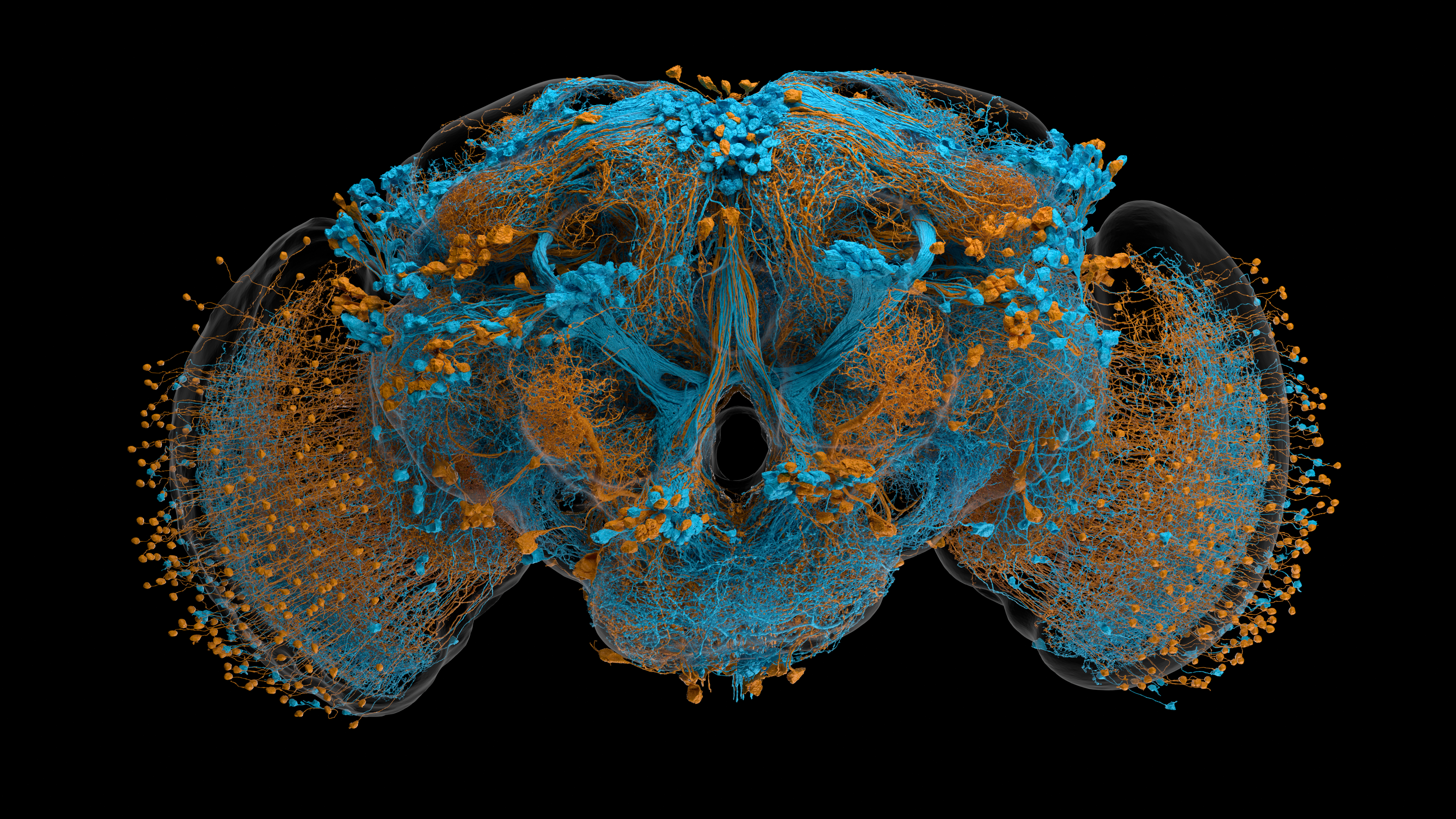
What the blue and orange rendering shows
Its blue structures represent male-specific neurons; orange structures represent sexually dimorphic neurons, according to the project gallery.
It is not the entire brain, and an absent color does not mean an absent biological function.
Selection and labeling are essential to interpreting the picture.
A useful comparison pairs this overview with one named cell type in the project's Dimorphism Explorer.
Inspect that cell's own partners and morphology rather than inferring function from the overall color balance.
Why the comparison needs matched boundaries
MaleCNS includes the nerve cord as well.
A whole-resource neuron count therefore mixes anatomical coverage with any biological difference.
The research team's comparison tools distinguish shared and sex-related connectivity at more specific levels.
That is more informative than placing two totals beside each other.
Before discussing a difference, specify the compared region, matching method and dataset versions.
If a cell lacks a clear match, uncertainty should remain visible rather than being forced into a neat story.
| Claim | Evidence needed |
|---|---|
| A structure differs in these reconstructions | Matched anatomical comparison with uncertainty recorded |
| The difference influences a behavior | Relevant activity measurements and functional interventions |
| The difference generalizes across a population | Independent specimens and an appropriate study design |
From a circuit difference to a behavior
It does not automatically prove that the pathway is sufficient or necessary for a behavior.
The next step is a targeted experimental question.
For example, would changing activity in a proposed pathway alter a defined response under specified conditions?
Our interpretation is that comparative maps are valuable because they narrow those questions.
Their importance does not depend on presenting a complete explanation of courtship, aggression or flexible behavior.
What readers should not extrapolate
Comparing a small number of specimens is not equivalent to establishing the distribution of a trait across all flies.
An even larger leap would be to use these insect circuits as a direct explanation of human social roles or intelligence.
This research does not establish that bridge.
When writing or sharing the finding, name the organism and the measured feature in the sentence.
'This fly cell type has different partners' is more accurate than a general claim about male and female minds.
- Avoid intelligence rankings based on neuron totals.
- Keep anatomical difference separate from behavioral explanation.
- Treat human extrapolations as new hypotheses requiring their own evidence.
What this page cannot conclude
- 01Reported categories and percentages describe a specific comparative analysis.
- 02This article makes no claims about human sex differences, individual ability or behavioral destiny.
- 03Prepared with AI assistance from the named research sources. dotSuper did not conduct these experiments, independently reproduce the studies or obtain an endorsement from the research institutions.
Sources
- 01Male CNS Connectome: project overviewHHMI Janelia / FlyEM · accessed Sep 15, 2026
- 02Sexual dimorphism in the complete Drosophila male central nervous system connectomeBerg et al., Cell (2026), PubMed record · accessed Sep 15, 2026
- 03Dimorphism ExplorerMaleCNS project · accessed Sep 15, 2026
- 04World-first male fly brain map helps unlock secret workings of the mindUniversity of Cambridge, Department of Zoology · accessed Sep 15, 2026
- 05Neuronal wiring diagram of an adult brainDorkenwald et al., Nature (2024) · accessed Sep 15, 2026
- 06MaleCNS research media galleryFlyEM / HHMI Janelia and collaborators · accessed Sep 15, 2026
Our editorial standard · Found an error? Send a correction with its source.
/ CITE OR SHARE THIS GUIDE
Make the evidence easy to verify.
When you reference this guide, link to its canonical URL. That gives readers one stable place for the evidence, limitations and future updates.
dotSuper Research Desk. (September 15, 2026). Male and Female Fly Brains: What Differs?. dotSuper. https://dotsuper.net/feeds/applied-systems/male-female-fly-brain-connectome-differences
Can a Fly Brain Run on a Computer?
Continue with a different question in our source-linked fly-brain series.
Read the next explainer