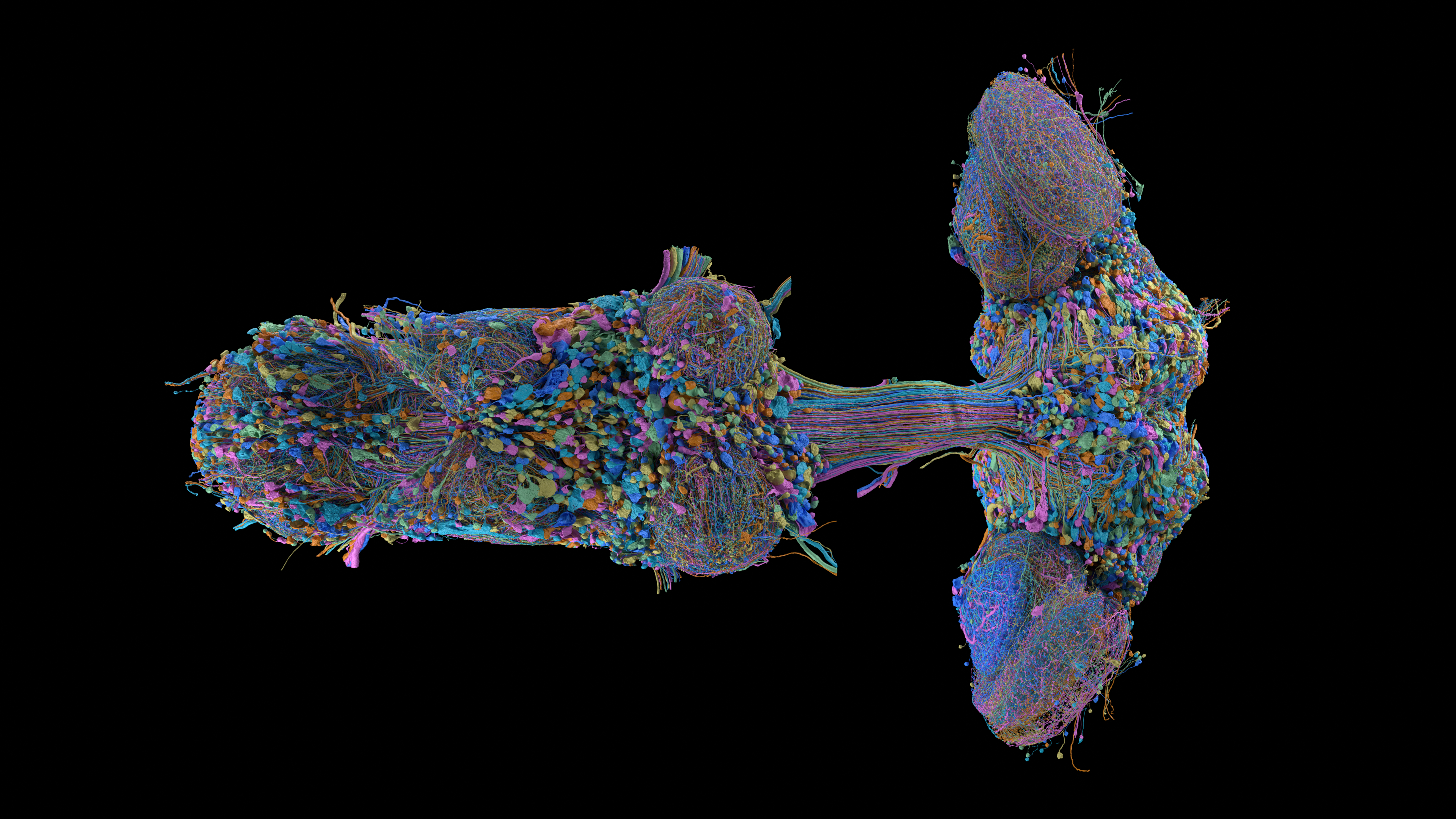
/ THE SHORT ANSWER
- 01A wiring dataset needs additional equations and assumptions before it can run.
- 02Published circuit predictions and game demonstrations are different evidence categories.
- 03Biological fidelity must be evaluated for a specified behavior or response.
/ dotSuper point of view
The right question is what a simulation reproduces and predicts, not whether an animation looks alive.
A file of connections is not an executable animal
They also need a definition of the output being measured.
A connectome constrains some of those choices.
It does not uniquely determine all of them.
Two simulations can start from the same graph and behave differently because their equations or inputs differ.
When you see a digital fly, ask for a component list: dataset, neuron model, sensory interface, body controller, environment and training procedure.
That is more revealing than a single label such as 'brain emulation'.
What a peer-reviewed model demonstrated
The study investigated feeding and grooming circuits.
Computational predictions were compared with biological experiments, including targeted activation.
Its contribution was a way to generate and investigate specific sensorimotor hypotheses.
That is a stronger scientific result than visual similarity alone.
It is also narrower than proving that the model reproduces every behavior, internal state or experience of the original animal.
How to judge a 'fly brain plays a game' claim
Those interfaces may contribute substantially to the observed behavior.
Ask whether the system was trained on the task, whether the original connection structure was changed and which baseline it beat.
Also ask what would happen with shuffled connections or a simpler controller.
These are evaluation questions, not a claim that every demonstration is invalid.
This article does not authenticate any particular viral Doom or Mario implementation.
A working demo and a validated biological model can be useful for different reasons.
| Claim | What would support it |
|---|---|
| The program runs | Code, dependencies and a reproducible execution |
| The system performs a task | Held-out evaluation and suitable baselines |
| The connectome contributes | Controlled comparisons that isolate its contribution |
| The model explains a biological response | Predictions tested against relevant biological evidence |
| A mind was uploaded | Not established by the evidence discussed here |
Running on different hardware is another question
This is research about implementation on a particular computing architecture.
Hardware execution, energy use and biological validity are separate dimensions.
A faster simulation can still rely on simplified biological assumptions.
If a hardware claim matters to a product decision, compare equivalent workloads and report the full measurement boundary.
Do not infer a commercial efficiency advantage merely from the word 'neuromorphic'.
Use language that preserves the achievement
This describes an important result without pretending that every unknown has disappeared.
Our suggested reading exercise is to write two lists: what the map supplies and what the simulation authors add.
The second list is not an embarrassment; it is where much of the modeling work happens.
For businesses, the parallel is straightforward.
Ask what a demonstration predicts about your actual workload before treating it as deployment evidence.
- Request the model's code and named dataset version.
- Separate training performance from unseen-task evaluation.
- Do not infer consciousness or memory preservation from task performance.
What this page cannot conclude
- 01No specific viral game-playing project was independently reproduced for this article.
- 02The Loihi 2 and connectomic graph studies are identified here as preprints; their claims should be read at that evidence level.
- 03Prepared with AI assistance from the named research sources. dotSuper did not conduct these experiments, independently reproduce the studies or obtain an endorsement from the research institutions.
Sources
- 01A Drosophila computational brain model reveals sensorimotor processingShiu et al., Nature (2024) · accessed Sep 15, 2026
- 02Drosophila brain model: code and documentationPhilip Shiu and collaborators · accessed Sep 15, 2026
- 03Neuromorphic Simulation of Drosophila Melanogaster Brain Connectome on Loihi 2arXiv preprint (2025) · accessed Sep 15, 2026
- 04Whole-Brain Connectomic Graph Model Enables Whole-Body Locomotion Control in Fruit FlyJin et al., arXiv preprint, revised June 2026 · accessed Sep 15, 2026
- 05MaleCNS research media galleryFlyEM / HHMI Janelia and collaborators · accessed Sep 15, 2026
Our editorial standard · Found an error? Send a correction with its source.
/ CITE OR SHARE THIS GUIDE
Make the evidence easy to verify.
When you reference this guide, link to its canonical URL. That gives readers one stable place for the evidence, limitations and future updates.
dotSuper Research Desk. (September 15, 2026). Can a Fly Brain Run on a Computer?. dotSuper. https://dotsuper.net/feeds/applied-systems/can-fly-brain-run-computer-simulation
What Fly Brain Research Could Teach Robots
Continue with a different question in our source-linked fly-brain series.
Read the next explainer