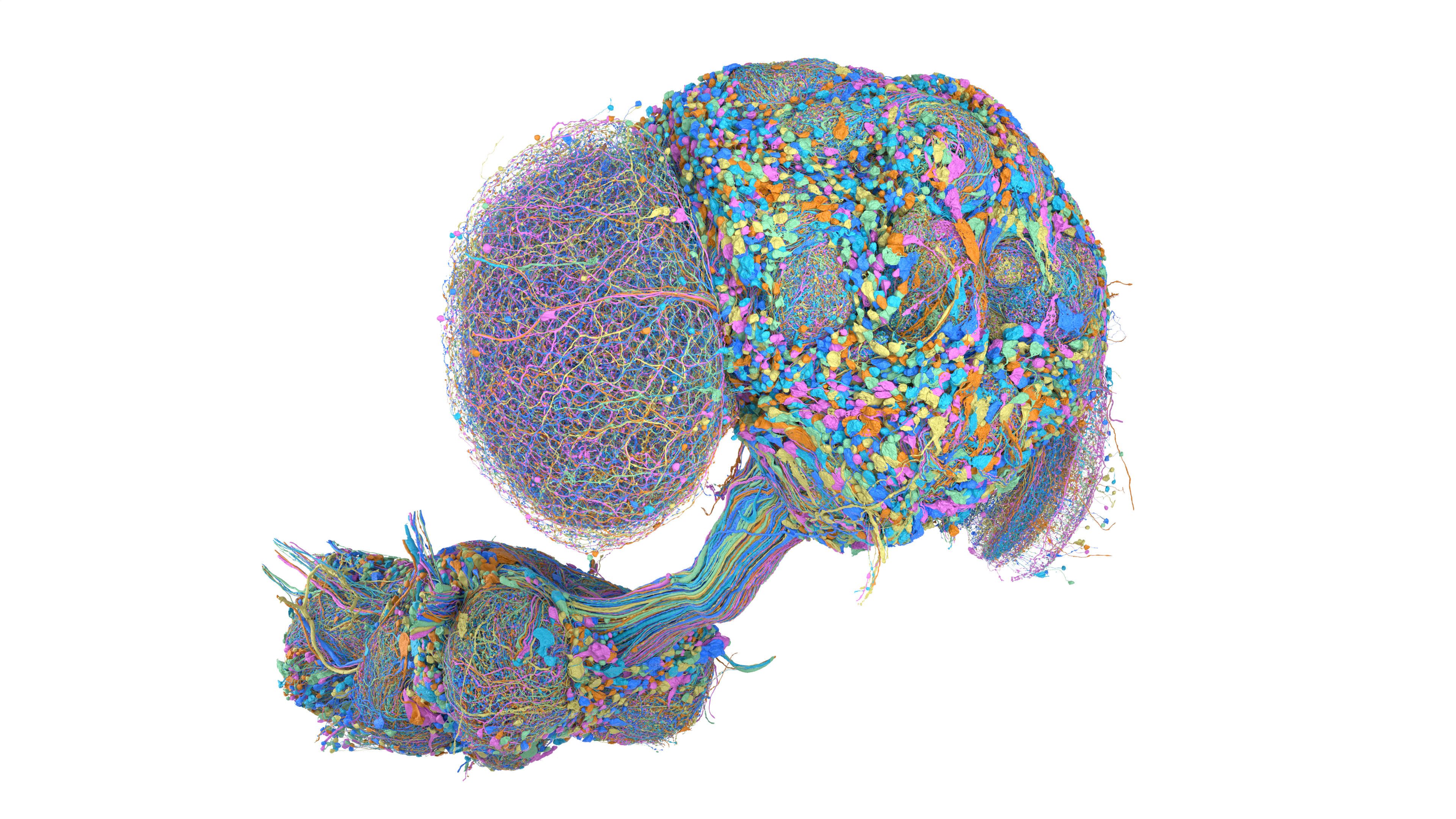
/ THE SHORT ANSWER
- 01A mapped brain and a simulated body are separate research resources.
- 02Learned controllers are not automatically faithful copies of biological circuits.
- 03Simulation results need additional evidence before physical deployment.
/ dotSuper point of view
The opportunity is disciplined sensorimotor modeling, not a plug-and-play insect brain for every machine.
A controller has to act through a body
Sensor delay, mechanical limits, contact forces and actuator behavior shape the task.
A controller that works in one simulated body can fail when those conditions change.
This is why 'a brain for a robot' is an incomplete specification.
For any proposed application, define the controlled body, available observations and permitted actions first.
Only then does it become meaningful to ask which neural architecture is useful.
What a realistic fly-body simulation contributes
It combines walking and flight research within one modeling framework.
The researchers trained artificial neural controllers using imitation and reinforcement learning.
The paper does not present those controllers as exact reconstructions of the biological nerve cord.
That distinction matters: realistic-looking movement can result from a learned engineering controller.
The contribution remains valuable, but it should not be relabeled as proof that a complete biological brain has been copied.
Where connectome-based control enters
The authors report locomotion results and comparisons with alternative controllers.
The work treats connectivity as part of a learning architecture, rather than claiming that structure alone supplies all behavior.
A useful follow-up question is which advantage survives changes in task, initialization and evaluation conditions.
Better performance on a defined benchmark is not automatically a universal advantage.
Plausible applications, with their next tests
It identifies experiments a robotics team might consider, not products shown to be commercially ready by these studies.
The strongest first experiment isolates one claimed benefit.
If the question is robustness to sensor noise, hold the body and training budget comparable rather than changing several ingredients at once.
A negative result can also be valuable.
It may show that a simpler controller is sufficient, or that the bottleneck is sensing and actuation rather than the network architecture.
| Possible direction | What to test next |
|---|---|
| Compact sensorimotor control | Task success against simpler controllers under equal resource limits |
| Robustness to noisy observations | Performance with held-out sensor disturbances |
| Adaptive locomotion | Recovery under changed terrain and body parameters |
| Neuromorphic execution | Measured latency and energy for comparable complete workloads |
| Physical robot transfer | Safe, bounded trials that expose simulation-to-reality differences |
What this means for manufacturing buyers
The purchasing question remains whether the whole system performs the required work safely and consistently.
A relevant pilot might evaluate a narrowly defined inspection or handling task with an existing baseline.
It should preserve operator authority, record failures and use the applicable safety process.
The research can inform long-term technical exploration.
It does not remove integration work, certification obligations or the need for independent evidence on the actual machine.
- Ask which component uses the biological research.
- Demand a baseline that could realistically solve the same job.
- Separate simulated performance from physical-system results.
- Keep research pilots outside uncontrolled production use.
What this page cannot conclude
- 01The application map is prospective analysis, not a list of proven commercial uses.
- 02This article is not machinery-operation or safety guidance. Physical trials require qualified engineering and appropriate safeguards.
- 03Prepared with AI assistance from the named research sources. dotSuper did not conduct these experiments, independently reproduce the studies or obtain an endorsement from the research institutions.
Sources
- 01Whole-body physics simulation of fruit fly locomotionVaxenburg et al., Nature (2025) · accessed Sep 15, 2026
- 02Flybody: MuJoCo fruit fly body model and locomotion tasksTuraga Lab · accessed Sep 15, 2026
- 03Whole-Brain Connectomic Graph Model Enables Whole-Body Locomotion Control in Fruit FlyJin et al., arXiv preprint, revised June 2026 · accessed Sep 15, 2026
- 04Neuromorphic Simulation of Drosophila Melanogaster Brain Connectome on Loihi 2arXiv preprint (2025) · accessed Sep 15, 2026
- 05MaleCNS research media galleryFlyEM / HHMI Janelia and collaborators · accessed Sep 15, 2026
Our editorial standard · Found an error? Send a correction with its source.
/ CITE OR SHARE THIS GUIDE
Make the evidence easy to verify.
When you reference this guide, link to its canonical URL. That gives readers one stable place for the evidence, limitations and future updates.
dotSuper Research Desk. (September 15, 2026). What Fly Brain Research Could Teach Robots. dotSuper. https://dotsuper.net/feeds/applied-systems/fly-brain-research-ai-robotics-applications
How Fly Brain Maps Help Explain Vision
Continue with a different question in our source-linked fly-brain series.
Read the next explainer