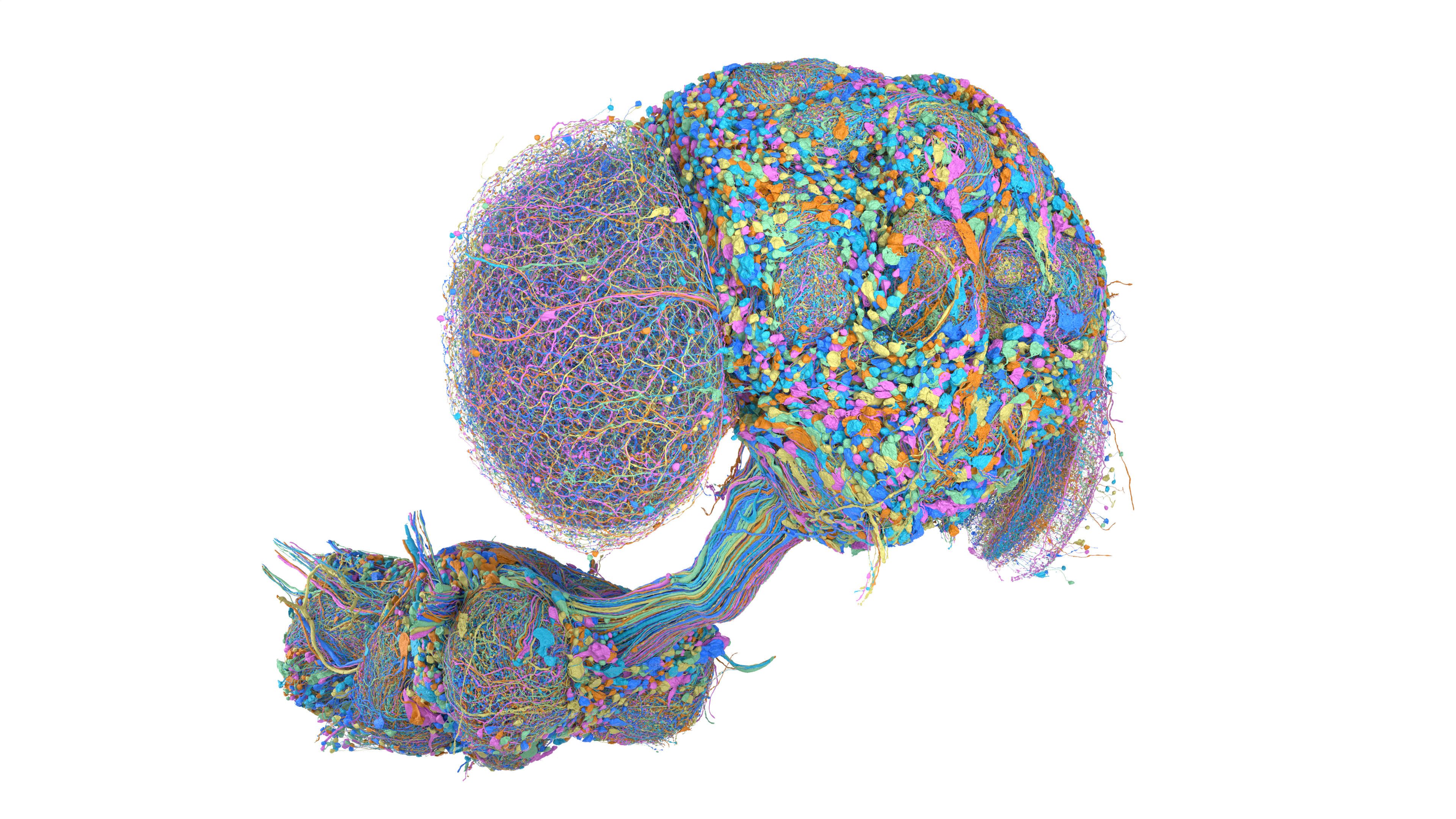
/ THE SHORT ANSWER
- 01Physical microscopy supplies the evidence; AI reconstructs structures from it.
- 02Split and merge errors can alter the apparent circuit.
- 03Synthetic training shapes are not replacements for the real specimen's anatomy.
/ dotSuper point of view
The transferable AI lesson is a controlled human-and-machine workflow, not unattended automation of scientific judgment.
The research begins with the specimen
Image alignment, reconstruction and annotation then turn that evidence into a resource researchers can query.
These stages solve different problems.
An image can be sharp while a reconstruction joins the wrong branches.
A reconstruction can be geometrically plausible while a cell-type annotation remains uncertain.
Read the method as a chain of evidence transformations.
For each stage, ask what enters, what leaves and what kind of mistake would survive into the next stage.
| Stage | Question to ask |
|---|---|
| Imaging | Which structures can this preparation and resolution reveal? |
| Alignment and segmentation | Are adjacent observations assigned to the correct structure? |
| Reconstruction | Were branches accidentally separated or joined? |
| Proofreading and annotation | Which uncertainties were corrected, recorded or retained? |
| Release | Can another researcher identify the exact version used? |
Why a plausible-looking neuron can still be wrong
Both can change a proposed pathway.
A merge may suggest continuity that is not present in the tissue.
A split may hide a route that matters to the research question.
This is why expert review is not merely cosmetic cleanup.
The aim is to prevent a visually convincing artifact from becoming a biological conclusion.
What synthetic training data actually contributes
The reported evaluation involved mouse axon data, not a new claim that the MaleCNS specimen was invented by generative AI.
Synthetic shapes augmented a training process; the underlying observations still came from microscopy.
Keep the distinction explicit: simulated training examples may help a model recognize geometry, but they do not establish that a generated branch exists in the real specimen.
Accuracy must be assessed against reserved evidence.
A dataset is a maintained scientific product
This makes the release identifier important for anyone trying to reproduce a result.
A later correction need not invalidate every earlier analysis.
Its importance depends on whether the changed structure participates in the circuit or statistic being studied.
Our suggested practice is to preserve the version, selected cells, thresholds and relevant known defects alongside every exported result.
That lets a future update be assessed specifically rather than through guesswork.
The business application is quality control
This is dotSuper's operating interpretation, not evidence that a neuroscience algorithm has already improved a factory or office.
Different data and failure costs require their own evaluation.
A sensible first project measures review time and important mistakes before and after one bounded change.
It should not remove human oversight merely because the model produces convincing-looking output.
- Keep original inputs available for review.
- Define the mistakes that could change the decision.
- Record corrections rather than silently overwriting them.
- Retain versions so results can be reproduced.
What this page cannot conclude
- 01The synthetic-neuron example concerns a particular research evaluation, not a guaranteed improvement on arbitrary image data.
- 02Business workflow suggestions are dotSuper analysis, not reported customer results or a claim to reproduce the mapping team's methods.
- 03Prepared with AI assistance from the named research sources. dotSuper did not conduct these experiments, independently reproduce the studies or obtain an endorsement from the research institutions.
Sources
- 01AI-generated synthetic neurons speed up brain mappingGoogle Research (April 2026) · accessed Sep 15, 2026
- 02A connectomics milestone: mapping the complete male fruit fly brainGoogle Research · accessed Sep 15, 2026
- 03MaleCNS release notesMaleCNS project · accessed Sep 15, 2026
- 04Male CNS Connectome: project overviewHHMI Janelia / FlyEM · accessed Sep 15, 2026
- 05MaleCNS research media galleryFlyEM / HHMI Janelia and collaborators · accessed Sep 15, 2026
Our editorial standard · Found an error? Send a correction with its source.
/ CITE OR SHARE THIS GUIDE
Make the evidence easy to verify.
When you reference this guide, link to its canonical URL. That gives readers one stable place for the evidence, limitations and future updates.
dotSuper Research Desk. (September 15, 2026). How AI Helped Map the Fruit Fly Brain. dotSuper. https://dotsuper.net/feeds/applied-systems/how-ai-mapped-fruit-fly-brain
Male and Female Fly Brains: What Differs?
Continue with a different question in our source-linked fly-brain series.
Read the next explainer