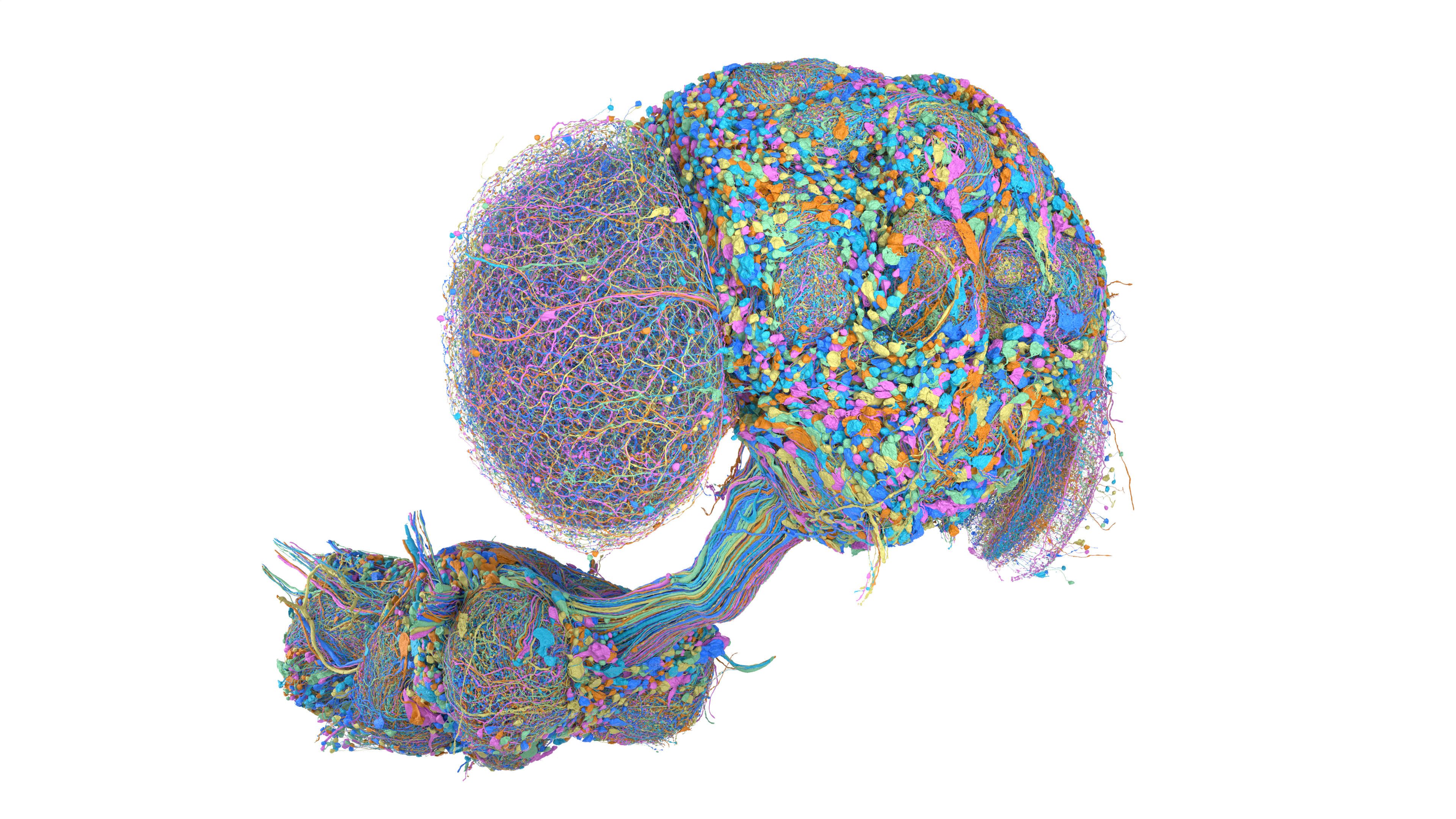
/ THE SHORT ANSWER
- 01A structural snapshot does not directly disclose an individual's memories.
- 02Learning claims require evidence about changes or functional responses.
- 03Studies in different species must not be merged into one fly-brain result.
/ dotSuper point of view
The next explanatory step is connecting structure to changing function, not treating a static map as a memory file.
Why a detailed picture is not a memory reader
It does not provide a plain-language record of what the specimen experienced before imaging.
The distinction is between a representation of structure and an explanation of changing state.
Knowing that a route exists does not fully specify when it is used or how its influence changes.
This does not make anatomical detail irrelevant to learning.
It makes the next question more precise: which properties must be measured or modeled in addition to the map?
From possible influence to measured effect
Its relevance here is methodological.
A learning explanation needs more than a claim that two structures are connected or two observations are correlated.
When reading a study, identify which parts are measured, which are inferred and which remain proposals for future experiments.
The difference between a promising method and a completed whole-brain explanation should remain explicit.
A related learning study, in a different animal
The work combines connectomics, physiological evidence and modeling to study sensory prediction.
The study concerns learning to cancel predictable sensory responses.
It is not a report that scientists recovered a fly's memories, and it is not the MaleCNS dataset.
The broader lesson is that structure becomes more explanatory when combined with measurements of function.
Keeping the species and experiment visible prevents several distinct advances from being compressed into one exaggerated headline.
Four questions that are often mixed together
A result at one level can help design the next experiment.
It does not automatically satisfy the next level's requirements.
Our reading framework below is deliberately conservative.
It helps readers appreciate incremental scientific progress without interpreting every new map as a solution to cognition.
| Claim | Evidence that would be relevant |
|---|---|
| This circuit could participate | Anatomy and a mechanistic hypothesis |
| This model predicts a response | Specified inputs, outputs and independent evaluation |
| This circuit changes with learning | Appropriate before-and-after or longitudinal functional evidence |
| This specific memory has been decoded | A defined decoding task with independent validation, not anatomy alone |
What AI teams can take from the distinction
Prompts, data, user behavior and feedback can change the operating outcome.
That is dotSuper's interpretation, not a biological equivalence between companies and brains.
The useful practice is to retain evidence about behavior over time rather than relying only on an architecture diagram.
For one AI workflow, record the input distribution, accepted-output criteria and recurring failures.
A visible change in performance should trigger investigation into what changed, not an automatic claim that the system learned.
- Ask what changed and how it was measured.
- Keep structural, functional and behavioral evidence separate.
- Avoid 'memory uploaded' language unless the study actually tests that claim.
What this page cannot conclude
- 01The electric-fish study is included as a related methodological example, not as evidence about the MaleCNS fly specimen.
- 02Neither this article nor the cited structural maps demonstrate memory recovery, consciousness transfer or a complete theory of learning.
- 03Prepared with AI assistance from the named research sources. dotSuper did not conduct these experiments, independently reproduce the studies or obtain an endorsement from the research institutions.
Sources
- 01The fly connectome reveals a path to the effectomePospisil et al., Nature (2024) · accessed Sep 15, 2026
- 02Connectome analysis of a cerebellum-like circuit for sensory predictionPerks et al., Nature (September 2026) · accessed Sep 15, 2026
- 03Network statistics of the whole-brain connectome of DrosophilaLin et al., Nature (2024) · accessed Sep 15, 2026
- 04Drosophila brain model: code and documentationPhilip Shiu and collaborators · accessed Sep 15, 2026
- 05MaleCNS research media galleryFlyEM / HHMI Janelia and collaborators · accessed Sep 15, 2026
Our editorial standard · Found an error? Send a correction with its source.
/ CITE OR SHARE THIS GUIDE
Make the evidence easy to verify.
When you reference this guide, link to its canonical URL. That gives readers one stable place for the evidence, limitations and future updates.
dotSuper Research Desk. (September 15, 2026). Can a Brain Map Explain Learning and Memory?. dotSuper. https://dotsuper.net/feeds/applied-systems/brain-connectome-learning-memory-explained
How to Explore the Fly Brain Map Yourself
Continue with a different question in our source-linked fly-brain series.
Read the next explainer