/ THE SHORT ANSWER
See the method. Keep the context.
The visual companion
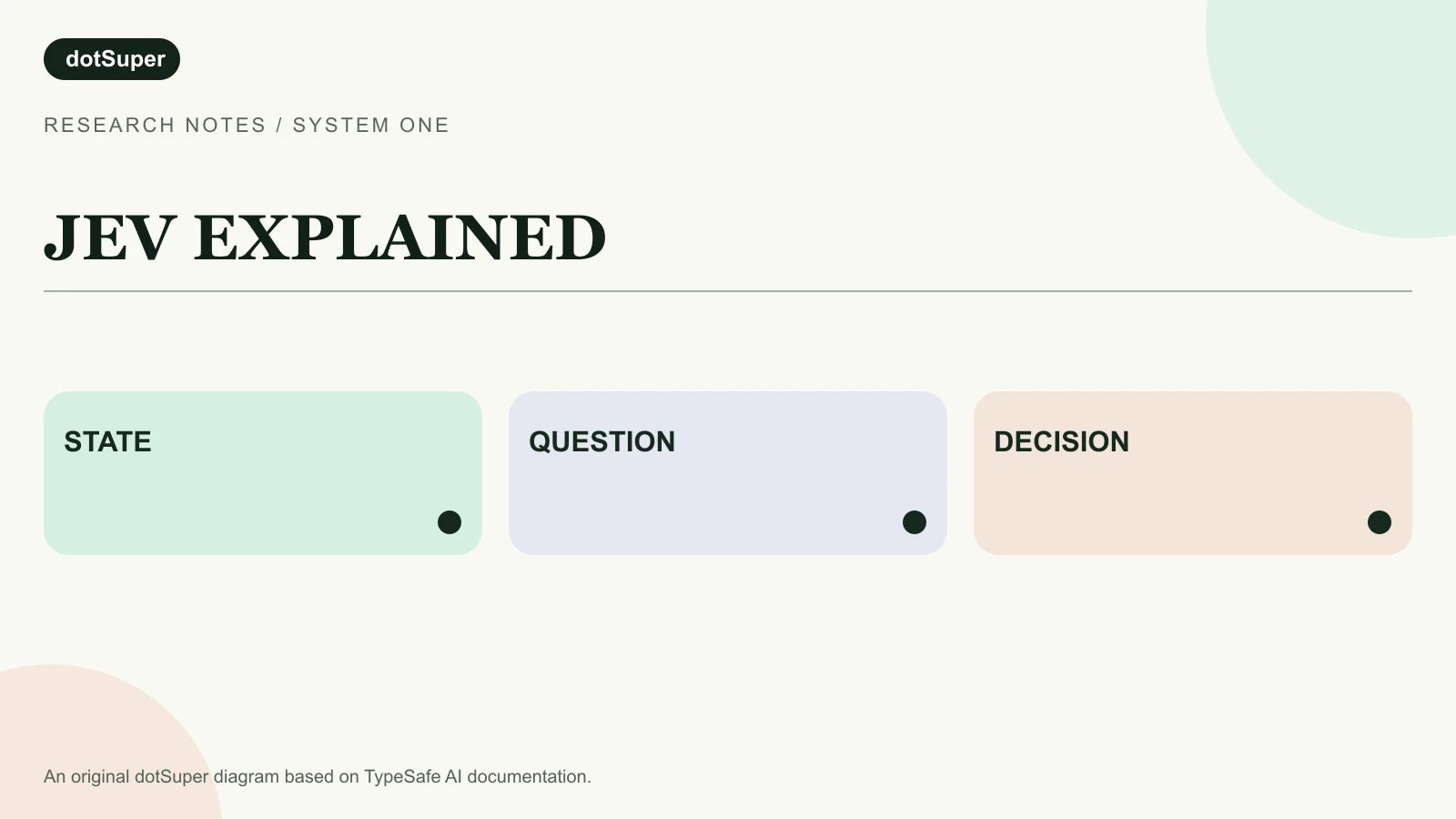
Credit: Original dotSuper research diagram based on cited TypeSafe AI documentation.
Reuse: Original dotSuper artwork. No TypeSafe image or logo reproduced.
Read the diagram: A practical view of where a bounded AI judgment fits inside a controlled workflow.
A three-step diagram: business state enters a bounded question, Jev returns a typed decision, and application code decides the next action.
Thumbnail credit and reuse
Credit: Original dotSuper research diagram based on cited TypeSafe AI documentation.
Reuse: Original dotSuper artwork. No TypeSafe image or logo reproduced.
- 01Jev returns typed decisions rather than paragraphs.
- 02Choice, Score and Noul answer different bounded questions.
- 03A valid output shape does not guarantee a correct decision.
/ dotSuper point of view
Jev is useful when a team needs many repeatable judgments that code can inspect, not when it needs another writer.
The useful question behind the launch
Many business systems need something smaller: identify which queue an incoming request belongs in, whether a document needs review, or which specialist should receive a case.
TypeSafe launched Jev on 15 September 2026 for this class of repeated decision.
The company calls it a System One model, a product label rather than proof that it reasons like a person.
The important design shift is that the application defines the possible answers before the model runs.
Jev reads the relevant state, such as a customer message and account status, then returns a value the software can use.
It is not intended to draft the reply to the customer.
Three question shapes
Score places an item on a stated rubric, such as low to high urgency.
Noul returns a probability for a yes-or-no question, such as whether a message asks to cancel an order.
TypeSafe says several questions can be evaluated in one call.
A typed answer is easier to process than prose, but teams still have to decide what the labels mean.
Include an unclear or human-review path where the real world will not fit neatly into the options.
Code should validate the business record and own the final action.
A concrete example
One question classifies the issue as delivery, quality, invoice or unclear.
A second scores operational urgency against a written rubric.
Code checks whether the order number exists, places the case in the right queue and alerts a person if the disruption is serious.
This is a proposed workflow, not a reported Jev deployment or dotSuper customer result.
The model should not invent the order number, compute a contractual penalty or send a supplier accusation on its own.
Those steps need source data, deterministic checks and human authority.
What Jev does not solve
Its documentation also warns that adversarial content in the state can influence an answer.
Use ordinary code for arithmetic and dates, and a generative model when the deliverable is an explanation, email or report.
The company advertises schema-safe outputs and calibrated probabilities.
Neither removes the need to measure accuracy on your own examples.
A wrong category can be perfectly valid JSON.
Confidence is a routing signal, not permission to skip review in high-stakes cases.
How to decide whether to try it
Write down the allowed labels, a few boundary examples and the cost of each wrong choice.
Compare Jev with your existing rules or LLM on the same held-out cases.
Measure accepted decisions, review minutes, latency and end-to-end cost, then keep a human route for uncertainty.
At dotSuper, we can help map a workflow into explicit questions, checks and review points.
The outcome may be Jev, an LLM, simpler rules or no automation at all.
The one-page decision card
State the input fields, the allowed answers, the action each answer triggers, the information that must be present, and who owns a mistake.
For a supplier complaint, an allowed answer might be quality issue, delivery issue, billing issue or unclear.
Unclear must be a real route, not a forced best guess.
List three examples for each label, then add deliberately difficult examples where a message mentions two issues or denies one.
This is more useful than calling a model good because it passed a generic benchmark.
After launch, compare the chosen label with the final resolution and review the mistakes every week.
| Field | Example | Owner |
|---|---|---|
| Input | Message, supplier ID and purchase-order reference | Operations |
| Allowed result | Quality, delivery, billing or unclear | Operations |
| Automatic step | Place a low-risk case in a review queue | Application code |
| Human gate | Approve safety, payment or contract actions | Authorized staff |
What this page cannot conclude
- 01TypeSafe performance figures are vendor-reported and have not been independently reproduced by dotSuper.
- 02Examples are proposed workflows, not dotSuper customer deployments or measured results.
- 03Model versions, access, capabilities and pricing may change after publication.
- 04Jev 1.13 accepts text and JSON state, not image, audio or video input; image inspection requires a separate system.
Sources
- 01Introducing System One Models and JevTypeSafe AI · accessed Sep 24, 2026
- 02TypeSafe introductionTypeSafe AI · accessed Sep 24, 2026
- 03Primitives: Choice, Score and NoulTypeSafe AI · accessed Sep 24, 2026
- 04Jev 1.13 limitationsTypeSafe AI · accessed Sep 24, 2026
- 05TypeSafe model input and pricingTypeSafe AI · accessed Sep 24, 2026
Our editorial standard · Found an error? Send a correction with its source.
/ CITE OR SHARE THIS GUIDE
Make the evidence easy to verify.
When you reference this guide, link to its canonical URL. That gives readers one stable place for the evidence, limitations and future updates.
dotSuper Research Desk. (September 24, 2026). What Is Jev? A Decision Model, Not a Chatbot. dotSuper. https://dotsuper.net/feeds/market-intelligence/what-is-jev-ai-decision-model