/ THE SHORT ANSWER
See the method. Keep the context.
The visual companion
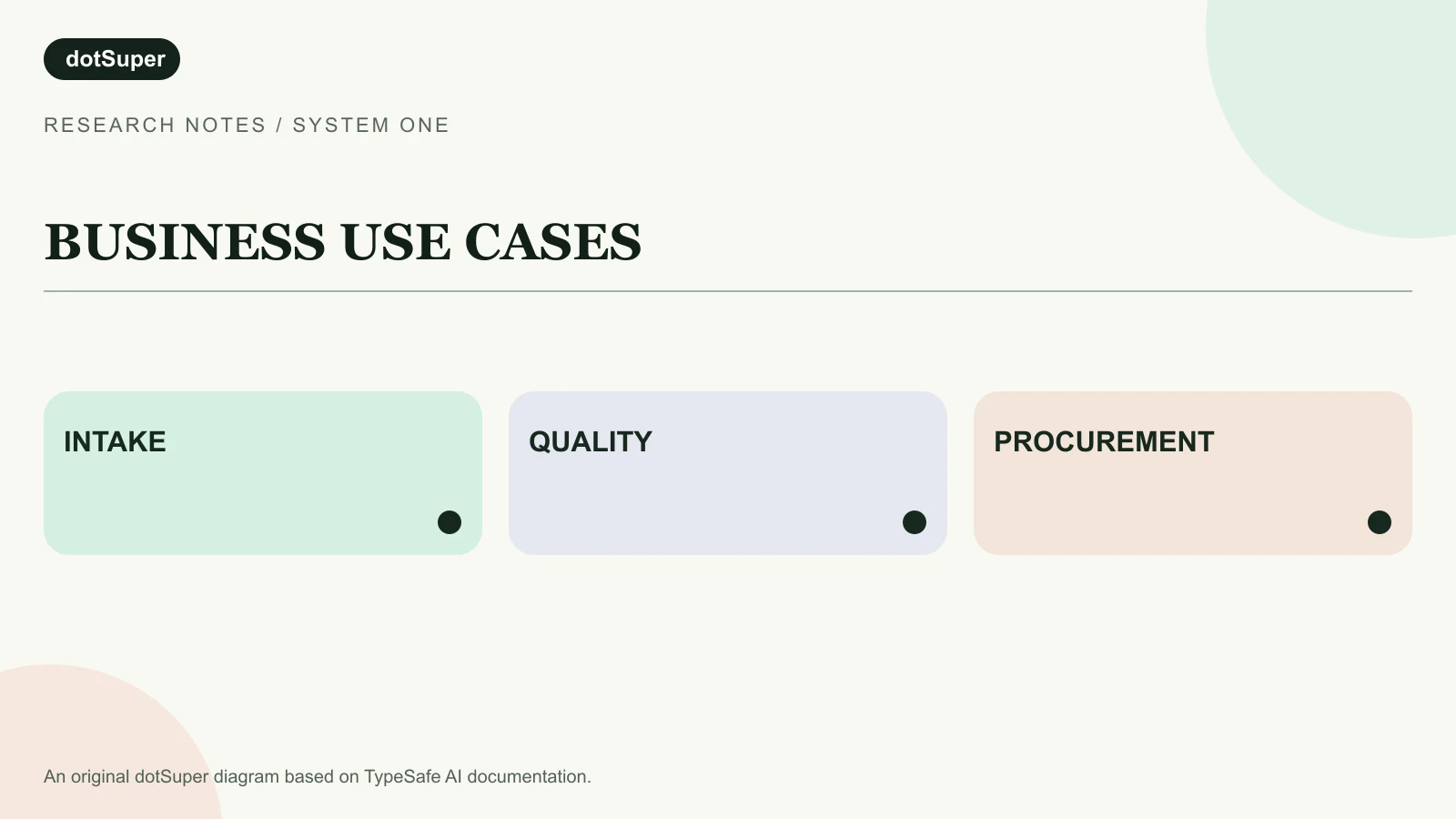
Credit: Original dotSuper research diagram based on cited TypeSafe AI documentation.
Reuse: Original dotSuper artwork. No TypeSafe image or logo reproduced.
Read the diagram: A practical view of where a bounded AI judgment fits inside a controlled workflow.
Three example business queues for Jev: customer intake, quality issue triage and procurement exception routing, each leading to a reviewable next step.
Thumbnail credit and reuse
Credit: Original dotSuper research diagram based on cited TypeSafe AI documentation.
Reuse: Original dotSuper artwork. No TypeSafe image or logo reproduced.
- 01Start with frequent low-risk judgments, not autonomous high-stakes actions.
- 02Define allowed labels and uncertainty handling before calling a model.
- 03Keep records, arithmetic and final authority in the surrounding system.
/ dotSuper point of view
The practical opportunity is not automating an entire department; it is improving one repeated decision inside a controlled workflow.
Start where a decision already exists
TypeSafe lists customer support, model routing, risk assessment and compliance screening among possible applications.
Those are ideas, not proof of performance in every business.
A pilot must still test the model on local language, documents and edge cases.
For dotSuper's audience, the most promising first steps are customer intake, shop-floor quality triage and procurement exception routing.
They have clear owners, visible outcomes and an easy path to human review.
Pilot one: customer intake
Define categories such as booking change, payment question, complaint and unclear.
Ask a bounded Choice question over the message, then use code to check customer identity and open the correct queue.
A separate signal can flag explicit cancellation or urgent service disruption.
Success is not merely a high classification score.
Measure whether the request reached the right owner on the first try, how long it waited and how often staff had to correct the route.
Do not automatically send a sensitive response or disclose account details because a category was selected.
Pilot two: manufacturing quality reports
Jev is text-oriented in this proposed workflow, so use the written report and structured metadata rather than claiming image inspection.
Ask whether the report suggests a safety stop, routine rework, supplier issue or unclear.
Code checks machine ID, batch ID and time stamps, then opens the appropriate review path.
The system should never let a model label override an actual safety procedure.
A high-severity or uncertain case goes to a qualified person.
Log the original report, chosen route and any correction so the team can distinguish useful triage from dangerous false reassurance.
Pilot three: procurement exceptions
Let code calculate prices, quantities, tax and dates.
Use a bounded judgment only for the semantic part, such as whether a supplier note indicates a substitution request, delivery delay, quality concern or no actionable change.
The next step can be a buyer review with the relevant documents attached.
Payment release and contract interpretation remain with the authorized owner.
This split follows TypeSafe's own guidance to keep math and date comparison in code.
A pilot that yields an answer
Keep a holdout set that was not used to word the questions.
Compare a simple rule baseline, an LLM and Jev on missed critical cases, correction time, latency and total cost.
Review errors by language, channel and case type.
If the model improves speed but misses rare serious cases, route that segment to a person. dotSuper can help design the case set, operating controls and measurement plan before any integration is expanded.
What the team should record during the pilot
Strip personal details where they are not needed.
A dashboard that shows only accuracy hides whether critical cases were missed or whether every case still required human work.
Set separate success thresholds for routine and high-risk paths.
An illustrative rule is to auto-route a reversible routine case only after enough representative cases show the error rate is acceptable; uncertain, contradictory or safety-related cases go to review regardless of apparent confidence.
The threshold is not a universal Jev setting.
It must be selected and revisited by the business.
| Measure | What to record |
|---|---|
| First-route accuracy | Did the case reach the correct owner without reassignment? |
| Critical misses | How many safety or payment cases were under-prioritized? |
| Human effort | Minutes of review and correction per accepted case |
| Timeliness | Time from intake to accountable owner |
| Unit economics | API spend plus staff correction cost |
What this page cannot conclude
- 01TypeSafe performance figures are vendor-reported and have not been independently reproduced by dotSuper.
- 02Examples are proposed workflows, not dotSuper customer deployments or measured results.
- 03Model versions, access, capabilities and pricing may change after publication.
- 04The manufacturer quality example uses written descriptions and metadata; Jev 1.13 does not accept images as direct input.
Sources
- 01TypeSafe example use casesTypeSafe AI · accessed Sep 24, 2026
- 02Jev 1.13 limitationsTypeSafe AI · accessed Sep 24, 2026
- 03Confidence and thresholdsTypeSafe AI · accessed Sep 24, 2026
- 04TypeSafe introductionTypeSafe AI · accessed Sep 24, 2026
- 05TypeSafe models and input limitsTypeSafe AI · accessed Sep 24, 2026
Our editorial standard · Found an error? Send a correction with its source.
/ CITE OR SHARE THIS GUIDE
Make the evidence easy to verify.
When you reference this guide, link to its canonical URL. That gives readers one stable place for the evidence, limitations and future updates.
dotSuper Research Desk. (September 24, 2026). Jev AI Use Cases for Business Operations. dotSuper. https://dotsuper.net/feeds/market-intelligence/jev-ai-business-use-cases