/ THE SHORT ANSWER
See the method. Keep the context.
The visual companion
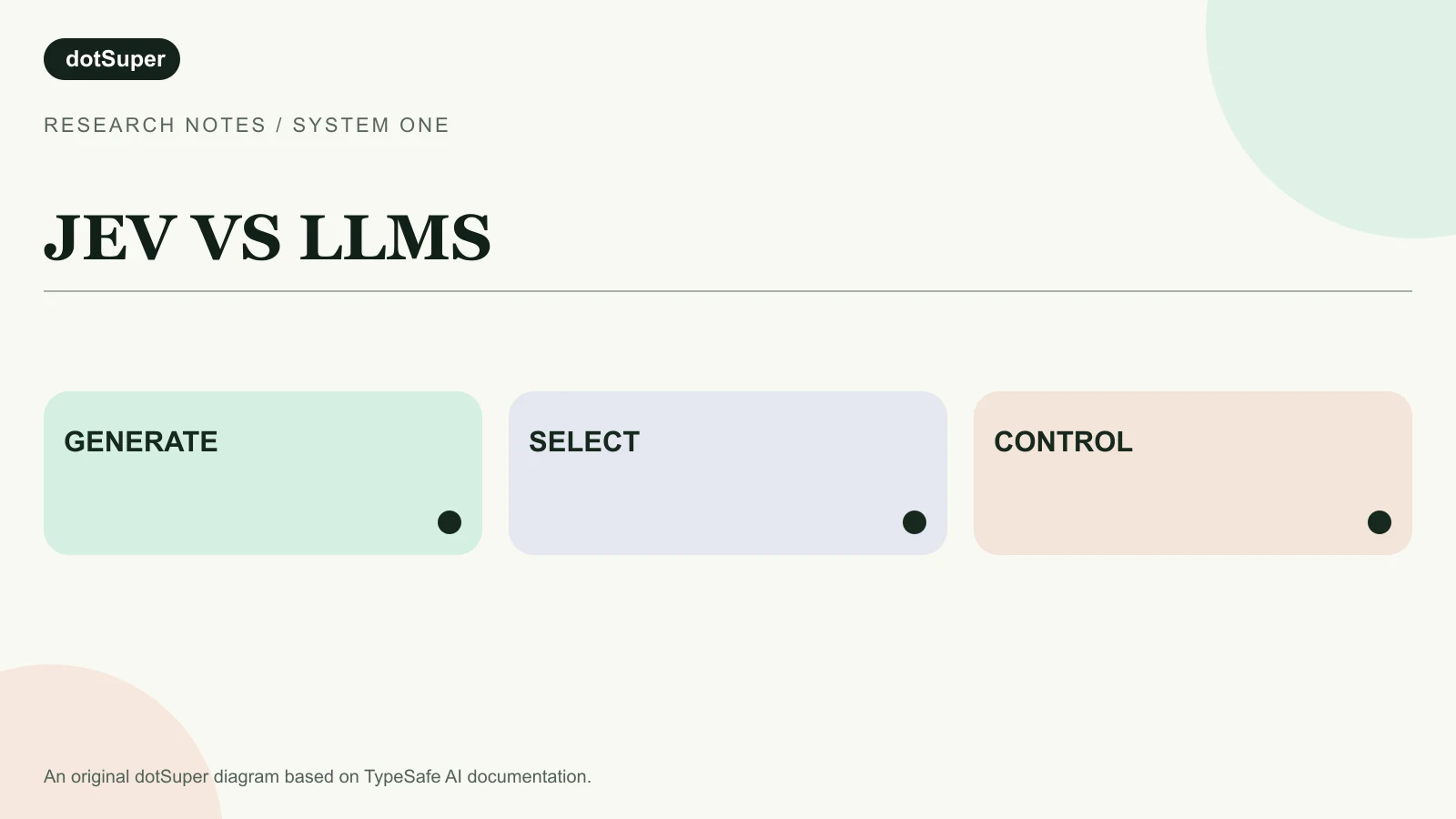
Credit: Original dotSuper research diagram based on cited TypeSafe AI documentation.
Reuse: Original dotSuper artwork. No TypeSafe image or logo reproduced.
Read the diagram: A practical view of where a bounded AI judgment fits inside a controlled workflow.
Three-lane diagram showing an LLM generating open-ended text, Jev selecting bounded answers and application code controlling actions.
Thumbnail credit and reuse
Credit: Original dotSuper research diagram based on cited TypeSafe AI documentation.
Reuse: Original dotSuper artwork. No TypeSafe image or logo reproduced.
- 01Both systems can return structured data, but they are optimized for different work.
- 02Closed-set decisions suit Jev better than open-ended generation.
- 03Measure correctness, confidence behavior and human review, not format alone.
/ dotSuper point of view
Structured output is an interface constraint; deciding whether a model is good at a task requires a separate test.
The comparison people usually miss
That solves part of the software integration problem: the result has fields that an application can parse.
It does not prove the answer is correct, consistent, fast enough or affordable at the scale of a real workflow.
TypeSafe built Jev specifically around bounded, typed questions rather than generating an answer token by token.
The two approaches are not mutually exclusive.
A support application could use Jev to route a case and an LLM to draft a reply.
The software can then check the reply against policy, require approval and log what happened.
Choose by the shape of the work
For a severity rubric, Score fits.
For a yes-or-no signal, Noul returns a probability.
These are only useful if the labels and criteria are well written and the input state contains the right evidence.
A language model remains the better starting point when the system must explain a decision in natural language, summarize a long record, write code or infer a new value that was not among predefined options.
TypeSafe's own limitations page says Jev is not trained to generate text.
An invoice workflow shows the boundary
Ordinary parsing or an LLM may extract the invoice number, line items and free-text notes.
Code should compare totals, dates and purchase-order numbers exactly.
A bounded model could classify the exception as missing PO, price mismatch, duplicate risk or unclear, then estimate whether a reviewer is needed.
Do not ask Jev to add line items or compare due dates.
TypeSafe flags counting, numerical precision and date ordering as weak points for Jev 1.13.
If a wrong label could release payment, the model should suggest a queue, not authorize the transfer.
How to test both fairly
Include obvious cases, ambiguous cases, missing evidence and adversarial text.
Give both systems the same facts and allowed actions.
Record not just schema failures but misroutes, false negatives, time to accepted decision and the number of cases escalated to a person.
A generated LLM answer may be slower but more useful if the work includes explanation.
A fast typed decision may save money if it replaces a narrow repeated judgment.
The denominator should be an accepted business outcome, not an API call.
The deployment pattern
Let the decision model provide a typed signal.
Use a generative model only where generated content adds value.
Put thresholds and handoffs in versioned code, monitor drift and review errors by segment.
dotSuper can help teams separate semantic judgment from system control and design a small pilot that measures both.
A simple selection matrix
It is a design aid, not a benchmark score.
The exception is when a task combines several needs: then split it into smaller steps and pass only the relevant evidence to each component.
For every proposed automatic action, document the consequence of a false positive and a false negative.
If neither is tolerable, treat the model as a suggestion engine and require explicit human approval.
| Work | Starting point | Why |
|---|---|---|
| Route a request to one known queue | Jev Choice or simple rules | Bounded answer; compare against a rules baseline |
| Draft a reply with context and tone | Generative LLM | Needs new natural-language content |
| Add invoice values or compare dates | Deterministic code | Exact calculation is testable |
| Release payment or change permissions | Authorized workflow with human gate | Consequential action needs accountable approval |
What this page cannot conclude
- 01TypeSafe performance figures are vendor-reported and have not been independently reproduced by dotSuper.
- 02Examples are proposed workflows, not dotSuper customer deployments or measured results.
- 03Model versions, access, capabilities and pricing may change after publication.
Sources
- 01TypeSafe introductionTypeSafe AI · accessed Sep 24, 2026
- 02Primitives: Choice, Score and NoulTypeSafe AI · accessed Sep 24, 2026
- 03Jev 1.13 limitationsTypeSafe AI · accessed Sep 24, 2026
- 04Confidence and thresholdsTypeSafe AI · accessed Sep 24, 2026
- 05TypeSafe model limitationsTypeSafe AI · accessed Sep 24, 2026
Our editorial standard · Found an error? Send a correction with its source.
/ CITE OR SHARE THIS GUIDE
Make the evidence easy to verify.
When you reference this guide, link to its canonical URL. That gives readers one stable place for the evidence, limitations and future updates.
dotSuper Research Desk. (September 24, 2026). Jev vs LLM Structured Outputs: Which Should You Use?. dotSuper. https://dotsuper.net/feeds/market-intelligence/jev-vs-llm-structured-outputs