/ THE SHORT ANSWER
See the method. Keep the context.
The visual companion
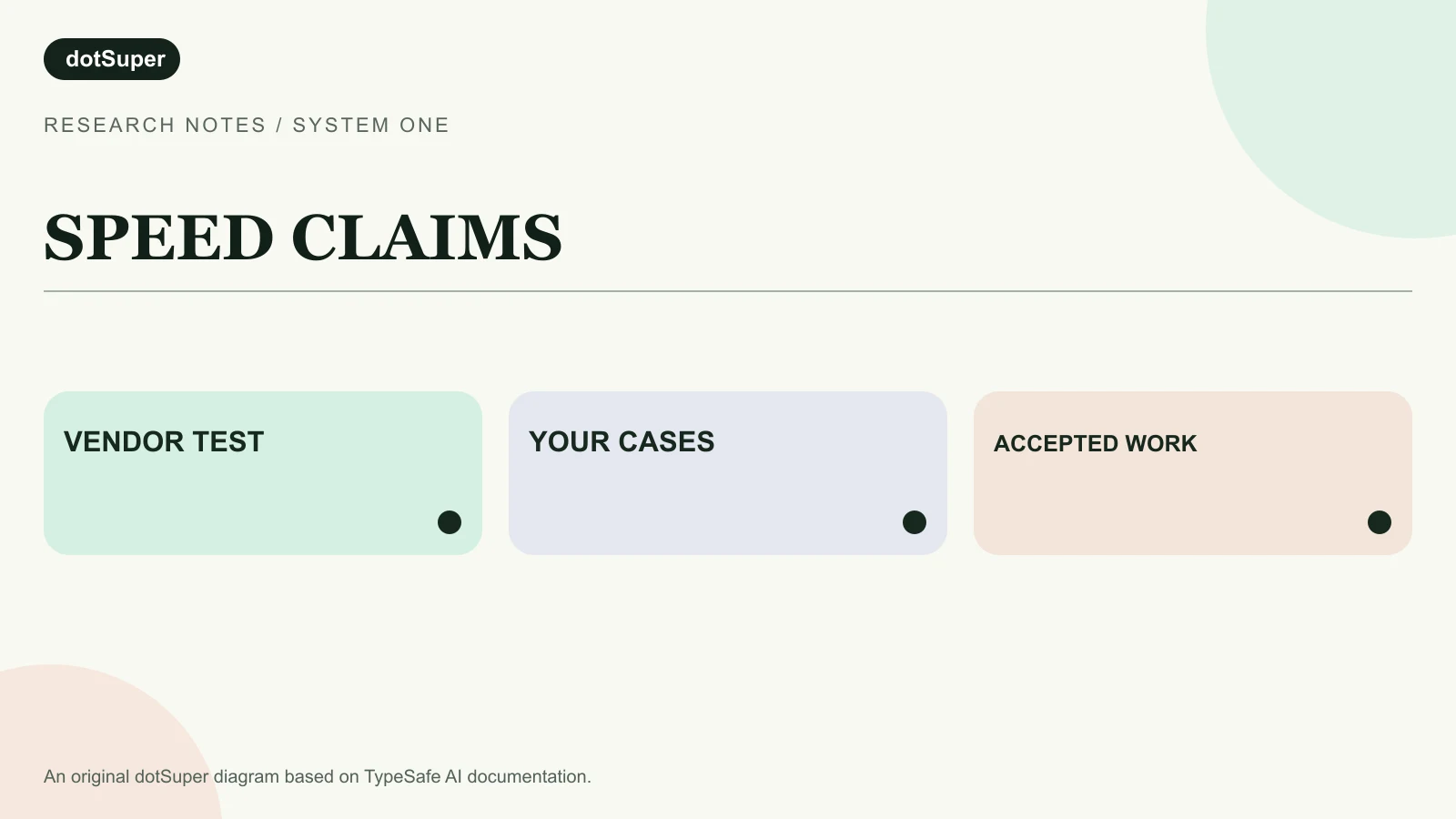
Credit: Original dotSuper research diagram based on cited TypeSafe AI documentation.
Reuse: Original dotSuper artwork. No TypeSafe image or logo reproduced.
Read the diagram: A practical view of where a bounded AI judgment fits inside a controlled workflow.
Evaluation funnel showing that vendor-reported benchmark results should be tested on local cases and judged by accepted business work.
Thumbnail credit and reuse
Credit: Original dotSuper research diagram based on cited TypeSafe AI documentation.
Reuse: Original dotSuper artwork. No TypeSafe image or logo reproduced.
- 01TypeSafe reports 193.6x speed and 444.6x cost gains on its own workflow evaluation.
- 02The company itself says these gains may be at the high end of real-world results.
- 03Compare quality, review time and end-to-end cost on your own cases.
/ dotSuper point of view
The headline ratios are an invitation to run a task-matched experiment, not a procurement forecast.
What TypeSafe actually reports
Its launch post says the ratios come from its own workflow evaluations and are likely at the high end of real-world gains.
This is a vendor benchmark, not an independent study or a result that every deployment should expect.
The company lists an input price of $0.042 per million tokens in the launch post.
Prices and model versions can change, so teams should check the current product terms before using this number in a budget.
More importantly, token price is not the total cost of a decision.
Why the task shape matters
A general-purpose LLM may spend time generating text that the application never needed.
That gives Jev a plausible advantage on classification, scoring and routing.
It says much less about drafting, long-form research, code generation or tasks that require exact arithmetic.
TypeSafe also describes its demonstration as favorable to Jev in some respects, including a short, dense input.
Its workflow evaluation uses reference probabilities from larger external models, not a universal ground truth for every business decision.
These details should travel with the headline figure.
A fair business comparison
Freeze 100 to 200 representative examples with an agreed answer and known edge cases.
Run Jev, a current LLM with structured outputs and a simple rules baseline.
Give each the same usable input and identical action boundaries.
Track wrong-route rate, critical misses, review rate, end-to-end latency, API and tool spend, engineering effort and minutes of staff correction.
Separate high-volume easy cases from hard exceptions.
A model that is cheaper per call but requires more review may cost more per accepted result.
Do not hide the difficult cases
TypeSafe's own limitations page notes literal interpretation, numeric weakness, context distraction and adversarial sensitivity in Jev 1.13.
A high average score can hide exactly the tail cases that matter most in production.
Confidence can help route uncertain Choice and Score results to a person, but the threshold has to be tuned on your own held-out data.
For consequential actions, a human approval step remains appropriate even when the model reports high confidence.
A useful conclusion
If the job is to create a defensible explanation or synthesize a novel answer, a generative model may still carry the work.
The correct architecture can use both and keep business rules in code.
dotSuper can help turn the claim into a measurable pilot with representative cases, safe escalation paths and a total-cost comparison.
How to read the headline ratios
They do not mean that every Jev call will be 193.6 times faster or 444.6 times cheaper than every language model.
TypeSafe itself says the results may sit toward the high end of real-world gains.
Results can change with input length, number of questions, network location, model choice and how much validation a complete system performs.
The more useful cost equation is API spend plus retries plus engineer maintenance plus human correction, divided by accepted outcomes.
A low per-call price has little value if the model sends expensive exceptions to the wrong queue.
Report medians and tail latency for the whole workflow, not just the model response.
| Published item | Supports | Does not establish |
|---|---|---|
| 193.6x faster | Vendor-observed speed on its published workflow test | The same ratio on your cases or network |
| 444.6x cheaper | Vendor-observed cost on its published workflow test | Total savings after staff review |
| $0.042 per million input tokens | Listed Jev 1.13 input rate at publication | A permanent price or full workflow budget |
What this page cannot conclude
- 01TypeSafe performance figures are vendor-reported and have not been independently reproduced by dotSuper.
- 02Examples are proposed workflows, not dotSuper customer deployments or measured results.
- 03Model versions, access, capabilities and pricing may change after publication.
Sources
- 01TypeSafe launch and benchmark methodologyTypeSafe AI · accessed Sep 24, 2026
- 02Jev 1.13 limitationsTypeSafe AI · accessed Sep 24, 2026
- 03Confidence and thresholdsTypeSafe AI · accessed Sep 24, 2026
- 04TypeSafe introductionTypeSafe AI · accessed Sep 24, 2026
- 05TypeSafe model prices and limitsTypeSafe AI · accessed Sep 24, 2026
Our editorial standard · Found an error? Send a correction with its source.
/ CITE OR SHARE THIS GUIDE
Make the evidence easy to verify.
When you reference this guide, link to its canonical URL. That gives readers one stable place for the evidence, limitations and future updates.
dotSuper Research Desk. (September 24, 2026). How Fast Is Jev? Reading the Benchmark Claims. dotSuper. https://dotsuper.net/feeds/market-intelligence/jev-speed-cost-benchmark-claims