/ THE SHORT ANSWER
See the method. Keep the context.
The visual companion
Reuse: Original artwork created for dotSuper. No public reuse licence has been specified. Attribution to research sources does not grant rights to their artwork or datasets.
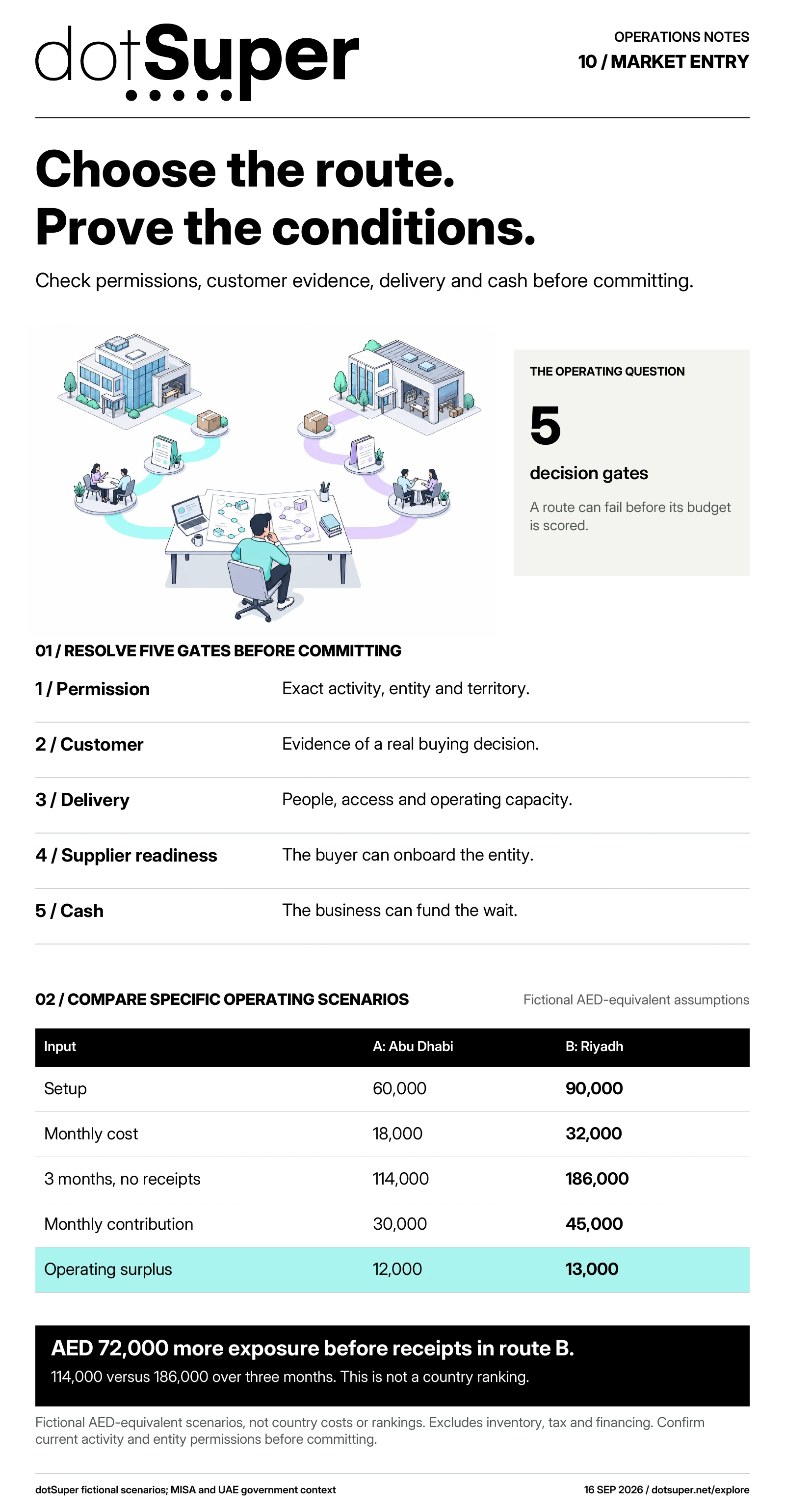
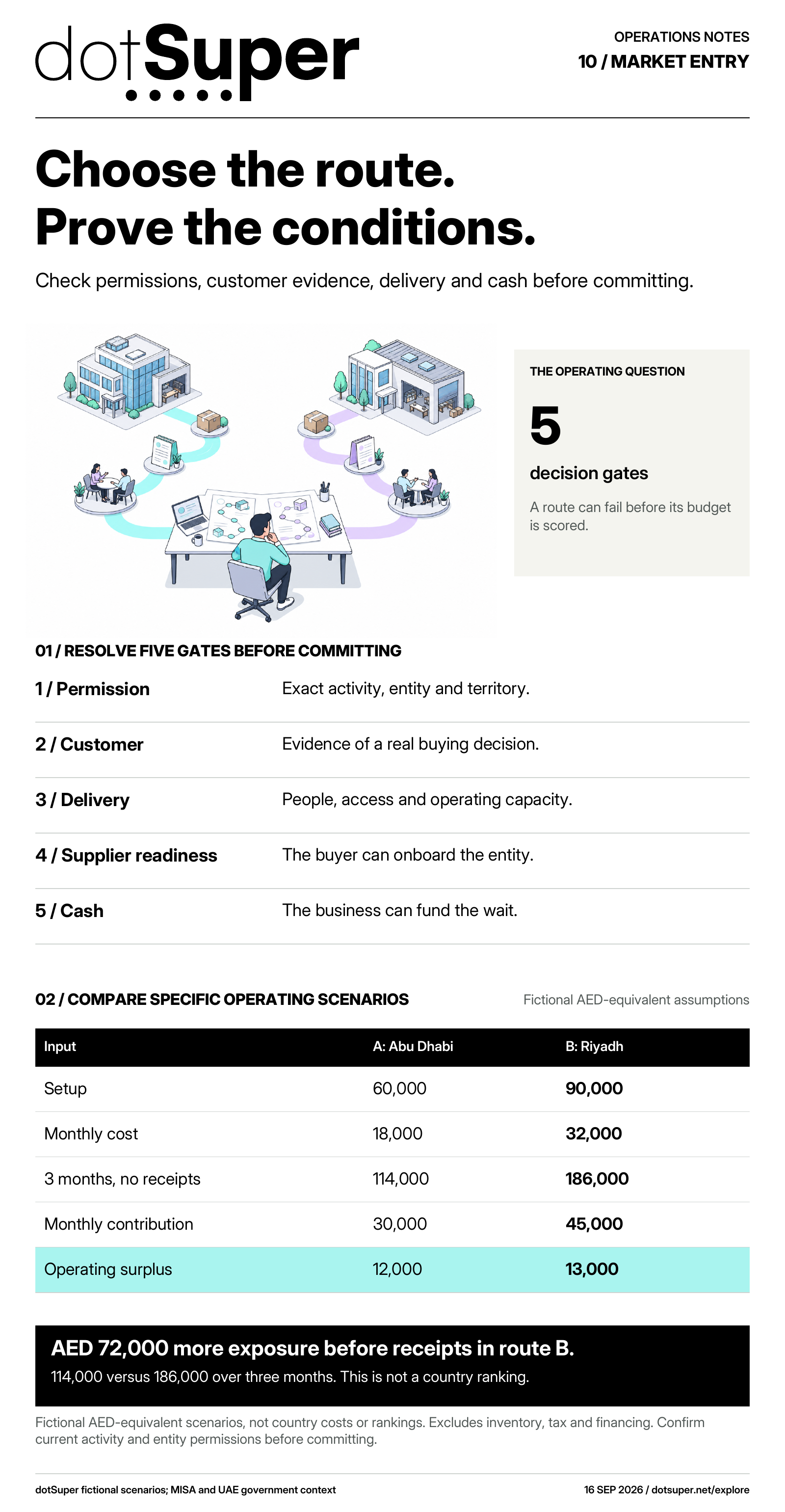
Read the diagram: Check permissions, customer evidence, delivery and cash before committing. Fictional AED-equivalent scenarios, not country costs or rankings. Excludes inventory, tax and financing. Confirm current activity and entity permissions before committing.
Five market-entry gates are activity permission, customer evidence, delivery capability, supplier qualification and cash exposure. Fictional Abu Dhabi and Riyadh routes require AED-equivalent 114,000 and 186,000 before receipts over three months. The difference is 72,000 and is not a country ranking.
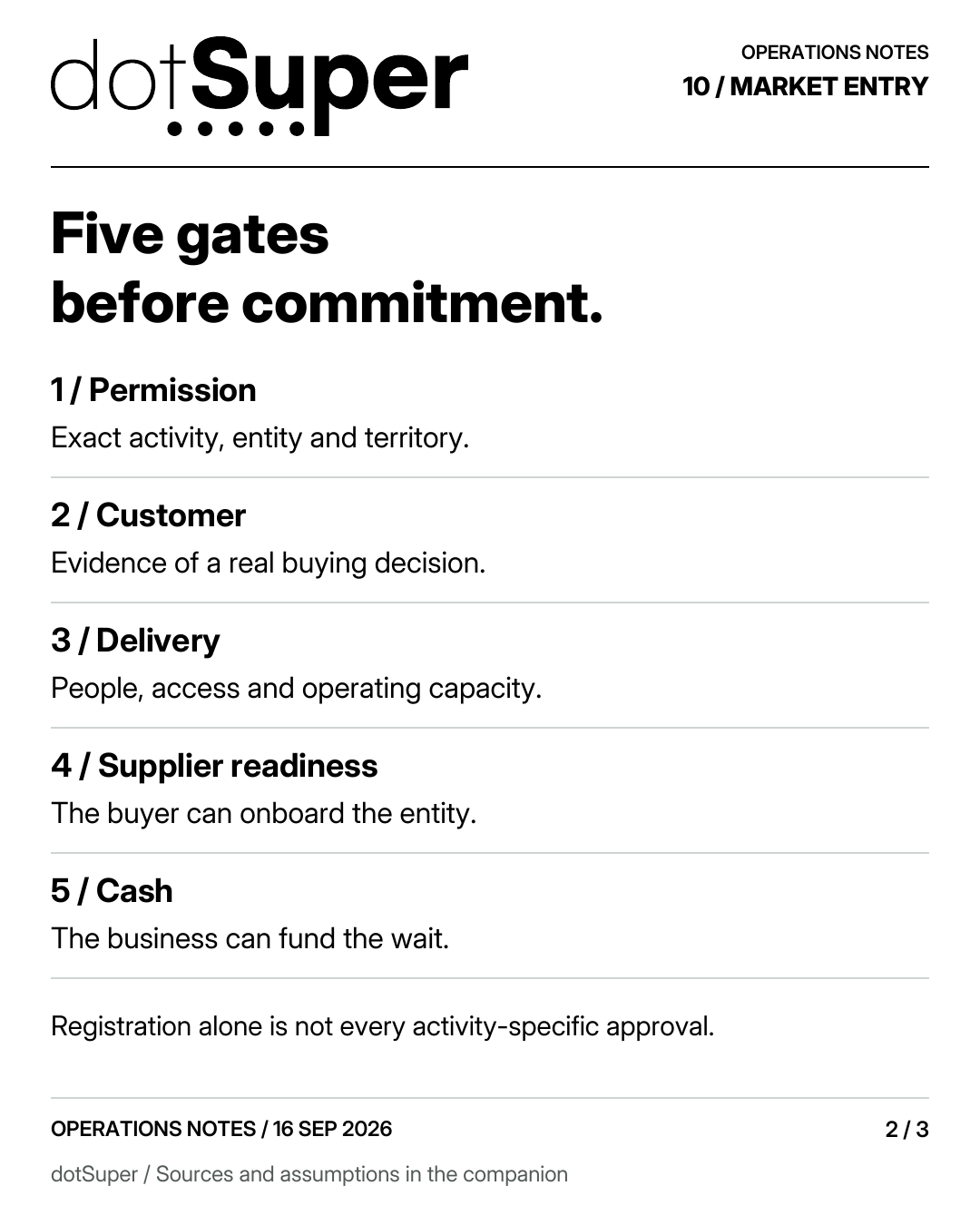
Five gates: exact activity, entity and territory permission; evidence of a real buying decision; people and delivery capability; buyer-specific supplier readiness; and the cash to fund the wait.
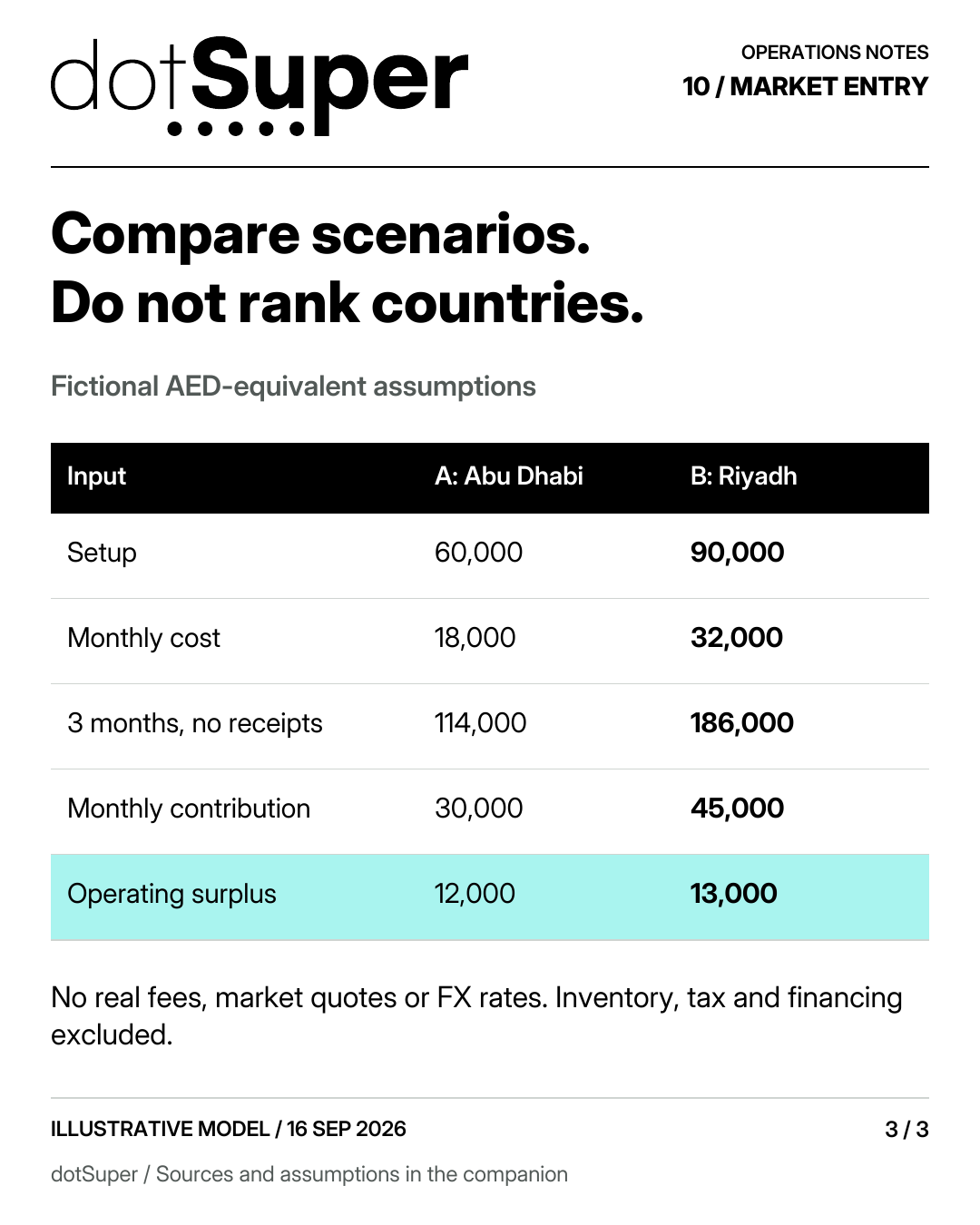
Fictional Abu Dhabi route: setup 60,000, monthly cost 18,000, three-month pre-receipt exposure 114,000, assumed monthly contribution 30,000 and steady-state surplus 12,000, all AED-equivalent.
Fictional Riyadh route: setup 90,000, monthly cost 32,000, three-month pre-receipt exposure 186,000, assumed monthly contribution 45,000 and steady-state surplus 13,000, all AED-equivalent.
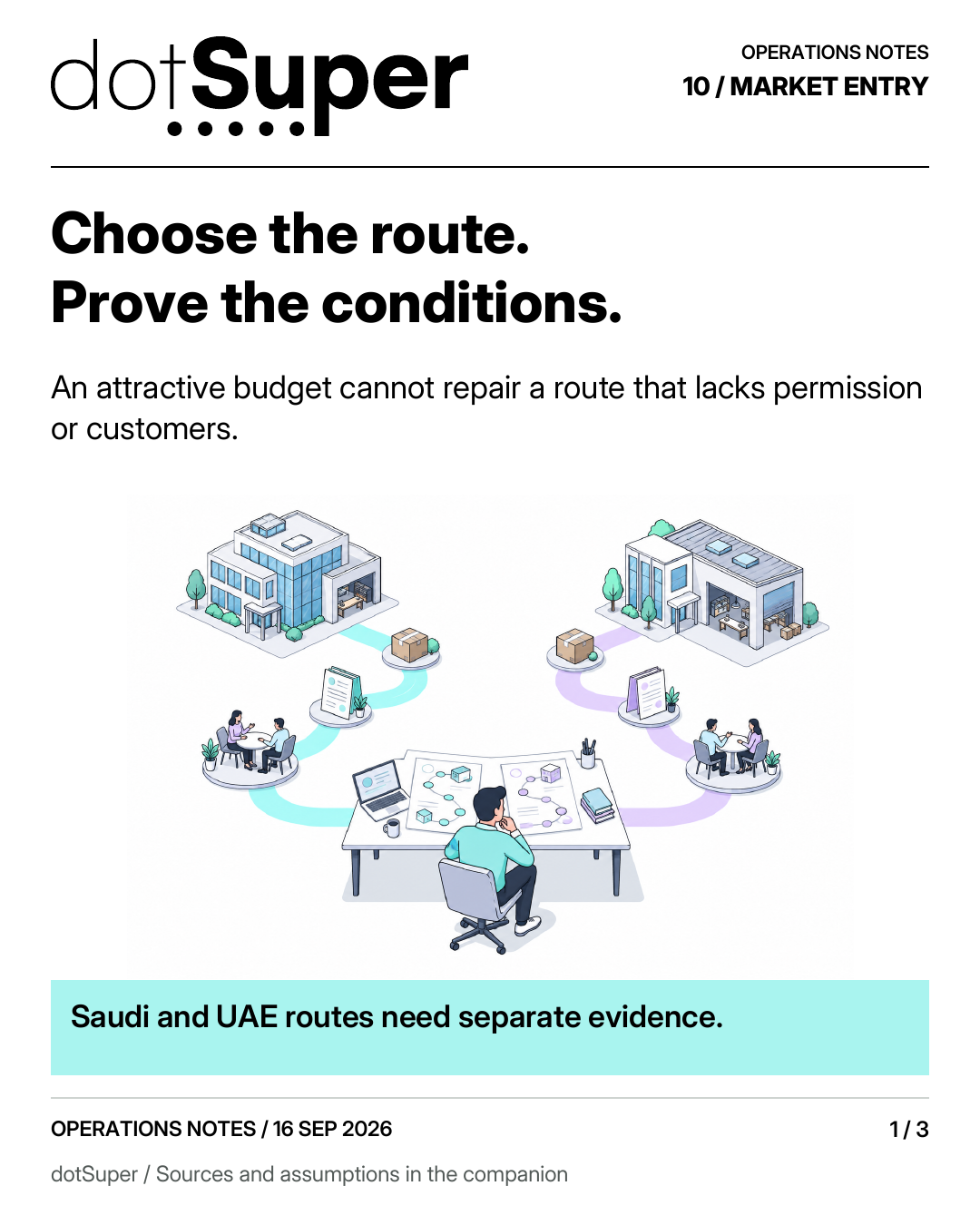
Choose the route. Prove the conditions. An attractive budget cannot repair a route that lacks permission or customers. Saudi and UAE routes need separate evidence.
Five gates before commitment. 1 / Permission / Exact activity, entity and territory. 2 / Customer / Evidence of a real buying decision. 3 / Delivery / People, access and operating capacity. 4 / Supplier readiness / The buyer can onboard the entity. 5 / Cash / The business can fund the wait. Registration alone is not every activity-specific approval.
Compare scenarios. Do not rank countries. Fictional AED-equivalent assumptions Setup / 60,000 / 90,000 Monthly cost / 18,000 / 32,000 3 months, no receipts / 114,000 / 186,000 Monthly contribution / 30,000 / 45,000 Operating surplus / 12,000 / 13,000 No real fees, market quotes or FX rates. Inventory, tax and financing excluded.
The Abu Dhabi and Riyadh amounts are fictional AED-equivalent assumptions. They are not actual fees, market prices, exchange rates or country rankings.
Inventory, tax, financing and route-specific obligations are excluded from the simplified cash illustration. Contribution and demand remain assumed.
MISA registration does not establish every operating permission. UAE routes depend on actual authority, activity and entity.
UAE mainland and free-zone pages were read during research on 16 September 2026; later same-day requests returned no extractable text. No successful fresh recheck or entity-specific legal assessment is claimed.
| Fictional route | Setup AED-equivalent | Monthly operating cost AED-equivalent | Three-month pre-receipt funding AED-equivalent | Assumed monthly contribution AED-equivalent | Steady-state surplus AED-equivalent |
|---|---|---|---|---|---|
| A: Abu Dhabi scenario | 60,000 | 18,000 | 114,000 | 30,000 | 12,000 |
| B: Riyadh scenario | 90,000 | 32,000 | 186,000 | 45,000 | 13,000 |
Reuse: Original artwork created for dotSuper. No public reuse licence has been specified. Attribution to research sources does not grant rights to their artwork or datasets.
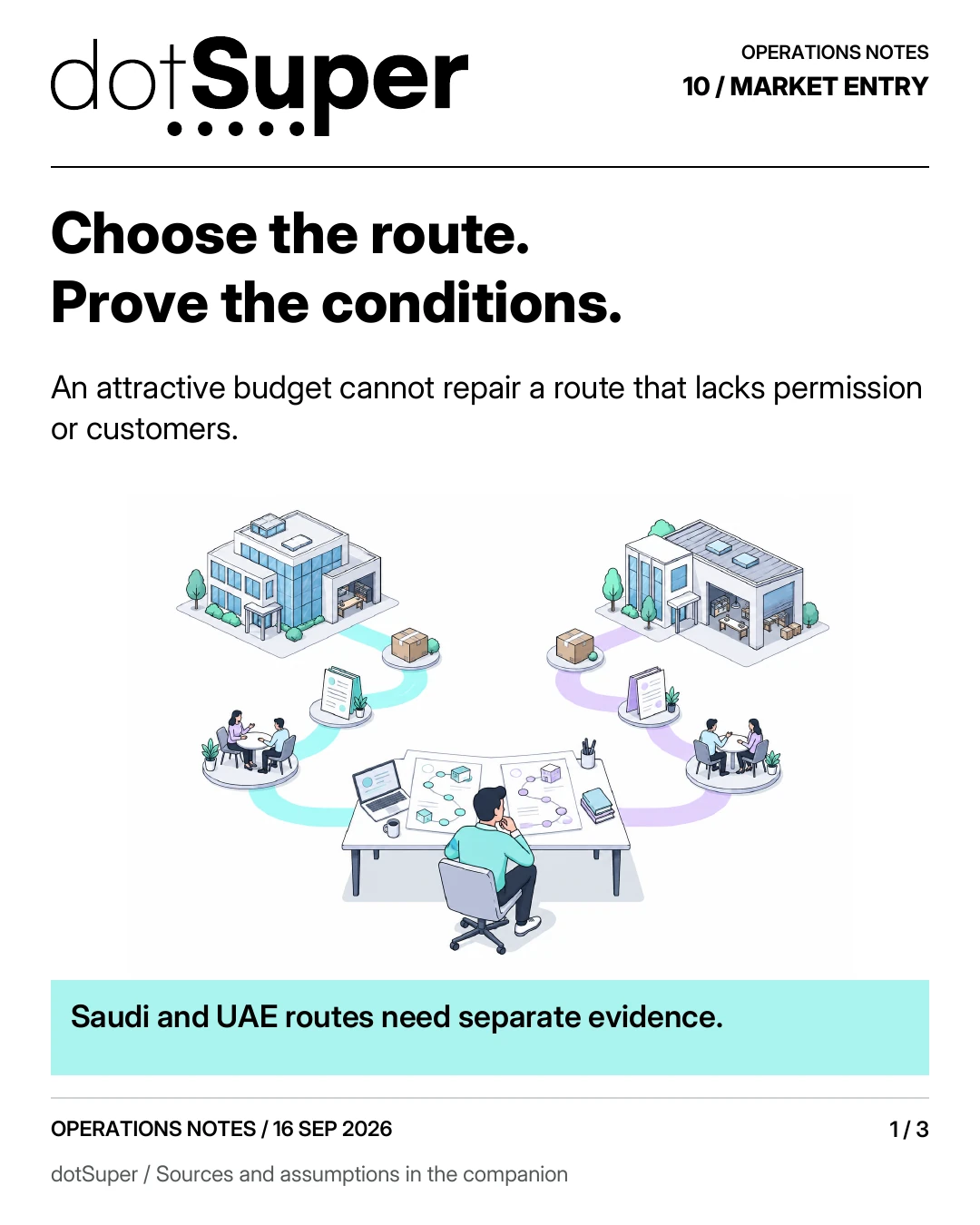
Read the diagram: Panel 1 of 3. Choose the route.
Choose the route. Prove the conditions. An attractive budget cannot repair a route that lacks permission or customers. Saudi and UAE routes need separate evidence.
The Abu Dhabi and Riyadh amounts are fictional AED-equivalent assumptions. They are not actual fees, market prices, exchange rates or country rankings.
Reuse: Original artwork created for dotSuper. No public reuse licence has been specified. Attribution to research sources does not grant rights to their artwork or datasets.
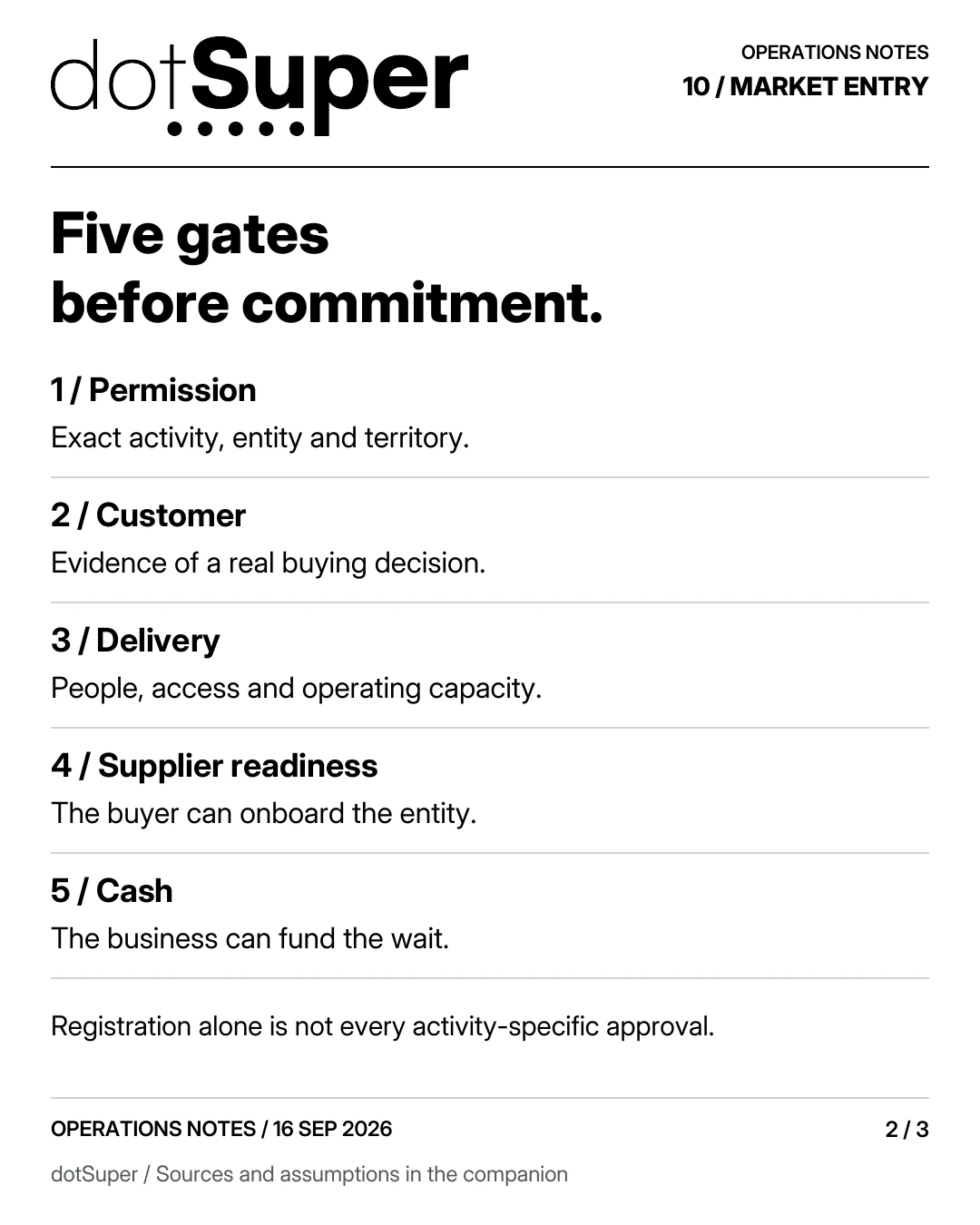
Read the diagram: Panel 2 of 3. Five gates before commitment.
Five gates before commitment. 1 / Permission / Exact activity, entity and territory. 2 / Customer / Evidence of a real buying decision. 3 / Delivery / People, access and operating capacity. 4 / Supplier readiness / The buyer can onboard the entity. 5 / Cash / The business can fund the wait. Registration alone is not every activity-specific approval.
The Abu Dhabi and Riyadh amounts are fictional AED-equivalent assumptions. They are not actual fees, market prices, exchange rates or country rankings.
Reuse: Original artwork created for dotSuper. No public reuse licence has been specified. Attribution to research sources does not grant rights to their artwork or datasets.
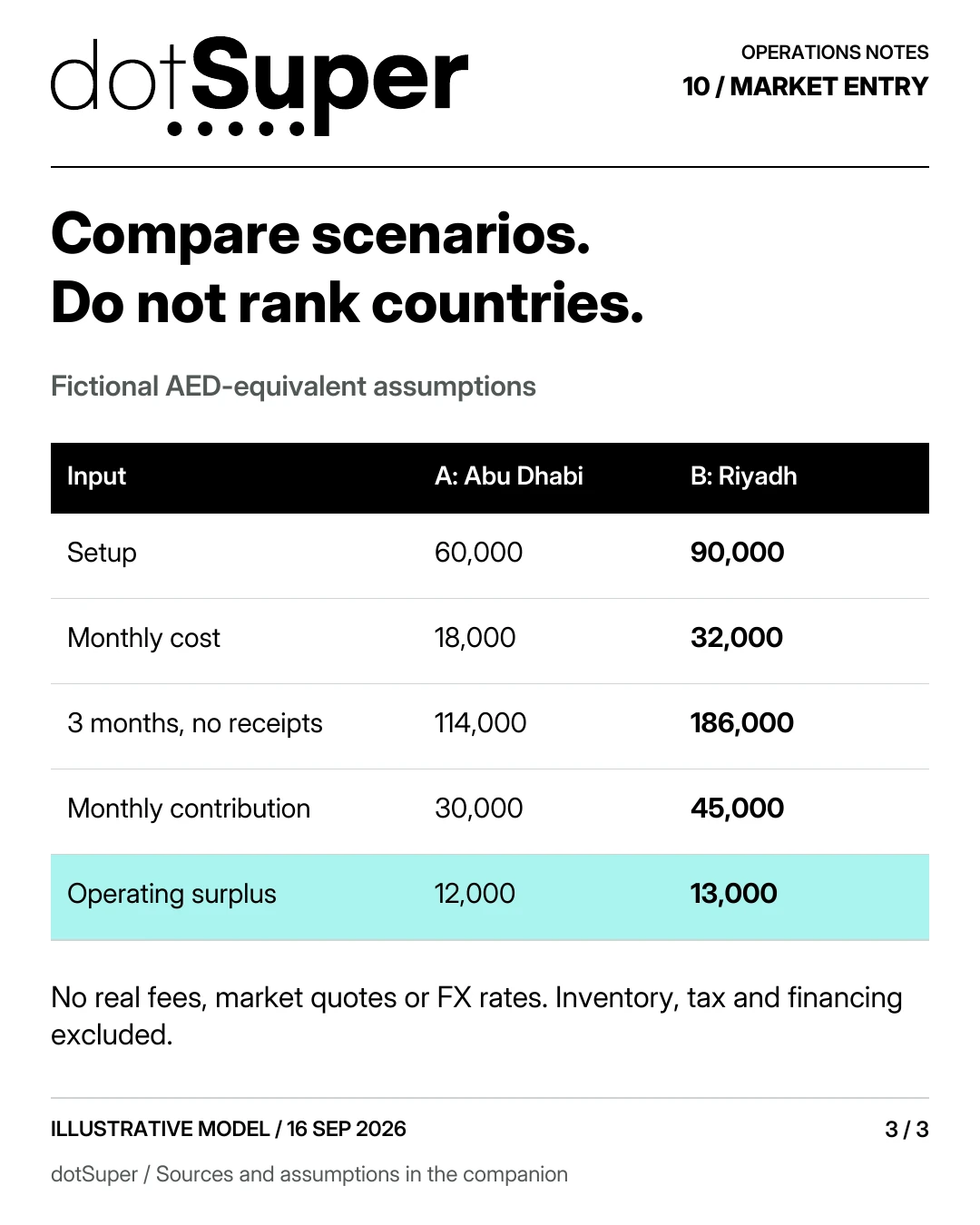
Read the diagram: Panel 3 of 3. Compare scenarios.
Compare scenarios. Do not rank countries. Fictional AED-equivalent assumptions Setup / 60,000 / 90,000 Monthly cost / 18,000 / 32,000 3 months, no receipts / 114,000 / 186,000 Monthly contribution / 30,000 / 45,000 Operating surplus / 12,000 / 13,000 No real fees, market quotes or FX rates. Inventory, tax and financing excluded.
The Abu Dhabi and Riyadh amounts are fictional AED-equivalent assumptions. They are not actual fees, market prices, exchange rates or country rankings.
Fictional example: market route scenarios.
Fictional route: A: Abu Dhabi scenario; Setup AED-equivalent: 60,000; Monthly operating cost AED-equivalent: 18,000; Three-month pre-receipt funding AED-equivalent: 114,000; Assumed monthly contribution AED-equivalent: 30,000; Steady-state surplus AED-equivalent: 12,000.
Fictional route: B: Riyadh scenario; Setup AED-equivalent: 90,000; Monthly operating cost AED-equivalent: 32,000; Three-month pre-receipt funding AED-equivalent: 186,000; Assumed monthly contribution AED-equivalent: 45,000; Steady-state surplus AED-equivalent: 13,000.
| Fictional route | Setup AED-equivalent | Monthly operating cost AED-equivalent | Three-month pre-receipt funding AED-equivalent | Assumed monthly contribution AED-equivalent | Steady-state surplus AED-equivalent |
|---|---|---|---|---|---|
| A: Abu Dhabi scenario | 60,000 | 18,000 | 114,000 | 30,000 | 12,000 |
| B: Riyadh scenario | 90,000 | 32,000 | 186,000 | 45,000 | 13,000 |
Take it into your next working session
Keep the source credits with the file. Check the reuse terms and adapt the method to your context.
Credit: dotSuper original fictional worked-example data.
Reuse: Original illustrative data. No public reuse licence has been specified. These are not client measurements or research results.
Reuse: Original artwork created for dotSuper. No public reuse licence has been specified. Attribution to research sources does not grant rights to their artwork or datasets.
Reuse: Original artwork created for dotSuper. No public reuse licence has been specified. Attribution to research sources does not grant rights to their artwork or datasets.
Reuse: Original artwork created for dotSuper. No public reuse licence has been specified. Attribution to research sources does not grant rights to their artwork or datasets.
Reuse: Original artwork created for dotSuper. No public reuse licence has been specified. Attribution to research sources does not grant rights to their artwork or datasets.
Reuse: Original artwork created for dotSuper. No public reuse licence has been specified. Attribution to research sources does not grant rights to their artwork or datasets.
Reuse: Original artwork created for dotSuper. No public reuse licence has been specified. Attribution to research sources does not grant rights to their artwork or datasets.
Thumbnail credit and reuse
Reuse: Original artwork created for dotSuper. No public reuse licence has been specified. Attribution to research sources does not grant rights to their artwork or datasets.
- 01Specify activity permission, customer evidence, delivery, supplier readiness and cash for each route.
- 02Registration is distinct from activity-specific approvals and customer qualification.
- 03The fictional routes require AED-equivalent 114,000 and 186,000 through three months without receipts.
- 04The AED-equivalent 72,000 difference is scenario arithmetic, not a country cost ranking or exchange-rate claim.
/ dotSuper point of view
Market entry is a choice between specific customer and operating routes. Permissions and delivery feasibility are gates; attractive fictional cash arithmetic cannot establish demand or lawful access.
Audience, question and answer
Choose a customer segment and delivery route before ranking countries.
Confirm demand, lawful activity, purchasing access, delivery feasibility and cash exposure for a particular city, entity and offer.
A broad regional growth statistic cannot establish that one firm can sell, deliver and collect profitably.
This explanation is a market-entry decision map, not a country league table or incorporation recommendation.
The UAE and Saudi Arabia are separate markets.
Other MENA countries need separate research; neither jurisdiction's rules or evidence should be copied across the region.
This is general research, not legal or tax advice.
Current official route evidence
It also recognises excluded or restricted activities and further competent-authority approvals.
Registration should not be treated as permission to perform every activity.
MISA, Updated Investment Law, Articles 7–8 and official explanatory material, checked 16 September 2026 (source 1).
For the UAE mainland, the government describes a sequence beginning with business activity and legal form, followed by licensing and relevant approvals.
The selected activity affects the route.
An advertised quick digital registration service is not an end-to-end time estimate for an operating industrial business.
UAE government, Steps to start a business on the mainland, live page checked 16 September 2026 (source 4).
The UAE also has authority-specific free-zone routes.
The official portal directs investors to choose the sector and relevant zone and supplies links to individual authorities.
This supports comparing actual routes, not claiming that all free-zone licences confer identical market access.
UAE government, Starting a business in a free zone, checked 16 September 2026 (source 3).
UAE federal supplier registration and Saudi public tender discovery have documented channels, discussed in the buying-decision companion.
They are useful research entry points, but registration does not prove an award or private-sector demand.
UAE MoF supplier register (source 2) and Monsha'at's Etimad instructions, updated 2 August 2026 (source 5), both checked 16 September 2026.
UAE mainland and free-zone pages were read during research on 16 September 2026; later same-day requests returned no extractable text.
No successful fresh recheck or entity-specific legal assessment is claimed.
Five gates before committing to a route
Identify the customer role, problem, buying trigger and evidence of willingness to pay.
A list of factories is a prospect universe, not an addressable revenue estimate.
Distinguish a conversation, a qualified problem, a procurement invitation and a signed order.
Record why an opportunity was lost or delayed.
Activity gate.
Specify what the business will actually do: sell goods, import, install, maintain, manufacture, advise or process data.
Different actions can require different permissions and delivery arrangements.
Ask the relevant authority or qualified adviser about the exact activity and entity; do not settle for a generic package description.
Access gate.
Confirm how the selected customer buys.
Public tenders, enterprise vendor lists, distributors and direct private contracts are different routes.
Investigate buyer-specific local-content, qualification or service requirements where relevant.
No universal local-content percentage or blanket regional-headquarters obligation is asserted here.
Delivery gate.
Test the service promise with actual logistics, staff availability, parts, training and support.
Selling from one country does not establish that the business can legally or operationally perform an on-site activity in the other.
Identify who bears installation, warranty and return responsibilities.
Cash gate.
Build a dated cash model using setup expenditure, operating costs, inventory, deposits, payment milestones and collection uncertainty.
A positive gross margin can coexist with a cash shortfall.
Verify banking, tax and invoicing requirements for the actual route before contracting.
The gates need evidence and named owners.
“Unknown” is a useful state.
It should trigger a research action, not receive a neutral score that quietly helps a weak route win.
Two country-specific research branches
Examine the particular procurement channel and delivery responsibilities.
Keep the Saudi invoicing and data-protection assessment separate, using the invoice-readiness and accountable-AI companions as starting references rather than legal determinations.
For a UAE route, name the emirate and decide which mainland or specific free-zone option is being assessed.
Confirm that the licence and delivery arrangement fit the target customer and activity.
Distinguish federal purchasing from emirate-level and private purchasing.
Do not assume a Dubai route establishes identical conditions in Abu Dhabi or Sharjah.
In both branches, require evidence from actual counterparties and official route information.
A well-connected intermediary can help, but its commercial interest should be recorded.
Ask for specific deliverables and verifiable access rather than an untestable promise of market reach.
Worked example: a fictional industrial service provider
All figures below are assumed planning inputs, expressed in AED-equivalent purely to compare the arithmetic.
They are not actual setup fees, market prices or an exchange-rate statement.
The three-month no-receipts exposure is setup plus three times monthly cost.
It excludes inventory, tax, financing and other unmodelled cash items.
Those exclusions would need explicit estimates for a real decision.
The Riyadh scenario has a slightly larger assumed operating surplus but requires AED-equivalent 72,000 more launch cash under this stress case.
That does not prove Abu Dhabi is preferable.
If Riyadh has a verified anchor customer and the UAE route has only informal interest, the evidence quality differs materially.
If the Abu Dhabi route requires on-site work beyond the permissions actually obtained, the route fails the activity gate regardless of its attractive arithmetic.
If the Riyadh customer cannot complete supplier qualification within the cash runway, the route may need a different sequence.
Legal feasibility and delivery feasibility are gates, not small scoring penalties.
| Illustrative input | Abu Dhabi route | Riyadh route |
|---|---|---|
| One-time setup and launch budget | 60,000 | 90,000 |
| Monthly operating cash cost | 18,000 | 32,000 |
| Three months with no receipts, including setup | 114,000 | 186,000 |
| Assumed monthly contribution before operating cost, after ramp-up | 30,000 | 45,000 |
| Resulting monthly operating surplus | 12,000 | 13,000 |
Quantitative context and market-sizing discipline
Multiply only quantities whose meaning and source are clear.
Do not multiply all manufacturers by an imagined software budget and label it a market size.
Use interview and pipeline counts honestly.
Ten interviews are ten interviews, not evidence of demand across a country.
Separate invited participants, completed interviews, relevant respondents and those expressing a budget-backed need.
Record the date and recruitment method.
Customer discovery is especially prone to selection bias when introductions come from one network.
Do not claim measured search demand from an attractive topic or a search-engine result page.
This research did not obtain search-volume data.
Proposed content priority is an editorial judgment based on operating usefulness, time sensitivity and available evidence.
For a real route comparison, add sensitivity to delayed collections, lower win rate and higher service cost.
Keep the currencies native in the underlying model and record any conversion source and date.
This example deliberately uses a common fictional unit to avoid implying a current exchange rate.
Evidence and boundaries
Each source supports only the scope stated beside the claim.
| Claim | Evidence | Boundary |
|---|---|---|
| Saudi foreign-investor registration and activity conditions matter | MISA law Articles 7–8 | Actual entity and activity need review |
| UAE mainland setup begins with activity and legal form | UAE government mainland guide | Additional approvals can apply |
| UAE free-zone routes are authority-specific | UAE government zone guide | No universal permission or cost claim |
| Public buying access has documented channels | MoF and Monsha'at sources | Access is not an award or private-market demand |
| Example cash exposure is 114,000 versus 186,000 | Original setup-plus-three-month calculation | Fictional AED-equivalent assumptions |
| Gates should precede comparative scoring | dotSuper decision framework | Proposed method, not empirical ranking |
One practical next step
Gather evidence for all five gates, name the unresolved conditions and build a dated cash model using actual quotes and collection assumptions.
Counterevidence and limitations
A convenient setup route can be commercially weak if buyers lack urgency or budget.
Country size alone does not decide the first market.
Official setup guidance explains process, not total implementation time or service quality.
Intermediary quotations and customer interviews remain necessary for a concrete launch plan.
This explanation intentionally leaves actual fees, tax treatment, staffing rules, sector permits and procurement-specific obligations unquantified rather than inventing a neat comparison.
What this page cannot conclude
- 01The Abu Dhabi and Riyadh amounts are fictional AED-equivalent assumptions. They are not actual fees, market prices, exchange rates or country rankings.
- 02Inventory, tax, financing and route-specific obligations are excluded from the simplified cash illustration. Contribution and demand remain assumed.
- 03MISA registration does not establish every operating permission. UAE routes depend on actual authority, activity and entity.
- 04UAE mainland and free-zone pages were read during research on 16 September 2026; later same-day requests returned no extractable text. No successful fresh recheck or entity-specific legal assessment is claimed.
Sources
- 01MISA, Updated Investment Law, Articles 7–8 and official explanatory material, checked 16 September 2026Saudi Ministry of Investment · accessed Sep 16, 2026
- 02UAE MoF, supplier registration service, undated live page, checked 16 September 2026UAE Ministry of Finance · accessed Sep 16, 2026
- 03UAE government, Starting a business in a free zone, checked 16 September 2026UAE Government portal · accessed Sep 16, 2026
- 04UAE government, Steps to start a business on the mainland, live page checked 16 September 2026UAE Government portal · accessed Sep 16, 2026
- 05Monsha'at, Government Tenders and Procurements, page updated 2 August 2026, checked 16 September 2026Saudi Monshaat · accessed Sep 16, 2026
Our editorial standard · Found an error? Send a correction with its source.
/ CITE OR SHARE THIS GUIDE
Make the evidence easy to verify.
When you reference this guide, link to its canonical URL. That gives readers one stable place for the evidence, limitations and future updates.
dotSuper Research Desk. (September 17, 2026). Choose the route. Prove the conditions.. dotSuper. https://dotsuper.net/feeds/market-intelligence/saudi-uae-market-entry-gates