Positioning and customer promises
Turn Your Brand Promise Into an Operating Commitment
Choose a credible customer promise, identify the delivery obligations behind it and decide which claims to publish, qualify, test or withhold.
The method, in brief
Which promise can the business credibly make and consistently deliver?
Choose a promise only after linking the audience's desired change to a concrete delivery obligation and supporting evidence. Withhold or test claims that depend on capabilities or outcomes the business has not demonstrated.
Why this framework matters
Positioning becomes useful when it changes what the business commits to deliver.
Choose a promise only after linking the audience's desired change to a concrete delivery obligation and supporting evidence. Withhold or test claims that depend on capabilities or outcomes the business has not demonstrated.
Audience and decision
For a founder, commercial lead and operations lead who must choose which customer promise their business can credibly make. The decision is one positioning hypothesis to test, the operating commitments behind it, and the claims to withhold. Use this before a website rewrite, a market launch or a repositioning workshop. It is especially useful when the current promise describes technology but gives a buyer little reason to change supplier.
Include one person who delivers the service and, where possible, a customer representative. A founder can explain intent; an operator can expose where that intent fails in practice. Neither substitutes for customer evidence. Allow two hours for the workshop after discovery preparation, followed by customer testing over a period appropriate to access and buying cycles.
Research and source ledger
All sources accessed 16 September 2026. Source descriptions establish intellectual lineage, not validation of this new worksheet.
Attribution: Brand as a connection between purpose and experience is third-party thinking. Backward reasoning from an outcome adapts theory-of-change practice, whose history includes Carol Weiss and other evaluation scholars. dotSuper's original contribution is the promise-to-obligation ledger, the exclusion decision and the evidence release rule. This is not Miltenburg's Brand Thinking Canvas and does not reproduce its layout, questions or paid exercises. See the comparative study for reuse details.
| Source and date | Relevant evidence and limit |
|---|---|
| Anne Miltenburg, Brand the Change, BIS publisher listing, Fall 2017 listed | Identifies the author, practical brand-building purpose, paperback ISBN 9789063694784 and 224 pages. Publisher description only; the full book was not read. |
| Hachette listing, 18 January 2018 on-sale date | Same paperback ISBN. Records a distribution-date discrepancy, not evidence of a separate revised edition. |
| Miltenburg, author organisation guidebook page, undated | Explains the connection among purpose, identity and interactions. Accessible overview, not the complete methodology. |
| Center for Theory of Change, What is Theory of Change?, undated | Connects desired outcomes with necessary conditions and assumptions. This is evaluation practice, not proof that brand promises cause commercial outcomes. |
| Steve Blank, Customer Development Manifesto, 17 September 2009 | Supports testing customer hypotheses outside internal planning. Entrepreneurial method, not a universal sampling rule. |
Existing approaches and their limits
A mission workshop can produce agreement without changing what buyers experience. A positioning sentence can be clear while its proof is weak. A causal map can make assumptions visible while remaining entirely speculative. These approaches become useful together when each desired market claim creates an operational obligation and a test that could disprove it.
The proposed method therefore begins with a change the audience values and ends with permission to say something specific. It does not score how inspiring a purpose sounds. A safety-critical manufacturer may rightly prioritise delivery reliability over a distinctive emotional story. A commodity supplier may win through availability and transparent terms rather than a novel category narrative.
Structure and rationale
Use five linked records: change, audience, alternative, obligation, evidence. These are records in a ledger, not five equally weighted boxes. An evidence gap can send a team back to any earlier record.
The change describes an observable improvement for someone outside the firm. The audience identifies the people who benefit and the people who buy, including any conflict between them. The alternative names what they currently do, including postponing action. The obligation names what the company must consistently deliver for the promise to be true. The evidence identifies what is known, what is inferred and what remains to test. A final release decision classifies each proposed claim as publish, qualify, test or withhold.
This structure makes positioning costly in a useful way. A promise of independence requires transferable access, documentation and support arrangements. A promise of faster decisions requires a defined start and end event. If the company cannot accept the obligation, the promise should change.
Inputs and preparation
Bring three recent customer conversations, two lost or stalled opportunities, actual deliverables, delivery complaints and current sales copy. These counts are practical starting points, not an adequate market sample. Add the business's capacity constraints, recurring supplier dependencies and a list of statements already used publicly. Remove identifying customer information from shared workshop material unless use is authorised.
Before the session, the facilitator extracts claims verbatim into a private working list and asks delivery staff which ones they would hesitate to repeat. Identify the accountable decision maker. If no customer evidence exists, the output must be a research hypothesis rather than an approved positioning statement.
Facilitation and use
1. State the choice, 10 minutes. Write the market, audience and decision date. Keep the question narrow: which promise should lead the first discussion with an operations director, for example. Do not try to settle every brand touchpoint in one workshop. 2. Describe the desired change, 15 minutes. Complete: someone currently experiences a specific difficulty; after working with us they should be able to do something observable. Separate the immediate deliverable from the eventual business outcome. Ask who could be worse off if the change succeeds. 3. Locate the audience and alternative, 20 minutes. Identify beneficiary, buyer and delivery participant. Record the current workaround and what makes it attractive. Ask why a sensible customer might prefer that alternative. This question prevents the team from equating difference with value. 4. Write two competing promises, 20 minutes. Use plain language and include scope. For each, record one deliberate exclusion, such as no autonomous production-control decisions. Exclusion is useful only when it changes the offer or delivery obligation. 5. Audit obligations, 25 minutes. Walk through acquisition, onboarding, use, failure and handover. Attach a named owner and observable behaviour to every promise. Identify missing capability, supplier permission and unresolved commercial terms. 6. Review evidence, 20 minutes. Have delivery staff challenge each claim before the founder defends it. Separate reported customer outcomes, independently measured outcomes and projections. Record denominators, dates and conditions for quantitative claims. 7. Choose a test and release status, 10 minutes. Select one promise and the strongest competing explanation. Write what the team will change if the test fails. Set a review date and specify who may approve publication.
Decision definitions
Use categorical judgments rather than a brand-strength score. Publish means the wording is supported within its stated scope and an owner accepts the obligation. Qualify means useful support exists but context or uncertainty must appear alongside it. Test means a plausible proposition needs customer or operational evidence. Withhold means the claim is contradicted, unauthorised or dependent on a capability the business does not have.
These categories are editorial decisions, not legal clearance. A single satisfied customer may justify an attributed case statement with permission; it does not justify a universal performance claim. Disagreement is recorded as an unresolved item rather than averaged into a score.
Worked example: illustrative, not a documented client case
A small AI implementation firm considers leading with “automate your entire factory.” Its delivery team can improve document review but has neither plant-control expertise nor a tested safety case. The obligation audit places the factory-wide promise in withhold.
Its alternative promise is: “Make supplier quote reviews easier to check and hand over.” The audience is a procurement manager; finance approves expenditure; buyers use the result. The current alternative is a spreadsheet that is slow but familiar. The meaningful change is a review with traceable source documents and a clear exception queue. The obligation includes preserving original quotations, retaining human approval and documenting how another employee can operate the workflow.
The team has a working demonstration, but no measured customer improvement. It can publish the service description with scope. It cannot claim a percentage time saving. The next test asks two procurement teams to review their own permitted sample quotations using both the existing process and the prototype. Observers capture correction effort, missing terms and ability to locate source evidence. If the prototype makes checking harder, the promise or product must change.
The selected positioning is narrower, but it changes concrete delivery decisions. The team budgets for handover rehearsal and exception handling instead of creating a broader technology claim. The test remains exploratory and does not establish market demand or a causal business result.
Outputs, failure modes and validation limits
The output is a one-page positioning decision, a claim register, an obligation backlog and a customer-test brief. A useful decision can be “retain the current positioning until evidence improves.” Do not force a new slogan merely because a workshop took place.
Common failures include retrospectively inventing a purpose, treating founder conviction as customer evidence, omitting the current workaround and choosing a promise that only the best employee can deliver. A counterexample is an emergency repair service whose customers value response coverage more than the proposed sustainability story. If discovery repeatedly shows this, operational relevance should lead the buying message while purpose informs how the company operates.
Validate usability first: can an uninvolved operator trace a public claim to its delivery obligation and evidence? Then test buyer comprehension and relevance using competing statements without coaching. Commercial validation requires observed buying behaviour over time. No workshop result, attractive graphic or book association establishes that validation.
Working files and reuse
The five-page PDF includes a visual reference, two fillable worksheet pages, an illustrative worked example and a facilitator/source guide. An expandable CSV working log is also available.
All examples are illustrative, not measured client results. Original promise-to-obligation ledger, informed by the cited concepts. Not field validated. The full Brand the Change book was not read; its proprietary canvas, exercises and layout are not reproduced.
Original dotSuper material prepared for review. No public reuse licence has been assigned. Third-party source material retains its own terms.
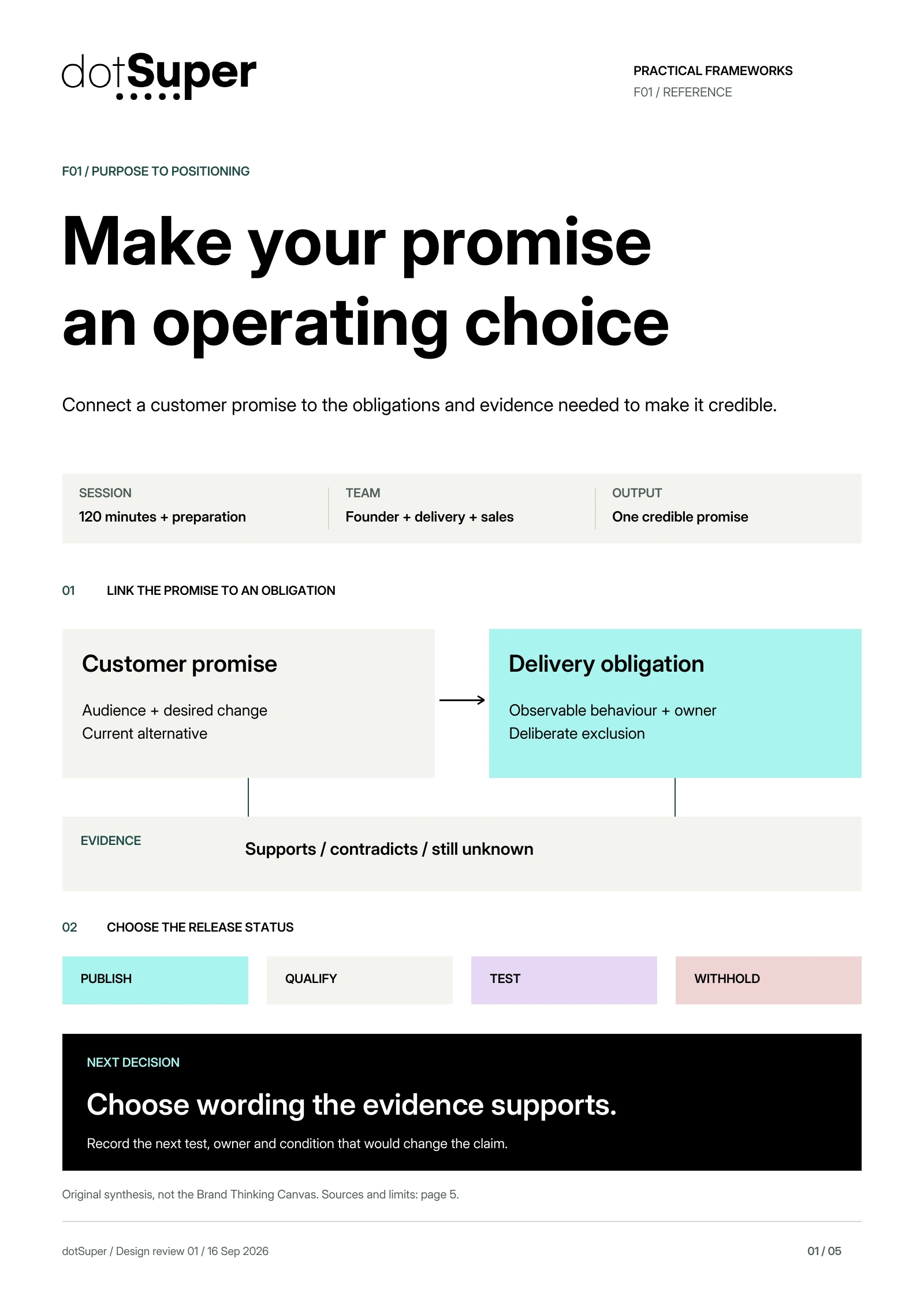
The PDF is not represented as a tagged PDF/UA document. The text on this page provides a readable alternative to the diagram and method.
See the method. Keep the context.
The visual companion
Reuse: Original dotSuper material. No public reuse licence has been specified. Contact dotSuper for reuse permissions. Third-party source material retains its own terms.
Read the diagram: Purpose to Positioning. Original dotSuper reference diagram. Original dotSuper synthesis. Conceptual lineage: Anne Miltenburg, theory-of-change practice and Steve Blank. No author endorsement or canvas adaptation is claimed.
Connect the customer promise, its audience, desired change and current alternative to a delivery obligation with an observable behaviour, owner and deliberate exclusion. The evidence record keeps support, contradictions and unknowns together. Select publish, qualify, test or withhold; record the next test, owner and condition that would change the wording.
Original promise-to-obligation ledger, informed by the cited concepts. Not field validated. The full Brand the Change book was not read; its proprietary canvas, exercises and layout are not reproduced.
Take it into your next working session
Keep the source credits with the file. Check the reuse terms and adapt the method to your context.
Reuse: Original dotSuper material. No public reuse licence has been specified. Contact dotSuper for reuse permissions. Third-party source material retains its own terms.
Reuse: Original dotSuper material. No public reuse licence has been specified. Contact dotSuper for reuse permissions. Third-party source material retains its own terms.
Thumbnail credit and reuse
Reuse: Original dotSuper material. No public reuse licence has been specified. Contact dotSuper for reuse permissions. Third-party source material retains its own terms.
Sources, context and limits
Keep the evidence beside the method.
- Original promise-to-obligation ledger, informed by the cited concepts. Not field validated. The full Brand the Change book was not read; its proprietary canvas, exercises and layout are not reproduced.
- This combined dotSuper method is research-informed and has not been field validated. Workshop agreement and a completed template are not proof of effectiveness.
- Worked examples are hypothetical. Country examples and intended regional audience do not establish country-wide or region-wide effectiveness.
- Source access and adaptation limits are recorded in the source ledger. Attribution does not imply endorsement or a licence to reproduce third-party artwork.
- Brand the Change, BIS publisher listing
BIS Publishers · accessed Sep 16, 2026
- Hachette listing
Hachette UK · accessed Sep 16, 2026
- author organisation guidebook page
Brand the Change · accessed Sep 16, 2026
- What is Theory of Change?
Center for Theory of Change · accessed Sep 16, 2026
- Customer Development Manifesto
Steve Blank · accessed Sep 16, 2026
/ CITE OR SHARE THIS GUIDE
Make the evidence easy to verify.
When you reference this guide, link to its canonical URL. That gives readers one stable place for the evidence, limitations and future updates.
dotSuper Research Desk. (September 17, 2026). Turn Your Brand Promise Into an Operating Commitment. dotSuper. https://dotsuper.net/feeds/market-intelligence/purpose-to-positioning
Bring it into the work
Start with one real decision
Bring one promise your business makes. Identify the operating commitment and evidence needed to support it.
Download the fillable framework