Value propositions and economics
Connect Your Value Proposition to Evidence and Economics
Connect a proposed benefit to measured work, realistic value capture and a specific next proof before making a commercial claim.
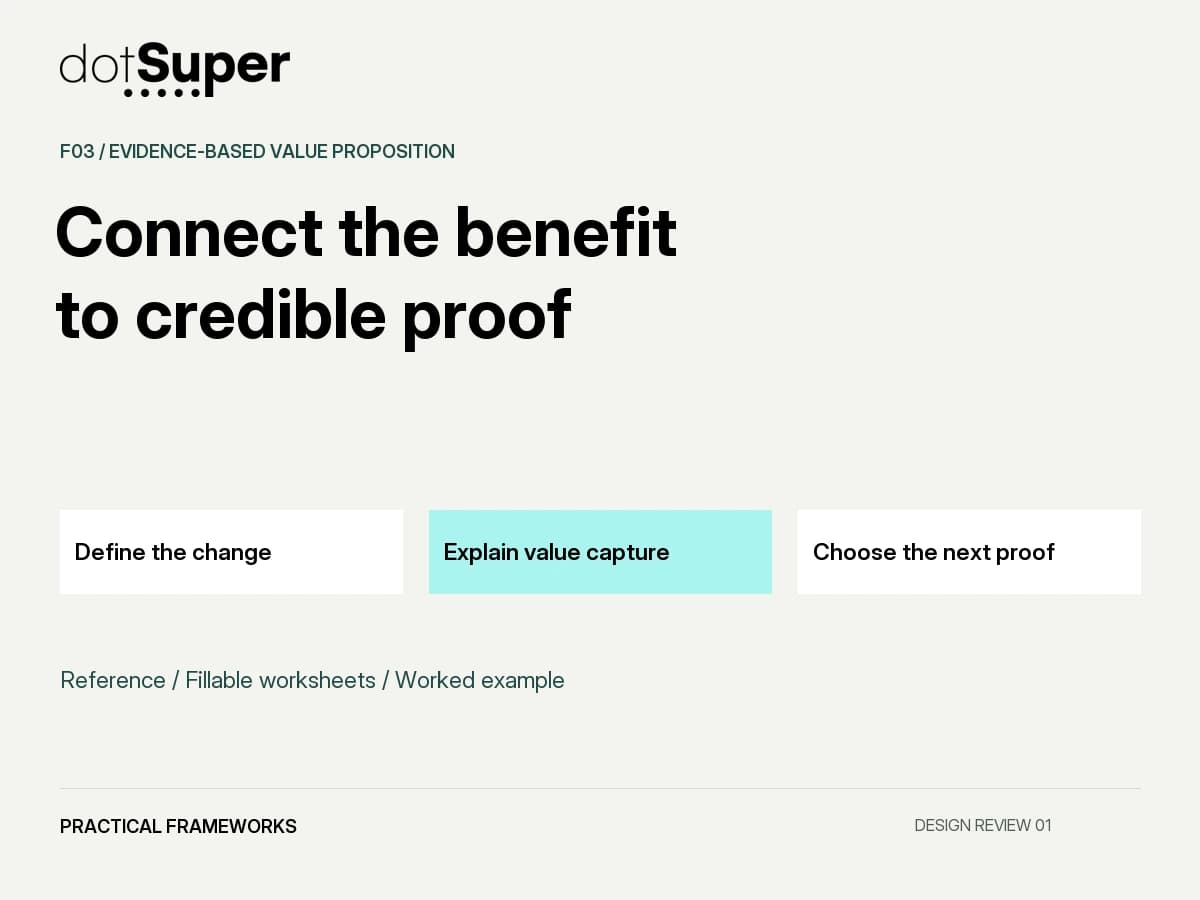
The method, in brief
What benefit can we credibly claim, and what would prove it?
Define the buyer, workflow change, quality condition and value-capture mechanism. Include review and operating costs, then choose a test that addresses the remaining uncertainty. Keep projected capacity value separate from actual cash savings.
Why this framework matters
A persuasive value proposition needs an operational mechanism and a credible route from improvement to business value.
Define the buyer, workflow change, quality condition and value-capture mechanism. Include review and operating costs, then choose a test that addresses the remaining uncertainty. Keep projected capacity value separate from actual cash savings.
Audience and decision
For a founder, commercial lead, finance partner and delivery lead choosing what to offer a defined customer segment and how to substantiate it. Decide which benefit can lead the offer, which claims need qualification, what evidence to gather and whether the economics justify a next test. Use this after basic problem discovery and before turning a technical capability into sales collateral.
The unit of work is one offer for one buying context. “AI for manufacturing” is too broad. “Assisted quotation comparison for a procurement team receiving inconsistent supplier PDFs” is specific enough to investigate. Plan a 90-minute review plus the time required to obtain actual workflow observations and customer feedback.
Research and source ledger
Accessed 16 September 2026.
Lineage: Customer-value concepts and hypothesis testing are established third-party ideas. Separating operational change, economic conversion, buyer proof and claim permission is dotSuper's proposed synthesis. The complete source models are not reproduced. The empirical study is used to justify caution about transfer, not to attach someone else's result to dotSuper.
| Source and publication date | What it supports and does not support |
|---|---|
| Alexander Osterwalder, original Value Proposition Canvas article, 2012 | Customer jobs, pains and gains provide a recognised vocabulary. These concepts do not establish demand for a particular offer. |
| Strategyzer, tool usage policy, undated | The Value Proposition Canvas is copyrighted; adaptation, software inclusion and sale as a tool require express permission. This dossier uses a distinct evidence table. |
| Strategyzer, Learning Card, Nabila Amarsy, 9 March 2015 | Linking observation to an explicit subsequent action informs the review cycle. No card reproduction or implied licence. |
| Eric Ries, Lean Startup principles, undated | Experimentation informs how an uncertain offer should be tested. The method is not a guarantee of commercial success. |
| Brynjolfsson, Li and Raymond, Generative AI at Work, working paper 2023, subsequently published 2025 | A field study of customer support demonstrates context-dependent productivity effects. Its result is not a forecast for manufacturers or this offer. |
Existing approaches and limitations
Feature-benefit lists often assume that a technical improvement creates economic value. Value-proposition exercises can capture the intended customer fit while leaving it untested. ROI calculators can hide weak evidence behind precise arithmetic. A customer testimonial may support relevance but omit the baseline, denominator or costs needed to support a financial claim.
This method keeps those gaps visible. A benefit should pass through three different questions: does the workflow improve, can the organisation capture the improvement, and will the buyer value it enough to act? A reduction in active task time may create capacity without reducing payroll. A faster report may have little value if the decision meeting remains weekly. A more accurate answer may still be unusable if it arrives too late.
Structure and rationale
Create a claim chain with seven fields: customer situation, current alternative, observable change, capture mechanism, costs and dependencies, proof, next commitment. The next commitment might be access to a permitted sample, a budget review or a paid pilot. It must match the stage of the relationship and should never be disguised as a research requirement.
Each link can fail independently. The model may improve extraction but increase human checking. Time may be released without available work to absorb it. The finance owner may regard the improvement as immaterial. The framework therefore avoids combining everything into an attractiveness score. It exposes the weakest link and selects an experiment that can resolve it.
Inputs and preparation
Bring a problem-discovery summary, at least one observed workflow sample, a description of the current alternative, current cost information and a draft service scope. Include customer effort, integration, data preparation, review, training and support in the cost list. Mark vendor estimates and internal guesses. Record the time horizon and currency before calculating anything.
Ask the operational owner what would change in staffing, throughput, service quality or avoided loss if the proposed benefit occurred. Ask finance which of these can be recognised as cash savings, capacity or a risk reduction. Do not assign monetary value to prevented harm simply to make an investment appear positive.
Facilitation and use
1. Define the customer situation, 10 minutes. Name the role, work episode, trigger and consequence. Specify where the offer does not apply. Reuse an evidence ID from discovery rather than rewriting a problem from memory. 2. Document the current alternative, 10 minutes. Include cost, familiarity, reliability and switching friction. Compare against the actual working process, not an intentionally inefficient straw man. 3. Write a falsifiable benefit, 15 minutes. Identify the unit, baseline, expected direction and quality condition. For example, reduce review minutes per eligible quotation while retaining all critical commercial terms. Label any target as a target. 4. Explain value capture, 15 minutes. Describe what happens to the released resource. More throughput requires demand and downstream capacity. Cash savings require a credible change in actual expenditure. Record when value would appear and who controls the change. 5. Include the full burden, 15 minutes. Add exceptions, rework, subscription or usage charges, integration maintenance, retraining and management effort. Compare a simple workflow fix as well as the proposed AI intervention. 6. Choose the next proof, 15 minutes. Separate a comprehension test from a workflow test and a buying test. An interview can reveal whether a buyer understands the proposition. It cannot demonstrate a measured time saving. A prototype can establish performance under test conditions without proving willingness to pay. 7. Set release wording and action, 10 minutes. Approve a scoped service description, qualify an observed result or keep the claim internal. Assign an evidence owner and a date on which stale assumptions must be revisited.
Definitions and assumptions
Potential capacity value is released time multiplied by an agreed cost rate. It is an analytical proxy, not cash saved. Realised cash saving is a verified reduction in expenditure after incremental costs. Incremental contribution requires additional profitable work actually delivered, with variable costs accounted for. Risk reduction should state the changed exposure and evidence, not only an invented expected-loss number.
Use ranges when inputs are uncertain, preserve the original units and show which assumption drives the decision. Avoid assigning numerical confidence such as 87% without a statistical basis. “Measured on 40 eligible items in one team during one week” conveys more than an unsupported confidence score.
Worked example: illustrative, not a client result
A procurement team handles 600 quotations each month. A hypothetical sample suggests 12 active review minutes per eligible quotation. A proposed assisted process targets 7 minutes, including source checking. If all 600 were eligible and the target were achieved, 3,000 minutes or 50 hours would be released monthly.
At an assumed loaded cost of AED 90 per hour, the capacity proxy is AED 4,500 per month. That is not AED 4,500 of cash savings. Assume software and support cost AED 1,500 monthly and initial integration costs AED 9,000. Spreading integration across twelve months adds AED 750 per month. The resulting proxy after those costs is AED 2,250 monthly, before any omitted training or management burden.
The optimistic assumption is that every quotation qualifies. At 60% eligibility, released time becomes 30 hours and the capacity proxy AED 2,700. After the same AED 2,250 monthly equivalent cost, only AED 450 remains. The team has not established sufficient value to make a broad efficiency promise. It needs eligibility measurement, a realistic exception workload and a capacity-use plan.
The offer is therefore framed as a bounded pilot to test review effort and critical-term retention. A separate workflow improvement, requiring suppliers to use a structured response template, remains in the comparison. If that cheaper intervention performs as well, it may be the better recommendation.
Outputs, failure modes and validation limits
Produce a one-page offer hypothesis, a claim-evidence ledger, an assumptions table and an agreed next commitment. Keep the illustrative calculation out of case-study sections and sales proof. A prospect's willingness to share data is evidence of engagement, not a purchase or a proven return.
Failure modes include counting the same time saving twice, multiplying median time by volume without checking task mix, ignoring work transferred to reviewers, treating gross revenue as contribution and assuming all released capacity is used. A counterexample is a low-volume specialist process where reliability matters greatly but labour saving cannot cover implementation costs. The appropriate offer might be a focused quality intervention with a different justification.
Validate each claim using evidence appropriate to it. Repeat workflow measurement across relevant conditions, verify finance assumptions with the owner, and observe commercial behaviour. This proposed ledger has not been shown to improve conversion or investment outcomes. Its first test is whether users can identify unsupported claims and make a clearer next decision.
Working files and reuse
The five-page PDF includes a visual reference, two fillable worksheet pages, an illustrative worked example and a facilitator/source guide. An expandable CSV working log is also available.
All examples are illustrative, not measured client results. Original evidence and value-capture ledger, not an adaptation of Strategyzer canvas artwork. Potential capacity value is not cash saved. All numerical examples are hypothetical. The combined method is not validated.
Original dotSuper material prepared for review. No public reuse licence has been assigned. Third-party source material retains its own terms.
The PDF is not represented as a tagged PDF/UA document. The text on this page provides a readable alternative to the diagram and method.
See the method. Keep the context.
The visual companion
Reuse: Original dotSuper material. No public reuse licence has been specified. Contact dotSuper for reuse permissions. Third-party source material retains its own terms.
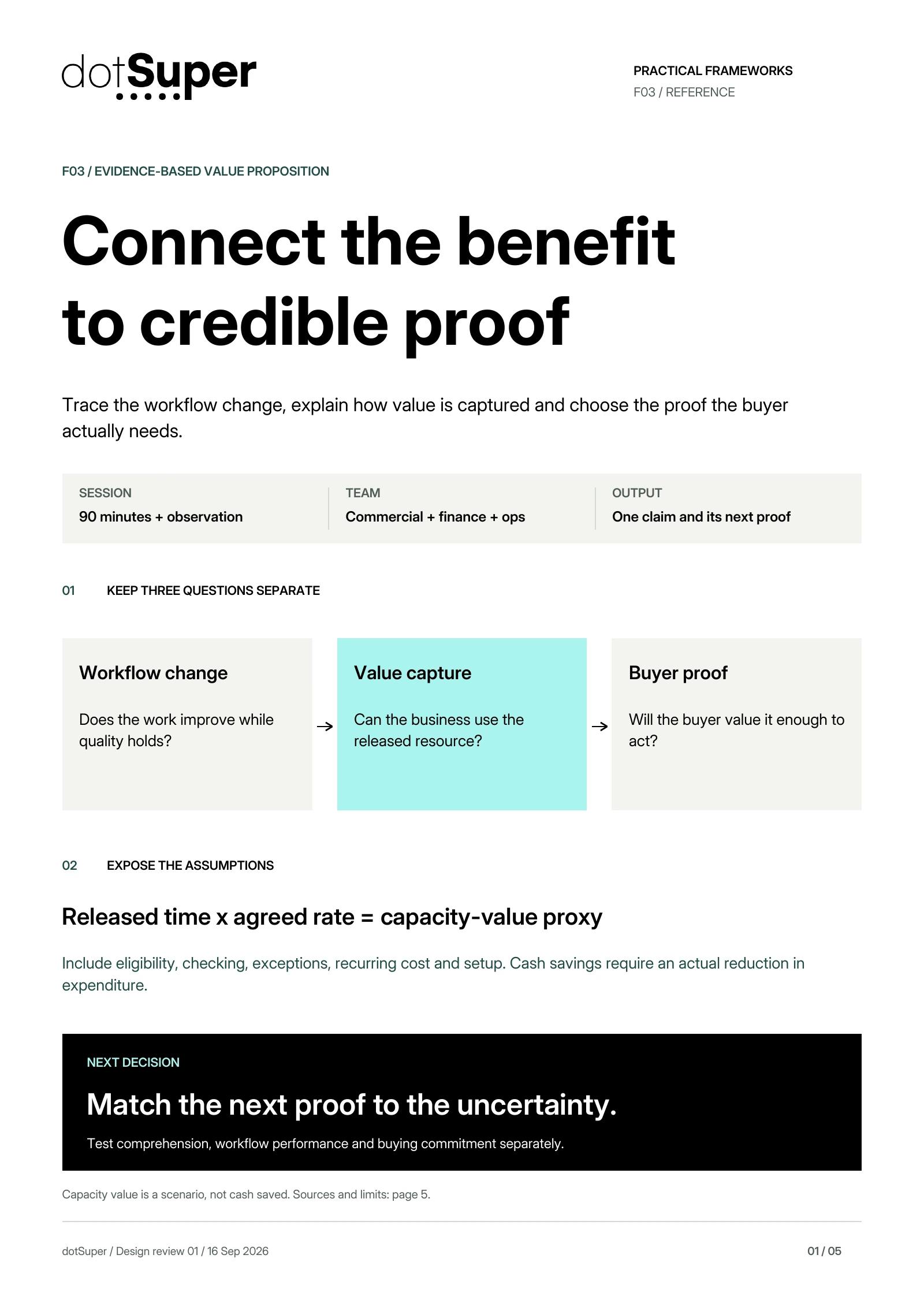
Read the diagram: Evidence-Based Value Proposition. Original dotSuper reference diagram. Customer-value and experimentation concepts are established. The claim chain and decision record are dotSuper synthesis. The copyrighted Value Proposition Canvas is not reproduced.
Evaluate workflow change, value capture and buyer proof separately. Released time multiplied by an agreed rate is a capacity-value proxy. Include eligibility, checking, exceptions, recurring cost and setup. Cash savings require an actual reduction in expenditure. Test comprehension, workflow performance and buying commitment separately.
Original evidence and value-capture ledger, not an adaptation of Strategyzer canvas artwork. Potential capacity value is not cash saved. All numerical examples are hypothetical. The combined method is not validated.
| Measure | 100% eligible | 60% eligible |
|---|---|---|
| Eligible quotations per month | 600 | 360 |
| Potential released capacity | 50 hours | 30 hours |
| Capacity-value proxy | AED 4,500 | AED 2,700 |
| Software/support plus setup allocation | AED 2,250 | AED 2,250 |
| Proxy after listed costs | AED 2,250 | AED 450 |
Take it into your next working session
Keep the source credits with the file. Check the reuse terms and adapt the method to your context.
Reuse: Original dotSuper material. No public reuse licence has been specified. Contact dotSuper for reuse permissions. Third-party source material retains its own terms.
Reuse: Original dotSuper material. No public reuse licence has been specified. Contact dotSuper for reuse permissions. Third-party source material retains its own terms.
Thumbnail credit and reuse
Reuse: Original dotSuper material. No public reuse licence has been specified. Contact dotSuper for reuse permissions. Third-party source material retains its own terms.
Sources, context and limits
Keep the evidence beside the method.
- Original evidence and value-capture ledger, not an adaptation of Strategyzer canvas artwork. Potential capacity value is not cash saved. All numerical examples are hypothetical. The combined method is not validated.
- This combined dotSuper method is research-informed and has not been field validated. Workshop agreement and a completed template are not proof of effectiveness.
- Worked examples are hypothetical. Country examples and intended regional audience do not establish country-wide or region-wide effectiveness.
- Source access and adaptation limits are recorded in the source ledger. Attribution does not imply endorsement or a licence to reproduce third-party artwork.
- original Value Proposition Canvas article
Strategyzer · accessed Sep 16, 2026
- tool usage policy
Strategyzer · accessed Sep 16, 2026
- Learning Card
Strategyzer · accessed Sep 16, 2026
- Lean Startup principles
theleanstartup.com · accessed Sep 16, 2026
- Generative AI at Work
nber.org · accessed Sep 16, 2026
/ CITE OR SHARE THIS GUIDE
Make the evidence easy to verify.
When you reference this guide, link to its canonical URL. That gives readers one stable place for the evidence, limitations and future updates.
dotSuper Research Desk. (September 17, 2026). Connect Your Value Proposition to Evidence and Economics. dotSuper. https://dotsuper.net/feeds/market-intelligence/evidence-based-value-proposition
Bring it into the work
Start with one real decision
Bring one proposed benefit and test the workflow change, economics and evidence behind it.
Download the fillable framework