/ THE SHORT ANSWER
See the method. Keep the context.
The visual companion
Reuse: No public reuse licence has been specified. Source attribution does not grant rights to third-party material.
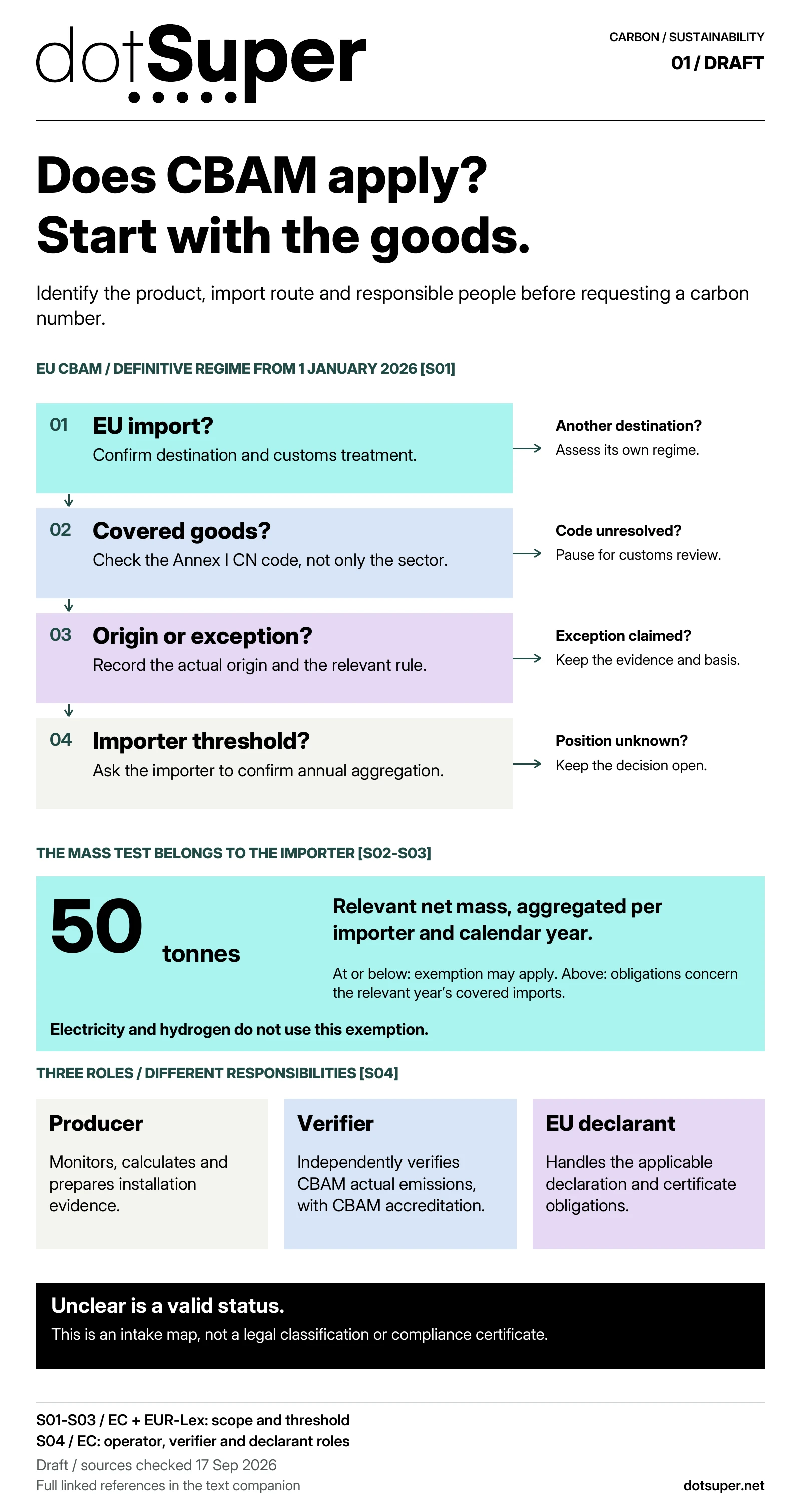
Read the diagram: Related visual guide: Does CBAM apply? Start with the goods. This dotSuper diagram illustrates the surrounding workflow; the article covers the specific topic.
EU CBAM intake map: check EU import scope, Annex I goods classification, origin or exceptions, and the importer’s annual aggregation. The relevant mass exemption is at or below 50 tonnes per importer per calendar year; electricity and hydrogen are excluded. Producer evidence, accredited verification and declarant obligations are separate responsibilities. Unknown answers stay unresolved.
Dated orientation, not a shipment ruling. Unknown classification goes to a qualified customs reviewer. Electricity and hydrogen do not use the 50-tonne exemption.
Does CBAM apply? Start with the goods.
Check EU import scope.
Confirm the Annex I product code.
Review origin and exceptions.
Ask the importer about annual aggregation.
Unknown classification stays unresolved. A qualified customs reviewer makes the classification decision.
50 tonnes. Whose imports?
Aggregate relevant net mass per importer and calendar year.
Do not assess only one factory’s shipments.
Electricity and hydrogen do not use this exemption.
The test is at importer level. The relevant threshold boundary is above 50 tonnes, not 50 tonnes or more.
Three responsibilities. Keep them distinct.
Producer / prepares installation and emissions evidence.
Accredited verifier / independently assesses CBAM actual emissions.
Authorised declarant / handles applicable EU declaration and certificate duties.
Internal review or software checks do not confer accreditation. dotSuper is not presented as an accredited verifier.
| Decision | Evidence to record | Decision or evidence owner |
|---|---|---|
| EU import scope | Destination, customs procedure and relevant import treatment | Importer / customs reviewer |
| Goods and origin | CN classification, product description, origin and exceptions | Qualified customs reviewer with producer input |
| Mass-based exemption | Relevant net mass aggregated per importer and calendar year | EU importer |
| Production evidence | Installation, product, period, method and supporting records | Non-EU installation operator |
| Actual-emissions verification | Required calculation and supporting evidence | Independent CBAM-accredited verifier |
| Declaration and certificates | Applicable EU submissions and certificate obligations | Authorised CBAM declarant |
Take it into your next working session
Keep the source credits with the file. Check the reuse terms and adapt the method to your context.
Credit: Original dotSuper educational content and diagrams.
Reuse: Copyright dotSuper. No new public reuse licence is assigned; third-party sources retain their own terms.
Thumbnail credit and reuse
Reuse: No public reuse licence has been specified. Source attribution does not grant rights to third-party material.
- 01Do not copy an EU assessment into the UK regime.
- 02Separate destination-specific thresholds and roles.
- 03A listed carbon-pricing scheme does not guarantee relief.
/ dotSuper point of view
build one controlled evidence collection layer, then separate the destination-specific rules and outputs. A factory invoice can be collected once. Its use in a legal calculation still needs the correct method.
Start with the real request
If your business supplies both EU and UK customers, it is tempting to build a universal "CBAM pack" and send it everywhere.
Reuse the underlying records where appropriate, but do not assume the same applicability decision, calculation or declaration will work in both places.
The short answer: build one controlled evidence collection layer, then separate the destination-specific rules and outputs.
A factory invoice can be collected once.
Its use in a legal calculation still needs the correct method.
The headline differences
The EU mass threshold is not a blanket exemption for each exporting factory, and electricity/hydrogen need separate treatment.
EU regime, EU exception guidance, HMRC policy summary.
This table is an orientation tool, not a complete applicability assessment.
Keep a dated record of the detailed rule used for each destination.
| Question | EU CBAM | UK CBAM |
|---|---|---|
| When does the relevant regime start? | Definitive regime from 1 January 2026 | Commencement from 1 January 2027 |
| What broad threshold distinction matters? | Mass-based threshold, with relevant exceptions | GBP50,000 value-based registration threshold |
| Who handles the importing-side obligation? | Authorised declarant arrangement | Liable importer under UK rules |
| What is the financial mechanism? | CBAM certificates | CBAM tax returns and payment |
| Can a shared product name settle scope? | No, confirm relevant classification | No, confirm UK commodity-code scope |
Do not confuse start dates with preparation dates
A buyer's procurement deadline is not necessarily the statutory filing deadline.
Conversely, a future filing date does not mean historical production evidence can be reconstructed effortlessly later.
Agree the relevant data period with the importing party and technical adviser.
Build the collection plan around the evidence required, not only the calendar reminder for submitting a form.
Our proposed operating approach is to keep a separate calendar for customer commitments, data collection, technical review and importing-side filing.
The importer remains responsible for its own obligations.
The India CCTS question
The list is based on information as of 19 June and is not exhaustive.
Recognition does not automatically establish the relief available for an individual good.
HMRC explains that the effective price matters and that free allowances, rebates and refunds can affect relief.
HMRC qualifying carbon-pricing schemes.
Do not translate "CCTS is listed" into "buy any carbon credit and avoid UK CBAM."
Ask which eligible price was borne, which goods and emissions it relates to, and what evidence the importing party needs.
The appropriate adviser must resolve the actual relief claim.
For the EU, eligible carbon-price deductions are likewise a distinct question from purchasing voluntary offsets.
Keep the two jurisdictions' legal analyses separate rather than assuming that a UK recognition decision proves the EU outcome.
A fictional exporter with two destinations
Its operations team holds one production dataset.
Sales proposes sending both buyers the same spreadsheet with a different cover page.
Instead, the company creates two request records.
Each identifies the importing entity, destination, period, product classification, requested method and required evidence status.
The same source document can be referenced in both packs, but the calculation and review are routed separately.
When one buyer changes its request, the team can identify the affected output without silently changing the pack already sent to the other buyer.
Questions to ask each importer
Assign the decision to someone with the right role and competence.
- Which legal entity is responsible for the importing-side obligation?
- Which goods and classification are you assessing?
- What production and reporting periods must our data cover?
- Which current template or method should the response follow?
- What independent evidence is required, and at what stage?
- What documentation is needed for any carbon-price-relief analysis?
- Who will approve our final response and handle corrections?
Common mistakes to avoid
A producer's annual sales are not the same as an importer's relevant imports.
An internal sustainability report does not automatically satisfy either regime.
A single emissions number without scope and period is not a reusable universal answer.
These are reasons to organise the workflow, not reasons to panic or buy certificates before establishing the task.
Where dotSuper can help
Customs, tax and verification decisions need appropriate specialists.
Map your destination-specific workflow.
What this page cannot conclude
- 01General educational information, not legal, tax, investment or accredited verification advice. Rules and methods can change.
- 02No independent expert review or customer-specific determination is claimed. Fictional examples are teaching aids, not client results.
- 03Customs/tax reviewer to confirm the comparison against legislation and current implementation before using this comparison for an actual transaction.
- 04The worksheet is an original operating template, not an official form or guarantee of acceptance.
Sources
- 01EU regimeEuropean Commission / European Union · accessed Sep 17, 2026
- 02EU exception guidanceEuropean Commission / European Union · accessed Sep 17, 2026
- 03HMRC policy summaryUK Government · accessed Sep 17, 2026
- 04HMRC qualifying carbon-pricing schemesUK Government · accessed Sep 17, 2026
Our editorial standard · Found an error? Send a correction with its source.
/ CITE OR SHARE THIS GUIDE
Make the evidence easy to verify.
When you reference this guide, link to its canonical URL. That gives readers one stable place for the evidence, limitations and future updates.
dotSuper Research Desk. (September 17, 2026). EU vs UK CBAM: What Exporters Must Separate. dotSuper. https://dotsuper.net/feeds/market-intelligence/eu-vs-uk-cbam-exporter-guide
CBAM Supplier Evidence Workflow
Route an EU CBAM request from product and installation records to a reviewed supplier response.
Open the framework