/ THE SHORT ANSWER
See the method. Keep the context.
The visual companion
Reuse: No public reuse licence has been specified. Source attribution does not grant rights to third-party material.
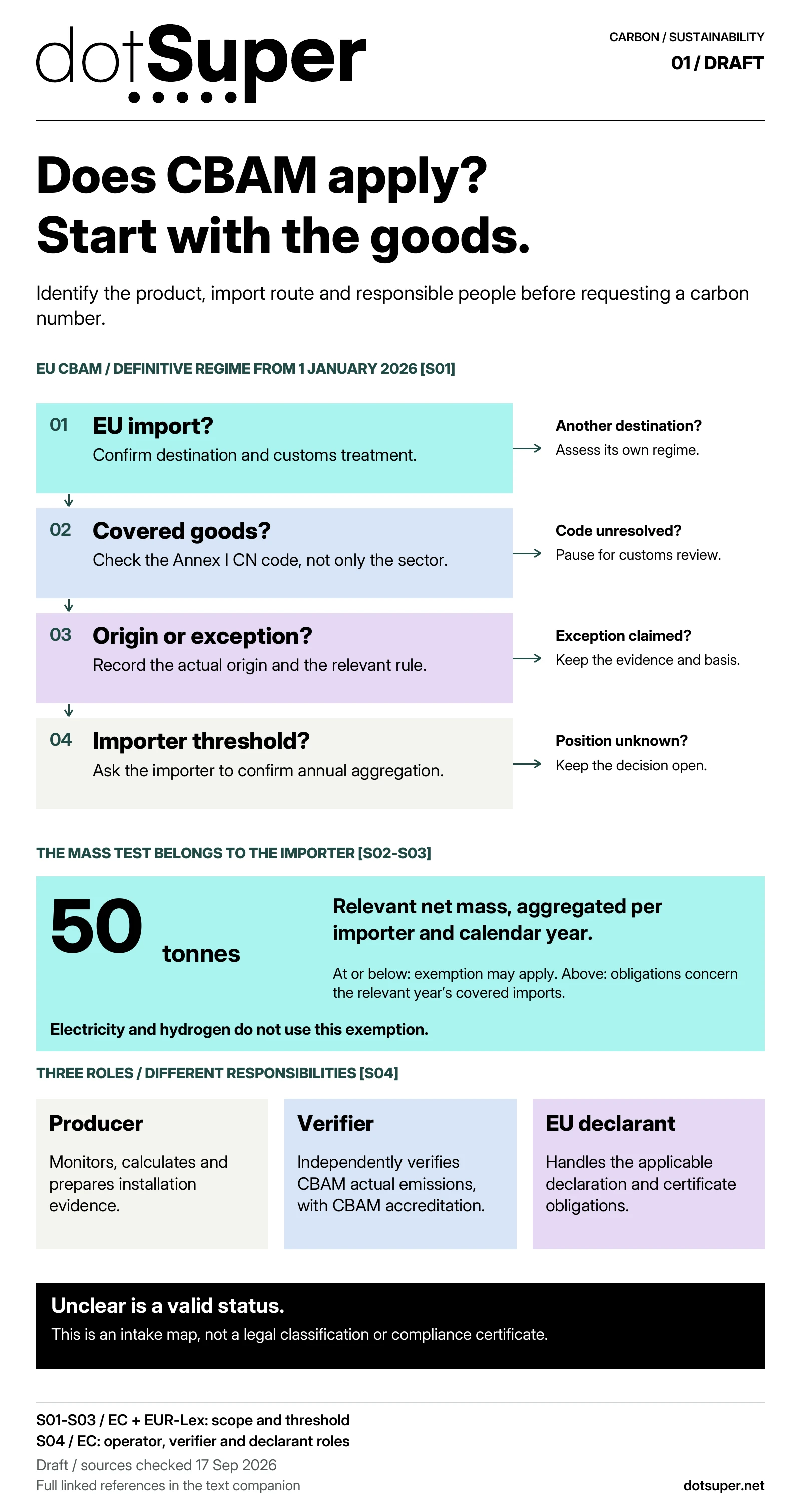
Read the diagram: Related visual guide: Does CBAM apply? Start with the goods. This dotSuper diagram illustrates the surrounding workflow; the article covers the specific topic.
EU CBAM intake map: check EU import scope, Annex I goods classification, origin or exceptions, and the importer’s annual aggregation. The relevant mass exemption is at or below 50 tonnes per importer per calendar year; electricity and hydrogen are excluded. Producer evidence, accredited verification and declarant obligations are separate responsibilities. Unknown answers stay unresolved.
Dated orientation, not a shipment ruling. Unknown classification goes to a qualified customs reviewer. Electricity and hydrogen do not use the 50-tonne exemption.
Does CBAM apply? Start with the goods.
Check EU import scope.
Confirm the Annex I product code.
Review origin and exceptions.
Ask the importer about annual aggregation.
Unknown classification stays unresolved. A qualified customs reviewer makes the classification decision.
50 tonnes. Whose imports?
Aggregate relevant net mass per importer and calendar year.
Do not assess only one factory’s shipments.
Electricity and hydrogen do not use this exemption.
The test is at importer level. The relevant threshold boundary is above 50 tonnes, not 50 tonnes or more.
Three responsibilities. Keep them distinct.
Producer / prepares installation and emissions evidence.
Accredited verifier / independently assesses CBAM actual emissions.
Authorised declarant / handles applicable EU declaration and certificate duties.
Internal review or software checks do not confer accreditation. dotSuper is not presented as an accredited verifier.
| Decision | Evidence to record | Decision or evidence owner |
|---|---|---|
| EU import scope | Destination, customs procedure and relevant import treatment | Importer / customs reviewer |
| Goods and origin | CN classification, product description, origin and exceptions | Qualified customs reviewer with producer input |
| Mass-based exemption | Relevant net mass aggregated per importer and calendar year | EU importer |
| Production evidence | Installation, product, period, method and supporting records | Non-EU installation operator |
| Actual-emissions verification | Required calculation and supporting evidence | Independent CBAM-accredited verifier |
| Declaration and certificates | Applicable EU submissions and certificate obligations | Authorised CBAM declarant |
Take it into your next working session
Keep the source credits with the file. Check the reuse terms and adapt the method to your context.
Credit: Original dotSuper educational content and diagrams.
Reuse: Copyright dotSuper. No new public reuse licence is assigned; third-party sources retain their own terms.
Thumbnail credit and reuse
Reuse: No public reuse licence has been specified. Source attribution does not grant rights to third-party material.
- 01Product classification comes before emissions collection.
- 02The importer owns its relevant annual aggregation.
- 03An unresolved scope question is not an exemption.
/ dotSuper point of view
CBAM applicability is not determined by your factory's size, the presence of metal in a product, or a customer's use of the acronym. Start with the destination regime, the product classification and the responsible importing party.
Start with the real request
Your first instinct may be to forward it to the person who pays the electricity bill.
Pause there.
Before calculating anything, establish what has been imported, where, by whom and under which rules.
A well-built emissions spreadsheet can still answer the wrong question.
The short answer: CBAM applicability is not determined by your factory's size, the presence of metal in a product, or a customer's use of the acronym.
Start with the destination regime, the product classification and the responsible importing party.
What CBAM covers, and what that does not tell you
EU importers or their indirect customs representatives undertake the declarant role.
A sector name is a starting point, not a product-level ruling.
European Commission overview.
That distinction matters to a company making assemblies.
"We use steel" is not equivalent to "every item we sell is a CBAM good."
Equally, "we only manufacture small components" is not evidence of an exemption.
Ask a competent customs specialist to confirm the classification against the applicable goods list.
1. Which destination and regime does the request concern?
A multinational can purchase centrally and move goods into different markets.
EU and UK CBAM need separate treatment.
If a trader sits between you and the destination importer, establish who will receive the data and its intended use.
Your working record should distinguish a confirmed destination from an assumption supplied by sales.
If the final destination is unknown, mark the applicability decision unresolved.
2. What is the actual product classification?
Do not let an AI tool choose the code solely from a catalogue title.
A proposed code should stay proposed until the authorised classification process resolves it.
3. Who is the importer or declarant?
Ask for the entity name, relevant contact and confirmation of the reporting arrangement.
Your factory's job may be to prepare installation and production evidence, not to buy certificates or file the importer's declaration.
4. How is the threshold assessed?
The Commission distinguishes imports above 50 tonnes for the relevant goods from electricity and hydrogen, which do not receive that mass-threshold treatment.
Commission implementation reminder.
Do not infer an importer's position from the volume you supply alone.
They may import relevant goods from other suppliers.
Ask the importing party to confirm its assessment, and record who made the decision and when.
5. What evidence is being requested now?
A commercial deadline can arrive before a statutory filing deadline.
Clarifying the request early gives your production and procurement teams a realistic collection plan.
A fictional example: the 12-tonne shortcut
Its sales manager proposes replying, "We are under 50 tonnes, so CBAM does not apply."
That reply jumps over product classification and the importer's total relevant imports.
A stronger response is: "Please confirm the importing entity, your applicability assessment and the production-data requirements for these goods.
We will coordinate the supporting information for our installation."
This does not establish that the shipment is in scope.
It keeps an unresolved question from becoming an unsupported exemption claim.
Use three outcomes, not a misleading yes/no badge
Give each outcome a date, a named decision owner and a trigger for reconsideration, such as a product change or new destination.
| Working outcome | Evidence needed | Next action |
|---|---|---|
| Relevant requirements identified | Confirmed product/destination/party assessment | Define the data pack and owners |
| Outside the assessed scope | Documented basis and reviewer | Retain the reasoning and revisit if facts change |
| Not yet resolved | Missing classification, destination or importer information | Escalate the gap before making a claim |
What to do this week
Put the product, destination, importer, classification evidence and unanswered questions on a single intake sheet.
Assign commercial clarification to sales, product information to engineering or quality, and classification questions to the appropriate customs specialist.
Only then ask the plant to collect data.
Otherwise, you risk collecting an impressive amount of information that nobody can confidently use.
Two common questions
No blanket conclusion follows from that label.
Legal applicability and a customer's commercial information request are separate questions.
Can we call ourselves CBAM compliant after completing this checklist?
No.
An intake sheet helps identify the task.
It does not replace the relevant calculations, controls, reporting or independent work.
Where dotSuper can help
We can discuss how to map the information flow, identify missing evidence and build a controlled response workflow.
Classification and regulatory determinations need appropriate specialist input.
Discuss your workflow with dotSuper.
What this page cannot conclude
- 01General educational information, not legal, tax, investment or accredited verification advice. Rules and methods can change.
- 02No independent expert review or customer-specific determination is claimed. Fictional examples are teaching aids, not client results.
- 03Customs specialist to confirm classification, exceptions and importer aggregation for any worked customer example.
- 04The worksheet is an original operating template, not an official form or guarantee of acceptance.
Sources
- 01European Commission overviewEuropean Commission / European Union · accessed Sep 17, 2026
- 02Commission implementation reminderEuropean Commission / European Union · accessed Sep 17, 2026
Our editorial standard · Found an error? Send a correction with its source.
/ CITE OR SHARE THIS GUIDE
Make the evidence easy to verify.
When you reference this guide, link to its canonical URL. That gives readers one stable place for the evidence, limitations and future updates.
dotSuper Research Desk. (September 17, 2026). Does CBAM Apply to Your Exports?. dotSuper. https://dotsuper.net/feeds/market-intelligence/does-cbam-apply-to-your-exports
CBAM Supplier Evidence Workflow
Route an EU CBAM request from product and installation records to a reviewed supplier response.
Open the framework