Carbon and sustainability / CBAM
CBAM Supplier Evidence Workflow
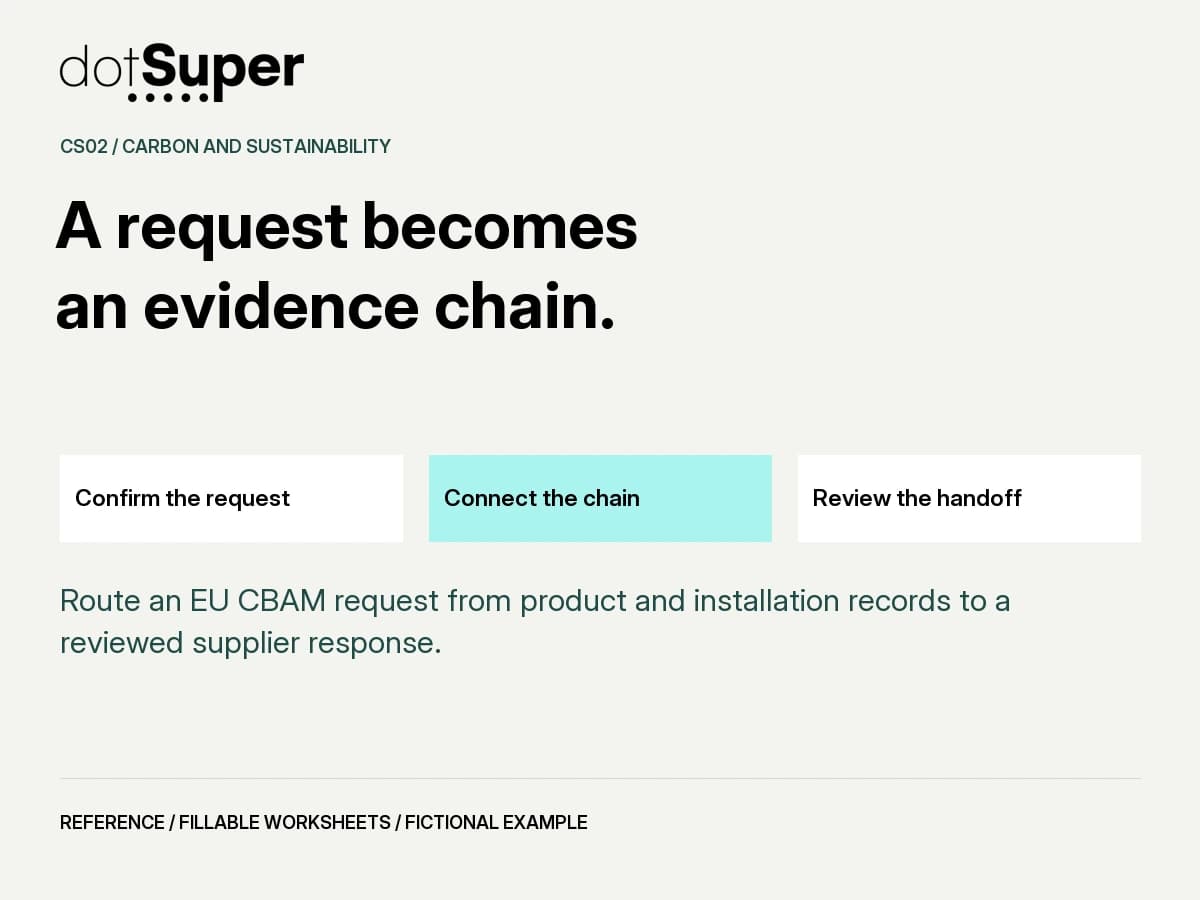
Route an EU CBAM request from product and installation records to a reviewed supplier response.
The method, in brief
How can your team use the cbam supplier evidence workflow?
Route an EU CBAM request from product and installation records to a reviewed supplier response. Versioned supplier response plan
Start with the decision
Route an EU CBAM request from product and installation records to a reviewed supplier response.
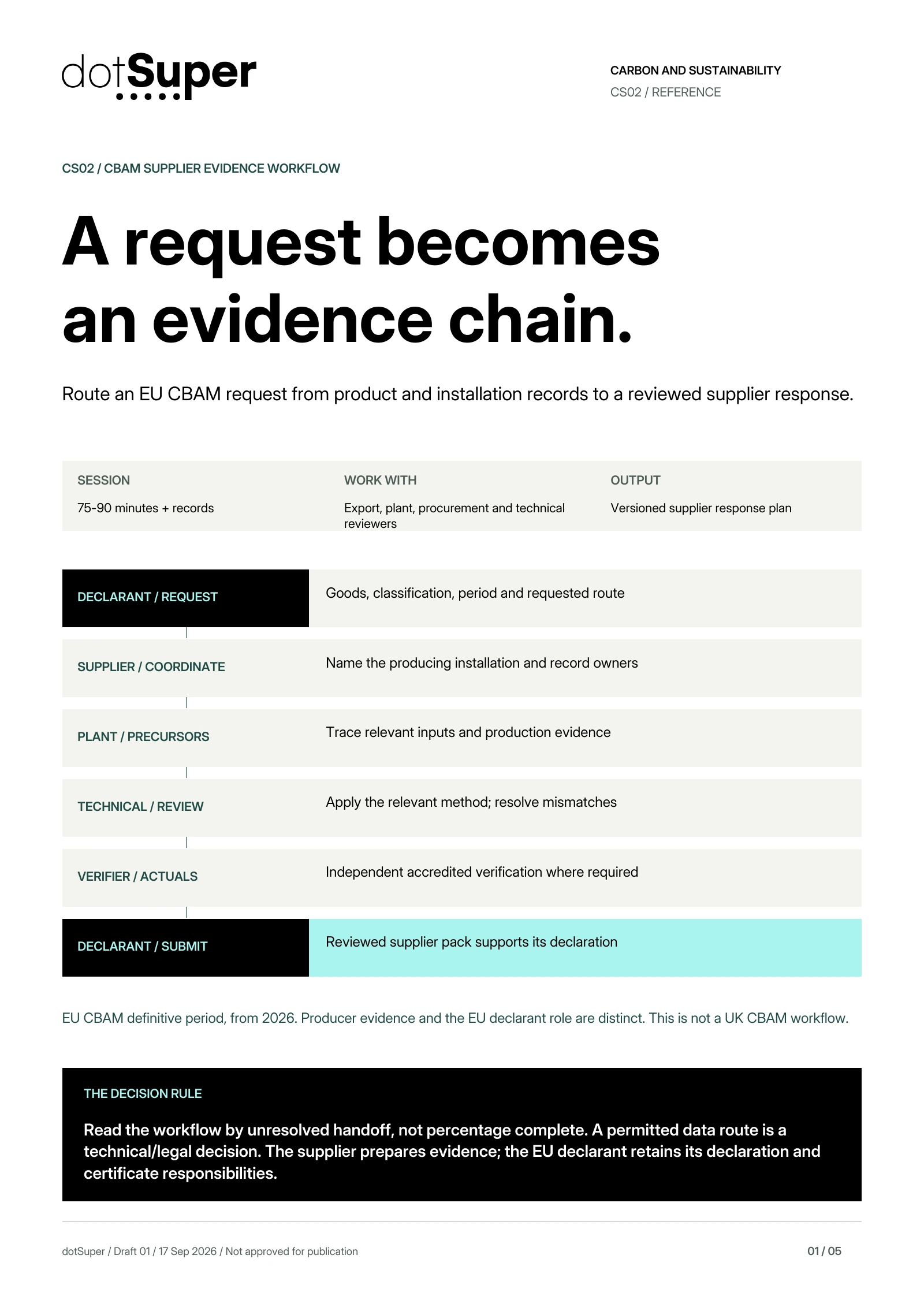
EU CBAM definitive period, from 2026. Producer evidence and the EU declarant role are distinct. This is not a UK CBAM workflow.
Versioned supplier response plan
Why the evidence comes first
Read the workflow by unresolved handoff, not percentage complete. A permitted data route is a technical/legal decision. The supplier prepares evidence; the EU declarant retains its declaration and certificate responsibilities.
- A trader invoice may not identify the producing installation or prove embedded emissions.
- Mixing periods, products or methods can break an otherwise well-documented handoff.
- A supplier response supports the EU declarant. It is not the declaration itself.
1. Triage applicability questions
Record destination, product/CN classification owner, importer/declarant and reporting period. Do not decide importer aggregation from your shipments alone.
2. Agree the requested data route
Ask what actual/default information is needed under the applicable method. Record the technical reviewer and exact guidance version.
3. Map the record chain
Link finished goods, installation, production process and relevant purchased precursors. Keep country, supplier and period identifiers.
4. Resolve and review
Log missing sources, inconsistent units and allocation questions. Where actuals are used, plan the required independent verification.
5. Release and retain
Share only an authorised version with its limitations, evidence index and review status. Keep revisions and recipient acknowledgement.
Worksheet 1: Who requested what, for which goods?
Record recipient, EU declarant contact, destination, product ID, requested period and request version.
Example response: Fictional EU buyer asks Meridian Fasteners for evidence on one screw product.
Record unresolved answers explicitly, with an owner and next action. Do not invent a value to complete the form.
Worksheet 2: Who resolves applicability?
Record CN classification evidence, scope questions and the declarant/customs reviewer. Do not self-certify exemption.
Example response: Classification is pending with the importer's customs specialist.
Record unresolved answers explicitly, with an owner and next action. Do not invent a value to complete the form.
Worksheet 3: Where were the goods produced?
Record operator, installation, process, location and contact. Distinguish trader from producer.
Example response: Meridian plant P1; rod supplier is a trader and must identify the steel installation.
Record unresolved answers explicitly, with an owner and next action. Do not invent a value to complete the form.
Worksheet 4: Which data route and method apply?
Name actual/default route under review, method version, relevant boundary and technical owner.
Example response: Actual route considered; technical reviewer has not accepted the evidence yet.
Record unresolved answers explicitly, with an owner and next action. Do not invent a value to complete the form.
Worksheet 5: Can the relevant inputs be traced?
Link product/batch, production period, precursor supplier/installation, unit and source IDs.
Example response: Batch B-17 links to rod lot R-8; installation identifier is missing.
Record unresolved answers explicitly, with an owner and next action. Do not invent a value to complete the form.
Worksheet 6: What supports the calculation inputs?
Record monitoring/production evidence, source coverage, conversions and allocation decisions. No invented factors.
Example response: Production ledger exists; precursor evidence period does not match the requested period.
Record unresolved answers explicitly, with an owner and next action. Do not invent a value to complete the form.
Worksheet 7: Are role and scope questions resolved?
If classification, declarant role or applicable period is unresolved, hold the final CBAM answer.
Example response: HOLD until customs and technical reviewers confirm the scope.
Record unresolved answers explicitly, with an owner and next action. Do not invent a value to complete the form.
Worksheet 8: Is the evidence chain coherent?
Record missing links, inconsistencies and their resolution. Quantity invoices alone are not verified emissions data.
Example response: HOLD: trader invoice does not establish the producing installation or emissions.
Record unresolved answers explicitly, with an owner and next action. Do not invent a value to complete the form.
Worksheet 9: Is verification status appropriate?
For actual emissions, record the independent accredited verifier and report status. Check applicability and accepted route.
Example response: Not verified. Do not describe the response as verified actual emissions.
Record unresolved answers explicitly, with an owner and next action. Do not invent a value to complete the form.
Worksheet 10: Who will resolve each exception?
Record issue ID, action, owner and date. Escalate possible default treatment to the technical/declarant team.
Example response: E-03: procurement requests installation evidence; technical reviewer decides the route.
Record unresolved answers explicitly, with an owner and next action. Do not invent a value to complete the form.
Worksheet 11: What version can be handed over?
Name reviewer, recipient, document index, limitations and release status. The EU declarant owns its submission.
Example response: Send a gap list for clarification; hold the final actual-emissions response.
Record unresolved answers explicitly, with an owner and next action. Do not invent a value to complete the form.
Worksheet 12: What triggers withdrawal or revision?
Record changed source, product, method or period; notify recipients through an owned process.
Example response: A corrected precursor file reopens calculation, review and affected communication.
Record unresolved answers explicitly, with an owner and next action. Do not invent a value to complete the form.
Use decision gates, not a confidence badge
These gates control the next action. They do not determine legal compliance, verified emissions or entitlement to credits.
| Condition | Next action |
|---|---|
| Classification, role or scope unresolved | HOLD final applicability answer; refer to customs/declarant specialist. |
| Installation, precursor or period link missing | HOLD unsupported actual-data claim; obtain records or review the permitted route. |
| Actual emissions lack required verification | HOLD verified-actuals label; engage an appropriately accredited independent verifier. |
| Method, allocation or exception uncertain | ESCALATE to the technical reviewer; no AI guess or silent substitution. |
One missing installation breaks the chain.
Fictional Meridian Fasteners buys steel rods through a trader and supplies screws to an EU customer. Its invoice links the rod lot to production, but it does not identify the steel-producing installation. The example uses no official emissions figures.
Working decision: HOLD THE FINAL ACTUAL-DATA RESPONSE
The team can respond promptly with an owned evidence-gap list. The technical reviewer and declarant decide how to resolve the request; the diagram does not grant an exemption.
Original fictional record flow, informed by the topic in Commission steel guidance. It is not a copied official example or an official supplier form.
| Chain link | What the team can establish |
|---|---|
| Finished product > rod lot | Internal batch records support the relationship. |
| Rod lot > producing installation | Missing. Procurement requests the upstream record. |
| Installation > appropriate emissions evidence | Unresolved until source and period are reviewed. |
| Evidence > final supplier response | Hold the verified-actuals claim; agree the next data route. |
Use the worksheet with your team
Download the five-page PDF to work through the canvas. The CSV provides a working-log structure. Keep a controlled copy, identify the reviewer and record version changes.
This webpage is a readable guide, not an automated assessment. The PDF contains form fields; compatibility has not been independently tested across PDF readers.
See the method. Keep the context.
The visual companion
Credit: Original dotSuper educational content and diagrams.
Reuse: Copyright dotSuper. No new public reuse licence is assigned; third-party sources retain their own terms.
Read the diagram: CBAM Supplier Evidence Workflow. Original dotSuper decision aid, with the full method below.
Route an EU CBAM request from product and installation records to a reviewed supplier response.
DECLARANT / REQUEST: Goods, classification, period and requested route
SUPPLIER / COORDINATE: Name the producing installation and record owners
PLANT / PRECURSORS: Trace relevant inputs and production evidence
TECHNICAL / REVIEW: Apply the relevant method; resolve mismatches
VERIFIER / ACTUALS: Independent accredited verification where required
DECLARANT / SUBMIT: Reviewed supplier pack supports its declaration
Original dotSuper coordination worksheet, not legal advice, an official CBAM form or verification. No goods classification, exemption, liability calculation or certificate deduction is determined. Carbon credits are not CBAM certificates.
Take it into your next working session
Keep the source credits with the file. Check the reuse terms and adapt the method to your context.
Credit: Original dotSuper educational content and diagrams.
Reuse: Copyright dotSuper. No new public reuse licence is assigned; third-party sources retain their own terms.
Credit: Original dotSuper educational content and diagrams.
Reuse: Copyright dotSuper. No new public reuse licence is assigned; third-party sources retain their own terms.
Thumbnail credit and reuse
Credit: Original dotSuper educational content and diagrams.
Reuse: Copyright dotSuper. No new public reuse licence is assigned; third-party sources retain their own terms.
Sources, context and limits
Keep the evidence beside the method.
- Original dotSuper coordination worksheet, not legal advice, an official CBAM form or verification. No goods classification, exemption, liability calculation or certificate deduction is determined. Carbon credits are not CBAM certificates.
- Review against applicable legislation, product code, period and latest guidance before publication.
- A CBAM technical reviewer must confirm method, precursors, allocations and any default-value treatment.
- Independent accredited verification remains separate from dotSuper workflow support.
- No independent expert sign-off, assurance or customer-specific compliance determination is claimed. Geographic tags identify readers, not legal applicability.
- eu: CBAM definitive regime
European Commission, DG TAXUD · accessed Sep 17, 2026
- verification: Verification of CBAM emissions
European Commission, DG TAXUD · accessed Sep 17, 2026
- eu_library: CBAM legislation and guidance
European Commission, DG TAXUD · accessed Sep 17, 2026
- steel: Guidance No. 5d: Iron and steel
European Commission, DG TAXUD · accessed Sep 17, 2026
/ CITE OR SHARE THIS GUIDE
Make the evidence easy to verify.
When you reference this guide, link to its canonical URL. That gives readers one stable place for the evidence, limitations and future updates.
dotSuper Research Desk. (September 17, 2026). CBAM Supplier Evidence Workflow. dotSuper. https://dotsuper.net/feeds/applied-systems/cbam-supplier-evidence-workflow
Bring it into the work
Start with one real carbon-data request
Bring your buyer request and sample records. Discuss how dotSuper can help organise evidence, owners and review workflows. Specialist accounting, legal decisions and independent verification remain separate.
Discuss your workflow