/ THE SHORT ANSWER
See the method. Keep the context.
The visual companion
Reuse: No public reuse licence has been specified. Source attribution does not grant rights to third-party material.
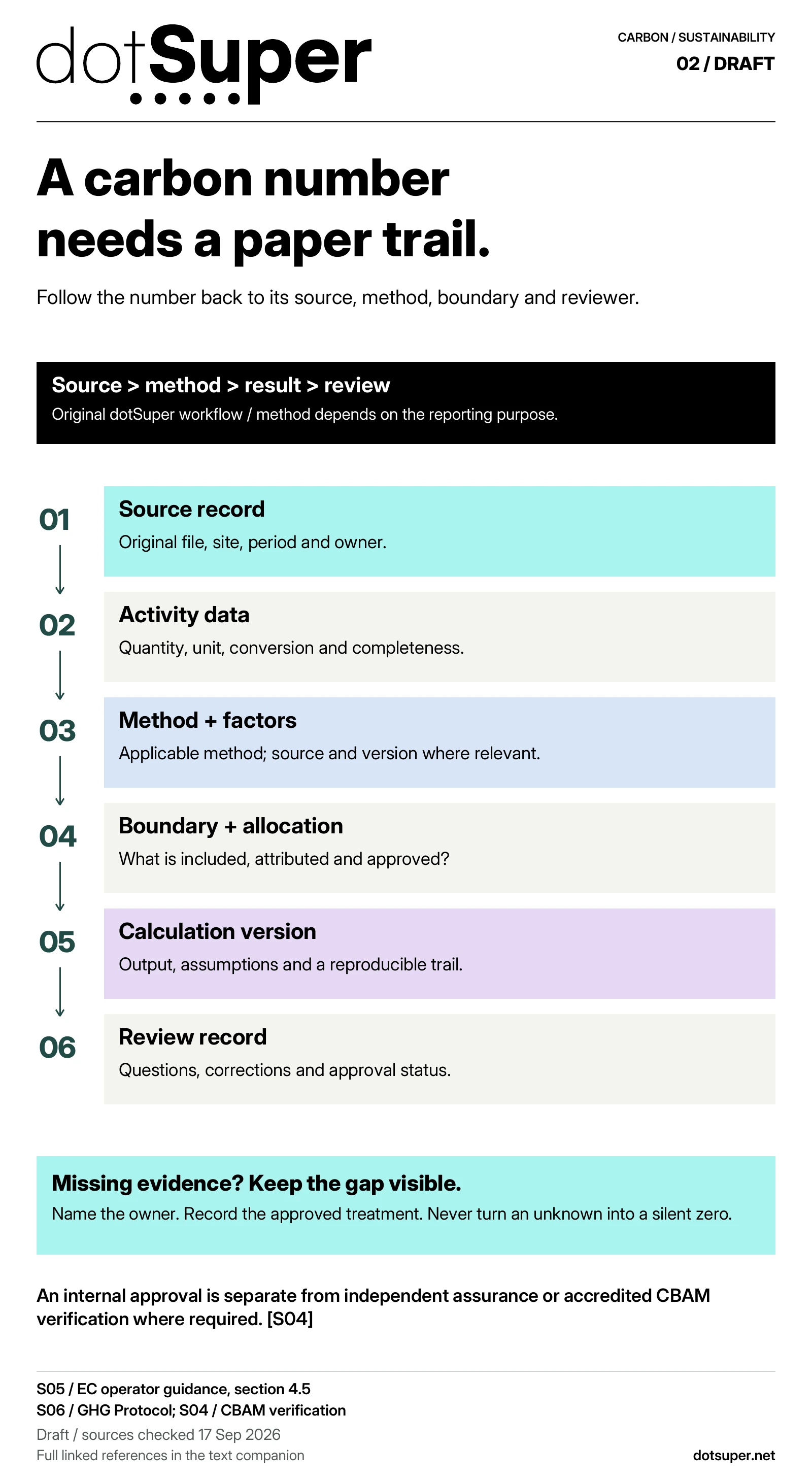
Read the diagram: Related visual guide: A carbon number needs a paper trail. This dotSuper diagram illustrates the surrounding workflow; the article covers the specific topic.
A six-stage carbon evidence chain connects the source record, activity data, method and factors, boundary and allocation, calculation version, and review record. Missing evidence is assigned an owner and remains visible. Internal approval is separate from independent assurance or accredited CBAM verification where required.
Original dotSuper workflow. The applicable accounting method determines the records needed. Internal review does not replace independent assurance or CBAM verification.
Start with the record. Keep the original.
Source / file, site, period and owner.
Activity / quantity, unit and any conversion.
Method / applicable rule, factor source and version.
If evidence is missing, label the gap and name its owner. Do not silently invent a value.
Make the result reproducible.
Boundary / what belongs in the calculation?
Allocation / what basis assigns emissions?
Calculation / which version and assumptions?
The specialist approves the applicable method. A corporate total is not automatically a CBAM product result.
A reviewer needs more than a total.
Trace the source and calculation.
Record questions and corrections.
Keep approval and external-review states separate.
Internal sign-off does not replace independent assurance or accredited CBAM verification where required.
| Stage | Retain | Review question |
|---|---|---|
| 1. Source | Original record, site, period, owner and stable reference | Can we find the underlying evidence? |
| 2. Activity data | Quantity, original unit, conversions and gaps | Does the value describe the correct activity? |
| 3. Method | Applicable rule; factor source, units and version where relevant | Who approved the method and factor? |
| 4. Boundary / allocation | Reporting boundary, allocation basis and rationale | Does the attribution match the intended purpose? |
| 5. Calculation | Version, output and unresolved assumptions | Can another person reproduce the result? |
| 6. Review | Reviewer, corrections, decision and external-review status | What was checked, and what remains open? |
Take it into your next working session
Keep the source credits with the file. Check the reuse terms and adapt the method to your context.
Credit: Original dotSuper educational content and diagrams.
Reuse: Copyright dotSuper. No new public reuse licence is assigned; third-party sources retain their own terms.
Thumbnail credit and reuse
Reuse: No public reuse licence has been specified. Source attribution does not grant rights to third-party material.
- 01Connect installation, output and precursor evidence.
- 02Keep units, periods and methods visible.
- 03Separate internal review from independent verification.
/ dotSuper point of view
organise records around a traceable evidence chain. Keep the original source, the interpretation, the calculation and the approved output connected. The checklist below is a proposed operating structure, not a replacement for an official template.
Start with the real request
Neither is a spreadsheet whose most important number came from a message nobody can find.
The useful question is simple: if a reviewer points to a number, can your team explain where it came from, what it covers and who approved it?
The short answer: organise records around a traceable evidence chain.
Keep the original source, the interpretation, the calculation and the approved output connected.
The checklist below is a proposed operating structure, not a replacement for an official template.
Start with the right version of the rules
An old transitional workbook should not be assumed suitable for a new reporting use case.
Record the method and version your specialist has selected.
Commission legislation and guidance library.
Do not redesign the entire company archive on day one.
Start with one installation, one product family and one specific request.
Make the evidence chain work before expanding it.
The eight parts of a useful evidence pack
Your specialist must determine the relevant boundary.
Collecting electricity data for a broader corporate inventory, for example, does not automatically make it an input to every product's CBAM calculation.
| Part | What to organise | Suggested owner |
|---|---|---|
| Request and scope | Customer request, intended use, goods, period and reporting assumptions | Export/compliance lead |
| Installation identity | Producing site, entity, contact and relevant process description | Plant management |
| Production records | Output quantities, units, routes and links to the relevant products | Production/quality |
| Activity records | Relevant measurements, fuel/process records and source documents | Engineering and operations |
| Purchased inputs | Supplier, producing installation where needed, material and precursor evidence | Procurement |
| Methods | Approved factors, conversions, boundaries and attribution rules | Technical specialist |
| Calculations and exceptions | Versioned workings, gaps, estimates and corrective actions | Assigned preparer |
| Review and release | Approvals, recipient, output version and independent reports where applicable | Accountable business owner |
Make each record understandable without its author
A production report may use kilograms while the output table expects tonnes.
A supplier's document may relate to last year's production rather than the period requested.
Our recommended record fields are: unique ID, entity, site, period, activity, quantity, unit, evidence location, method/version, preparer, reviewer and status.
Add product/process and supplier identifiers where relevant.
Preserve the original unit alongside any converted value.
Do not overwrite the original when correcting an extraction error.
Keep the correction and its reason linked to the source.
Otherwise, the team cannot distinguish a better calculation from an unexplained change.
Treat missing information as a work item
Give each gap an owner, consequence, due date and permitted next step.
A permitted default or estimate must be identifiable as such.
It must not be labelled measured or verified simply because it appears in a completed workbook.
| Gap | Poor response | Better control |
|---|---|---|
| Supplier cannot provide relevant data | Copy another supplier's number | Log the absence and obtain a method-specific decision |
| Document covers the wrong period | Change the heading | Preserve the period and request appropriate evidence |
| Meter record conflicts with invoice | Choose the lower figure | Reconcile the difference and document the decision |
| Factor source is unknown | Keep it because the workbook runs | Hold that calculation until the factor is reviewed |
A fictional factory handoff
Finance has a summary, but nobody can reconstruct its inputs.
The first improvement is not a new dashboard.
The team chooses a single product and reporting period, assigns evidence IDs and records the location of each original file.
The preparer documents each transformation.
A reviewer resolves discrepancies before the customer-facing output is released.
The result is a repeatable handoff, not a claim that the factory is automatically compliant.
The same collection layer may support several reporting purposes, but the calculations and approvals remain purpose-specific.
Prepare for independent work without imitating it
An internal quality check or an AI review is not that verification.
Organise the material so the appropriate verifier can follow it, and keep questions and corrections in a controlled issue log.
Commission verification guidance.
Set retention and access rules for the applicable obligations and roles.
Do not apply a single generic retention period to every supplier record, personal contact detail and regulatory document.
Share only what the intended recipient needs.
Your first working session
Choose a real number in a current customer request.
Trace it backwards to its records, then forward through the method and approval.
Every break in that chain becomes a concrete improvement task.
A productive session ends with named owners and unresolved questions, not an optimistic percentage-complete badge.
Where dotSuper can help
Technical methodology and independent verification remain separate specialist responsibilities.
Map your documentation workflow.
What this page cannot conclude
- 01General educational information, not legal, tax, investment or accredited verification advice. Rules and methods can change.
- 02No independent expert review or customer-specific determination is claimed. Fictional examples are teaching aids, not client results.
- 03Technical reviewer to tailor record requirements and retention to the installation, goods, method and role.
- 04The worksheet is an original operating template, not an official form or guarantee of acceptance.
Sources
- 01Commission legislation and guidance libraryEuropean Commission / European Union · accessed Sep 17, 2026
- 02Commission verification guidanceEuropean Commission / European Union · accessed Sep 17, 2026
Our editorial standard · Found an error? Send a correction with its source.
/ CITE OR SHARE THIS GUIDE
Make the evidence easy to verify.
When you reference this guide, link to its canonical URL. That gives readers one stable place for the evidence, limitations and future updates.
dotSuper Research Desk. (September 17, 2026). CBAM Documents: A Factory Checklist. dotSuper. https://dotsuper.net/feeds/applied-systems/cbam-documents-factory-checklist
CBAM Supplier Evidence Workflow
Route an EU CBAM request from product and installation records to a reviewed supplier response.
Open the framework