/ THE SHORT ANSWER
See the method. Keep the context.
The visual companion
Reuse: No public reuse licence has been specified. Source attribution does not grant rights to third-party material.
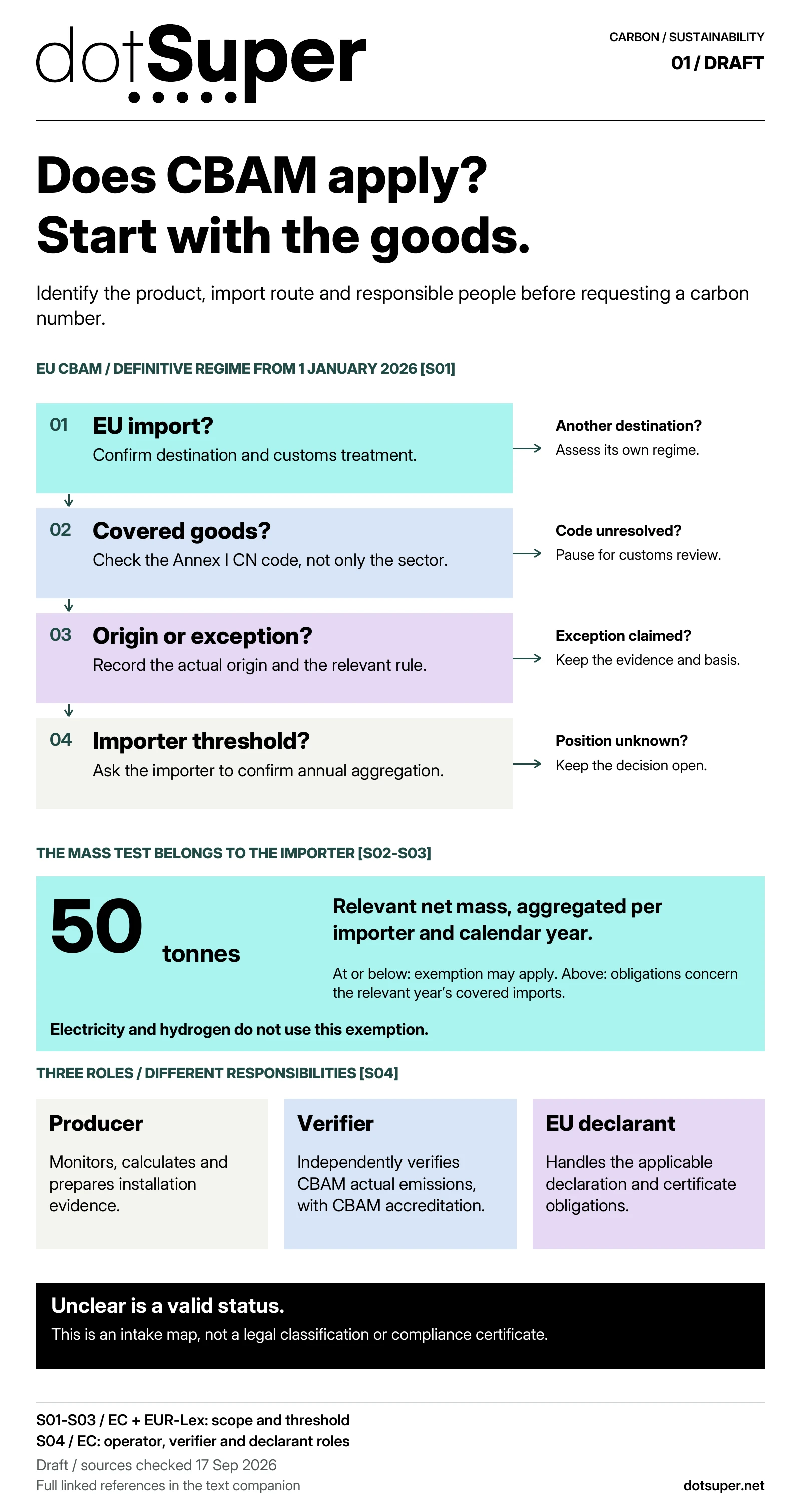
Read the diagram: Identify the product, import route and responsible people before requesting a carbon number.
EU CBAM intake map: check EU import scope, Annex I goods classification, origin or exceptions, and the importer’s annual aggregation. The relevant mass exemption is at or below 50 tonnes per importer per calendar year; electricity and hydrogen are excluded. Producer evidence, accredited verification and declarant obligations are separate responsibilities. Unknown answers stay unresolved.
Dated orientation, not a shipment ruling. Unknown classification goes to a qualified customs reviewer. Electricity and hydrogen do not use the 50-tonne exemption.
Does CBAM apply? Start with the goods.
Check EU import scope.
Confirm the Annex I product code.
Review origin and exceptions.
Ask the importer about annual aggregation.
Unknown classification stays unresolved. A qualified customs reviewer makes the classification decision.
50 tonnes. Whose imports?
Aggregate relevant net mass per importer and calendar year.
Do not assess only one factory’s shipments.
Electricity and hydrogen do not use this exemption.
The test is at importer level. The relevant threshold boundary is above 50 tonnes, not 50 tonnes or more.
Three responsibilities. Keep them distinct.
Producer / prepares installation and emissions evidence.
Accredited verifier / independently assesses CBAM actual emissions.
Authorised declarant / handles applicable EU declaration and certificate duties.
Internal review or software checks do not confer accreditation. dotSuper is not presented as an accredited verifier.
| Decision | Evidence to record | Decision or evidence owner |
|---|---|---|
| EU import scope | Destination, customs procedure and relevant import treatment | Importer / customs reviewer |
| Goods and origin | CN classification, product description, origin and exceptions | Qualified customs reviewer with producer input |
| Mass-based exemption | Relevant net mass aggregated per importer and calendar year | EU importer |
| Production evidence | Installation, product, period, method and supporting records | Non-EU installation operator |
| Actual-emissions verification | Required calculation and supporting evidence | Independent CBAM-accredited verifier |
| Declaration and certificates | Applicable EU submissions and certificate obligations | Authorised CBAM declarant |
Take it into your next working session
Keep the source credits with the file. Check the reuse terms and adapt the method to your context.
Reuse: No public reuse licence has been specified. Source attribution does not grant rights to third-party material.
Reuse: No public reuse licence has been specified. Source attribution does not grant rights to third-party material.
Reuse: No public reuse licence has been specified. Source attribution does not grant rights to third-party material.
Reuse: No public reuse licence has been specified. Source attribution does not grant rights to third-party material.
Thumbnail credit and reuse
Reuse: No public reuse licence has been specified. Source attribution does not grant rights to third-party material.
- 01Annex I classification comes before a sector label.
- 02The mass test belongs to the importer and calendar year.
- 03Evidence preparation, independent verification and declaration are separate roles.
/ dotSuper point of view
Check EU import scope, the goods classification, origin and exceptions, then the importer-level threshold. The producer prepares emissions evidence; the authorised declarant handles the applicable EU declaration and certificate duties.
Begin with the import, not the company label
It covers selected goods within cement, iron and steel, aluminium, fertilisers, electricity and hydrogen.
A business using steel is not automatically exporting a covered good.
Start with the actual product and its Combined Nomenclature classification.
[S01]
Our intake sequence is an operating aid: identify the destination and customs treatment; record the product code and description; establish origin and relevant exceptions; identify the importer and the applicable threshold assessment.
An unresolved answer stays unresolved.
A familiar product name or AI-generated code does not settle classification.
Record the source and reviewer beside the decision.
Retain the product specification and the version of the classification advice used.
When the product, processing route or destination changes, return to the intake decision rather than carrying forward an earlier answer.
Use the right denominator for the threshold
At or below the threshold, the de minimis exemption may apply; above it, obligations concern the relevant year’s imports, not only the excess.
Electricity and hydrogen are excluded from this exemption.
[S02, S03]
A producer may know its own shipments but cannot infer what the same EU importer bought from other suppliers.
Ask the importer to own and confirm the aggregation.
Separate this evidence request from any promise that a small factory is exempt.
The graphic intentionally provides an unresolved branch.
If code, origin, procedure or annual aggregation is missing, collect the missing evidence and obtain a qualified decision before marking the route in or out of scope.
Put responsibility beside the evidence
A CBAM-accredited independent verifier assesses the actual-emissions evidence.
The authorised CBAM declarant uses the information for its EU obligations.
[S04]
A trader can coordinate documents without becoming the installation operator.
Keep the manufacturing installation identifiable through the chain.
An internal review, buyer acceptance or software check is not the same event as accredited verification.
dotSuper’s proposed role is to organise source records, ownership and review queues. dotSuper is not presented as an accredited verifier, customs adviser or authorised declarant.
One useful next move
Attach the product description, proposed classification, destination, producer installation, reporting period and importer contact.
Mark each field as evidenced, awaiting confirmation or unresolved, and name who can resolve it.
Keep EU and UK assessments separate.
This graphic concerns EU CBAM only.
No import liability, certificate amount, product footprint or compliance result has been calculated.
Who this guide is for
What this page cannot conclude
- 01Dated orientation, not a shipment ruling. Unknown classification goes to a qualified customs reviewer. Electricity and hydrogen do not use the 50-tonne exemption.
- 02Confirm current CN classification, origin, customs procedure and applicable exceptions with a qualified reviewer.
- 03Confirm the EU importer’s aggregated calendar-year position; one exporter’s shipment log is insufficient.
- 04Source review used official indexed legislative text and Commission guidance. Direct EUR-Lex retrieval was challenged, so this is not a complete direct-document legal review. Confirm current law and facts with a qualified reviewer before operational reliance.
Sources
- 01S01: CBAM definitive regimeEuropean Commission · accessed Sep 17, 2026
- 02S02: Regulation (EU) 2023/956, consolidated 20 October 2025EUR-Lex / European Union · accessed Sep 17, 2026
- 03S03: CBAM Compliance Essentials for Importers and Indirect Customs Representatives as from 1 January 2026European Commission · accessed Sep 17, 2026
- 04S04: Verification of CBAM emissionsEuropean Commission · accessed Sep 17, 2026
- 05S12: CBAM legislation and guidanceEuropean Commission · accessed Sep 17, 2026
Our editorial standard · Found an error? Send a correction with its source.
/ CITE OR SHARE THIS GUIDE
Make the evidence easy to verify.
When you reference this guide, link to its canonical URL. That gives readers one stable place for the evidence, limitations and future updates.
dotSuper Research Desk. (September 17, 2026). Does CBAM apply? Start with the goods.. dotSuper. https://dotsuper.net/feeds/market-intelligence/cbam-applicability-and-roles