/ THE SHORT ANSWER
See the method. Keep the context.
The visual companion
Reuse: No public reuse licence has been specified. Source attribution does not grant rights to third-party material.
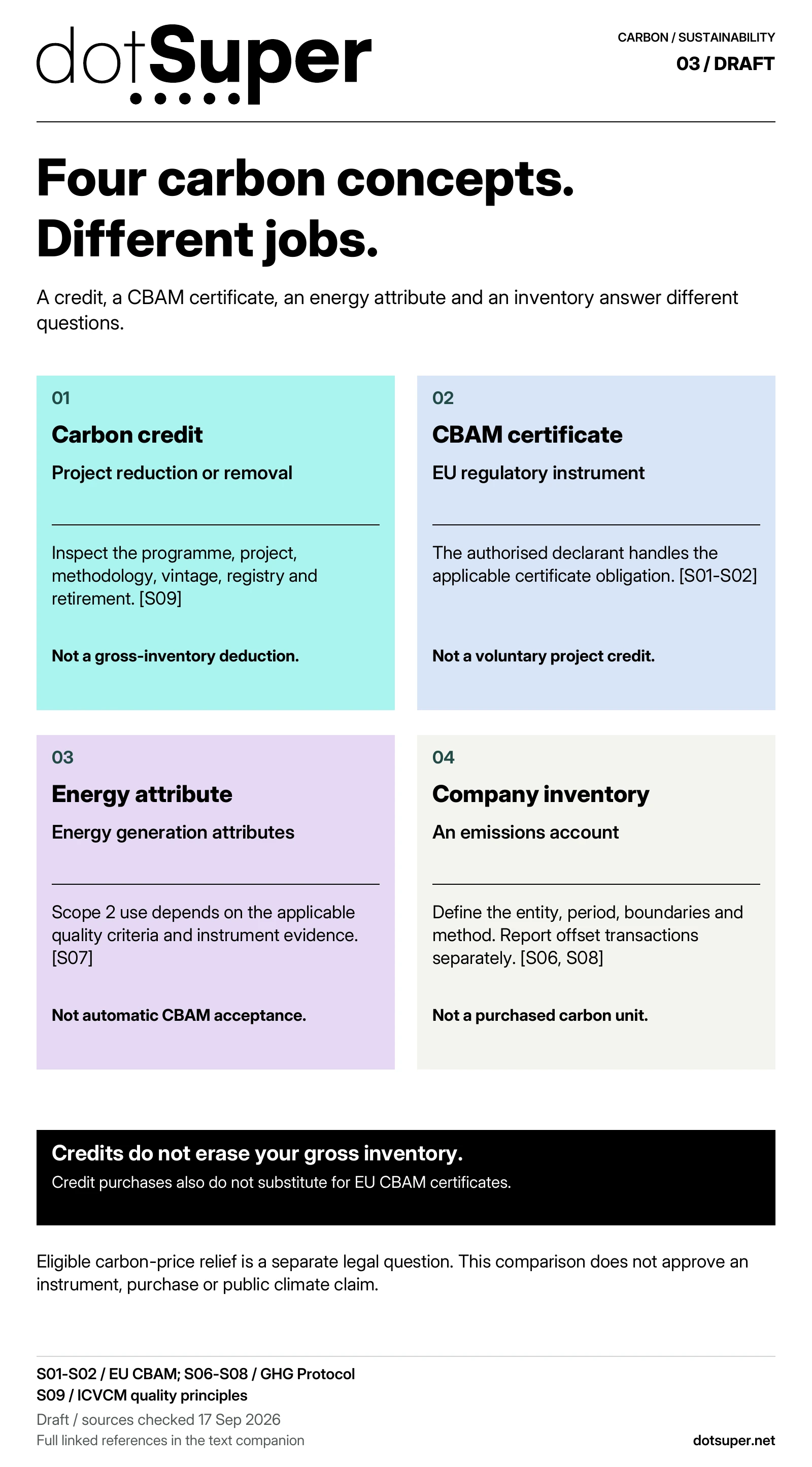
Read the diagram: Related visual guide: Four carbon concepts. Different jobs. This dotSuper diagram illustrates the surrounding workflow; the article covers the specific topic.
Four concepts are compared: project carbon credits, EU CBAM certificates, energy attributes and company inventories. They serve different purposes. Credits do not themselves reduce the gross inventory or substitute for CBAM certificates. Energy-attribute use has its own accounting conditions.
Concept comparison, not eligibility or claims advice. Instrument quality, accounting treatment and permitted claims depend on the applicable programme and rules.
Credit or certificate? Different purposes.
Carbon credit / programme-defined project reduction or removal.
EU CBAM certificate / instrument for a regulated EU obligation.
A voluntary credit does not substitute for a CBAM certificate. Eligible carbon-price relief is a separate question.
Energy attributes have their own rules.
Identify the instrument and ownership.
Check period, cancellation and quality criteria.
Apply the published Scope 2 accounting rules.
An energy attribute is not an offset credit. It is not automatically accepted in a CBAM calculation.
Your inventory is an emissions account.
Define the company boundary and period.
Report Scope 1, 2 and 3 under the applicable method.
Report offset transactions separately.
Purchasing carbon credits does not itself reduce the gross company inventory.
| Concept | Purpose | Evidence to inspect | Does not itself establish |
|---|---|---|---|
| Carbon credit | Programme-defined project reduction or removal | Programme, project, methodology, vintage, registry, serials and retirement | A reduction in the buyer’s gross inventory or a CBAM certificate |
| EU CBAM certificate | Regulated EU embedded-emissions obligation | Authorised declarant, registry and applicable surrender record | A voluntary project credit or the factory’s whole inventory |
| Energy attribute | Attributes of energy generation; conditional Scope 2 use | Instrument ownership, cancellation, period and applicable quality criteria | An offset credit or automatic CBAM acceptance |
| Company inventory | Emissions account for an entity boundary and period | Activity data, method, factors, boundaries and review | A purchased unit or a net total reduced by credit purchases |
Take it into your next working session
Keep the source credits with the file. Check the reuse terms and adapt the method to your context.
Credit: Original dotSuper educational content and diagrams.
Reuse: Copyright dotSuper. No new public reuse licence is assigned; third-party sources retain their own terms.
Thumbnail credit and reuse
Reuse: No public reuse licence has been specified. Source attribution does not grant rights to third-party material.
- 01A reduction project does not automatically create credits.
- 02Identify scheme, methodology and monitoring duties.
- 03Do not treat future credit revenue as certain.
/ dotSuper point of view
a project needs a valid route through a specific mechanism and methodology. Environmental improvement, eligibility, registration, issuance and sale are different milestones. Screen the project before committing money to registration or promised revenue.
Start with the real request
Energy use falls.
Someone says, "You should be earning carbon credits for this."
Perhaps there is a relevant opportunity.
Perhaps there is not.
The equipment invoice alone cannot answer the question.
The short answer: a project needs a valid route through a specific mechanism and methodology.
Environmental improvement, eligibility, registration, issuance and sale are different milestones.
Screen the project before committing money to registration or promised revenue.
First identify the mechanism and your role
Your company's route is not determined merely by being a manufacturer.
BEE CCTS overview.
Ask whether the relevant entity is obligated under the applicable provisions and whether the proposed activity fits the route being discussed.
Obtain the answer from a qualified specialist using current rules, not a generic sales presentation.
This article is an early documentation screen.
It is not a finding that your company qualifies or that a particular project will receive credits.
Gate 1: name the methodology
BEE's published list includes methodologies covering certain industrial energy-efficiency/fuel-switching and other activities.
Being in a broad sector is not enough to establish project eligibility.
BEE methodologies.
If the answer is only "solar gets credits" or "all efficiency projects qualify," stop and request specifics.
A methodology can contain conditions about the activity, boundary, dates, technology and monitoring that materially change the answer.
Gate 2: establish the baseline and additionality questions
It represents the counterfactual against which the relevant programme assesses the project.
Additionality asks, under the applicable rules, whether the credited benefit is beyond what would otherwise occur.
ICVCM identifies additionality and robust quantification among its core quality principles.
ICVCM principles.
Prepare the investment timeline, approvals, existing operations, alternative options and any relevant legal requirements.
Do not rewrite historical decisions to make a project appear eligible.
A specialist must determine what the chosen methodology requires and whether the evidence meets it.
Gate 3: check whether you can monitor the claim
Who owns the instruments and records?
Are calibration, missing-data treatment and relevant production variables addressed?
Can the project be separated appropriately from unrelated operational changes?
In our proposed screening process, each necessary parameter gets a source, owner, frequency, evidence link and gap status.
"The engineer knows roughly" is a lead for further work, not a monitoring system.
If the project depends on records that were never collected, establish the consequences before signing a revenue-sharing contract.
Do not assume future automation can recover missing historical evidence.
Gate 4: distinguish the milestones
A project application is not an issued credit.
A forecast is not a registry asset.
An issued unit is not guaranteed revenue.
Ask the prospective provider to show who does each step, what triggers fees and which costs remain payable if the project fails a gate.
Record who owns the relevant rights and data.
Any public environmental claim requires its own careful assessment.
A fictional efficiency proposal
The internal investment case was approved before anyone considered credit revenue.
A developer now promises a fixed number of credits without asking for the methodology, investment timeline or baseline records.
The right response is not an automatic rejection of the project.
It is to request a written, methodology-specific eligibility assessment and the evidence supporting the promised quantity.
The timing of the decision and the available records are facts to disclose, not inconvenient details to conceal.
While the assessment proceeds, the business can still measure operational improvements.
The value of an energy-saving project does not have to depend on credit issuance.
Understand the economics without treating revenue as certain
Ask who carries the risk of delays, lower issuance or no issuance.
Model a no-credit-revenue case alongside any upside case.
Label future prices and issued quantities as assumptions.
Compare contractual promises against what the counterparty is genuinely obligated to deliver.
Seek appropriate legal and financial advice before accepting material commitments.
The cheapest initial offer may not be the lowest-risk arrangement if key costs, ownership terms or failure outcomes are omitted.
Your first screening pack
Add the named methodology only when identified, not as a guess.
Classify the next step as: worth specialist assessment, missing essential evidence, or unsuitable for the proposed route.
These are working categories, not a certification score.
Where dotSuper can help
We do not promise project eligibility, issued credits, a sale price or an investment return.
Discuss your project-documentation needs.
What this page cannot conclude
- 01General educational information, not legal, tax, investment or accredited verification advice. Rules and methods can change.
- 02No independent expert review or customer-specific determination is claimed. Fictional examples are teaching aids, not client results.
- 03Carbon-project specialist to apply the actual methodology, project-date rules and current BEE procedure. No credit eligibility determination made here.
- 04The worksheet is an original operating template, not an official form or guarantee of acceptance.
Sources
- 01BEE CCTS overviewBureau of Energy Efficiency, India · accessed Sep 17, 2026
- 02BEE methodologiesBureau of Energy Efficiency, India · accessed Sep 17, 2026
- 03ICVCM principlesIntegrity Council for the Voluntary Carbon Market · accessed Sep 17, 2026
Our editorial standard · Found an error? Send a correction with its source.
/ CITE OR SHARE THIS GUIDE
Make the evidence easy to verify.
When you reference this guide, link to its canonical URL. That gives readers one stable place for the evidence, limitations and future updates.
dotSuper Research Desk. (September 17, 2026). Can Your Factory Generate Carbon Credits?. dotSuper. https://dotsuper.net/feeds/market-intelligence/can-your-factory-generate-carbon-credits
Carbon Data Readiness Canvas
Turn one reporting request into an owned evidence map before calculating or buying software.
Open the framework