/ THE SHORT ANSWER
See the method. Keep the context.
The visual companion
Reuse: No public reuse licence has been specified. Source attribution does not grant rights to third-party material.
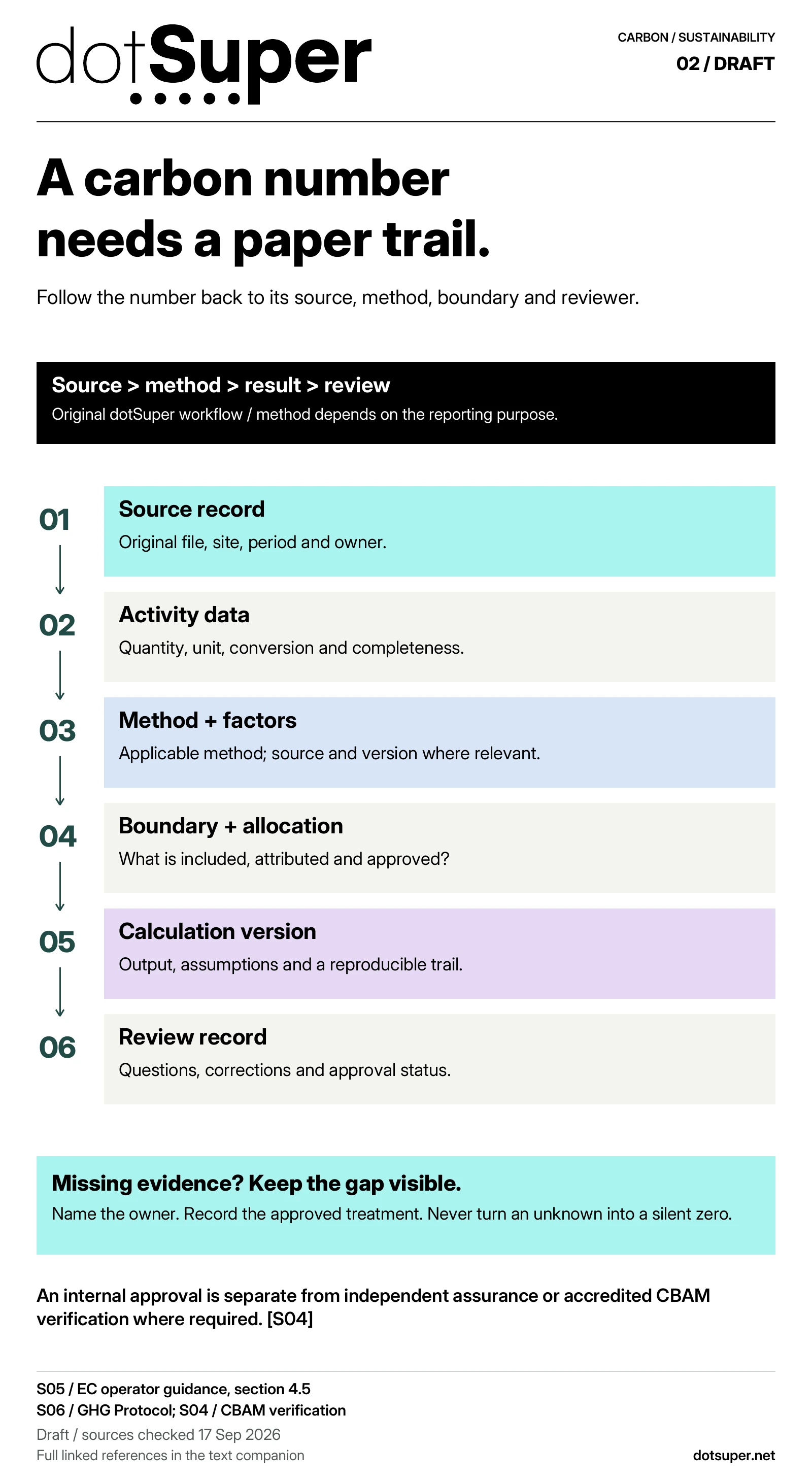
Read the diagram: Related visual guide: A carbon number needs a paper trail. This dotSuper diagram illustrates the surrounding workflow; the article covers the specific topic.
A six-stage carbon evidence chain connects the source record, activity data, method and factors, boundary and allocation, calculation version, and review record. Missing evidence is assigned an owner and remains visible. Internal approval is separate from independent assurance or accredited CBAM verification where required.
Original dotSuper workflow. The applicable accounting method determines the records needed. Internal review does not replace independent assurance or CBAM verification.
Start with the record. Keep the original.
Source / file, site, period and owner.
Activity / quantity, unit and any conversion.
Method / applicable rule, factor source and version.
If evidence is missing, label the gap and name its owner. Do not silently invent a value.
Make the result reproducible.
Boundary / what belongs in the calculation?
Allocation / what basis assigns emissions?
Calculation / which version and assumptions?
The specialist approves the applicable method. A corporate total is not automatically a CBAM product result.
A reviewer needs more than a total.
Trace the source and calculation.
Record questions and corrections.
Keep approval and external-review states separate.
Internal sign-off does not replace independent assurance or accredited CBAM verification where required.
| Stage | Retain | Review question |
|---|---|---|
| 1. Source | Original record, site, period, owner and stable reference | Can we find the underlying evidence? |
| 2. Activity data | Quantity, original unit, conversions and gaps | Does the value describe the correct activity? |
| 3. Method | Applicable rule; factor source, units and version where relevant | Who approved the method and factor? |
| 4. Boundary / allocation | Reporting boundary, allocation basis and rationale | Does the attribution match the intended purpose? |
| 5. Calculation | Version, output and unresolved assumptions | Can another person reproduce the result? |
| 6. Review | Reviewer, corrections, decision and external-review status | What was checked, and what remains open? |
Take it into your next working session
Keep the source credits with the file. Check the reuse terms and adapt the method to your context.
Credit: Original dotSuper educational content and diagrams.
Reuse: Copyright dotSuper. No new public reuse licence is assigned; third-party sources retain their own terms.
Thumbnail credit and reuse
Reuse: No public reuse licence has been specified. Source attribution does not grant rights to third-party material.
- 01Identify the producing installation.
- 02Separate material identity from emissions evidence.
- 03Escalate allocation and method questions.
/ dotSuper point of view
map the relevant input-to-product evidence chain before calculating a product figure. A trader's invoice, a material certificate and an emissions report can each establish different facts. One should not be silently substituted for another.
Start with the real request
We only turn it into parts."
That may describe your factory perfectly.
It does not, on its own, explain the emissions information your customer needs.
For a component manufacturer, the awkward part of a carbon-data request can sit upstream: identifying the purchased input, its producer and the evidence that belongs with it.
Looking only at the finishing process can miss the question the buyer is asking.
The short answer: map the relevant input-to-product evidence chain before calculating a product figure.
A trader's invoice, a material certificate and an emissions report can each establish different facts.
One should not be silently substituted for another.
What the official example teaches
It illustrates why a non-integrated producer needs to consider the relevant precursor information as well as its own process.
This article offers an original documentation workflow, not a reproduction of the Commission's calculations.
Commission steel guidance, section 4.3.
First confirm that your specific goods are covered and which production boundary applies.
Not every steel-containing product is automatically within CBAM, and the appropriate treatment is not determined by the marketing description alone.
Draw the chain before requesting documents
Producing installation -> purchased rod -> receipt record -> relevant production process -> output product -> customer data pack.
This is a proposed traceability sketch, not a rule requiring an identical lot-level accounting method in every case.
The specialist-approved methodology determines which aggregation, period and attribution are appropriate.
The sketch helps answer practical questions.
Does purchasing know the producer or only the trader?
Can production identify which relevant inputs entered the process?
Are quantities expressed consistently?
Does the supporting emissions information correspond to the intended installation and period?
Separate identity evidence from emissions evidence
This small habit prevents a folder full of genuine documents from being mistaken for a complete evidence chain.
| Record | What it can help establish | What it does not automatically establish |
|---|---|---|
| Purchase invoice | Commercial supplier, item, quantity and date | Producing installation's emissions |
| Material certificate | Relevant material identity or properties | A CBAM emissions result |
| Goods-receipt record | What the factory received | Appropriate allocation to every output |
| Production record | Process and output information | Validity of an upstream emission value |
| Supplier emissions information | A stated emissions result and its scope | Suitability for another site, period or method |
| Applicable verification report | The reviewed scope and result | Coverage of goods outside that report |
Deal with intermediaries explicitly
Procurement should ask how the supplied material is linked to the reported producer and what evidence is available through the chain.
Avoid asking for "your carbon number" without identifying what needs to be covered.
Ask for the applicable producer/installation, goods, production period, methodology, data status and relevant supporting references.
Record unavailable information rather than filling the gap with a different mill's figure.
Commercial confidentiality is a real constraint.
Agree authorised recipients and a suitable sharing arrangement.
If full evidence cannot be shared directly, involve the appropriate specialists in identifying an acceptable route rather than inventing a workaround.
A fictional problem with two suppliers
One provides relevant evidence.
The other provides only a brochure describing its environmental programme.
Production wants to use the first supplier's figure for both because the material grade looks similar.
That is not a defensible evidence substitution.
Material similarity does not demonstrate matching production route, installation, period or emissions.
The practical response is to identify the affected inputs, preserve their provenance, request the missing information and obtain a method-specific decision on any permitted alternative.
Keep the unresolved status visible in the calculation workflow.
Do not label a substitute figure as the second supplier's actual emissions.
Do not create an allocation rule in a meeting
A convenient split by revenue or units sold is not automatically the right allocation.
Ask the technical reviewer to document the relevant method and its treatment of these facts.
Then make the system implement that decision consistently.
The review should remain attached to the rule so that a later product or process change triggers reconsideration.
The Commission steel guidance describes production and monitoring concepts for the definitive period.
Use the current relevant sections and legislation rather than importing assumptions from an old transitional workbook.
Steel guidance.
Run one sample chain end to end
Gather one coherent set of purchase, producer, receipt, production and output records.
List the missing connections.
Ask the technical reviewer whether the chain supports the intended calculation and what remains unresolved.
The purpose is not to calculate the entire year's liability during the first session.
It is to discover whether the underlying information can be connected reliably.
Where dotSuper can help
Steel-sector methodology and independent verification must be handled by the appropriate specialists.
Discuss your precursor-data workflow.
What this page cannot conclude
- 01General educational information, not legal, tax, investment or accredited verification advice. Rules and methods can change.
- 02No independent expert review or customer-specific determination is claimed. Fictional examples are teaching aids, not client results.
- 03Steel-sector specialist to approve product classification, precursor boundary, attribution and any future numerical example.
- 04The worksheet is an original operating template, not an official form or guarantee of acceptance.
Sources
Our editorial standard · Found an error? Send a correction with its source.
/ CITE OR SHARE THIS GUIDE
Make the evidence easy to verify.
When you reference this guide, link to its canonical URL. That gives readers one stable place for the evidence, limitations and future updates.
dotSuper Research Desk. (September 17, 2026). CBAM for Steel Parts: Trace the Precursor. dotSuper. https://dotsuper.net/feeds/applied-systems/cbam-steel-parts-trace-the-precursor
CBAM Supplier Evidence Workflow
Route an EU CBAM request from product and installation records to a reviewed supplier response.
Open the framework