/ THE SHORT ANSWER
See the method. Keep the context.
The visual companion
Reuse: No public reuse licence has been specified. Source attribution does not grant rights to third-party material.
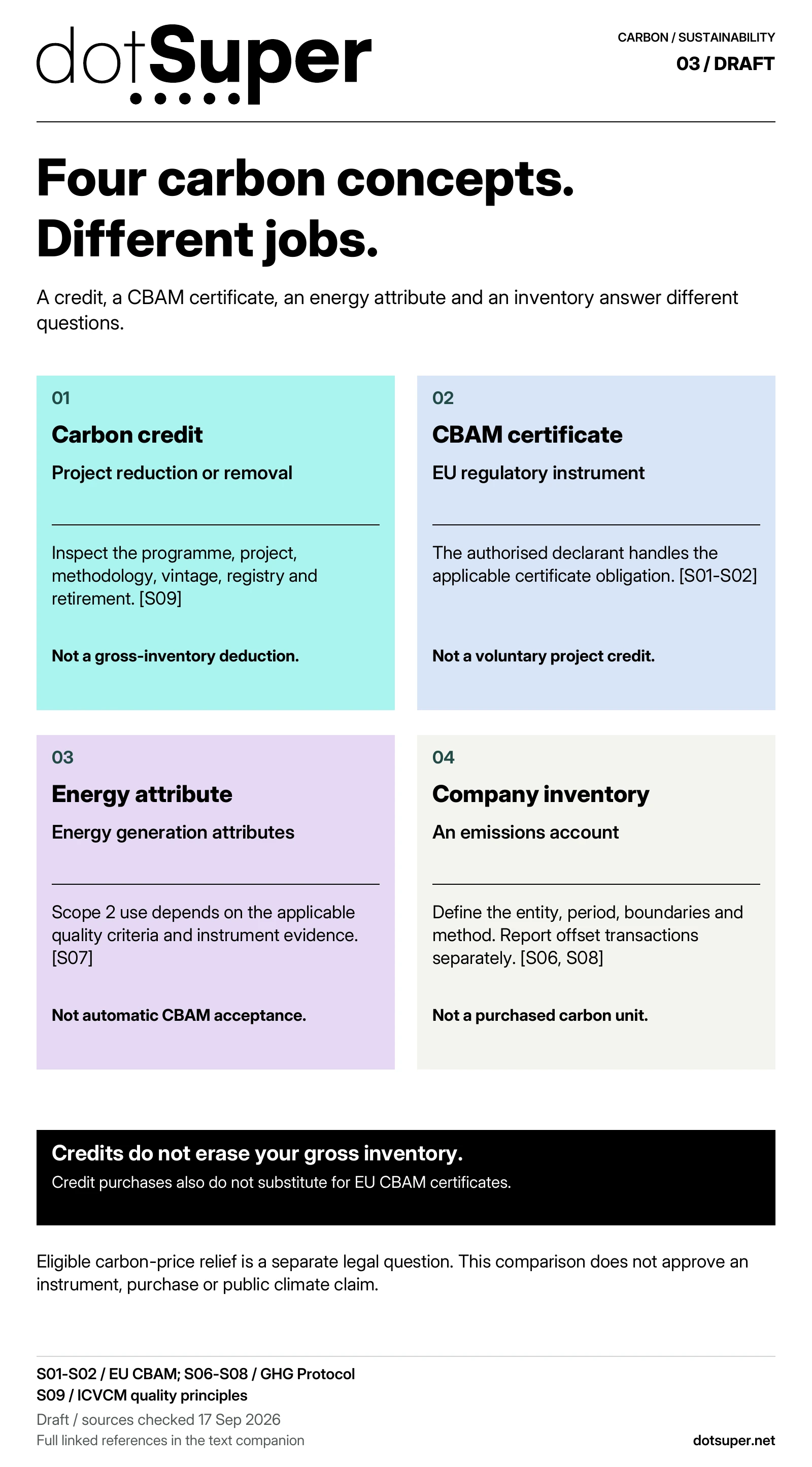
Read the diagram: A credit, a CBAM certificate, an energy attribute and an inventory answer different questions.
Four concepts are compared: project carbon credits, EU CBAM certificates, energy attributes and company inventories. They serve different purposes. Credits do not themselves reduce the gross inventory or substitute for CBAM certificates. Energy-attribute use has its own accounting conditions.
Concept comparison, not eligibility or claims advice. Instrument quality, accounting treatment and permitted claims depend on the applicable programme and rules.
Credit or certificate? Different purposes.
Carbon credit / programme-defined project reduction or removal.
EU CBAM certificate / instrument for a regulated EU obligation.
A voluntary credit does not substitute for a CBAM certificate. Eligible carbon-price relief is a separate question.
Energy attributes have their own rules.
Identify the instrument and ownership.
Check period, cancellation and quality criteria.
Apply the published Scope 2 accounting rules.
An energy attribute is not an offset credit. It is not automatically accepted in a CBAM calculation.
Your inventory is an emissions account.
Define the company boundary and period.
Report Scope 1, 2 and 3 under the applicable method.
Report offset transactions separately.
Purchasing carbon credits does not itself reduce the gross company inventory.
| Concept | Purpose | Evidence to inspect | Does not itself establish |
|---|---|---|---|
| Carbon credit | Programme-defined project reduction or removal | Programme, project, methodology, vintage, registry, serials and retirement | A reduction in the buyer’s gross inventory or a CBAM certificate |
| EU CBAM certificate | Regulated EU embedded-emissions obligation | Authorised declarant, registry and applicable surrender record | A voluntary project credit or the factory’s whole inventory |
| Energy attribute | Attributes of energy generation; conditional Scope 2 use | Instrument ownership, cancellation, period and applicable quality criteria | An offset credit or automatic CBAM acceptance |
| Company inventory | Emissions account for an entity boundary and period | Activity data, method, factors, boundaries and review | A purchased unit or a net total reduced by credit purchases |
Take it into your next working session
Keep the source credits with the file. Check the reuse terms and adapt the method to your context.
Reuse: No public reuse licence has been specified. Source attribution does not grant rights to third-party material.
Reuse: No public reuse licence has been specified. Source attribution does not grant rights to third-party material.
Reuse: No public reuse licence has been specified. Source attribution does not grant rights to third-party material.
Reuse: No public reuse licence has been specified. Source attribution does not grant rights to third-party material.
Thumbnail credit and reuse
Reuse: No public reuse licence has been specified. Source attribution does not grant rights to third-party material.
- 01A company inventory is an accounting record, not a purchased unit.
- 02Energy attributes have Scope 2 conditions; they are not offset credits.
- 03A shared carbon label does not make instruments interchangeable.
/ dotSuper point of view
Separate project credits, EU CBAM certificates, energy-attribute instruments and company inventories. Buying a credit does not itself reduce reported gross inventory emissions or substitute for CBAM certificates.
Start with the question, then identify the record
Treating them as one balance invites incorrect calculations and claims.
Ask whether the business is measuring emissions, documenting energy attributes, meeting a specific obligation or funding an external mitigation activity.
This comparison groups four concepts for explanation.
It does not claim that every crediting programme, energy market or jurisdiction uses identical rules.
A company inventory is included because it is commonly confused with purchased instruments, even though it is an accounting record.
Project credits and CBAM certificates
Before relying on it, examine the project, methodology, vintage, serials and registry status, together with additionality, quantification, reversal and double-counting risks.
A label does not guarantee every claimed benefit.
[S09]
A CBAM certificate belongs to the EU’s regulated mechanism for embedded emissions in covered imports.
The authorised declarant has the relevant certificate duties.
It is not a generic voluntary offset instrument.
A separate question concerns an eligible carbon price paid during production; buying any voluntary credit does not automatically establish that relief.
[S01, S02]
Our proposed control is to maintain separate registers for credit transactions and CBAM responsibilities.
Link each to the decision owner and evidence required by its own rules.
Do not use a shared spreadsheet column called offsets to merge the two.
Energy attributes and company inventories
Under the published GHG Protocol Scope 2 Guidance, contractual instruments must meet quality criteria to support the market-based accounting method.
Possession of a certificate alone does not answer every accounting question.
[S07]
A company inventory reports emissions within a defined organisational boundary and period.
GHG Protocol requires inventory reporting independently of offset transactions, with those transactions disclosed separately.
Purchasing credits therefore does not rewrite the gross Scope 1, 2 and 3 inventory.
[S06, S08]
The current Scope 2 resource page describes the 2025-26 consultation separately from the published guidance.
This guide does not turn consultation proposals into current requirements.
It also does not claim that an energy instrument is automatically accepted for a CBAM calculation.
Keep the claim beside its evidence
Attach the period, boundary, instrument record and reviewer.
If the statement crosses categories, identify the rule that permits the connection rather than assuming one.
dotSuper can propose an evidence workflow.
This comparison does not certify a project, establish credit eligibility, recommend a purchase, calculate liability or authorise a public climate claim.
Who this guide is for
What this page cannot conclude
- 01Concept comparison, not eligibility or claims advice. Instrument quality, accounting treatment and permitted claims depend on the applicable programme and rules.
- 02Check the actual programme, instrument, ownership and retirement or surrender evidence before any purchase or claim.
- 03Use published Scope 2 rules and quality criteria, not consultation proposals as adopted requirements.
- 04Any statement about carbon-price relief requires separate review under the destination regime. No credit purchase or relief is recommended here.
Sources
- 01S01: CBAM definitive regimeEuropean Commission · accessed Sep 17, 2026
- 02S02: Regulation (EU) 2023/956, consolidated 20 October 2025EUR-Lex / European Union · accessed Sep 17, 2026
- 03S06: Corporate Accounting and Reporting StandardGHG Protocol · accessed Sep 17, 2026
- 04S07: Scope 2 GuidanceGHG Protocol · accessed Sep 17, 2026
- 05S08: Can carbon offsets be used to reduce a company's scope 3 emissions?GHG Protocol Technical Support · accessed Sep 17, 2026
- 06S09: The Core Carbon PrinciplesIntegrity Council for the Voluntary Carbon Market · accessed Sep 17, 2026
Our editorial standard · Found an error? Send a correction with its source.
/ CITE OR SHARE THIS GUIDE
Make the evidence easy to verify.
When you reference this guide, link to its canonical URL. That gives readers one stable place for the evidence, limitations and future updates.
dotSuper Research Desk. (September 17, 2026). Four carbon concepts. Different jobs.. dotSuper. https://dotsuper.net/feeds/market-intelligence/carbon-instruments-are-different