/ THE SHORT ANSWER
See the method. Keep the context.
The visual companion
Reuse: Original artwork created for dotSuper. No public reuse licence has been specified. Attribution to research sources does not grant rights to their artwork or datasets.
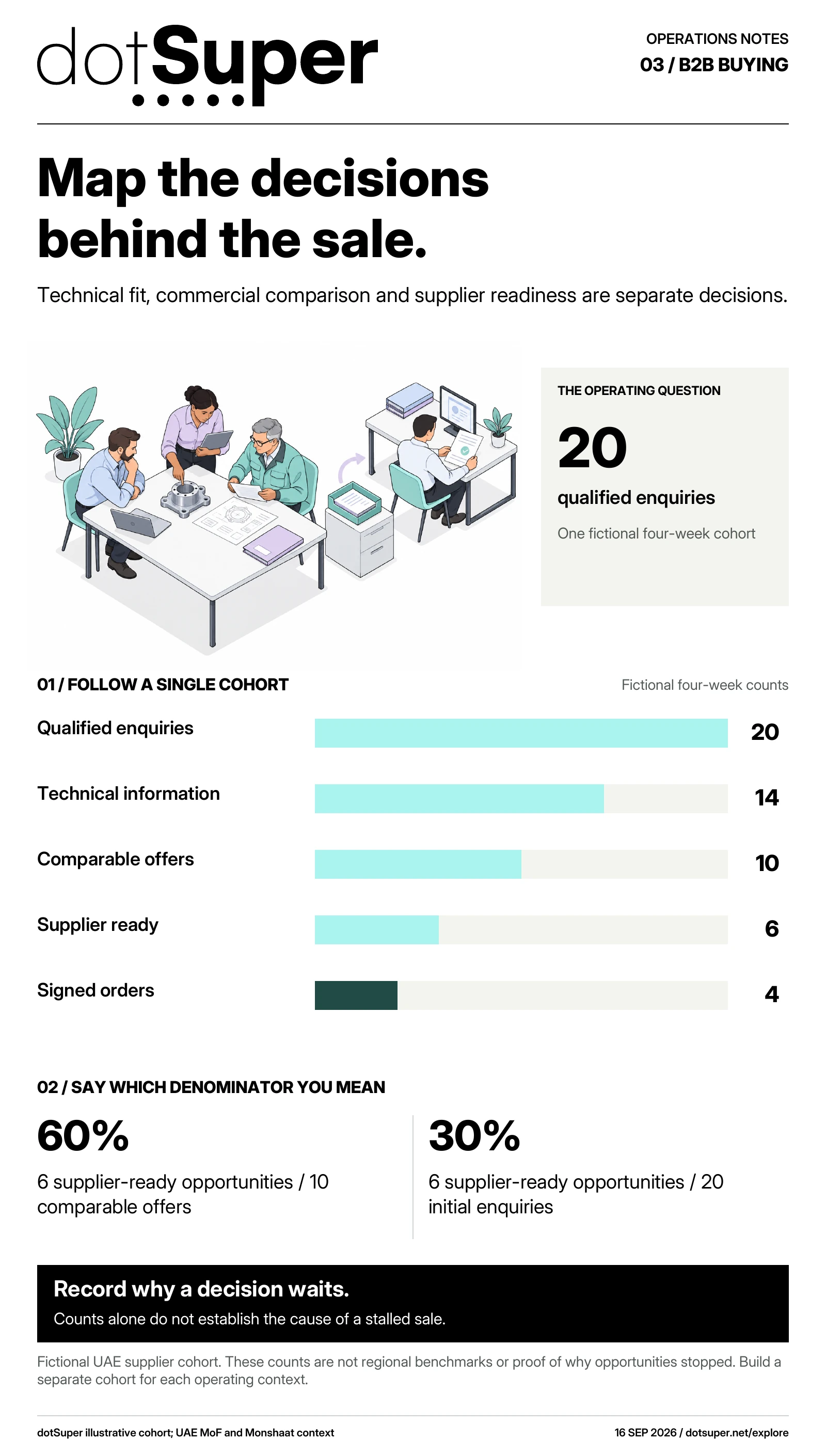
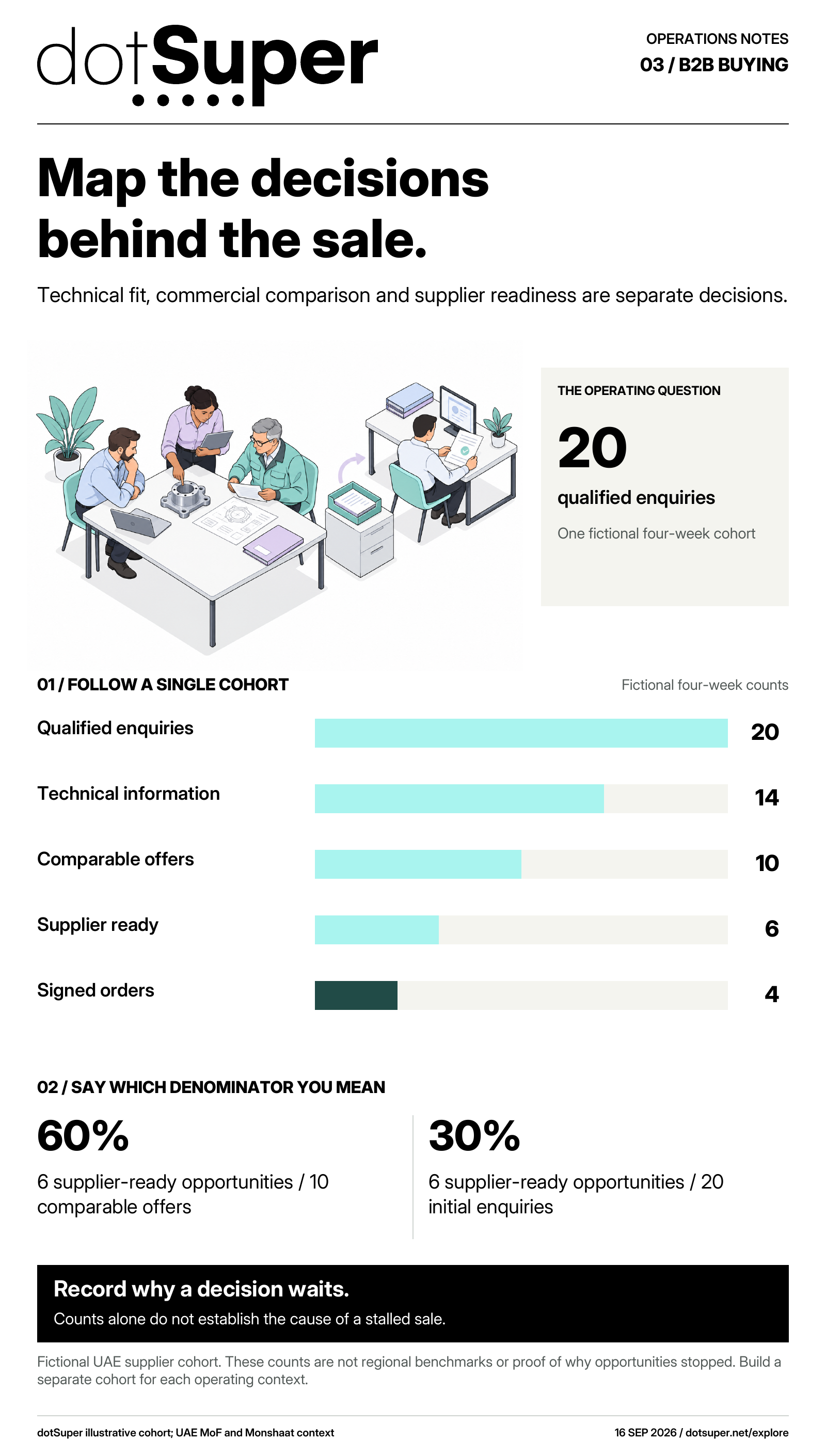
Read the diagram: Technical fit, commercial comparison and supplier readiness are separate decisions. Fictional UAE supplier cohort. These counts are not regional benchmarks or proof of why opportunities stopped. Build a separate cohort for each operating context.
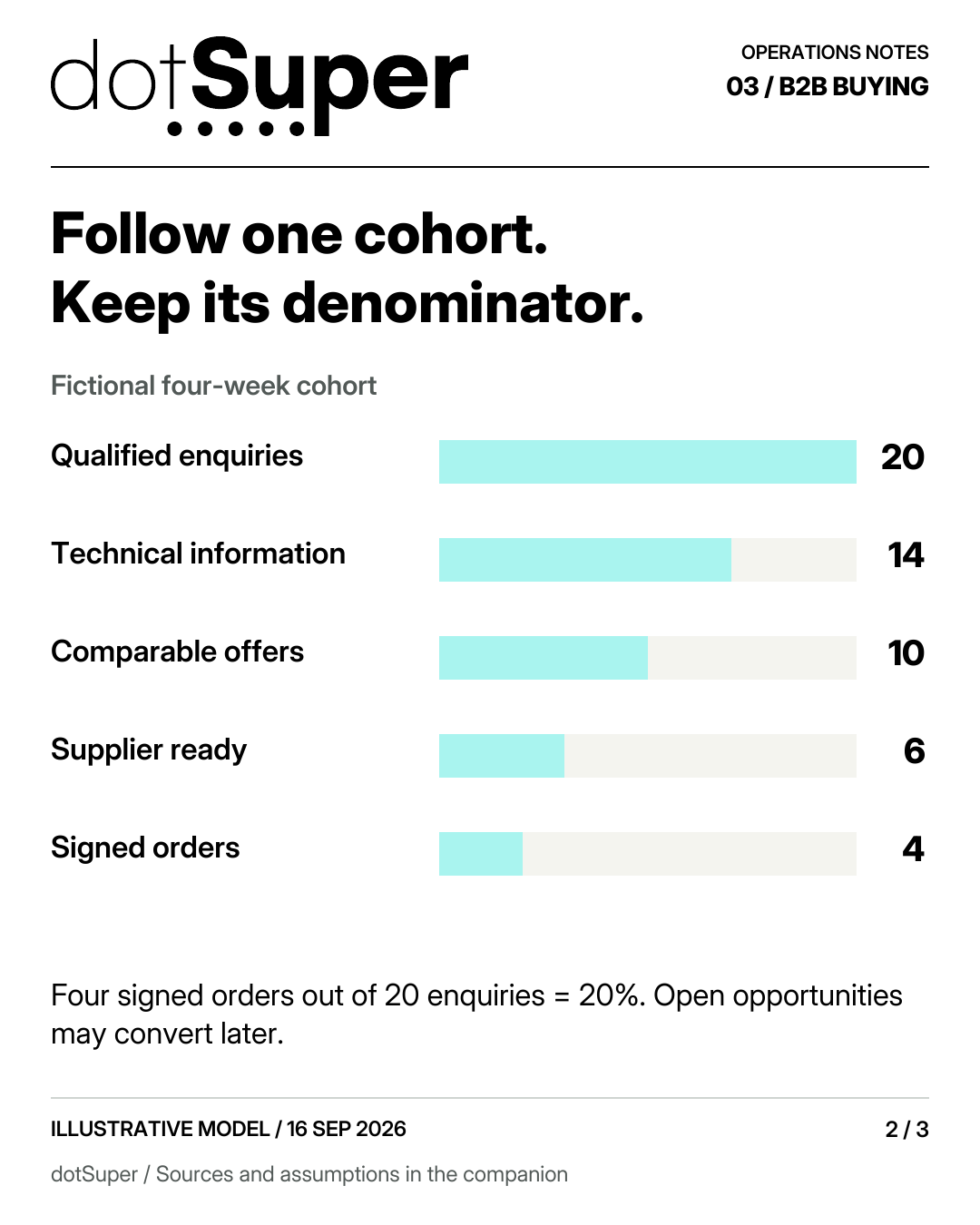
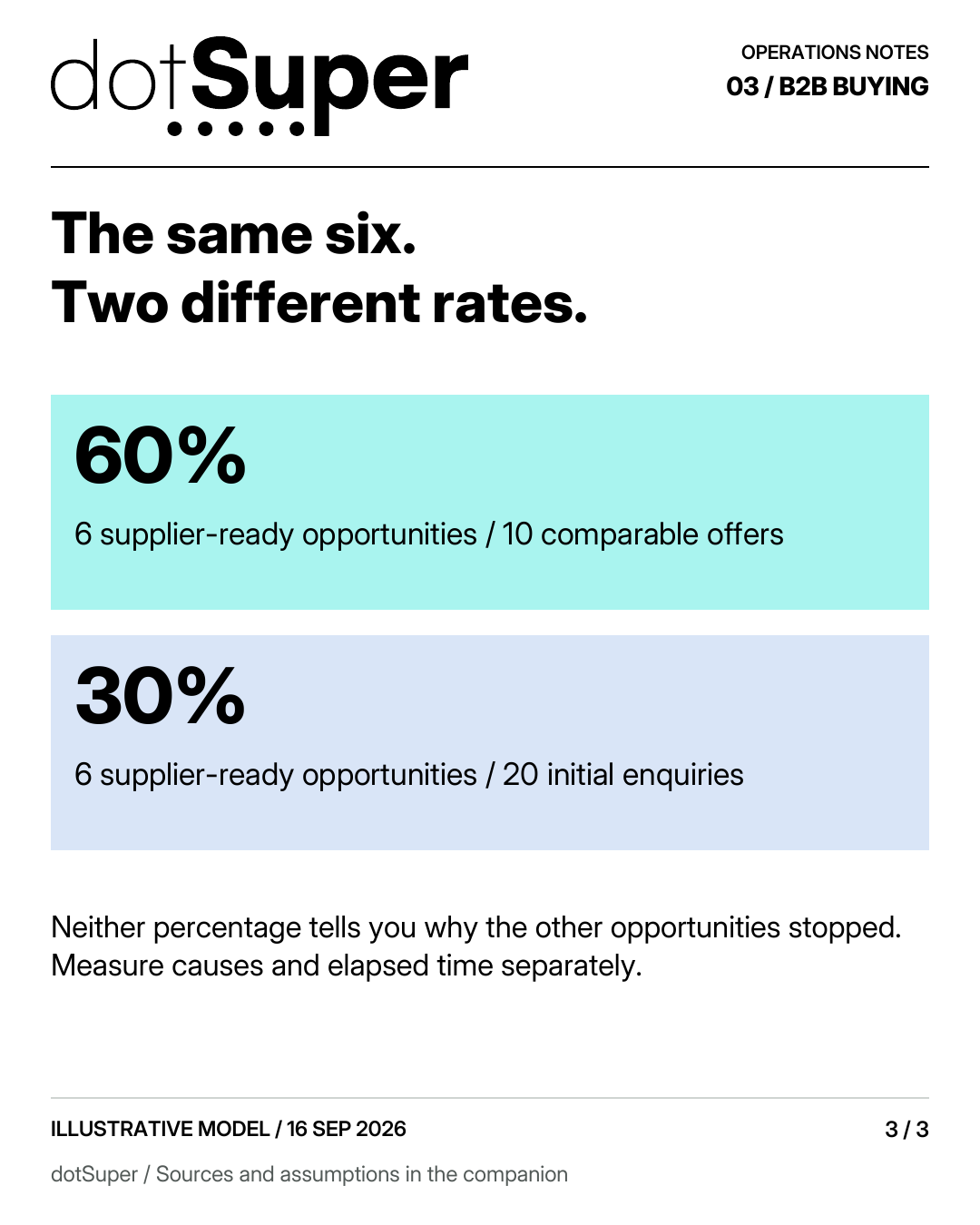
A fictional four-week buying cohort has 20 qualified enquiries, 14 with sufficient technical information, ten comparable offers, six supplier-ready opportunities and four signed orders. Six of ten offers is 60%; six of the original 20 enquiries is 30%.
The four-week example starts with 20 qualified enquiries: 14 have sufficient technical information, ten comparable offers, six supplier-ready opportunities and four signed orders. The order rate is 4/20 = 20%. Open opportunities may convert later.
Technical scope can return to an earlier decision for revision. Measure causes and elapsed time separately from stage counts.
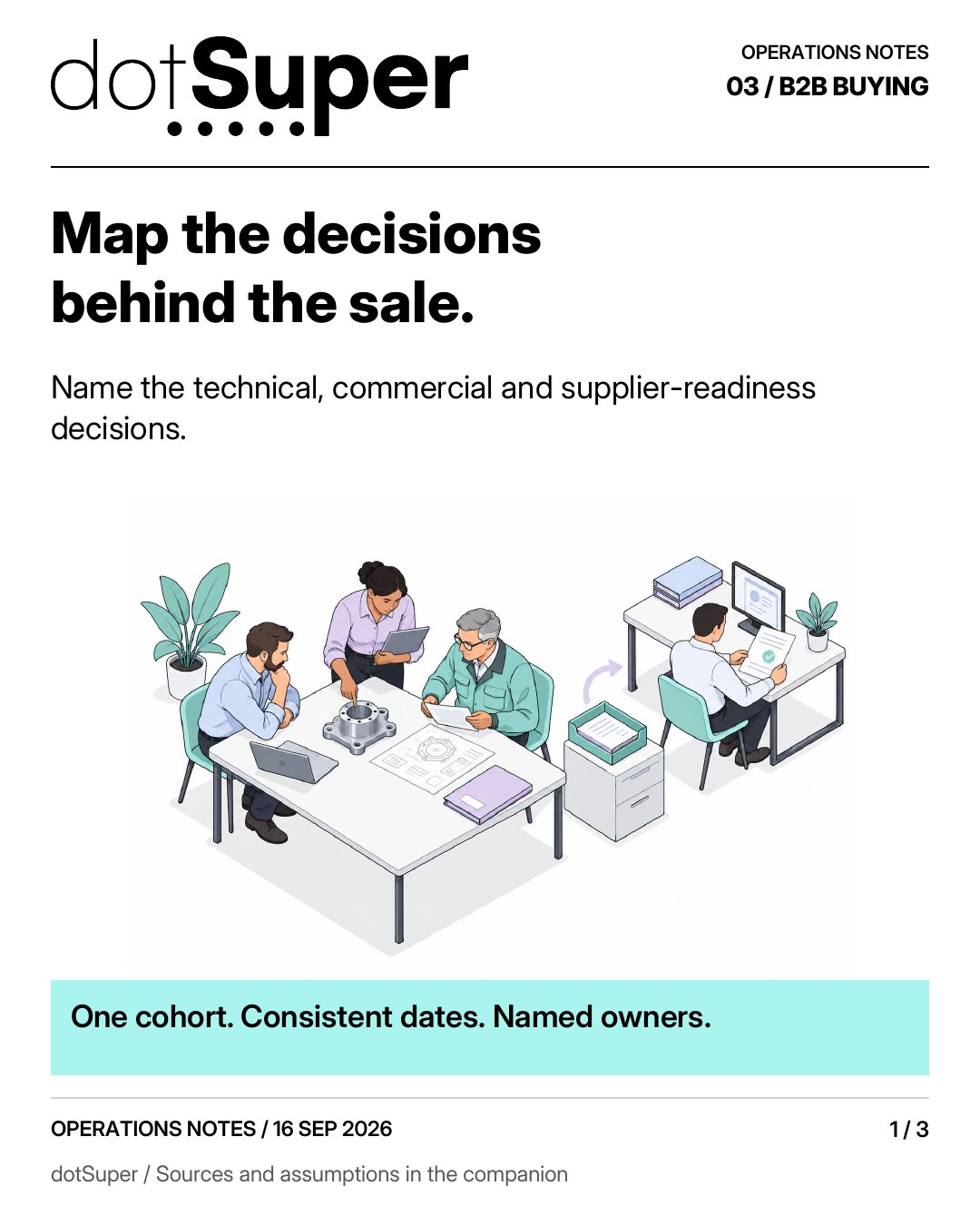
Map the decisions behind the sale. Name the technical, commercial and supplier-readiness decisions. One cohort. Consistent dates. Named owners.
Follow one cohort. Keep its denominator. Fictional four-week cohort Qualified enquiries / 20 / 20 Technical information / 14 / 14 Comparable offers / 10 / 10 Supplier ready / 6 / 6 Signed orders / 4 / 4 Four signed orders out of 20 enquiries = 20%. Open opportunities may convert later.
The same six. Two different rates. 60% / 6 supplier-ready opportunities / 10 comparable offers 30% / 6 supplier-ready opportunities / 20 initial enquiries Neither percentage tells you why the other opportunities stopped. Measure causes and elapsed time separately.
The cohort is a fictional UAE supplier example, not a Saudi or UAE benchmark. The same values must not be reused as a Saudi operating result.
Stage counts do not identify causes, prove an automation effect or establish a universal linear buying process.
Official procurement sources have federal or agency scope. They do not measure private-market conversion, deal duration or buyer behaviour.
| Stage | Opportunities in the same fictional cohort |
|---|---|
| Qualified | 20 |
| Sufficient technical information | 14 |
| Comparable offers | 10 |
| Supplier ready | 6 |
| Signed | 4 |
Reuse: Original artwork created for dotSuper. No public reuse licence has been specified. Attribution to research sources does not grant rights to their artwork or datasets.
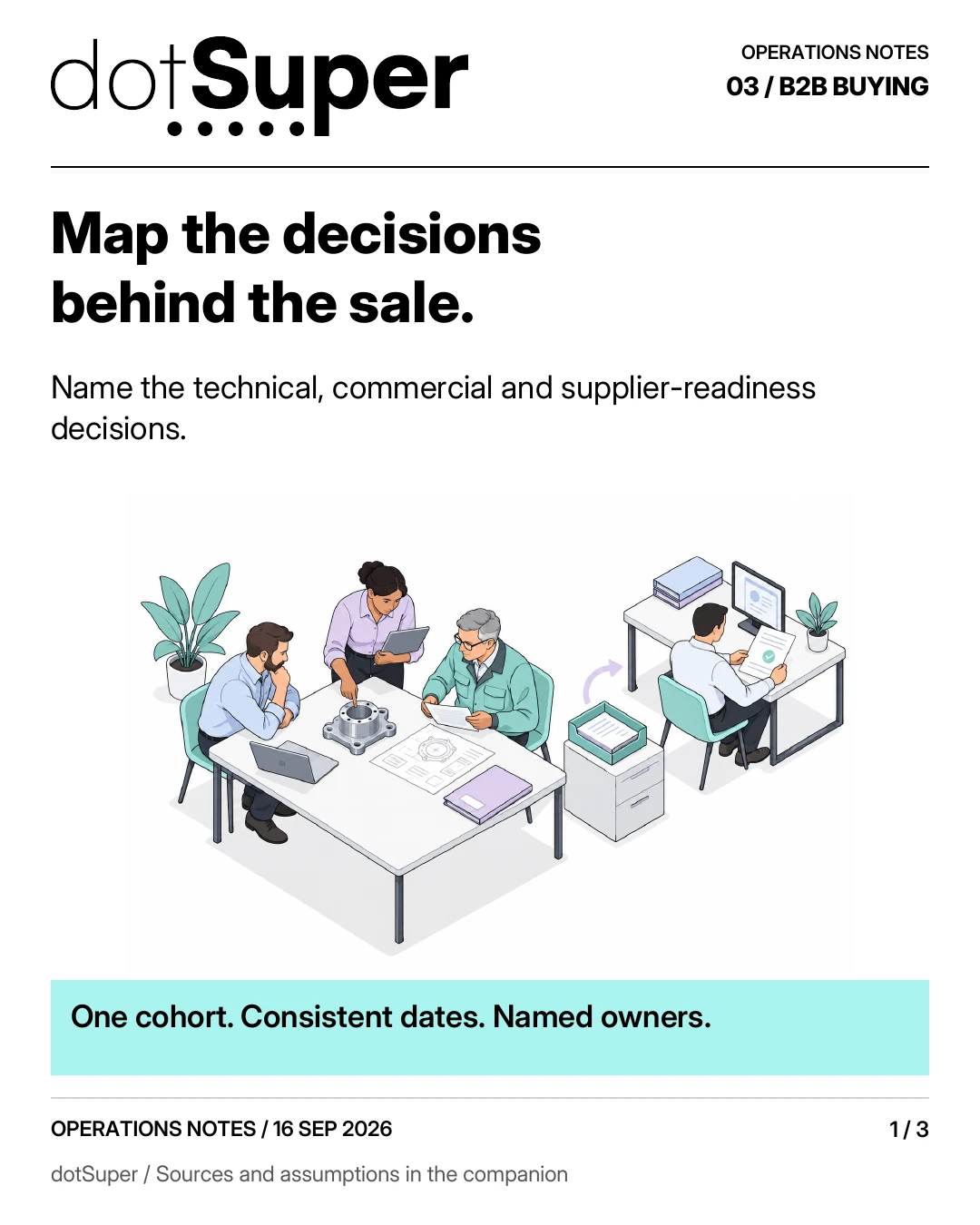
Read the diagram: Panel 1 of 3. Map the decisions behind the sale.
Map the decisions behind the sale. Name the technical, commercial and supplier-readiness decisions. One cohort. Consistent dates. Named owners.
The cohort is a fictional UAE supplier example, not a Saudi or UAE benchmark. The same values must not be reused as a Saudi operating result.
Reuse: Original artwork created for dotSuper. No public reuse licence has been specified. Attribution to research sources does not grant rights to their artwork or datasets.
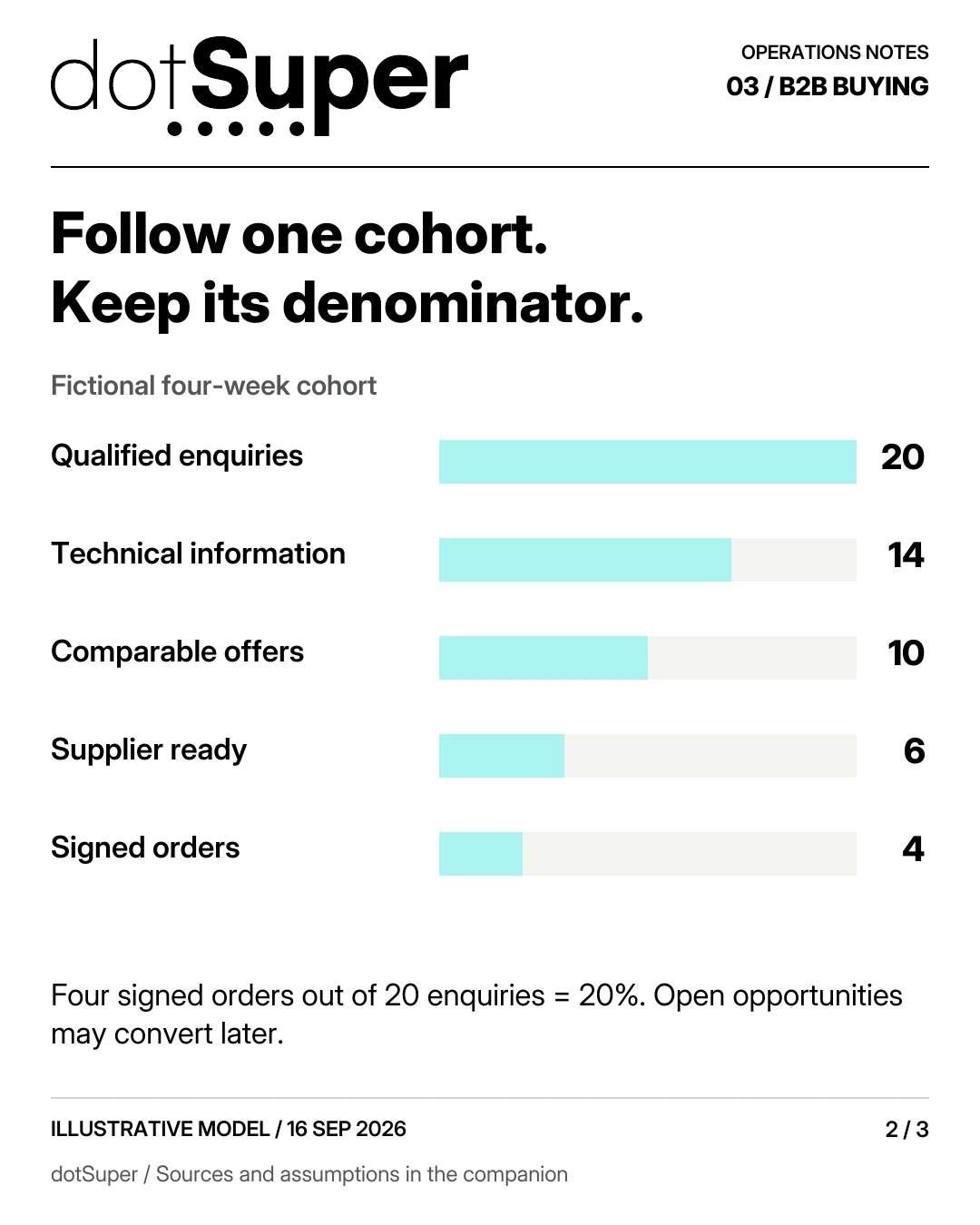
Read the diagram: Panel 2 of 3. Follow one cohort.
Follow one cohort. Keep its denominator. Fictional four-week cohort Qualified enquiries / 20 / 20 Technical information / 14 / 14 Comparable offers / 10 / 10 Supplier ready / 6 / 6 Signed orders / 4 / 4 Four signed orders out of 20 enquiries = 20%. Open opportunities may convert later.
The cohort is a fictional UAE supplier example, not a Saudi or UAE benchmark. The same values must not be reused as a Saudi operating result.
Fictional example: buying stages.
Stage: Qualified; Opportunities in the same fictional cohort: 20.
Stage: Sufficient technical information; Opportunities in the same fictional cohort: 14.
Stage: Comparable offers; Opportunities in the same fictional cohort: 10.
Stage: Supplier ready; Opportunities in the same fictional cohort: 6.
Stage: Signed; Opportunities in the same fictional cohort: 4.
| Stage | Opportunities in the same fictional cohort |
|---|---|
| Qualified | 20 |
| Sufficient technical information | 14 |
| Comparable offers | 10 |
| Supplier ready | 6 |
| Signed | 4 |
Reuse: Original artwork created for dotSuper. No public reuse licence has been specified. Attribution to research sources does not grant rights to their artwork or datasets.
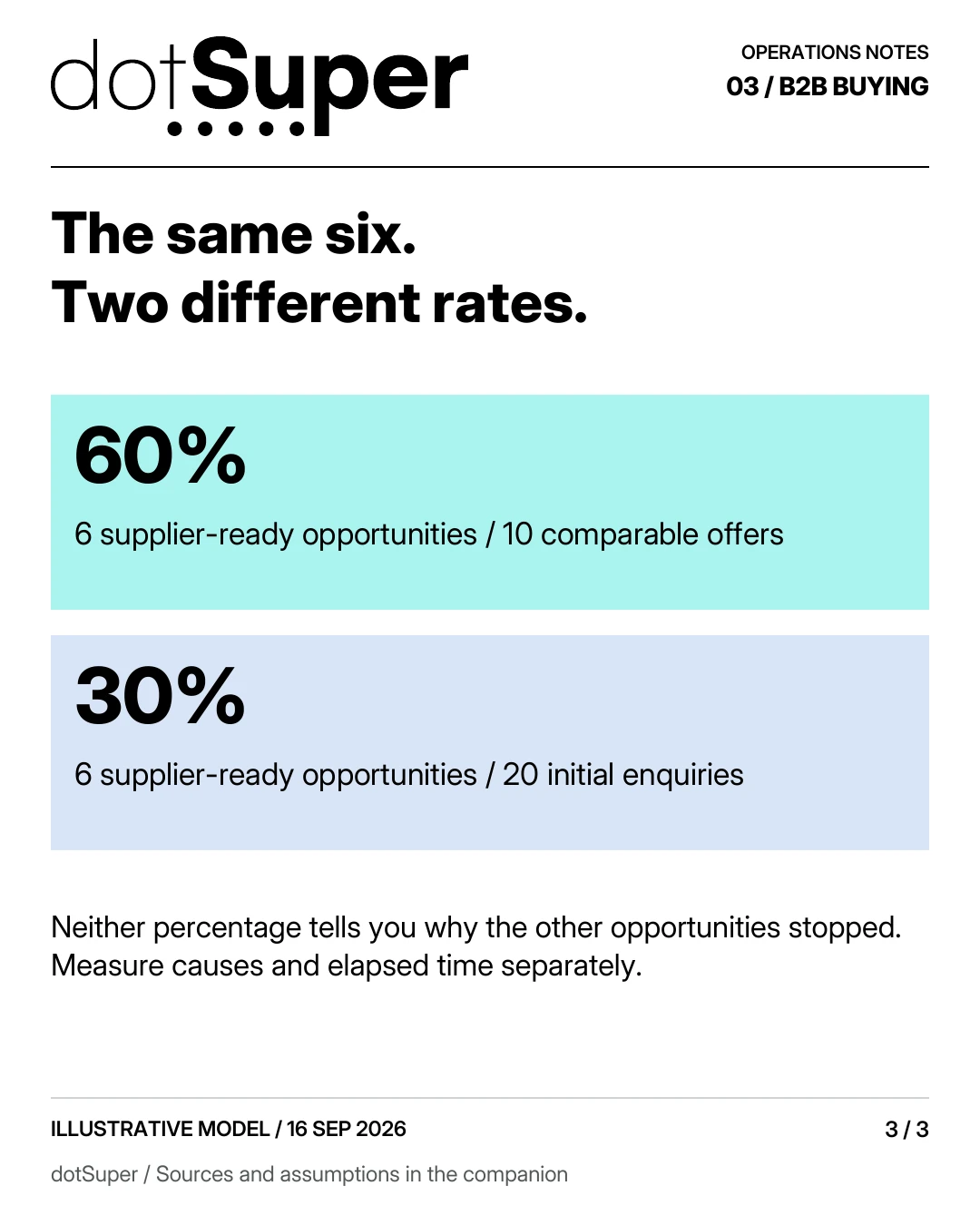
Read the diagram: Panel 3 of 3. The same six.
The same six. Two different rates. 60% / 6 supplier-ready opportunities / 10 comparable offers 30% / 6 supplier-ready opportunities / 20 initial enquiries Neither percentage tells you why the other opportunities stopped. Measure causes and elapsed time separately.
The cohort is a fictional UAE supplier example, not a Saudi or UAE benchmark. The same values must not be reused as a Saudi operating result.
Fictional example: buying stages.
Stage: Qualified; Opportunities in the same fictional cohort: 20.
Stage: Sufficient technical information; Opportunities in the same fictional cohort: 14.
Stage: Comparable offers; Opportunities in the same fictional cohort: 10.
Stage: Supplier ready; Opportunities in the same fictional cohort: 6.
Stage: Signed; Opportunities in the same fictional cohort: 4.
| Stage | Opportunities in the same fictional cohort |
|---|---|
| Qualified | 20 |
| Sufficient technical information | 14 |
| Comparable offers | 10 |
| Supplier ready | 6 |
| Signed | 4 |
Take it into your next working session
Keep the source credits with the file. Check the reuse terms and adapt the method to your context.
Credit: dotSuper original fictional worked-example data.
Reuse: Original illustrative data. No public reuse licence has been specified. These are not client measurements or research results.
Reuse: Original artwork created for dotSuper. No public reuse licence has been specified. Attribution to research sources does not grant rights to their artwork or datasets.
Reuse: Original artwork created for dotSuper. No public reuse licence has been specified. Attribution to research sources does not grant rights to their artwork or datasets.
Reuse: Original artwork created for dotSuper. No public reuse licence has been specified. Attribution to research sources does not grant rights to their artwork or datasets.
Reuse: Original artwork created for dotSuper. No public reuse licence has been specified. Attribution to research sources does not grant rights to their artwork or datasets.
Reuse: Original artwork created for dotSuper. No public reuse licence has been specified. Attribution to research sources does not grant rights to their artwork or datasets.
Reuse: Original artwork created for dotSuper. No public reuse licence has been specified. Attribution to research sources does not grant rights to their artwork or datasets.
Thumbnail credit and reuse
Reuse: Original artwork created for dotSuper. No public reuse licence has been specified. Attribution to research sources does not grant rights to their artwork or datasets.
- 01Technical fit, commercial comparison and supplier readiness need distinct evidence and owners.
- 02UAE federal procurement and Saudi agency guidance describe specific routes, not every private buyer.
- 03In the fictional cohort, six supplier-ready opportunities equal 60% of comparable offers but 30% of initial enquiries.
- 04Follow open opportunities and return paths before attributing an order to automation.
/ dotSuper point of view
A useful buying map records the evidence needed for each decision. Stage counts describe a cohort; they do not explain why a purchase stopped.
Audience, question and answer
Map the purchasing organisation, transaction and approval evidence separately for each market.
A contact requesting a quotation may have no authority to approve the supplier, commit a budget or accept delivery.
An evidence map makes these hand-offs visible.
It should not suggest that every buyer follows a single funnel or that a country has one purchasing personality.
The practical unit is an opportunity attached to a specific buying entity and use case.
Record who requests the work, who verifies technical fit, who approves commercial terms, who registers the supplier, who signs, and who releases payment.
These roles can sit with one owner in a small firm or several departments in a larger operation.
This role model is dotSuper's analytical recommendation, not a measured distribution of Gulf buying behaviour.
Findings and source boundaries
The Ministry of Finance describes a platform covering tenders, bids, awards, purchase orders, invoices and electronic signatures.
Its scope is federal entities.
It does not establish how a Dubai private manufacturer buys maintenance services or how every emirate-level body procures.
UAE MoF, Digital Procurement Platform, undated live service page, checked 16 September 2026 (source 1).
Registration is its own workstream.
The federal register distinguishes domestic, free-zone and foreign suppliers, with documentation varying by category.
A sales qualification form should therefore capture the supplier's actual entity and registration route before promising eligibility.
UAE MoF, supplier registration service, undated live page, checked 16 September 2026 (source 2).
Saudi public procurement should be researched through the relevant agency and Etimad.
Monsha'at's instructions distinguish future, current and completed tenders on Etimad.
Those states create different information needs: market preparation, bid preparation and award learning.
This proves a discoverable route for that authority's procurements, not a conversion rate for Saudi B2B sales.
Monsha'at, Government Tenders and Procurements, page updated 2 August 2026, checked 16 September 2026 (source 3).
Supplier evidence can precede any sales meeting.
Monsha'at's supplier guide lists registration and organisational documents for its vendor route.
Treat the guide as agency-specific.
Verify the live tender's eligibility, required certificates and deadlines before a bid.
Monsha'at, Services Guide Q2 2025, vendor portal section, checked 16 September 2026 (source 4).
None of these sources measures the share of private buyers using WhatsApp, the typical number of stakeholders, average deal duration, trust in AI-generated content, or search popularity.
Such claims stay out of publication until supported by a defined sample.
Country-specific legal interpretations are outside this explanation; this is general research, not legal advice.
A useful decision map
Then ask what decision is blocked.
An engineer may need a material certificate; procurement may need a comparable commercial offer; finance may need agreed payment terms and a supplier record.
The owner may need a credible explanation of operating disruption during implementation.
For each hand-off, store four things: the question, the evidence needed, the person accountable and the acceptance condition.
A quotation containing a price but no scope boundary can appear complete in a CRM while remaining unusable to procurement.
A proof of concept can satisfy an engineer while leaving security review unresolved.
These are different forms of progress.
Separate the first order from repeat purchasing.
A repeat order within an approved agreement can have fewer decisions than a new supplier appointment.
Also separate urgent maintenance from planned capital investment.
Urgency changes the decision context; it does not remove purchasing controls automatically.
AI can draft a response matrix, extract missing requirements and keep supporting documents connected to an opportunity.
It should not invent certifications, write an unapproved price into a proposal or infer that a warm conversation means a purchase commitment.
The source document and approved version need to remain visible to the reviewer.
Quantitative context and illustrative example
The following is a fictional four-week cohort for a UAE industrial-service supplier, designed to show denominator discipline.
The Saudi team should construct its own cohort rather than reuse these values.
Twenty qualified enquiries entered the cohort.
Fourteen had sufficient technical information, ten reached a commercially comparable quotation, six completed the customer's supplier requirements and four produced signed orders.
The apparent order rate is 4/20, or 20%, for this specific fictional cohort.
It is not dotSuper performance or a UAE benchmark.
The transition from ten comparable offers to six supplier-ready opportunities is 6/10, or 60%.
That is a different denominator from 6/20, or 30% of initial enquiries.
Neither identifies the cause of attrition.
Two opportunities could be delayed, one withdrawn and one genuinely disqualified.
A later order could change the cohort result.
Suppose a team spends 30 minutes finding documents for each of the six supplier-ready opportunities.
That is three hours of retrieval work.
Consolidating a document pack may reduce that work, but it does not justify attributing all four orders to automation.
Interview the users and measure actual retrieval time before and after the change.
For an operating dashboard, define dates consistently: enquiry received, technical requirements accepted, offer submitted, supplier approval complete, order signed.
Measure elapsed calendar time and staff handling time separately.
Flag open opportunities as censored observations.
Do not report only closed deals and call the result a typical buying cycle.
Evidence and boundaries
Each source supports only the scope stated beside the claim.
| Claim | Evidence | What can be published | Limit |
|---|---|---|---|
| UAE federal buying includes several digital stages | MoF platform page above | Stage descriptions with federal scope | No private-market generalisation |
| Supplier types affect registration documents | MoF registration page above | Entity-specific preparation question | Live requirements may change |
| Saudi agency tenders have future/current/completed views | Monsha'at August 2026 page | Research route through Etimad | One authority's documented instructions |
| Vendor readiness needs documentary evidence | Monsha'at Q2 2025 guide | Check the actual tender's requirements | Not a universal Saudi checklist |
| Example order rate is 20% | 4 divided by 20, fictional cohort | Labelled illustrative arithmetic | No empirical market claim |
| Role and evidence map improves diagnosis | dotSuper analytical proposal | A method to test | Effectiveness not yet measured |
One practical next step
Record the entity, decision owner, required evidence and dates at each hand-off.
Counterevidence, limitations and next research
Technical scope may change after commercial review, requiring a revised quote and fresh approval.
Several suppliers may influence specifications before a formal tender.
Direct catalogue ordering can operate differently from a bespoke project.
Include the return path when recording the real process.
Institutional instructions are strong evidence for process but weak evidence for lived friction.
The next useful study is a purposive set of interviews, explicitly described as exploratory.
Recruit different firm sizes and buying routes in each country.
Ask participants to reconstruct a recent completed purchase using documents and dates rather than explain their culture in general terms.
Collect one stalled purchase as well as one successful purchase per participant where possible.
Record sector, purchase type, contract value band, buyer role, country, emirate or Saudi operating location, and whether the customer is private, federal, local government or another public body.
Keep personal identifiers out of public examples.
Do not claim statistical representativeness from a convenience sample.
What this page cannot conclude
- 01The cohort is a fictional UAE supplier example, not a Saudi or UAE benchmark. The same values must not be reused as a Saudi operating result.
- 02Stage counts do not identify causes, prove an automation effect or establish a universal linear buying process.
- 03Official procurement sources have federal or agency scope. They do not measure private-market conversion, deal duration or buyer behaviour.
Sources
- 01UAE MoF, Digital Procurement Platform, undated live service page, checked 16 September 2026UAE Ministry of Finance · accessed Sep 16, 2026
- 02UAE MoF, supplier registration service, undated live page, checked 16 September 2026UAE Ministry of Finance · accessed Sep 16, 2026
- 03Monsha'at, Government Tenders and Procurements, page updated 2 August 2026, checked 16 September 2026Saudi Monshaat · accessed Sep 16, 2026
- 04Monsha'at, Services Guide Q2 2025, vendor portal section, checked 16 September 2026Saudi Monshaat · accessed Sep 16, 2026
Our editorial standard · Found an error? Send a correction with its source.
/ CITE OR SHARE THIS GUIDE
Make the evidence easy to verify.
When you reference this guide, link to its canonical URL. That gives readers one stable place for the evidence, limitations and future updates.
dotSuper Research Desk. (September 17, 2026). Map the decisions behind the sale.. dotSuper. https://dotsuper.net/feeds/market-intelligence/b2b-buying-decision-map