/ THE SHORT ANSWER
See the method. Keep the context.
The visual companion
Reuse: No public reuse licence has been specified. Source attribution does not grant rights to third-party material.
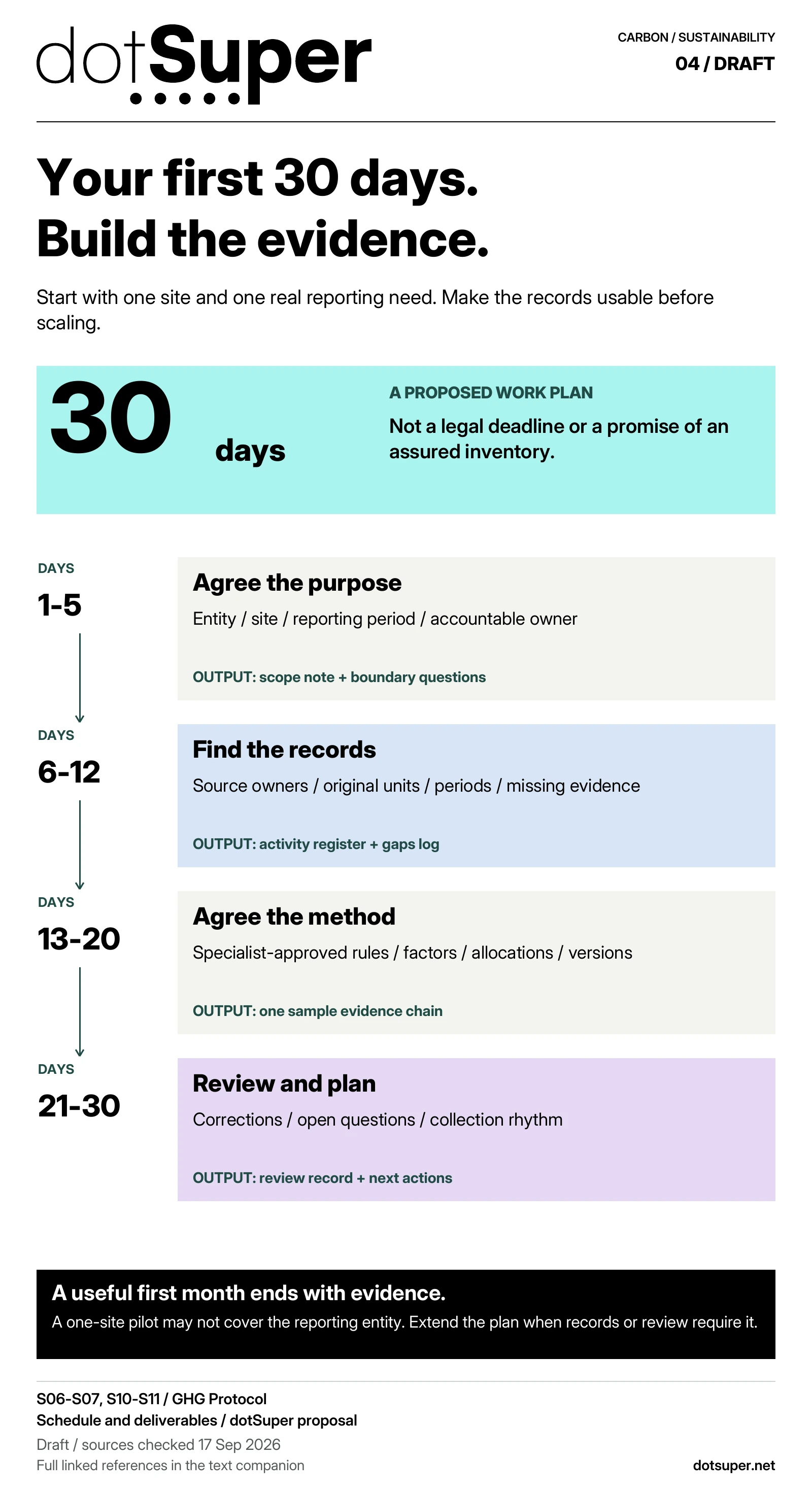
Read the diagram: Start with one site and one real reporting need. Make the records usable before scaling.
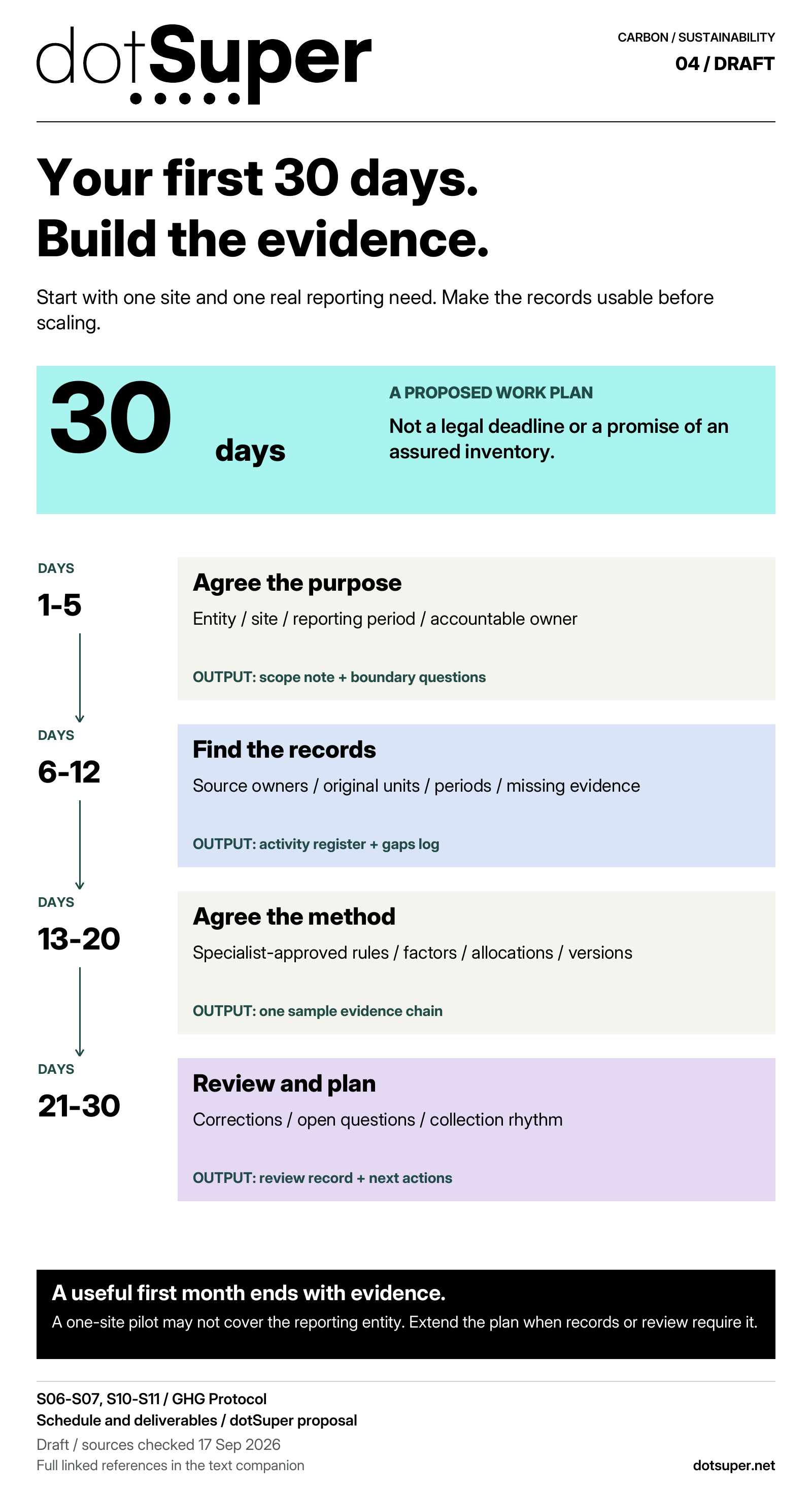
An original 30-day readiness plan: days 1-5 agree purpose and boundary; days 6-12 locate records and gaps; days 13-20 agree the method and prepare a sample; days 21-30 review and plan the next cycle. The schedule is a proposal, not a legal deadline, assurance or guaranteed compliance.
Proposed workflow, not a regulatory deadline. A one-site pilot may not cover the reporting entity. Completion depends on records, scope and specialist availability.
Days 1-12. Find the records.
1-5 / agree purpose, entity, boundary and period.
6-12 / assign source owners and document gaps.
A one-site pilot may not cover the whole reporting entity. Thirty days is a proposed plan, not a legal deadline.
Days 13-20. Agree the method.
Record method and factor versions.
Document conversions and allocations.
Prepare one source-to-result evidence trail.
A qualified specialist approves the approach. AI must not invent factors or fill missing evidence with guesses.
Days 21-30. Make it reviewable.
Record corrections and open questions.
Assign the next collection cycle.
Identify remaining specialist or independent review.
Finish with a reviewable sample and a gaps list. Completion is not assurance, certification or guaranteed compliance.
| Proposed days | Focus | Output | Decision gate |
|---|---|---|---|
| 1-5 | Purpose and boundary | Scope note, entity, site, period and owners | Specialist confirms the intended reporting boundary |
| 6-12 | Source records | Owner map, activity register and missing-evidence log | Known records and gaps remain distinguishable |
| 13-20 | Method and sample | Method/factor versions, allocation record and sample evidence pack | Qualified approval of method; no invented factors |
| 21-30 | Review and next cycle | Corrections, open issues and collection plan | Record remaining specialist or independent-review needs |
Take it into your next working session
Keep the source credits with the file. Check the reuse terms and adapt the method to your context.
Reuse: No public reuse licence has been specified. Source attribution does not grant rights to third-party material.
Reuse: No public reuse licence has been specified. Source attribution does not grant rights to third-party material.
Reuse: No public reuse licence has been specified. Source attribution does not grant rights to third-party material.
Reuse: No public reuse licence has been specified. Source attribution does not grant rights to third-party material.
Thumbnail credit and reuse
Reuse: No public reuse licence has been specified. Source attribution does not grant rights to third-party material.
- 01A reporting purpose determines the boundary and data needed.
- 02Assign owners and keep unknowns visible before calculating.
- 03Finish with a reviewable sample and a gaps list, not a compliance claim.
/ dotSuper point of view
Agree the purpose and boundary, assign data owners, organise source records, and prepare one traceable sample for specialist review. Thirty days is a proposed work plan, not a legal deadline or an assurance promise.
Days 1-5: decide what the work is for
These are different use cases.
Identify the entity, initial site, reporting period, decision owner and requested output before collecting a large quantity of data.
A one-site pilot is a way to learn the workflow.
It does not establish that the full corporate boundary contains only that site.
Ask the accounting specialist to confirm the consolidation approach and what other operations need inclusion.
Record unresolved boundary questions in a short register.
[S06]
The deliverable for this stage is an agreed scope note with named owners.
The five-day block is our planning proposal.
It is not an official deadline or a promise that difficult applicability questions can be resolved in that time.
Days 6-12: locate records and assign owners
Preserve original units and periods.
Record where each item lives, who can explain it and what evidence is missing.
An unavailable record remains a gap rather than becoming an invented zero.
For orientation, Scope 1 covers direct emissions from owned or controlled operations.
Scope 2 concerns purchased energy; Scope 3 covers other upstream and downstream value-chain emissions.
Actual classification depends on the boundary and applicable guidance.
[S07, S10, S11]
Build an activity-data register with an owner, period, source reference, unit, completeness status and next action.
Procurement can coordinate supplier requests, operations can explain production and energy records, and finance can help reconcile the reporting period.
These assignments are examples, not universal department duties.
Days 13-20: make the method reproducible
Record units, versions, conversion rules, allocations and treatment of missing information.
Software should implement those choices visibly rather than choose them silently.
Prepare one sample chain from source evidence to calculation and review status.
Check whether another team member can find the evidence and explain the method.
Do not publish a numerical example simply because a spreadsheet produces a total.
The deliverable is a working method and factor register, an allocation record where relevant, and a sample evidence pack.
A supplier delay or unsuitable data may require extending this block.
Days 21-30: review, correct and plan the next cycle
Assign remaining gaps and agree a future collection rhythm with the data owners.
Record what is ready to use, what is conditional and what still needs independent or specialist review.
The month should end with a useful operating decision: continue the pilot, expand collection, repair a specific gap or pause an unsupported output.
It should not end with a blanket claim that the company is compliant or the inventory assured.
The proposed 30-day outputs are a scope note, owner and source map, activity-data register, approved-method record, sample evidence pack and an open-issues list.
This graphic supplies a schedule and controls, not an emissions total, specialist opinion or verification service.
Who this guide is for
It does not establish national filing duties or a complete corporate inventory boundary.
What this page cannot conclude
- 01Proposed workflow, not a regulatory deadline. A one-site pilot may not cover the reporting entity. Completion depends on records, scope and specialist availability.
- 02Specialist review of purpose, consolidation boundary, period, relevant scopes, methods and factors before reporting.
- 03Do not describe a quick estimate or one-site pilot as an assured or complete company inventory.
- 04Extend the schedule where data quality, missing evidence or required review needs more time. No emissions total or factor is supplied.
Sources
- 01S06: Corporate Accounting and Reporting StandardGHG Protocol · accessed Sep 17, 2026
- 02S07: Scope 2 GuidanceGHG Protocol · accessed Sep 17, 2026
- 03S10: How does the GHG Protocol define and categorize emissions?GHG Protocol Technical Support · accessed Sep 17, 2026
- 04S11: Corporate Value Chain (Scope 3) StandardGHG Protocol · accessed Sep 17, 2026
Our editorial standard · Found an error? Send a correction with its source.
/ CITE OR SHARE THIS GUIDE
Make the evidence easy to verify.
When you reference this guide, link to its canonical URL. That gives readers one stable place for the evidence, limitations and future updates.
dotSuper Research Desk. (September 17, 2026). Your first 30 days. Build the evidence.. dotSuper. https://dotsuper.net/feeds/applied-systems/first-30-days-carbon-data