LTRLS Learning Through Real-Life Scenarios
The buyer needs a carbon number. Can you support it?
Handle five carbon-data decisions involving missing records, reporting boundaries, importer scope, factor versions and approval pressure. Leave with an evidence-response card.
No account needed. Work alone or discuss with a team.
What you will practise
Make the trade-off visible.
Start with the purpose of the request. Match the product, installation, period and method to traceable records, expose unresolved gaps and approve only the statement the evidence supports.
- Identify the reporting purpose before selecting a number.
- Distinguish missing evidence, an approved estimation method and verified actual data.
- Assign importer-level decisions to the people who hold the relevant records.
- Preserve source versions and keep internal approval distinct from external verification.
Built for the people making the call
Original fictional educational cases. Sources support the stated principles; the organisations, records and outcomes are invented. This experience does not determine a real shipment’s obligations, a project’s credit eligibility or a claim’s legal acceptability.
From the exercise to the business
What a better decision could change.
What you will learn
Make a useful response under pressure without concealing a data gap or claiming authority you do not have.
Potential business value
Reduce avoidable clarification loops, duplicated collection and unsupported commitments to customers. Measure those outcomes rather than assuming the exercise creates savings.
How the value could happen
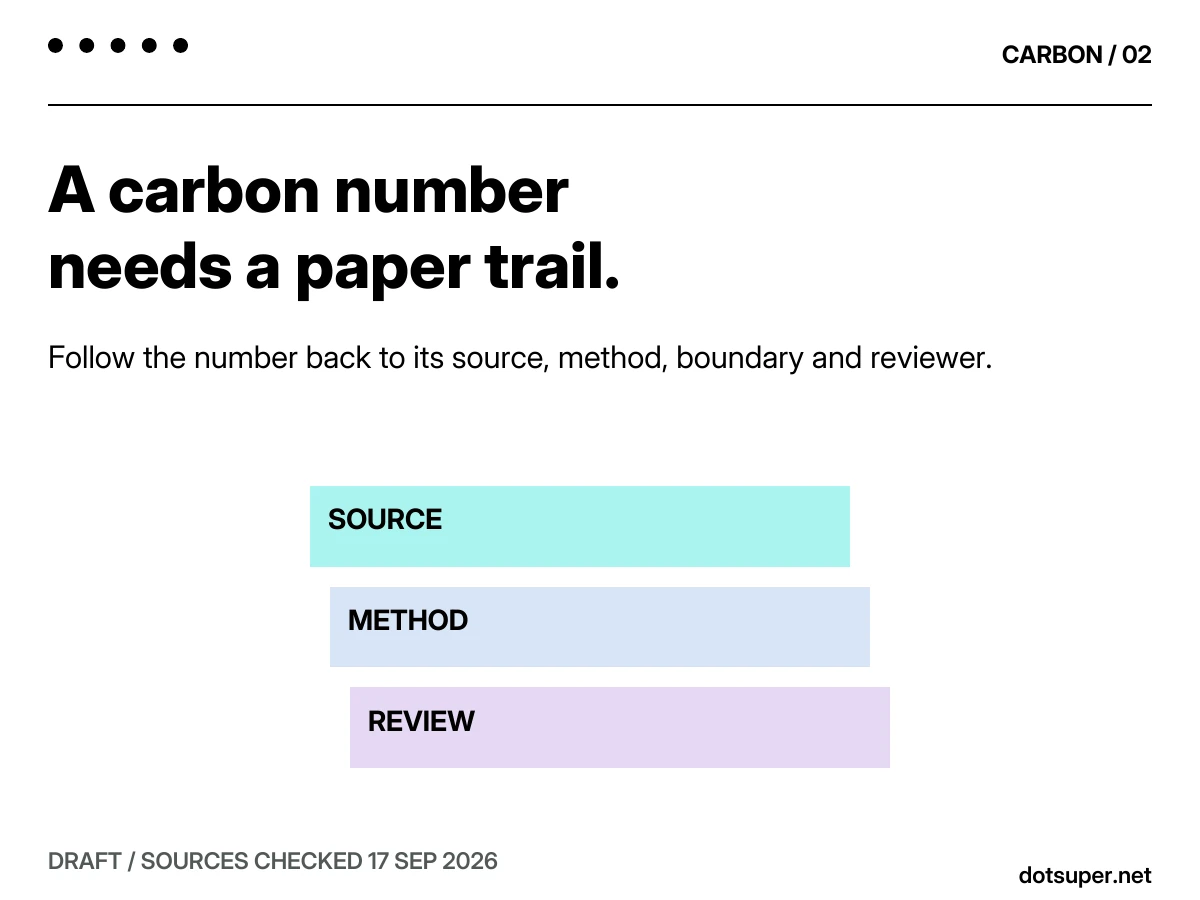
Clear request → matched records → visible gaps with owners → reviewed response → reusable evidence for the same scope.
Measures to examine
- Elapsed time from request to a scoped, usable first response.
- Reopened responses caused by wrong product, site, period or method.
- Relevant evidence items with an owner, source and review state.
- Repeat requests served from still-applicable approved records.
Keep these limits in view
- Do not optimise response speed by deleting unresolved items.
- Internal completeness is not accredited verification.
- Reusing evidence requires checking that its scope and period still match.
- No tariff classification, footprint or legal compliance is calculated by this experience.
A useful next step: Take one anonymised buyer request and complete the purpose, evidence, gap, owner and release fields before discussing automation.
Explore the companion method- 01
Read the situation
Identify the purpose, people and consequences.
- 02
Make your choice
Confirm a response before opening the reasoning.
- 03
Question the control
Discuss what would need to change in a real workflow.
- 04
Leave with a card
Record an owner, evidence, approval conditions and a stop point.
LTRLS / Practise before the real decision
A situation. A choice. A better question.
You coordinate carbon-data requests at a fictional components manufacturer. A buyer needs progress quickly, but a completed spreadsheet can hide the wrong boundary or an unsupported assertion. Make five decisions and build a response that another person can review.
Progress and notes stay in this page’s memory. Refreshing, leaving or closing the page loses them. Use anonymous examples and roles.
Running this with a team?
- Allow roughly 30 to 40 minutes for the five cases and a longer team discussion if needed; this timing is an estimate.
- Ask participants to identify the intended recipient and decision before choosing.
- Have sales explain the deadline and quality explain the evidence limit, then draft one joint response.
- Read every option’s consequence. A recommendation is conditional on the fictional facts.
- Use anonymous roles and invented record IDs. Notes stay in the existing player’s page memory and can be printed locally.
- Finish by naming one workflow measure, its current baseline and an owner. Do not award a compliance or competence score.
Prefer to read?
The complete case notes.
The same situations and reasoning, without the interactive flow.
Open all 5 cases
Case 01
The supplier sent a brochure
A fictional manufacturer is preparing a preliminary buyer pack for a steel component. Procurement must respond tomorrow. Evidence 1 (Buyer request): The buyer asks for the relevant steel-input emissions evidence and the producing installation. Evidence 2 (Available records): A delivery note identifies the mill. Its brochure gives a group sustainability average, without a product method or matching period. Evidence 3 (Pressure): The account manager wants to use the brochure figure so the sheet appears complete.
Which response moves the request forward most credibly?
- Use the group average as a provisional supplier value and add a general disclaimer.
- Send the matched records, identify the missing carbon evidence and assign the next request and method review.
- Withhold the entire response until the supplier provides every carbon field.
Recommended response for this scenario
Send the matched records, identify the missing carbon evidence and assign the next request and method review.
The brochure is not evidence for the requested input result. Relevant precursor data matters under the applicable CBAM method; a group average does not establish that match. Organise the known records and refer the missing-data treatment to the emissions specialist. Do not invent an actual value or assume all estimation routes are interchangeable.
Why each choice matters
- Use the group average as a provisional supplier value and add a general disclaimer.
- The buyer receives a number, but its connection to this input remains unsupported. A broad disclaimer does not establish the missing product, installation, period or method match. It also risks the provisional value being copied into a final field.
- Send the matched records, identify the missing carbon evidence and assign the next request and method review.
- The buyer can act on the known facts and see the unresolved dependency. This preserves the commercial conversation while procurement pursues the identified mill and a specialist determines what the applicable method permits.
- Withhold the entire response until the supplier provides every carbon field.
- The carbon value remains unmisstated, but useful identity and traceability records also stay unavailable. A scoped response with explicit gaps can support the buyer’s planning. Total silence is not required by these facts.
Practical control: Today, link the delivery record to the mill, request the specified evidence, record the gap owner and agree an update date. Ask the specialist to document the applicable treatment if the gap remains. Have the buyer confirm the intended use of the preliminary pack.
Discuss: What useful information can you send immediately, and which statement must remain open?
- Guidance No. 5d: Iron and steelEuropean Commission · Accessed 2026-09-18
- Guidance No. 3: CBAM methods for embedded emissionsEuropean Commission · Accessed 2026-09-18
Case 02
One company total, three different questions
The same manufacturer has a corporate emissions inventory. Sales wants one reusable carbon number for every customer questionnaire. Evidence 1 (Inventory): The existing report covers several sites and an annual company boundary. Evidence 2 (Requests): One customer asks for a product footprint; another asks for embedded-emissions data for a named CBAM good. Evidence 3 (Proposed shortcut): Finance can divide the corporate total by all tonnes sold, but no product allocation method has been agreed.
How should you decide what can be reused?
- Divide the corporate total by output and use that average in both responses.
- Commission two entirely new data-collection exercises and ignore the inventory records.
- Map each request to its purpose and boundary, then reuse only the records that match.
Recommended response for this scenario
Map each request to its purpose and boundary, then reuse only the records that match.
The Corporate Standard addresses corporate inventories. A CBAM result follows its own goods and production rules; a product-footprint request also needs its specified method and boundary. The sensible reuse unit is often the underlying record, not the final number. Clarify what each recipient actually needs before commissioning more work.
Why each choice matters
- Divide the corporate total by output and use that average in both responses.
- Both customers receive a consistent-looking value. Consistency of presentation does not establish appropriate boundaries, allocation or included processes for either request.
- Commission two entirely new data-collection exercises and ignore the inventory records.
- Each response starts separately, but the team may recollect useful records it already holds. The result needs its own method; the underlying invoices, meter records and production data may still be reusable after a scope check.
- Map each request to its purpose and boundary, then reuse only the records that match.
- The team separates the method decisions while retaining useful shared evidence. A short mapping step reveals missing product or installation detail before someone treats a company average as a qualified product result.
Practical control: Create a request map with purpose, unit, product, site, period, included processes and method owner. Mark each existing record reusable, partially applicable or unusable for that request, with a reason. Resolve allocation and boundary choices with the responsible specialist.
Discuss: Which record could support both responses even though their final results cannot be copied across?
- GHG Protocol Corporate StandardGHG Protocol · Accessed 2026-09-18
- Guidance No. 3: CBAM methods for embedded emissionsEuropean Commission · Accessed 2026-09-18
Case 03
Our shipments are small. Is the importer exempt?
A fictional exporter supplied 14 tonnes of a potentially covered steel good to one EU customer during 2026. Sales proposes marking the customer exempt from CBAM. Evidence 1 (Exporter log): It shows only this exporter’s shipments. Evidence 2 (Customer position): The EU importer also buys from other suppliers; its relevant annual aggregate is unknown. Evidence 3 (Classification): The product’s final CN classification and import treatment still await the customer’s qualified reviewer.
What is the strongest next response?
- Send the known shipment records and ask the importer’s responsible team to confirm scope and its annual aggregate.
- Confirm exemption because this exporter supplied less than 50 tonnes.
- Treat every EU shipment as definitely subject to the full CBAM obligations.
Recommended response for this scenario
Send the known shipment records and ask the importer’s responsible team to confirm scope and its annual aggregate.
The 50-tonne test aggregates relevant goods by importer and calendar year, not by individual supplier. Electricity and hydrogen do not use that exemption. Here, classification and aggregation are unresolved, so the evidence supports neither a confirmed exemption nor a final liability conclusion.
Why each choice matters
- Send the known shipment records and ask the importer’s responsible team to confirm scope and its annual aggregate.
- The decision reaches the party that can establish the missing import information. This avoids converting the exporter’s limited visibility into an exemption assurance while still providing evidence the customer needs.
- Confirm exemption because this exporter supplied less than 50 tonnes.
- The conclusion may be used in the customer’s planning before its relevant imports are known. The exporter’s shipment log is not the importer’s full calendar-year position.
- Treat every EU shipment as definitely subject to the full CBAM obligations.
- The team avoids a small-shipment assumption but creates a different unsupported conclusion. Unknown classification and an unresolved exemption assessment should remain open until reviewed, rather than automatically becoming “in scope”.
Practical control: Send product specifications, proposed classification, origin and shipment net-mass records. Ask the importer or its appointed team to document the applicable scope and annual aggregation. Record who made the decision and what changes would trigger reassessment.
Discuss: Which facts belong to the exporter, and which can only the importer or its appointed team establish?
- CBAM Regulation, consolidated 20 October 2025: Article 2a and Annex VIIEuropean Union / EUR-Lex · Accessed 2026-09-18
- CBAM definitive regimeEuropean Commission · Accessed 2026-09-18
Case 04
The spreadsheet still says final
A colleague reuses last year’s carbon workbook for a 2026 buyer request. The formulas run without errors. Evidence 1 (Old workbook): A factor tab was copied from a transitional-period file. It has no retained source link or applicability note. Evidence 2 (Current library): The Commission now lists definitive-period materials and corrected defaults. Evidence 3 (Commercial concern): Sales wants comparable year-on-year numbers and worries that changing the workbook will move the result.
What should you do before approving the output?
- Keep the old factor set for comparability and explain the approach if asked.
- Preserve the old file, identify the applicable source and review the changed assumptions before releasing a new version.
- Replace every factor with the newest number found online and keep the workbook name.
Recommended response for this scenario
Preserve the old file, identify the applicable source and review the changed assumptions before releasing a new version.
A formula check does not establish source applicability. The Commission distinguishes definitive materials from earlier reporting material and identifies corrections. Determine which source governs this use, retain its version and the old calculation, and explain material differences. Do not select a factor because it produces a preferred answer.
Why each choice matters
- Keep the old factor set for comparability and explain the approach if asked.
- The series appears stable, but the current response may use an inapplicable source. Comparability is something to explain and reconcile; it does not justify concealing a methodology mismatch.
- Preserve the old file, identify the applicable source and review the changed assumptions before releasing a new version.
- The team can distinguish a method update from a change in business activity. A controlled comparison supports an explanation of the revision and makes the chosen source reproducible.
- Replace every factor with the newest number found online and keep the workbook name.
- Some cells become newer, but the result loses a clear basis and version history. The newest date alone does not establish the right product, country, year, unit or reporting purpose.
Practical control: Record the source URL, instrument or document version, applicable year, product/country mapping, units and reviewer. Compare the old and proposed method on the same activity data before releasing a clearly versioned response. Keep unresolved differences in the review queue.
Discuss: How would you tell the buyer whether a changed result came from the factory or from the calculation basis?
- CBAM legislation and guidanceEuropean Commission · Accessed 2026-09-18
- Guidance No. 3: CBAM methods for embedded emissionsEuropean Commission · Accessed 2026-09-18
Case 05
The customer deadline is today
At 4 p.m. a buyer portal asks for a “verified” supplier carbon pack. Sales has promised an upload by 5 p.m.; this is a customer deadline, not a statutory filing date. Evidence 1 (Internal checks): Your team matched the source files and resolved its spreadsheet questions. Evidence 2 (External status): No accredited CBAM verification report supports the pack. The portal does not explain what its checkbox means. Evidence 3 (Relationship): The buyer needs a useful status update to plan its next step.
Which action respects the deadline without overstating the evidence?
- Tick verified because quality has completed the internal checks.
- Cancel the response and tell sales to stop discussing the request.
- Contact the buyer with an internally reviewed pack and explicit status, and agree the permitted upload or alternative response.
Recommended response for this scenario
Contact the buyer with an internally reviewed pack and explicit status, and agree the permitted upload or alternative response.
For an actual-emissions CBAM route, the relevant independent verification has its own accreditation requirements. Software checks and internal approval cannot supply that status. Clarify the customer’s term, communicate what has been done and agree a truthful next step. Buyer acceptance of preliminary material does not itself complete verification.
Why each choice matters
- Tick verified because quality has completed the internal checks.
- The portal may present the pack as independently verified. The checkbox’s ambiguity does not turn internal approval into the separate verification the buyer may expect.
- Cancel the response and tell sales to stop discussing the request.
- An unsupported attestation is avoided, but the buyer receives no useful evidence or recovery plan. The unresolved label is a reason to clarify the handoff, not automatically abandon the relationship.
- Contact the buyer with an internally reviewed pack and explicit status, and agree the permitted upload or alternative response.
- The buyer can distinguish available evidence from the missing verification. If the portal only accepts an unsupported attestation, keep that attestation on hold and escalate the commercial deadline rather than guessing its meaning.
Practical control: Record the internal review scope and outstanding external status separately. Send the buyer the available evidence, gap and proposed follow-up. Obtain a written clarification of the requested assertion; release only the version and statement the approver can support.
Discuss: What exact sentence would you send so the buyer can act without interpreting “reviewed” as “verified”?
- Verification of CBAM emissionsEuropean Commission · Accessed 2026-09-18
Worked example / Fictional teaching context
Carbon request and evidence-response card
Illustrative assumptions, not a customer result, forecast or professional assessment. Keep the conditions beside the numbers.
- Purpose
- A fictional EU buyer is collecting preliminary 2026 supplier information; the manufacturer is not making a customs declaration.
- Scope
- Product family R, Plant A, named production route and 2026 reporting period. Confirm whether the buyer needs preliminary or final-year data.
- Evidence available
- Purchase and production records identify the input supplier and installation. Supplier carbon evidence has not yet been provided.
- Gap
- The proposed precursor actual-data field cannot be substantiated from the supplier brochure. Do not label it verified.
- Owner and action
- Procurement requests the installation-specific records; the emissions specialist determines the applicable route for unresolved data.
- First response
- Send the matched records that can be shared, a plain-language gap list and a proposed next update. Obtain the buyer’s agreement on how provisional information may be used.
- Approval
- Quality approves the scope and wording. External verification is a separate outstanding state, not a renamed internal check.
- Success measure
- The buyer can identify what is usable, what remains open and who is resolving it without interpreting blank cells as zero.
Try the idea in a different situation
A second customer requests a product footprint for procurement rather than CBAM. Your team wants to copy the previous response. Write what can be reused, which boundaries and methods need confirmation, and the sentence you will send while those questions are open.
Prompts for your discussion
- Names the changed purpose and explains why the earlier result cannot simply be relabelled.
- Reuses source records only where product, site and period match.
- Keeps the method decision and approval owner explicit.
- Provides a useful next step and update date instead of an unsupported final number.
Use these prompts to examine the reasoning, not to award a score or certify readiness.
Sources and limits
Keep the context with the decision.
Original fictional educational cases. Sources support the stated principles; the organisations, records and outcomes are invented. This experience does not determine a real shipment’s obligations, a project’s credit eligibility or a claim’s legal acceptability.
Editorial source review: 2026-09-18. Not legal approval or a verified readiness assessment.
- CBAM definitive regimeEuropean Commission · Accessed 2026-09-18
- CBAM Regulation, consolidated 20 October 2025: Article 2a and Annex VIIEuropean Union / EUR-Lex · Accessed 2026-09-18
- Guidance No. 3: CBAM methods for embedded emissionsEuropean Commission · Accessed 2026-09-18
- Guidance No. 5d: Iron and steelEuropean Commission · Accessed 2026-09-18
- CBAM legislation and guidanceEuropean Commission · Accessed 2026-09-18
- Verification of CBAM emissionsEuropean Commission · Accessed 2026-09-18
- GHG Protocol Corporate StandardGHG Protocol · Accessed 2026-09-18
- All scenarios and records are fictional. The recommendations are original applications to the stated facts, not conclusions from an authority about a real business.
- Sources were reviewed on 18 September 2026. Rules, methods and claim requirements can change; recheck them for a real decision.
- No emissions factors, numerical footprint, credit price or revenue forecast is supplied.
- The lesson provides no competence score, legal determination, certification, institutional endorsement or verified business outcome.
- Estimated duration and learning usefulness have not been evaluated with intended participants.
- No independent subject-matter sign-off is claimed. Source research supports educational scenarios, not a determination for a real business.
/ CITE OR SHARE THIS GUIDE
Make the evidence easy to verify.
When you reference this guide, link to its canonical URL. That gives readers one stable place for the evidence, limitations and future updates.
dotSuper Research Desk. (September 18, 2026). The buyer needs a carbon number. Can you support it?. dotSuper. https://dotsuper.net/feeds/applied-systems/carbon-evidence-decision-lab
Move from practice to your operating context
Bring one decision into your operating context.
Take one anonymised buyer request and complete the purpose, evidence, gap, owner and release fields before discussing automation.
Explore with dotSuper