/ THE SHORT ANSWER
See the method. Keep the context.
The visual companion
Reuse: No public reuse licence has been specified. Source attribution does not grant rights to third-party material.
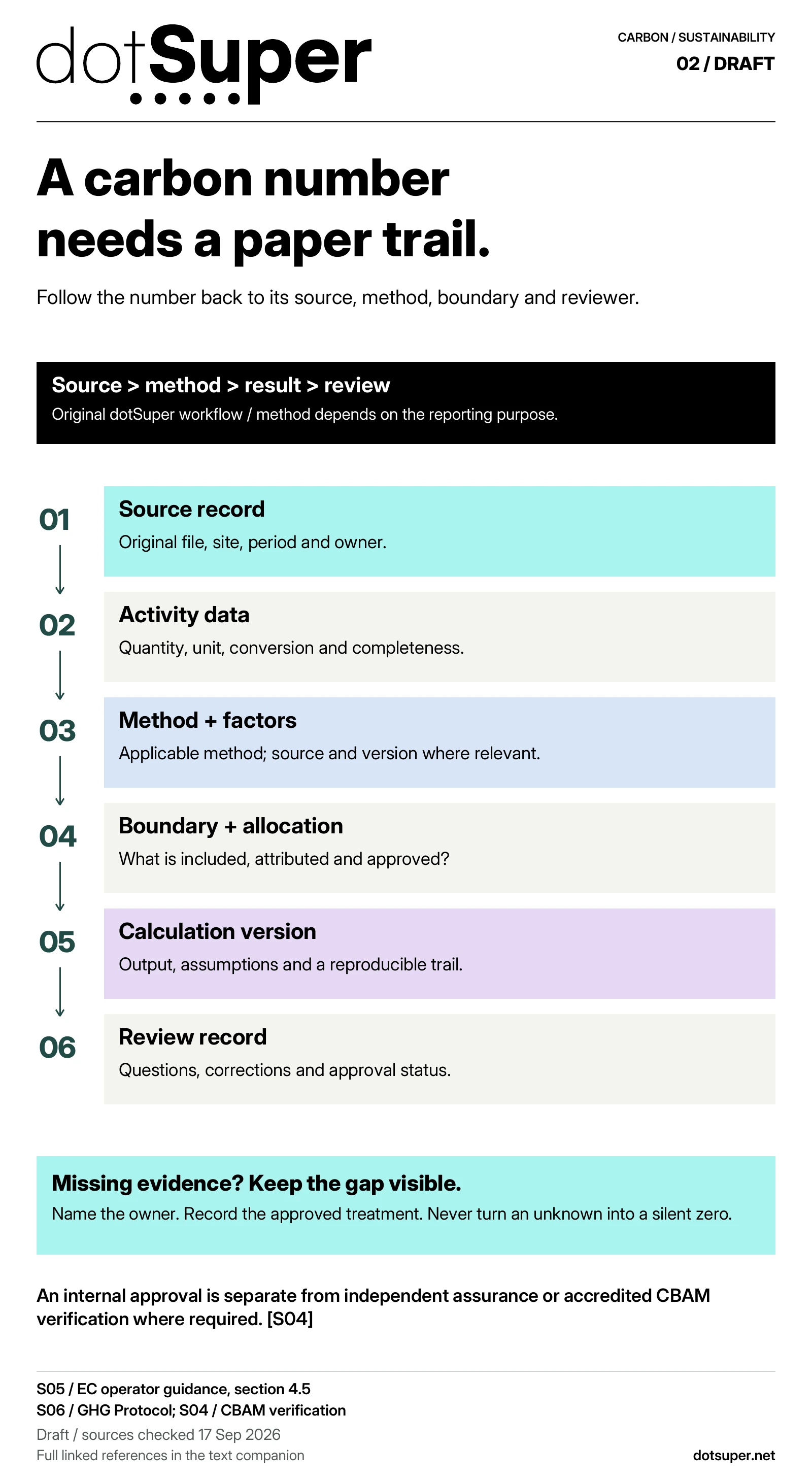
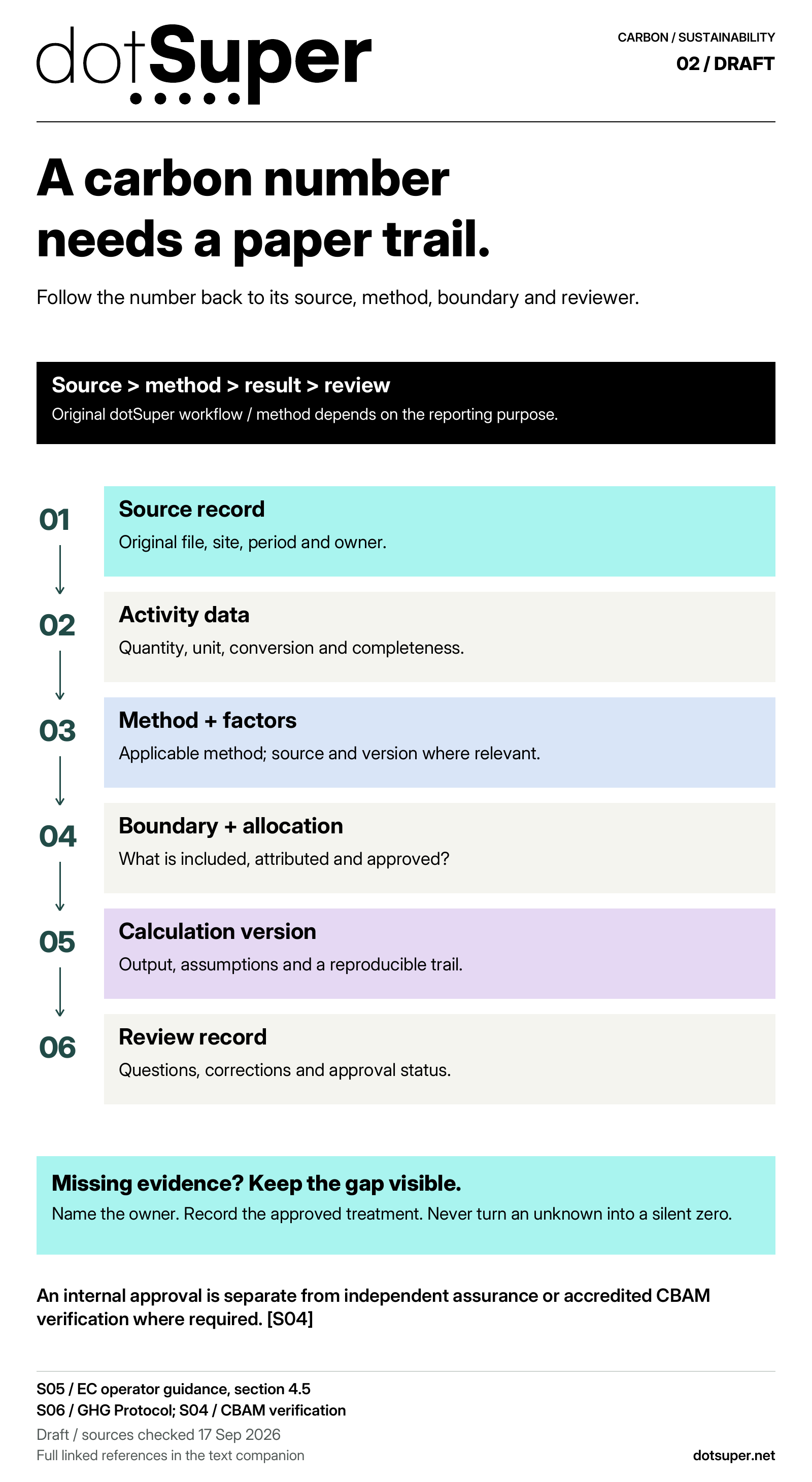
Read the diagram: Follow the number back to its source, method, boundary and reviewer.
A six-stage carbon evidence chain connects the source record, activity data, method and factors, boundary and allocation, calculation version, and review record. Missing evidence is assigned an owner and remains visible. Internal approval is separate from independent assurance or accredited CBAM verification where required.
Original dotSuper workflow. The applicable accounting method determines the records needed. Internal review does not replace independent assurance or CBAM verification.
Start with the record. Keep the original.
Source / file, site, period and owner.
Activity / quantity, unit and any conversion.
Method / applicable rule, factor source and version.
If evidence is missing, label the gap and name its owner. Do not silently invent a value.
Make the result reproducible.
Boundary / what belongs in the calculation?
Allocation / what basis assigns emissions?
Calculation / which version and assumptions?
The specialist approves the applicable method. A corporate total is not automatically a CBAM product result.
A reviewer needs more than a total.
Trace the source and calculation.
Record questions and corrections.
Keep approval and external-review states separate.
Internal sign-off does not replace independent assurance or accredited CBAM verification where required.
| Stage | Retain | Review question |
|---|---|---|
| 1. Source | Original record, site, period, owner and stable reference | Can we find the underlying evidence? |
| 2. Activity data | Quantity, original unit, conversions and gaps | Does the value describe the correct activity? |
| 3. Method | Applicable rule; factor source, units and version where relevant | Who approved the method and factor? |
| 4. Boundary / allocation | Reporting boundary, allocation basis and rationale | Does the attribution match the intended purpose? |
| 5. Calculation | Version, output and unresolved assumptions | Can another person reproduce the result? |
| 6. Review | Reviewer, corrections, decision and external-review status | What was checked, and what remains open? |
Take it into your next working session
Keep the source credits with the file. Check the reuse terms and adapt the method to your context.
Reuse: No public reuse licence has been specified. Source attribution does not grant rights to third-party material.
Reuse: No public reuse licence has been specified. Source attribution does not grant rights to third-party material.
Reuse: No public reuse licence has been specified. Source attribution does not grant rights to third-party material.
Reuse: No public reuse licence has been specified. Source attribution does not grant rights to third-party material.
Thumbnail credit and reuse
Reuse: No public reuse licence has been specified. Source attribution does not grant rights to third-party material.
- 01Preserve original records alongside extracted values.
- 02A factor without its source and version is incomplete evidence.
- 03Separate data preparation, internal approval and independent verification.
/ dotSuper point of view
Keep the source record, activity data, method and factor version, allocation decisions and review history connected. The chain should explain what was measured, what was assumed and who approved the result.
Build a chain a second person can follow
The sequence in this graphic is dotSuper’s proposed workflow, not an official reporting template.
Its purpose is to make questions and missing evidence visible before an external request becomes urgent.
Begin with a real reporting purpose.
A corporate inventory, product footprint and CBAM embedded-emissions calculation use different boundaries.
A company total cannot simply be relabelled as a product’s CBAM result.
The GHG Protocol Corporate Standard addresses corporate inventories, while CBAM has its own methodology.
[S05, S06]
Preserve six connected records
Record the site, period and source owner.
Keep a stable reference to the original file rather than only an extracted spreadsheet cell.
Second, prepare activity data with its original unit, relevant conversions and completeness status.
Third, attach the approved calculation method and factor source, version and units where a factor-based method applies.
Do not use a plausible value from an AI response as an authorised factor.
Fourth, document the boundary and any required allocation.
Keep the rationale, basis and responsible specialist connected to the result.
Fifth, store the calculation version, outputs and unresolved assumptions.
Sixth, record the reviewer, questions, corrections and approval state.
The Commission’s definitive-period operator guidance describes monitoring plans, source data, controls and versioned documentation.
It also ties the record trail to verification.
The six-part diagram is our practical organisation of those concerns, not a replacement for the required monitoring plan.
[S05]
Let gaps stop unsupported claims
Record whether the chosen method permits an estimate or default, who approved that treatment and how the result is qualified.
Do not silently substitute a corporate average for product-specific evidence.
Retain the correction trail.
When a source changes, identify affected calculations and response packs.
If a number has already been shared, keep the old version, issue the corrected version and record who received it.
These are proposed operating controls, not evidence that the resulting estimate is independently assured.
For applicable CBAM actual-emissions reporting, an accredited independent verifier has a distinct role.
Internal sign-off and software consistency checks do not confer that status.
[S04]
Start with one complete trail
Ask a colleague who did not prepare it to locate the original record, identify the period and unit, explain the method and find the approval.
Record the questions they cannot answer.
Use those questions to improve ownership and the data schema before selecting more software.
This guide contains no calculated emissions value and makes no claim about savings, assurance, compliance or regulator acceptance.
Who this guide is for
What this page cannot conclude
- 01Original dotSuper workflow. The applicable accounting method determines the records needed. Internal review does not replace independent assurance or CBAM verification.
- 02A qualified specialist must approve the reporting purpose, boundary, applicable method, factors and allocations.
- 03Apply the retention and verification requirements for the actual role and programme; no universal retention period is proposed.
- 04Review the final evidence pack before external use. No emissions factor, footprint or measured outcome has been invented.
Sources
- 01S05: Guidance No. 3: CBAM methods for the calculation of emissions embedded in goodsEuropean Commission · accessed Sep 17, 2026
- 02S06: Corporate Accounting and Reporting StandardGHG Protocol · accessed Sep 17, 2026
- 03S04: Verification of CBAM emissionsEuropean Commission · accessed Sep 17, 2026
Our editorial standard · Found an error? Send a correction with its source.
/ CITE OR SHARE THIS GUIDE
Make the evidence easy to verify.
When you reference this guide, link to its canonical URL. That gives readers one stable place for the evidence, limitations and future updates.
dotSuper Research Desk. (September 17, 2026). A carbon number needs a paper trail.. dotSuper. https://dotsuper.net/feeds/applied-systems/carbon-evidence-chain