/ THE SHORT ANSWER
See the method. Keep the context.
The visual companion
Reuse: No public reuse licence has been specified. Source attribution does not grant rights to third-party material.
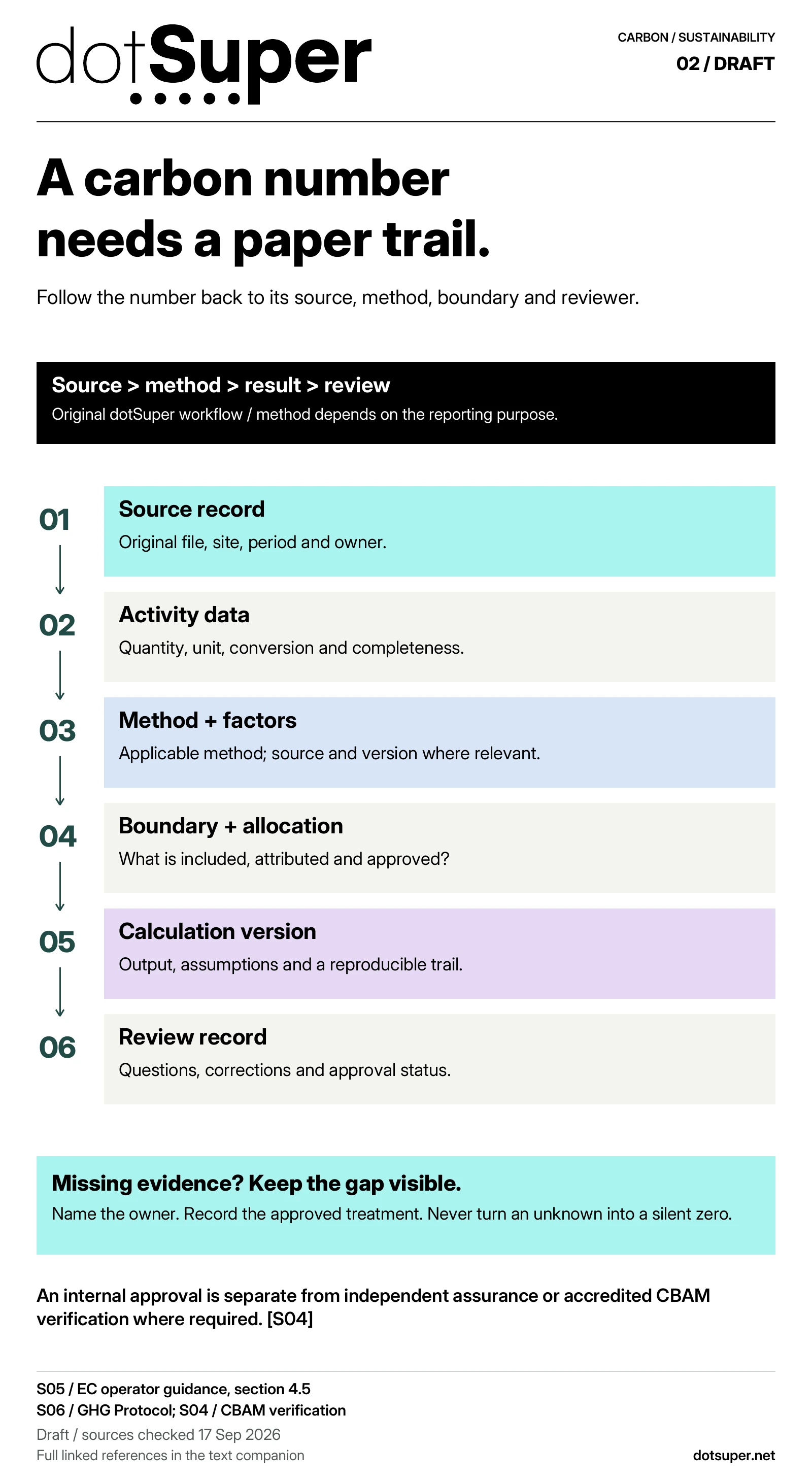
Read the diagram: Related visual guide: A carbon number needs a paper trail. This dotSuper diagram illustrates the surrounding workflow; the article covers the specific topic.
A six-stage carbon evidence chain connects the source record, activity data, method and factors, boundary and allocation, calculation version, and review record. Missing evidence is assigned an owner and remains visible. Internal approval is separate from independent assurance or accredited CBAM verification where required.
Original dotSuper workflow. The applicable accounting method determines the records needed. Internal review does not replace independent assurance or CBAM verification.
Start with the record. Keep the original.
Source / file, site, period and owner.
Activity / quantity, unit and any conversion.
Method / applicable rule, factor source and version.
If evidence is missing, label the gap and name its owner. Do not silently invent a value.
Make the result reproducible.
Boundary / what belongs in the calculation?
Allocation / what basis assigns emissions?
Calculation / which version and assumptions?
The specialist approves the applicable method. A corporate total is not automatically a CBAM product result.
A reviewer needs more than a total.
Trace the source and calculation.
Record questions and corrections.
Keep approval and external-review states separate.
Internal sign-off does not replace independent assurance or accredited CBAM verification where required.
| Stage | Retain | Review question |
|---|---|---|
| 1. Source | Original record, site, period, owner and stable reference | Can we find the underlying evidence? |
| 2. Activity data | Quantity, original unit, conversions and gaps | Does the value describe the correct activity? |
| 3. Method | Applicable rule; factor source, units and version where relevant | Who approved the method and factor? |
| 4. Boundary / allocation | Reporting boundary, allocation basis and rationale | Does the attribution match the intended purpose? |
| 5. Calculation | Version, output and unresolved assumptions | Can another person reproduce the result? |
| 6. Review | Reviewer, corrections, decision and external-review status | What was checked, and what remains open? |
Take it into your next working session
Keep the source credits with the file. Check the reuse terms and adapt the method to your context.
Credit: Original dotSuper educational content and diagrams.
Reuse: Copyright dotSuper. No new public reuse licence is assigned; third-party sources retain their own terms.
Thumbnail credit and reuse
Reuse: No public reuse licence has been specified. Source attribution does not grant rights to third-party material.
- 01Use real evidence tasks, not feature lists alone.
- 02Keep accounting choices and review controls visible.
- 03Compare operating effort, not only subscription price.
/ dotSuper point of view
buy for a defined workflow, not a generic promise of compliance. A useful platform should make evidence and decisions easier to trace. It should not make uncertainty easier to hide.
Start with the real request
That is not an argument against carbon-accounting software.
It is an argument for testing what happens before the chart appears: where the data came from, what rule was applied, what was missing and who approved the result.
The short answer: buy for a defined workflow, not a generic promise of compliance.
A useful platform should make evidence and decisions easier to trace.
It should not make uncertainty easier to hide.
Write the use case before the vendor shortlist
Try: "We need to collect activity records from three sites, maintain approved factors, resolve missing evidence and release a reviewed inventory pack for this reporting period."
A corporate inventory, a product footprint, a carbon project and a CBAM response are different use cases.
The GHG Protocol itself distinguishes corporate accounting from project-credit quantification.
Corporate Standard.
Ask which use case the product actually supports, what configuration is required and which responsibilities remain with your team or external specialists.
A module name is not evidence of fitness for purpose.
Test eight capabilities with your own sample
Use them to compare demonstrated behaviour, not to award a compliance badge.
| Capability | Demonstration to request |
|---|---|
| Evidence traceability | Open a reported value and follow it to the original source |
| Method control | Show the factor, unit, version, geography and approved use |
| Exceptions | Import a missing or conflicting record and show the resolution workflow |
| Review separation | Demonstrate preparer and approver roles |
| Change history | Correct a value without losing the previous released version |
| Supplier intake | Keep a draft supplier answer distinct from accepted evidence |
| Portability | Export records, methods and evidence references in usable formats |
| Security and access | Restrict a supplier or site user to the appropriate information |
Ask harder questions about methodology
Can your technical reviewer approve a methodology change before it affects outputs?
What happens when a supplier's figure has an incompatible boundary or period?
For electricity-related accounting, contractual instruments have specific quality considerations under Scope 2 guidance.
A platform should not convert an uploaded renewable-energy document into a zero-emissions result without an appropriate method and review.
Scope 2 Guidance.
For CBAM actual emissions, a software label does not replace the relevant accredited independent verification.
Ask what the platform exports for that process rather than accepting "verification included" without understanding the provider and scope.
Commission verification guidance.
When a spreadsheet can be enough
The word controlled matters more than the file extension.
Warning signs include simultaneous incompatible copies, unclear ownership, repeated manual transformations, lost approvals and difficulty reconstructing a released result.
Those are reasons to assess a more structured system, not proof that every company needs an enterprise platform immediately.
Before replacing a spreadsheet, document what it currently does well.
Otherwise, you may pay to recreate its useful logic while leaving the underlying ownership problem untouched.
Where AI helps, and where it should stop
Each extracted field should retain its source reference so a reviewer can resolve an error.
Do not let a model invent missing meter readings, select legal classifications from a product name, approve a novel allocation or publish a regulatory claim without accountable review.
Confidence scores are not proof of accuracy.
A plausible answer can be wrong in exactly the way that matters to the reporting use case.
Choose a small set of representative documents, including difficult ones.
Keep the expected interpretation and technical decisions with the reviewer, not with the system being evaluated.
A fictional pilot that reveals the real issue
It extracts quantities correctly but cannot distinguish two meters belonging to different sites.
The dashboard combines them, producing a result that looks internally consistent.
The purchasing team could celebrate extraction accuracy.
The better decision is to fix the site-identification and approval workflow before scaling.
Automation has accelerated a boundary error, not solved the accounting task.
The pilot should therefore evaluate the full chain from source to approved output, not just OCR accuracy or dashboard appearance.
Compare cost beyond the subscription
Clarify who owns the records and how you retrieve them if the subscription ends.
For a scorecard, choose weights based on the actual use case.
Keep non-negotiable requirements separate from weighted preferences: a strong dashboard score must not compensate for unacceptable access controls or an inability to preserve evidence.
A vendor's refusal to demonstrate a critical workflow is an unresolved risk, not automatically a zero or a passing result.
Record what was shown, by whom and with which sample.
Where dotSuper can help
We can scope implementation around approved methods, while technical accounting and independent assurance remain with the appropriate specialists.
Scope a carbon-data systems pilot.
What this page cannot conclude
- 01General educational information, not legal, tax, investment or accredited verification advice. Rules and methods can change.
- 02No independent expert review or customer-specific determination is claimed. Fictional examples are teaching aids, not client results.
- 03Editorial recommendations, not a vendor ranking. Confirm delivery capabilities and security requirements before any commercial offer.
- 04The worksheet is an original operating template, not an official form or guarantee of acceptance.
Sources
- 01Corporate StandardGHG Protocol · accessed Sep 17, 2026
- 02Scope 2 GuidanceGHG Protocol · accessed Sep 17, 2026
- 03Commission verification guidanceEuropean Commission / European Union · accessed Sep 17, 2026
Our editorial standard · Found an error? Send a correction with its source.
/ CITE OR SHARE THIS GUIDE
Make the evidence easy to verify.
When you reference this guide, link to its canonical URL. That gives readers one stable place for the evidence, limitations and future updates.
dotSuper Research Desk. (September 17, 2026). Carbon Software: Fix the Data Before Buying. dotSuper. https://dotsuper.net/feeds/applied-systems/carbon-software-fix-data-before-buying
Carbon Software Selection Scorecard
Compare software using the same evidence tasks, explicit weights and non-negotiable requirements.
Open the framework