/ THE SHORT ANSWER
See the method. Keep the context.
The visual companion
Reuse: No public reuse licence has been specified. Source attribution does not grant rights to third-party material.
Read the diagram: Related visual guide: Your first 30 days. Build the evidence. This dotSuper diagram illustrates the surrounding workflow; the article covers the specific topic.
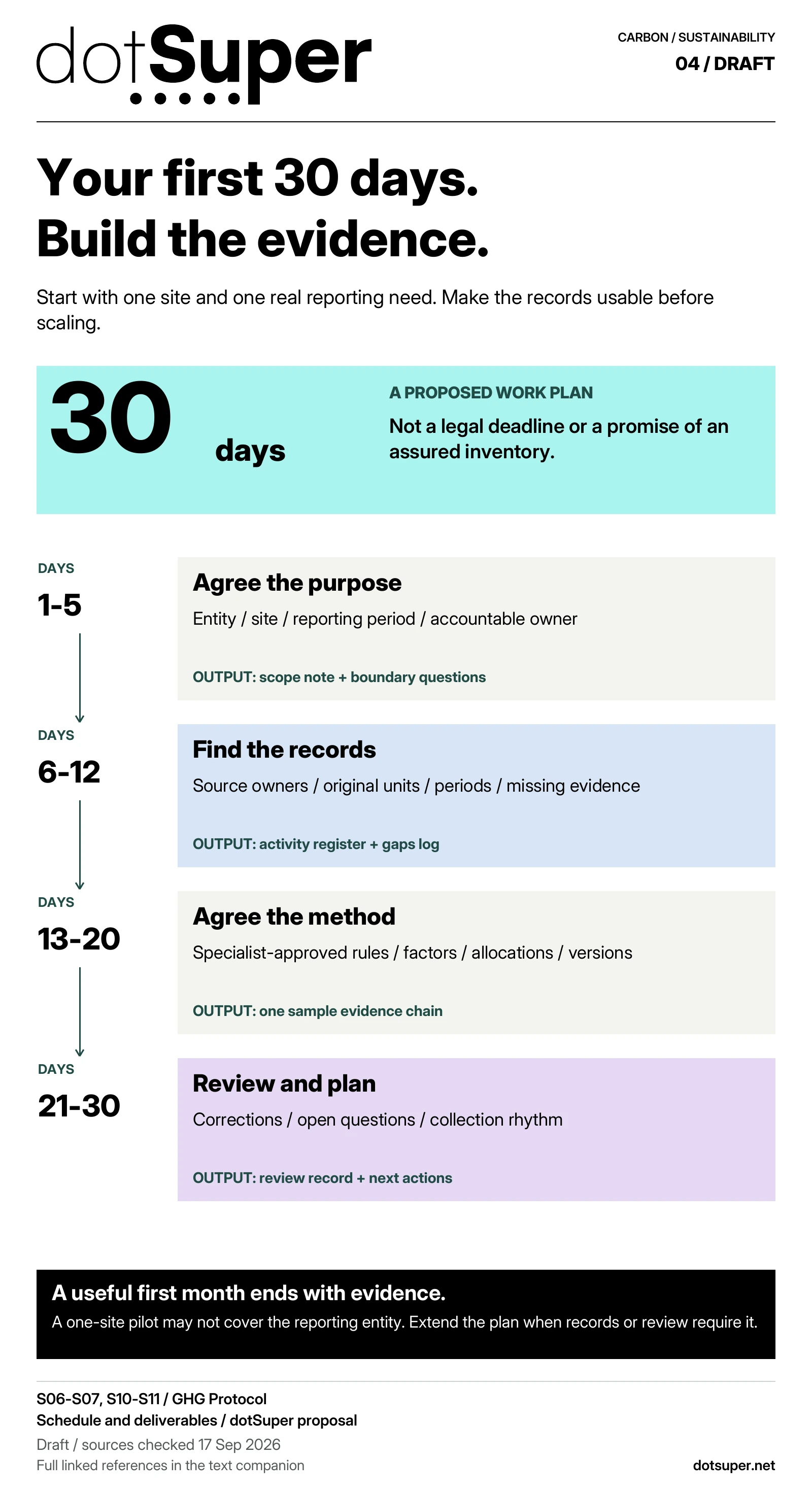
An original 30-day readiness plan: days 1-5 agree purpose and boundary; days 6-12 locate records and gaps; days 13-20 agree the method and prepare a sample; days 21-30 review and plan the next cycle. The schedule is a proposal, not a legal deadline, assurance or guaranteed compliance.
Proposed workflow, not a regulatory deadline. A one-site pilot may not cover the reporting entity. Completion depends on records, scope and specialist availability.
Days 1-12. Find the records.
1-5 / agree purpose, entity, boundary and period.
6-12 / assign source owners and document gaps.
A one-site pilot may not cover the whole reporting entity. Thirty days is a proposed plan, not a legal deadline.
Days 13-20. Agree the method.
Record method and factor versions.
Document conversions and allocations.
Prepare one source-to-result evidence trail.
A qualified specialist approves the approach. AI must not invent factors or fill missing evidence with guesses.
Days 21-30. Make it reviewable.
Record corrections and open questions.
Assign the next collection cycle.
Identify remaining specialist or independent review.
Finish with a reviewable sample and a gaps list. Completion is not assurance, certification or guaranteed compliance.
| Proposed days | Focus | Output | Decision gate |
|---|---|---|---|
| 1-5 | Purpose and boundary | Scope note, entity, site, period and owners | Specialist confirms the intended reporting boundary |
| 6-12 | Source records | Owner map, activity register and missing-evidence log | Known records and gaps remain distinguishable |
| 13-20 | Method and sample | Method/factor versions, allocation record and sample evidence pack | Qualified approval of method; no invented factors |
| 21-30 | Review and next cycle | Corrections, open issues and collection plan | Record remaining specialist or independent-review needs |
Take it into your next working session
Keep the source credits with the file. Check the reuse terms and adapt the method to your context.
Credit: Original dotSuper educational content and diagrams.
Reuse: Copyright dotSuper. No new public reuse licence is assigned; third-party sources retain their own terms.
Thumbnail credit and reuse
Reuse: No public reuse licence has been specified. Source attribution does not grant rights to third-party material.
- 01Define the boundary before collection.
- 02Assign source-record and method owners.
- 03Make one sample traceable before scaling.
/ dotSuper point of view
use the first month to define the purpose, locate the records, agree the methods and establish a review process. The schedule below is our proposed starting plan, not a statutory deadline or a promise to finish a verified inventory in 30 days.
Start with the real request
It should begin with a smaller, more answerable question: can we assemble a traceable picture of the emissions we are trying to understand?
That is less glamorous than a dashboard.
It is also much more useful when someone asks how a number was produced.
The short answer: use the first month to define the purpose, locate the records, agree the methods and establish a review process.
The schedule below is our proposed starting plan, not a statutory deadline or a promise to finish a verified inventory in 30 days.
Know which accounting task you are doing
It is not the standard for quantifying project reductions for carbon-credit issuance.
A product footprint and a CBAM calculation also need their own purpose and boundary.
GHG Protocol Corporate Standard.
Write a plain-language objective: "We need a first corporate inventory for the agreed entity and period to answer a customer request and identify data gaps."
Avoid the vague instruction "make us carbon compliant."
Days 1-5: define the job and assign ownership
List sites, leased operations and other boundary questions that need a decision.
Do not exclude a difficult-to-measure activity merely to make the first result look complete.
Name an accountable business owner, a coordinator, source owners and a technical reviewer.
Agree who may approve the final output.
In a small business, roles can overlap, but the preparer should not quietly approve their own unresolved assumptions.
Deliverable: a one-page scope note and an open-question register.
If the boundary is unresolved, say so.
Days 6-10: build the source inventory
Start with systems and documents, not recollections.
This table is a discovery aid, not a ruling on every item's accounting category.
Keep personal information to the minimum necessary and restrict access.
| Team | Possible starting records | Question to resolve |
|---|---|---|
| Operations | Fuel, process and equipment records | What activity and site does each record cover? |
| Facilities | Purchased energy and refrigerant service records | Are periods and ownership clear? |
| Finance | Invoices and reconciliations | Does financial evidence match physical activity? |
| Procurement | Material, supplier and service information | What level of supplier evidence is available? |
| Logistics | Transport and shipment records | Who purchased or operated the relevant service? |
| HR/travel | Business-travel and relevant workforce data | What is necessary, proportionate and permitted to collect? |
Days 11-15: agree the methods before scaling collection
Do not assume a renewable-energy claim or certificate automatically makes every energy entry zero.
GHG Protocol Scope 2 Guidance.
For value-chain activity, different Scope 3 categories and methods need different inputs.
Screen relevance and data quality with the technical reviewer before requesting large volumes of supplier information.
GHG Protocol Scope 3 calculation guidance.
Create an approved-factor register with the source, version, geography, year, unit and intended use.
Include the applicable global-warming-potential basis where needed.
If the factor is already expressed in CO2-equivalent units, do not apply another conversion merely because a template has an empty column.
Days 16-20: make one calculation traceable
Link the activity record to its factor, conversion, calculation and review.
Preserve the original evidence and units.
Suppose a fictional factory has an invoice labelled in litres but a workbook entry labelled in kilograms.
The correct action is not to rename the column and proceed.
Resolve the substance, units and any required conversion with the technical reviewer, then record the decision.
This example deliberately provides no invented density or emission factor.
Check for duplicate invoices, overlapping periods, missing sites and inconsistent boundaries.
These are data controls, not substitutes for a competent accounting methodology.
Days 21-25: make uncertainty visible
Distinguish measured activity, estimates and defaults.
Do not present all three with the same unqualified label.
An unexplained blank and an approved, disclosed estimate are different conditions.
Equally, a complete-looking table can still be incomplete if a whole relevant activity is absent.
Keep gross inventory reporting separate from any credit-purchasing narrative.
A reduction project, a bought credit and a change in reported activity should not disappear into one "net" figure without explanation.
Days 26-30: establish the next cycle
Record limitations and corrective actions.
Agree how the next period's records will arrive, who checks them and what happens when a source system or method changes.
Do not make the first month's objective an attractive public badge.
Make it a working process that another trained person could continue if the coordinator were away.
What good early progress looks like
Use a defined denominator if you show completeness percentages.
The number of uploaded files is not a measure of accounting quality.
A smaller, clearly bounded draft is more useful than an inflated claim of complete coverage.
It is also a better basis for deciding which collection tasks deserve automation.
Where dotSuper can help
A qualified specialist should approve boundaries and methods before external reporting.
Plan your first carbon-data workflow.
What this page cannot conclude
- 01General educational information, not legal, tax, investment or accredited verification advice. Rules and methods can change.
- 02No independent expert review or customer-specific determination is claimed. Fictional examples are teaching aids, not client results.
- 03GHG accounting specialist to approve organisational/operational boundaries, factors and methods before external use.
- 04The worksheet is an original operating template, not an official form or guarantee of acceptance.
Sources
- 01GHG Protocol Corporate StandardGHG Protocol · accessed Sep 17, 2026
- 02GHG Protocol Scope 2 GuidanceGHG Protocol · accessed Sep 17, 2026
- 03GHG Protocol Scope 3 calculation guidanceGHG Protocol · accessed Sep 17, 2026
Our editorial standard · Found an error? Send a correction with its source.
/ CITE OR SHARE THIS GUIDE
Make the evidence easy to verify.
When you reference this guide, link to its canonical URL. That gives readers one stable place for the evidence, limitations and future updates.
dotSuper Research Desk. (September 17, 2026). Carbon Accounting: Your First 30 Days. dotSuper. https://dotsuper.net/feeds/applied-systems/carbon-accounting-first-30-days
Carbon Data Readiness Canvas
Turn one reporting request into an owned evidence map before calculating or buying software.
Open the framework