/ THE SHORT ANSWER
See the method. Keep the context.
The visual companion
Reuse: No public reuse licence has been specified. Source attribution does not grant rights to third-party material.
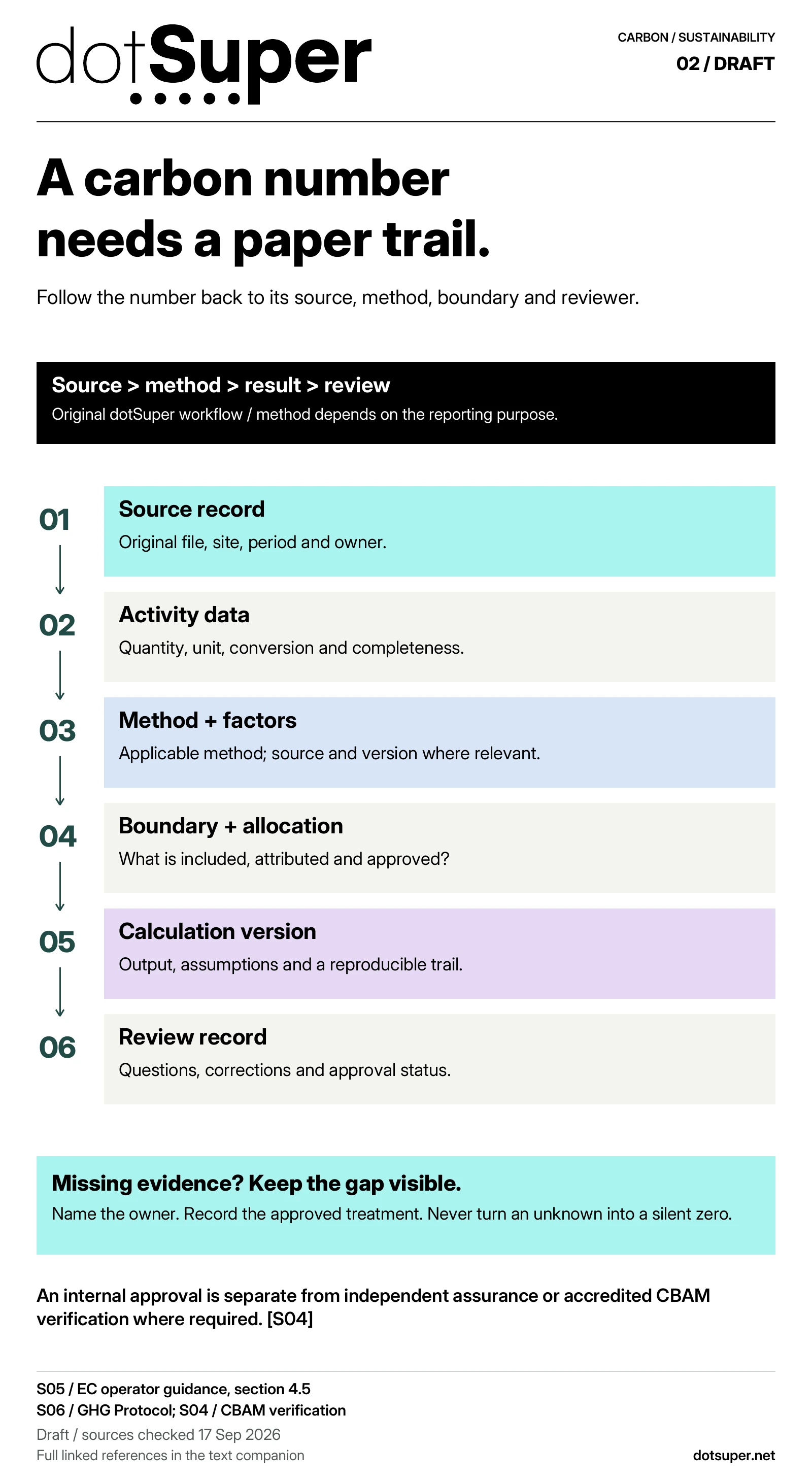
Read the diagram: Related visual guide: A carbon number needs a paper trail. This dotSuper diagram illustrates the surrounding workflow; the article covers the specific topic.
A six-stage carbon evidence chain connects the source record, activity data, method and factors, boundary and allocation, calculation version, and review record. Missing evidence is assigned an owner and remains visible. Internal approval is separate from independent assurance or accredited CBAM verification where required.
Original dotSuper workflow. The applicable accounting method determines the records needed. Internal review does not replace independent assurance or CBAM verification.
Start with the record. Keep the original.
Source / file, site, period and owner.
Activity / quantity, unit and any conversion.
Method / applicable rule, factor source and version.
If evidence is missing, label the gap and name its owner. Do not silently invent a value.
Make the result reproducible.
Boundary / what belongs in the calculation?
Allocation / what basis assigns emissions?
Calculation / which version and assumptions?
The specialist approves the applicable method. A corporate total is not automatically a CBAM product result.
A reviewer needs more than a total.
Trace the source and calculation.
Record questions and corrections.
Keep approval and external-review states separate.
Internal sign-off does not replace independent assurance or accredited CBAM verification where required.
| Stage | Retain | Review question |
|---|---|---|
| 1. Source | Original record, site, period, owner and stable reference | Can we find the underlying evidence? |
| 2. Activity data | Quantity, original unit, conversions and gaps | Does the value describe the correct activity? |
| 3. Method | Applicable rule; factor source, units and version where relevant | Who approved the method and factor? |
| 4. Boundary / allocation | Reporting boundary, allocation basis and rationale | Does the attribution match the intended purpose? |
| 5. Calculation | Version, output and unresolved assumptions | Can another person reproduce the result? |
| 6. Review | Reviewer, corrections, decision and external-review status | What was checked, and what remains open? |
Take it into your next working session
Keep the source credits with the file. Check the reuse terms and adapt the method to your context.
Credit: Original dotSuper educational content and diagrams.
Reuse: Copyright dotSuper. No new public reuse licence is assigned; third-party sources retain their own terms.
Thumbnail credit and reuse
Reuse: No public reuse licence has been specified. Source attribution does not grant rights to third-party material.
- 01Clarify the actual request first.
- 02Give the response one accountable owner.
- 03Disclose missing evidence rather than inventing an answer.
/ dotSuper point of view
turn the request into a defined task before turning it into a number. Confirm the purpose, product or organisation, reporting period, method, evidence expectations and recipient. Then assign an owner for the response.
Start with the real request
A customer asks for a "carbon certificate" before renewing the supplier file.
Sales forwards the message to quality.
Quality asks finance.
Finance sends the latest electricity bill.
Everyone is trying to help.
Nobody has established what the customer actually needs.
The short answer: turn the request into a defined task before turning it into a number.
Confirm the purpose, product or organisation, reporting period, method, evidence expectations and recipient.
Then assign an owner for the response.
The situation above is fictional.
The response process below is dotSuper's proposed operating approach, not an official reporting procedure.
First, translate the request
The GHG Protocol Corporate Standard is designed for an organisation-level inventory, not for quantifying the reductions from a credit-generating project.
A customer asking about a product or a border mechanism may require something different again.
GHG Protocol Corporate Standard.
Ask the buyer to identify the actual deliverable.
Do not assume the phrase "carbon certificate" means a credit, a footprint, a verification report and a statutory declaration all at once.
If the customer has not specified a method, that is a question to resolve, not permission to choose the easiest spreadsheet.
| Clarification | Why it matters |
|---|---|
| What decision or reporting purpose will this support? | Establishes the intended use |
| Which entity, installation and goods are covered? | Prevents unrelated records being combined |
| Which period and unit are required? | Avoids a plausible number for the wrong period or denominator |
| Is there a named methodology or template? | Defines the expected calculation and structure |
| What evidence and independent review are expected? | Separates preliminary information from an assured output |
| Who will receive the data and by when? | Establishes access and delivery controls |
Give the request one accountable owner
They need to maintain the scope, route questions and prevent contradictory replies.
A workable division is: sales owns clarification and expectations; production identifies processes and quantities; procurement coordinates supplier information; finance provides relevant transaction records; an appropriate specialist approves methodology; and an authorised business owner releases the response.
In a small company, one person may hold several roles.
Record the roles anyway.
A missing function is easier to recognise when it has a name.
Collect evidence against fields, not against vague instructions
"Please provide the production quantity for this installation and period, with the supporting report and unit" creates a usable request.
Maintain a table in which each requested field has an owner, evidence link, status and limitation.
Suggested statuses are not requested, requested, received, under review, approved and unresolved.
Received is not the same as approved.
When a supplier replies with a company-wide annual figure, do not silently treat it as product-specific information.
Preserve the original description and ask whether it meets the buyer's intended use.
A response template you can adapt
To prepare the correct information, please confirm the products and producing installation covered, the reporting period, the intended use, and any required methodology or template.
Please also confirm whether you need preliminary data or independently reviewed information.
We will identify available records, flag gaps and agree a realistic delivery date before issuing the completed response.
When information is missing, use a bounded statement: "We have the production records for the requested period.
Supplier-origin evidence for one input remains outstanding and is being followed up by procurement.
We will not describe the pack as complete until that issue is resolved."
A clear limitation is more useful than a confident-looking total with hidden uncertainty.
Work through a fictional example
It has a corporate emissions estimate, electricity invoices and purchase records.
The account manager wants to populate the requested product field with the corporate total divided by units sold.
That shortcut may mix organisational and product boundaries, production and sales periods, and an unsupported allocation.
The stronger next step is to identify the requested method, gather the relevant production and input records, and obtain technical direction before calculating.
Meanwhile, sales can confirm what information is available and what is pending.
The company does not need to remain silent while it resolves the technical issue.
It does need to distinguish a progress update from an approved result.
Before you press send
Ensure the number can be traced to evidence, that estimates are identified and that any relevant independent status is described accurately.
Check that confidential supplier material is going only to an authorised recipient.
For CBAM actual-emissions reporting, the independent verification requirement cannot be replaced by calling your internal review an audit.
Commission verification overview.
Keep the exact released version and a record of the recipient.
If a correction is needed later, you should be able to identify which customer received the affected output.
Make the second request easier
Build a reusable response library, but label each item with its scope and validity period.
Reusable does not mean universally applicable.
Start with one completed request before automating fifty.
A clear manual workflow gives you something reliable to automate.
Where dotSuper can help
Bring one anonymised request to a scoping conversation; do not upload confidential production records to a public form.
Talk through your supplier-data process.
What this page cannot conclude
- 01General educational information, not legal, tax, investment or accredited verification advice. Rules and methods can change.
- 02No independent expert review or customer-specific determination is claimed. Fictional examples are teaching aids, not client results.
- 03Confirm any customer-specific or regulatory form before representing the suggested response as sufficient.
- 04The worksheet is an original operating template, not an official form or guarantee of acceptance.
Sources
- 01GHG Protocol Corporate StandardGHG Protocol · accessed Sep 17, 2026
- 02Commission verification overviewEuropean Commission / European Union · accessed Sep 17, 2026
Our editorial standard · Found an error? Send a correction with its source.
/ CITE OR SHARE THIS GUIDE
Make the evidence easy to verify.
When you reference this guide, link to its canonical URL. That gives readers one stable place for the evidence, limitations and future updates.
dotSuper Research Desk. (September 17, 2026). Your Buyer Wants Carbon Data. Start Here.. dotSuper. https://dotsuper.net/feeds/applied-systems/buyer-wants-carbon-data-start-here
Carbon Data Readiness Canvas
Turn one reporting request into an owned evidence map before calculating or buying software.
Open the framework