/ THE SHORT ANSWER
See the method. Keep the context.
The visual companion
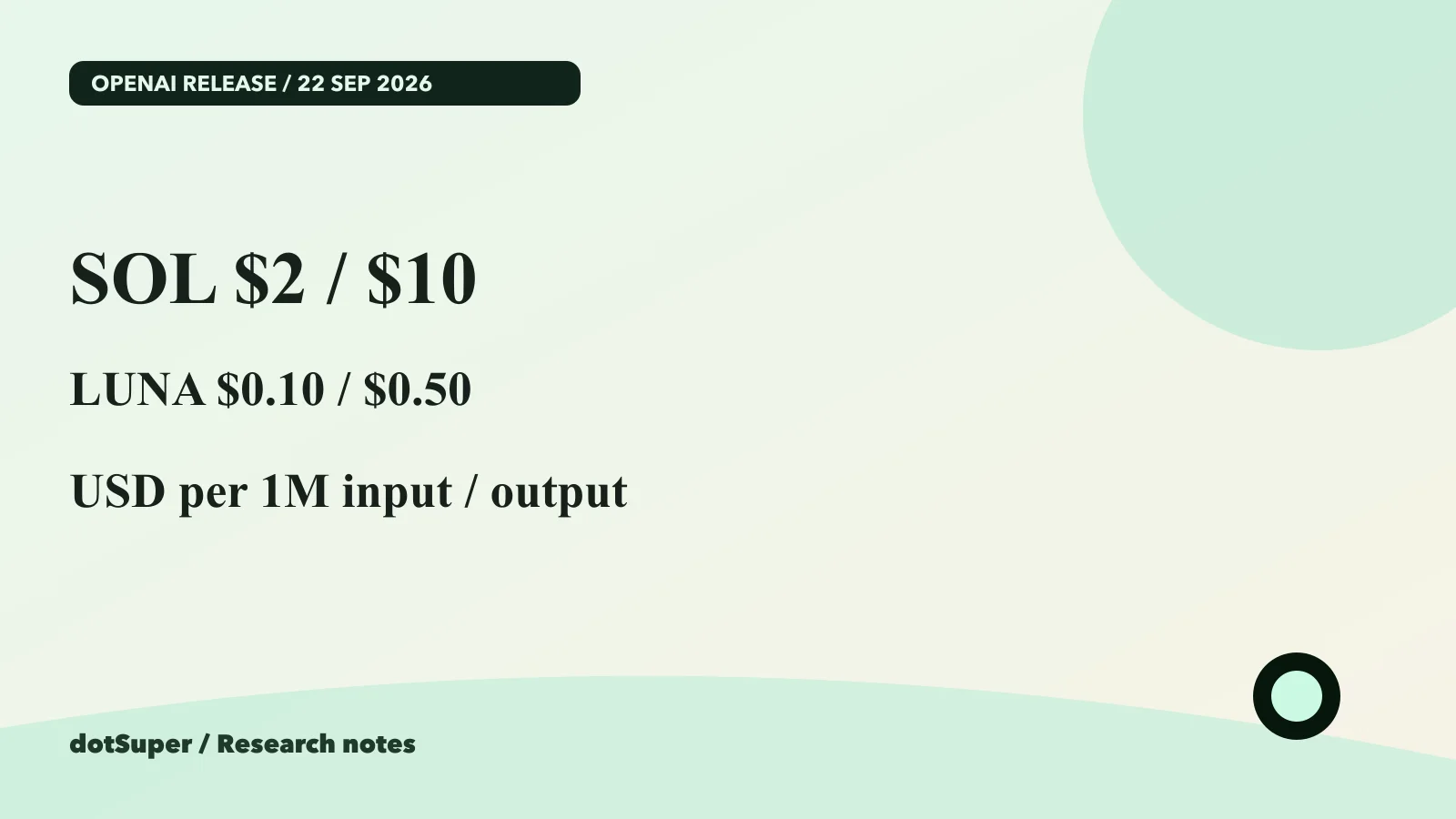
Credit: Original dotSuper research graphic based on cited primary sources.
Reuse: dotSuper original artwork. No third-party product image or logo reproduced.
Read the diagram: Listed prices are per-token rates, not the full cost of an accepted task.
SOL $2 / $10
LUNA $0.10 / $0.50
USD per 1M input / output
Thumbnail credit and reuse
Credit: Original dotSuper research graphic.
Reuse: dotSuper original artwork. No third-party product image or logo reproduced.
- 01Sol targets complex coding and agents; Luna targets focused volume.
- 02Published standard base rates differ by 20 times.
- 03Measure accepted-result cost, including review and retries.
/ dotSuper point of view
Use Luna for focused high-volume tasks that pass your quality threshold, and Sol for complex coding or agentic work when it earns its extra cost. Test both on representative tasks and include review and retry costs.
Two new options in one family
It describes Sol as suited to complex coding and agentic workflows, and Luna as its most efficient choice for focused work at scale.
The model catalog lists both with text and image inputs and text output.
Their capability descriptions suggest where to start testing, not where every workflow will end up.
A support desk, factory quality team and software engineering group may each draw a different boundary between routine and complex work.
The published price difference
Luna costs $0.10 and $0.50 respectively.
That is a 20-fold difference in those two rate lines.
The rate table has separate entries for cached input, cache writes, long prompts and other processing tiers.
Check the current pricing page for the configuration you actually use.
Suppose a batch consumes one million input tokens and 100,000 output tokens.
The simple base-rate estimate is $3 for Sol and $0.15 for Luna.
This is illustrative arithmetic, not a bill forecast.
It omits tools, retries, longer-context pricing and differences in output length.
Why the cheaper run can cost more
The reverse also happens: using Sol for every clean extraction task may add expense without a measurable quality gain.
Track cost per accepted answer, not only cost per response.
A useful scorecard has acceptance rate, correction minutes, time to resolution, token and tool cost, and the type of mistakes that reach a customer or decision maker.
Build a two-lane pilot
Start with routine extraction, structured classification and short drafting.
Add harder cases that require several documents, reasoning across exceptions or tool actions.
Have the same reviewers grade results without seeing the model label when practical.
A simple routing policy might send routine cases to Luna, escalate low-confidence or disputed cases to Sol and reserve approvals for a person.
Revisit the threshold as prompts, source data and model versions change.
Where dotSuper can help
The result should be a defensible cost and quality decision that your team can update as models change.
What this page cannot conclude
- 01Current as of 23 September 2026. Availability and pricing can change. Vendor benchmark results are attributed to their publishers.
- 02Examples describe a proposed evaluation, not a dotSuper customer result or independent model benchmark.
- 03Choose data handling, permissions and human review to fit the actual work and jurisdiction.
Sources
- 01GPT-6 Sol model guideOpenAI · accessed Sep 23, 2026
- 02GPT-6 Luna model guideOpenAI · accessed Sep 23, 2026
- 03OpenAI model catalogOpenAI · accessed Sep 23, 2026
Our editorial standard · Found an error? Send a correction with its source.
/ CITE OR SHARE THIS GUIDE
Make the evidence easy to verify.
When you reference this guide, link to its canonical URL. That gives readers one stable place for the evidence, limitations and future updates.
dotSuper Research Desk. (September 23, 2026). GPT-6 Sol vs Luna for Business. dotSuper. https://dotsuper.net/feeds/market-intelligence/gpt-6-sol-vs-luna-business-guide