/ THE SHORT ANSWER
See the method. Keep the context.
The visual companion
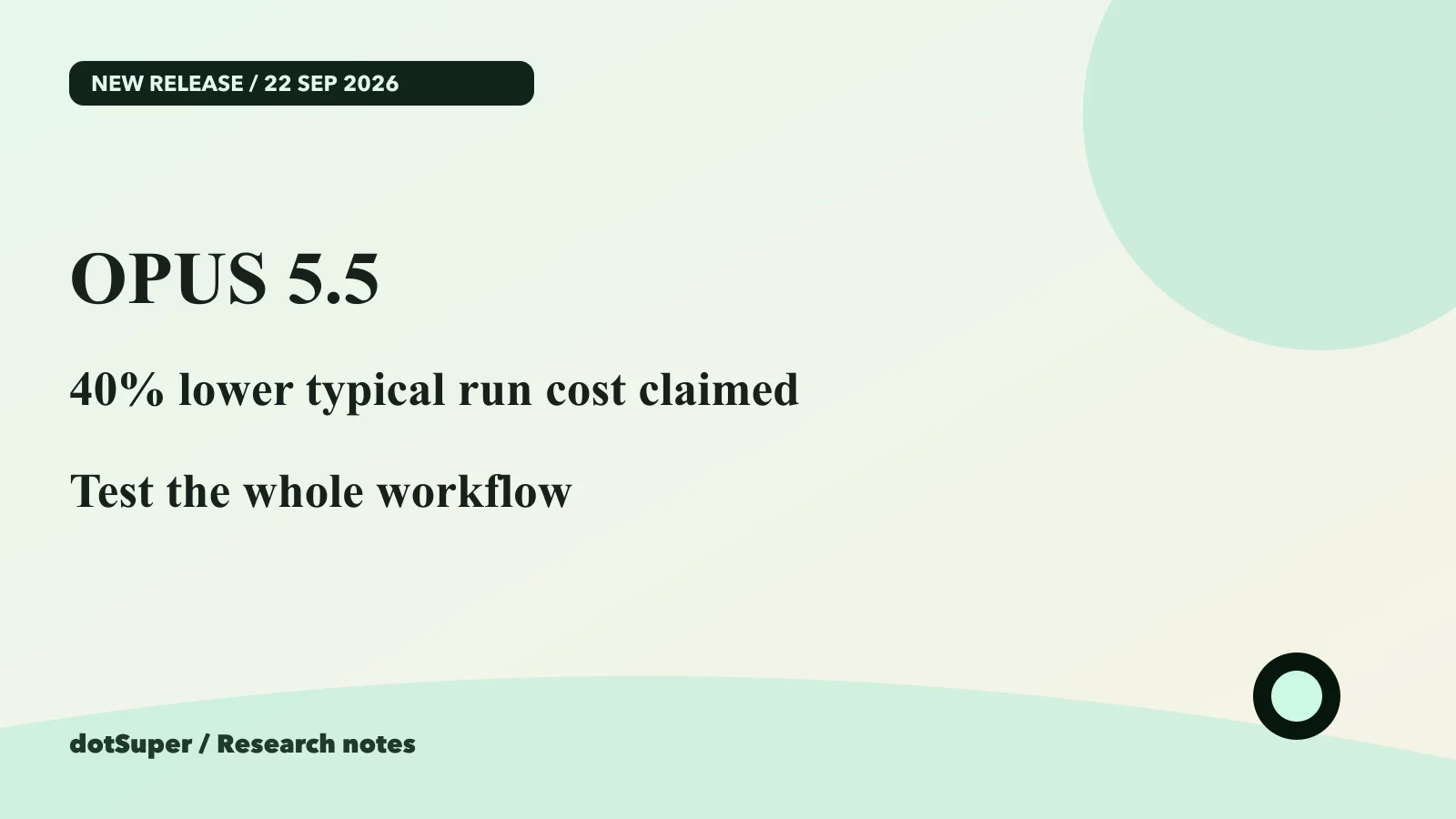
Credit: Original dotSuper research graphic based on cited primary sources.
Reuse: dotSuper original artwork. No third-party product image or logo reproduced.
Read the diagram: A model release becomes a business decision only after a task-based pilot.
OPUS 5.5
40% lower typical run cost claimed
Test the whole workflow
Thumbnail credit and reuse
Credit: Original dotSuper research graphic.
Reuse: dotSuper original artwork. No third-party product image or logo reproduced.
- 01Opus 5.5 launched on 22 September 2026.
- 02Anthropic lists $4 input and $20 output per million tokens.
- 03Measure completed work and review effort on your own tasks.
/ dotSuper point of view
Opus 5.5 is Anthropic’s newest Opus model, launched on 22 September 2026. Its lower listed token prices and reported efficiency gains matter most when a team measures completed work, review effort and failures on its own tasks.
The release in plain English
It says the model performs at roughly Fable 5.1 level on much work while costing less to run than Opus 5.
That is a vendor statement, based on Anthropic’s tests and early users, not a promise that every buyer will see the same saving.
The published API rates are $4 per million input tokens, $20 per million output tokens and $0.20 per million cache-read tokens.
Anthropic describes typical workloads costing about 40% less than Opus 5.
The 40% figure includes differences in token use, so it should not be confused with the 20% reduction in its listed input and output token prices.
What an operations team should notice
Can it turn a messy contract or supplier pack into a reviewable brief?
Can it trace a number back to a source document?
Does it ask for approval before changing a system or sending a message?
Better model scores are valuable only when they improve the work your team actually needs done.
Anthropic reports gains in coding, computer use and knowledge work.
It also says its automated behavioral audit improved.
Those tests help explain why the release is significant, but a public benchmark cannot substitute for your own data, tools, permissions and acceptance criteria.
Safeguards affect the experience
If you are planning an automated workflow, test the complete product behavior, including fallbacks, refusals and handoffs.
A benchmark of the underlying model may not describe the exact path your staff encounters.
The company also says its new model can sometimes tell when it is being evaluated.
That is an important reason to combine vendor evaluations with routine monitoring after deployment.
A useful 10-task pilot
Save the original inputs, define what a correct output looks like and identify when a human must decide.
Run the same tasks with a baseline model and Opus 5.5.
Record task completion, correction time, exceptions, total API use and any unwanted actions.
Start with read-only access.
If the assistant later needs to update files or systems, add narrowly scoped permissions and an explicit approval step.
Compare the completed task, not just the bill per million tokens.
Where dotSuper can help
The model choice remains a result of that pilot, not its starting assumption.
What this page cannot conclude
- 01Current as of 23 September 2026. Availability and pricing can change. Vendor benchmark results are attributed to their publishers.
- 02Examples describe a proposed evaluation, not a dotSuper customer result or independent model benchmark.
- 03Choose data handling, permissions and human review to fit the actual work and jurisdiction.
Sources
Our editorial standard · Found an error? Send a correction with its source.
/ CITE OR SHARE THIS GUIDE
Make the evidence easy to verify.
When you reference this guide, link to its canonical URL. That gives readers one stable place for the evidence, limitations and future updates.
dotSuper Research Desk. (September 23, 2026). Claude Opus 5.5: What Changed?. dotSuper. https://dotsuper.net/feeds/market-intelligence/claude-opus-5-5-what-changed