Market entry research
Choose Your Next Country and Segment Learning Investment
Compare defined country, segment and buying-route options, then select a bounded learning programme with explicit gates, budget and stopping conditions.
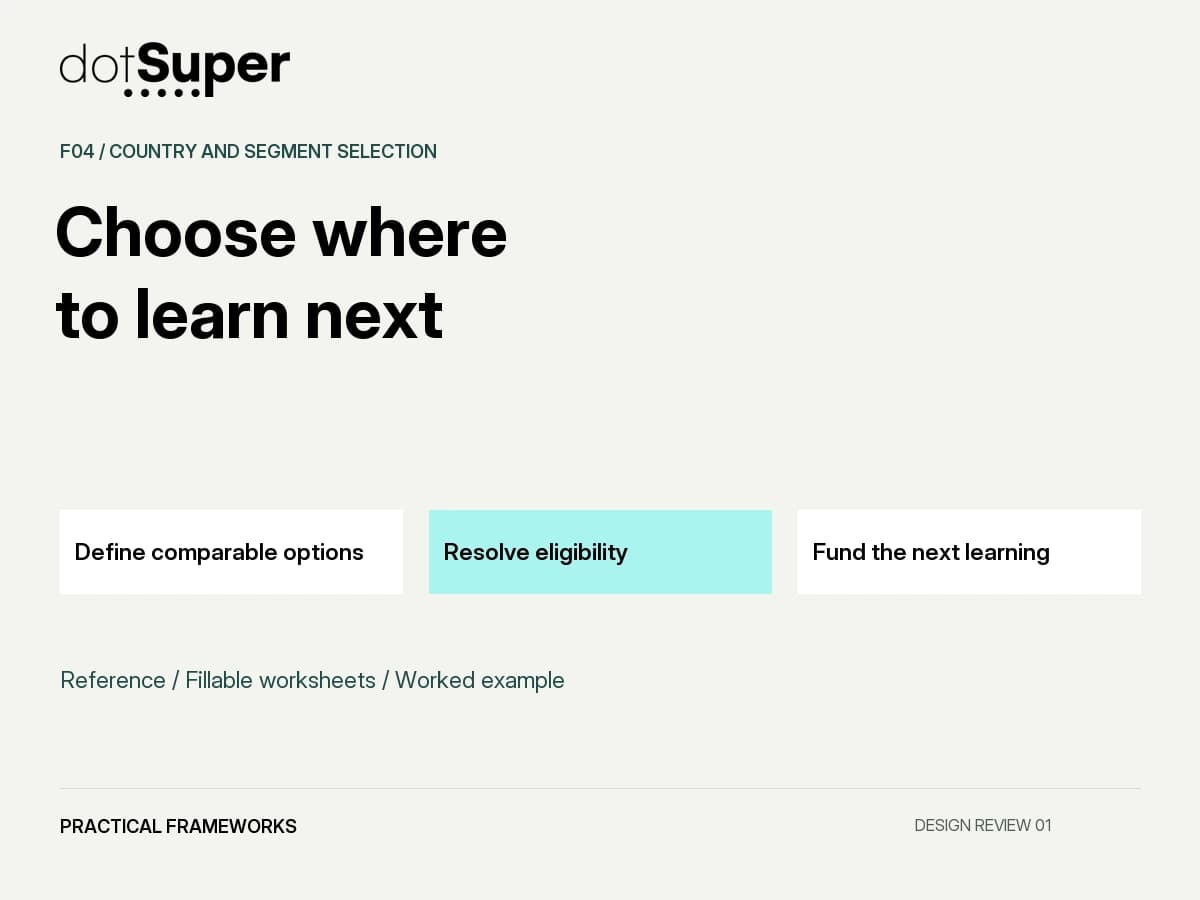
The method, in brief
Which market option deserves the next learning budget?
Compare specific combinations of country, segment, workflow and route. Resolve eligibility dependencies, retain separate evidence profiles and choose an affordable activity that could change the decision. Do not turn this into a universal country ranking.
Why this framework matters
The useful first market decision is often where to learn next, before committing to full entry.
Compare specific combinations of country, segment, workflow and route. Resolve eligibility dependencies, retain separate evidence profiles and choose an affordable activity that could change the decision. Do not turn this into a universal country ranking.
Audience and decision
For founders and commercial leaders allocating a limited discovery budget across countries, customer segments and routes to market. Decide where to conduct the next bounded learning programme and what would justify a larger commitment. A useful option combines country + segment + workflow + route. “Saudi Arabia” alone is not an actionable option.
Use the protocol before hiring a country sales team, signing a channel agreement or assuming one Gulf reference transfers across the region. A two-hour workshop can compare three or four well-defined options. Research preparation takes longer and should include buyer conversations and route-specific checks, not only macroeconomic reports.
Research and source ledger
Sources accessed 16 September 2026. Recheck regulatory and procurement material before a live commitment.
Lineage: Staged discovery and business-model reasoning are established concepts. The combination of feasibility gates, ordinal evidence profiles and an explicit learning-budget decision is dotSuper synthesis. Macro scores, country stereotypes and unsupported market sizes are deliberately excluded from the decision mechanism.
| Source and date | Relevance and boundary |
|---|---|
| International Trade Administration, UAE market entry strategy, 25 August 2025 | Identifies entry-route choices, competition and distributor due diligence. Written for US exporters, not a complete guide for an Indian AI services business. |
| ITA, Saudi Arabia market entry strategy, 12 May 2026 | Distinguishes selling to Saudi companies from assumptions about mandatory local agents; refers registration questions to MISA. Do not generalise its US-exporter context. |
| ITA, Saudi public-sector selling, 19 May 2026 | Shows why government procurement requires a separate route assessment. Tender-specific rules and exceptions require current authority checks. |
| Steve Blank, Customer Development, 2009 | Supports staged learning before expansion. It supplies no country attractiveness coefficients. |
| Strategyzer, Business Model Canvas overview, undated | Prompts attention to channels, costs and partners. The proposed selection sheet is not its nine-block canvas. |
Existing approaches and limitations
Country attractiveness matrices can make a large economy appear automatically preferable even when the firm lacks access to a relevant buyer. PESTLE analysis surfaces context but rarely tells a small team which interview to arrange next. Total-addressable-market estimates can conceal a tiny reachable segment. A distributor's enthusiastic forecast can blend market knowledge with an incentive to win exclusivity.
These approaches are useful inputs when their unit and provenance are clear. This framework instead ranks the next learning investment. A smaller segment with accessible users and a testable problem can merit research before a larger but inaccessible opportunity. That is not a judgment that the smaller market has greater ultimate potential.
Structure and rationale
Apply three passes: eligibility, evidence profile, learning option. Eligibility contains conditions that should not be averaged away: an acceptable contracting route, lawful data access, deliverability and a tolerable cash commitment. An unresolved condition is unknown, not a zero-quality market and not permission to proceed commercially.
For eligible research options, compare problem evidence, buyer access, delivery fit, economics and transferability. Keep each dimension visible. Then select a small set of activities that could change the decision, with an owner, cost ceiling, date and stopping rule. This converts a static ranking into a practical plan.
Inputs and preparation
For each option, assemble a segment definition, a list of potential accounts, at least one concrete workflow hypothesis, a route-to-buyer hypothesis, likely delivery requirements and a rough research budget. Document the seller's actual legal entity and location because these affect which official guidance applies. Record what is known about language, travel, support coverage, payment cycle and partner responsibilities.
Use primary authorities for live licensing, privacy and procurement questions. An official country guide is useful orientation but does not decide a specific firm's eligibility. Record the relevant authority and the question requiring confirmation. Do not turn a pending check into a claim that every business must use a particular local structure or hosting location.
Facilitation and use
1. Write comparable options, 15 minutes. For example, UAE private packaging manufacturers with quotation-review workflows through direct discovery; Saudi private industrial distributors through a prospective integration partner; Saudi public-sector tenders as a separate option. Avoid mixing a country with an entire industry in one row. 2. Apply eligibility gates, 20 minutes. Mark each condition pass, fail or unresolved, with evidence and a date. A fail excludes that route as currently defined. An unresolved gate can permit low-risk desk research while preventing the dependent commercial or data activity. 3. Build evidence profiles, 25 minutes. Rate each dimension using the definitions below. Record the evidence behind every judgment and who disagrees. Never score “relationships” from a national stereotype; score the team's actual access to named account roles. 4. Check economic exposure, 20 minutes. Estimate the cash and staff time committed before a meaningful buying signal. Include travel, translation, partner enablement and delayed payment. Use a range if the buying cycle is unknown. Separate research cost from full market-entry cost. 5. Challenge the provisional choice, 15 minutes. Ask what would have to be true for the second option to be better. Remove the strongest warm introduction and compare again. If the choice collapses, acknowledge dependence on one relationship. 6. Design the learning programme, 15 minutes. Choose activities that resolve uncertainties: interviews, a permitted sample assessment, partner capability checks or buyer procurement clarification. Define which evidence will justify, narrow or stop the next investment. 7. Approve the learning budget, 10 minutes. Assign one decision owner, a cash ceiling and a review date. Record the deferred options and the conditions for reopening them. Do not interpret this approval as authority to sign contracts or publish unsupported market claims.
Scoring definitions and assumptions
Use a three-level ordinal profile plus unknown. 0 means credible adverse evidence or an absent capability. 1 means plausible support with an important untested assumption. 2 means direct evidence adequate for this limited next decision. U means not assessed. A two is not twice a one. Do not total the columns or multiply them into a probability of success.
For buyer access, 0 means no credible route, 1 means an introduction is promised and 2 means the relevant role has agreed to a substantive discussion. For problem evidence, 0 means recent evidence contradicts the proposed problem, 1 means reports without episode evidence and 2 means multiple relevant episodes with corroboration. Define delivery fit and economics in the same concrete way before judging options. A ranking tied on present evidence should be resolved by the cheapest informative next test, not invented decimals.
Worked example: illustrative, not market research findings
Assume dotSuper can fund one six-week discovery programme. Option A is quotation-review support for private packaging firms in the UAE. Option B is document coordination for Saudi industrial distributors through a prospective partner. Option C is public-sector AI procurement in Saudi Arabia.
In the hypothetical evidence pack, A has three accepted buyer introductions, two relevant work episodes and a manageable sample-review route. B has one partner's strong interest but no customer access yet. C has an attractive headline opportunity but unresolved supplier eligibility and no qualified tender. Those are assumed facts for the example, not claims about actual dotSuper relationships.
The decision is to investigate A first while allocating a small separate action to checking B's partner access. C remains on a route-verification list. No aggregate country score is calculated. If A's introductions reveal that quotation volume is too low, its advantage disappears. If B's partner supplies direct access to buyers with a costly recurring problem, the next review may reverse the sequence.
The first programme targets six contrasting accounts, a workflow baseline where permission exists and an explicit review of willingness to allocate staff time or pilot budget. Six accounts do not estimate national demand. The output is enough evidence to choose a next experiment or stop, not a claim that the UAE is universally easier than Saudi Arabia.
Outputs, failure modes and validation limits
Deliver an option register, gate log, evidence profiles, budgeted discovery plan and decision record. Add a source-expiry column for facts that can change. Broader MENA expansion requires fresh country and segment research; UAE and Saudi results do not establish conditions in Egypt, Morocco or other markets.
Failures include using GDP as a proxy for reachable demand, treating a warm introduction as a qualified buyer, accepting a partner's exclusivity request before evidence, and combining government and private buying routes. A counterexample is a specialised service with a single existing Saudi anchor customer. Its best next investment may be deeper Saudi delivery capability even when generic desk research favours UAE access.
Validate the protocol by tracking forecast assumptions against actual discovery cost, buyer access and subsequent decisions. Its quality lies in exposing and updating assumptions. It has not been validated as a predictor of market-entry success.
Working files and reuse
The five-page PDF includes a visual reference, two fillable worksheet pages, an illustrative worked example and a facilitator/source guide. An expandable CSV working log is also available.
All examples are illustrative, not measured client results. A proposed market-learning protocol, not a country-attractiveness ranking or legal clearance. ITA guidance is written for US exporters. Confirm the actual entity and route. UAE and Saudi examples do not establish validity across MENA.
Original dotSuper material prepared for review. No public reuse licence has been assigned. Third-party source material retains its own terms.
The PDF is not represented as a tagged PDF/UA document. The text on this page provides a readable alternative to the diagram and method.
See the method. Keep the context.
The visual companion
Reuse: Original dotSuper material. No public reuse licence has been specified. Contact dotSuper for reuse permissions. Third-party source material retains its own terms.
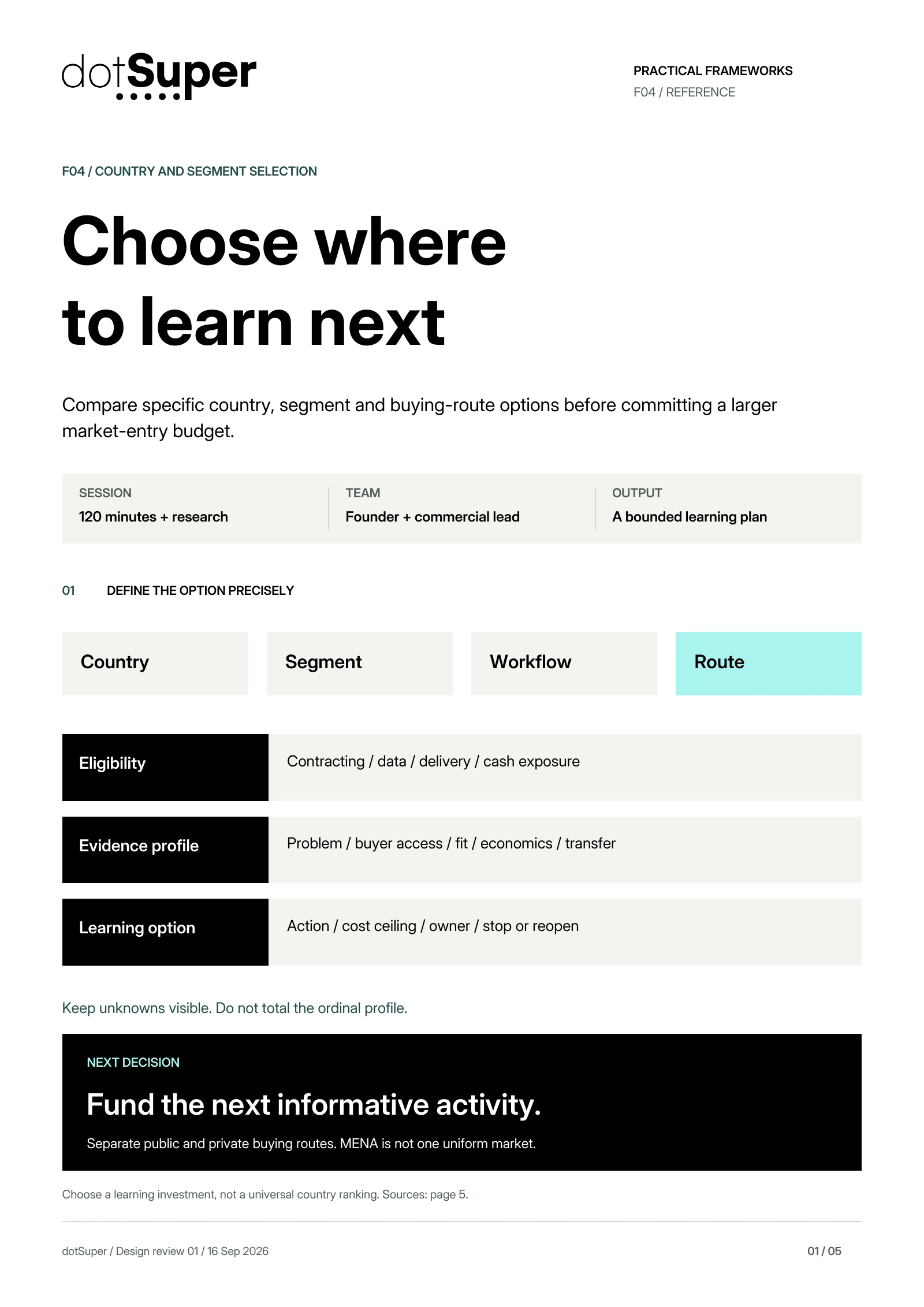
Read the diagram: Country and Segment Selection. Original dotSuper reference diagram. Original dotSuper selection protocol informed by staged discovery and business-model reasoning. Country guidance supplies context, not a universal score or eligibility opinion.
Define an option as country, segment, workflow and buying route. First examine contracting, data, delivery and cash exposure. Then record problem evidence, buyer access, delivery fit, economics and transferability. Choose a learning action with a cost ceiling, owner and stop or reopen condition. Keep unknowns visible and do not total ordinal ratings. Separate public and private routes; MENA is not one uniform market.
A proposed market-learning protocol, not a country-attractiveness ranking or legal clearance. ITA guidance is written for US exporters. Confirm the actual entity and route. UAE and Saudi examples do not establish validity across MENA.
Take it into your next working session
Keep the source credits with the file. Check the reuse terms and adapt the method to your context.
Reuse: Original dotSuper material. No public reuse licence has been specified. Contact dotSuper for reuse permissions. Third-party source material retains its own terms.
Reuse: Original dotSuper material. No public reuse licence has been specified. Contact dotSuper for reuse permissions. Third-party source material retains its own terms.
Thumbnail credit and reuse
Reuse: Original dotSuper material. No public reuse licence has been specified. Contact dotSuper for reuse permissions. Third-party source material retains its own terms.
Sources, context and limits
Keep the evidence beside the method.
- A proposed market-learning protocol, not a country-attractiveness ranking or legal clearance. ITA guidance is written for US exporters. Confirm the actual entity and route. UAE and Saudi examples do not establish validity across MENA.
- This combined dotSuper method is research-informed and has not been field validated. Workshop agreement and a completed template are not proof of effectiveness.
- Worked examples are hypothetical. Country examples and intended regional audience do not establish country-wide or region-wide effectiveness.
- Source access and adaptation limits are recorded in the source ledger. Attribution does not imply endorsement or a licence to reproduce third-party artwork.
- UAE market entry strategy
International Trade Administration · accessed Sep 16, 2026
- Saudi Arabia market entry strategy
International Trade Administration · accessed Sep 16, 2026
- Saudi public-sector selling
International Trade Administration · accessed Sep 16, 2026
- Customer Development
Steve Blank · accessed Sep 16, 2026
- Business Model Canvas overview
Strategyzer · accessed Sep 16, 2026
/ CITE OR SHARE THIS GUIDE
Make the evidence easy to verify.
When you reference this guide, link to its canonical URL. That gives readers one stable place for the evidence, limitations and future updates.
dotSuper Research Desk. (September 17, 2026). Choose Your Next Country and Segment Learning Investment. dotSuper. https://dotsuper.net/feeds/market-intelligence/country-and-segment-selection
Bring it into the work
Start with one real decision
Bring two market options and define the evidence needed to choose the next learning investment.
Download the fillable framework