Buying decisions and procurement
Map the Buying Decision and Its Evidence Requirements
Clarify the actual approval path, each role's evidence requirements and the next legitimate commitment in a complex business purchase.
The method, in brief
Who must decide what, and what evidence will they need?
Start with one specific buying commitment. Confirm the approval path with the customer, connect concerns to observable evidence and assign the next mutual actions. A supportive contact does not establish purchasing authority.
Why this framework matters
Trust grows through relevant evidence and clear responsibilities, not a speculative map of personal influence.
Start with one specific buying commitment. Confirm the approval path with the customer, connect concerns to observable evidence and assign the next mutual actions. A supportive contact does not establish purchasing authority.
Audience and decision
For a founder, account lead or implementation sponsor navigating a purchase that involves operators, technology, finance, procurement and management. Decide whose requirements remain unresolved, what evidence they need, who can approve which stage and whether the opportunity is ready for a pilot proposal. Use this when a supportive contact says the project is promising but cannot explain the approval path.
The goal is a sound purchase and deliverable commitment. It is not a technique for bypassing procurement, manipulating stakeholders or identifying a single person to pressure. Plan a 75-minute internal mapping session followed by direct confirmation with the customer. Internal guesses stay visibly unconfirmed until checked.
Research and source ledger
All sources accessed 16 September 2026.
Lineage: Multi-person organisational buying is established research, with several foundational contributors rather than one universal role taxonomy. dotSuper's contribution is a map of decision rights, required evidence and unresolved conditions. The proposed role names and readiness definitions are operational choices, not quotations from Webster and Wind.
| Source and date | Relevant foundation and limit |
|---|---|
| Frederick E. Webster Jr. and Yoram Wind, A General Model for Understanding Organizational Buying Behavior, Journal of Marketing 36(2), 1972, pp. 12-19 | Foundational organisational buying research; author-hosted paper and bibliographic/abstract record located. This dossier does not reproduce its model or claim a full close reading of the scanned text. |
| Johnston and Lewin, Organizational buying behavior: Toward an integrative framework, 1996 | Accessible abstract identifies a review of earlier buying research. Full article was not accessed; no detailed finding is attributed to it. |
| UK GDS/CDDO, Define your purchasing strategy, updated 3 September 2026 | Informs questions about capability, costs and ownership. UK government-specific rules are not applied as UAE or Saudi requirements. |
| ITA, Saudi public-sector selling, 19 May 2026 | Establishes the need to distinguish formal procurement routes and current tender conditions. It is orientation for US exporters, not a complete eligibility opinion. |
| NIST, AI RMF Core, RMF 1.0, 2023 | Provides a risk-governance reference for accountable AI decisions. It is voluntary guidance and not a procurement certificate. |
Existing approaches and limitations
Organisation charts show reporting relationships but can miss who reviews data access, who bears implementation work or who can reject a contract term. Sales qualification acronyms can help structure a conversation but may compress a complex decision into a single stage label. Stakeholder power-interest matrices can encourage speculation about influence without explaining what a person is legitimately accountable for.
The proposed method links each role to a decision and an evidence requirement. Trust is treated as demonstrated reliability within that responsibility. It is not a cultural personality trait or a score assigned from nationality. A buyer may trust the team while correctly declining a project whose ownership or benefit remains unclear.
Structure and rationale
Build three connected records: a decision path, a role-evidence register and a commitment log. The decision path follows discovery access, pilot authorisation, purchase approval, deployment acceptance and renewal or exit. These stages may merge or repeat in a small business.
The register distinguishes the person affected by the work, the person accountable for outcomes, the technical or risk reviewer, the budget authority and the contracting authority. One person may hold several roles. Each row records the decision they own, evidence requested, current concern, evidence status and next agreed action. The commitment log records what both parties agreed to do, by when, and under what conditions.
Inputs and preparation
Bring meeting notes, the customer's stated procurement process, a proposed scope, a deployment sketch and a list of unresolved commercial and data questions. Use business-role identifiers in broadly shared drafts. Restrict personal contact details to the authorised customer system.
Ask the sponsor to describe a recent comparable purchase, including a purchase that stopped. This is more informative than assuming every organisation follows a standard sequence. Record whether the conversation concerns an exploratory study, a paid pilot or a production purchase. Authority for one does not automatically confer authority for the next.
Facilitation and use
1. Define the next decision, 10 minutes. State exactly what the customer would authorise: staff time for discovery, access to redacted samples or funding for a bounded pilot. Specify what remains outside the decision. 2. Reconstruct the approval path, 15 minutes. Use the customer's example purchase. Mark known approvals, reviews and contracting steps. Identify whether the contact is describing formal policy or customary practice. Keep both when they differ. 3. Map responsibilities, 15 minutes. For each role, record what the person is trying to protect or achieve. An IT reviewer may need an access-control demonstration; a plant manager may need a fallback that works during an outage; finance may need cost assumptions. 4. Translate concerns into evidence, 15 minutes. Replace “needs reassurance” with an observable requirement. Examples include a source-trace demonstration, sample evaluation, deletion procedure, support schedule or finance-reviewed baseline. Ask the role holder to confirm that the evidence would address the actual concern. 5. Find gaps and conflicts, 10 minutes. A sponsor may want speed while operations lacks time to label evaluation data. Record the conflict and an owner for resolving it. Do not interpret silence from an absent reviewer as agreement. 6. Agree the next commitment, 10 minutes. Assign actions to both customer and supplier. Record deadlines and dependencies. Send only material the customer has requested through agreed channels; the worksheet itself does not authorise outreach or disclosure. 7. Review after each material change. Reopen affected rows when scope, deployment, price, data flow or staff changes. A prior approval may no longer cover the revised project.
Readiness definitions and assumptions
Use unidentified, identified, requirement confirmed, evidence reviewed and decision recorded. These states apply to a specific decision, not to a person's attitude. “Evidence reviewed” does not mean approved. The final record must include the decision, conditions, date and responsible role.
Do not produce a win probability from the count of completed rows. A single unresolved deployment constraint may stop an otherwise supported project. A missing role may be genuinely unnecessary in a small firm, but record who owns that responsibility instead of inventing a department. Sales-cycle estimates should be ranges based on comparable purchases or explicitly labelled assumptions.
Worked example: illustrative, not a documented Saudi client
A Saudi private industrial distributor is considering an assistant to prepare supplier-comparison drafts. The commercial director supports a pilot. An initial sales map labels the opportunity “approved,” but the decision path reveals that the director has approved only staff time for scoping.
The procurement manager owns the workflow result and requires evidence that missing delivery terms are flagged. IT owns system access and asks for a data-flow description and a test of permissions. Finance needs the full cost of review, software and ongoing support. The person authorised to sign the agreement needs scope, acceptance and exit terms. Buyers require a way to challenge incorrect extractions without being penalised for slowing the pilot.
The supplier proposes a redacted sample assessment before any live connection. Each role confirms what that assessment can answer. The commercial director coordinates a review but does not override IT's unresolved access question. The current next decision becomes permission for a bounded sample assessment, with a separate later decision on paid deployment.
If the customer were a public entity, the team would create a separate procurement-path record and verify the applicable tender route. It would not assume the private distributor's process transfers. If a partner introduces the account, the map also identifies who is authorised to represent whom and what information may be shared.
Outputs, failure modes and validation limits
Deliver a confirmed decision path, role-evidence table, gap list and mutual commitment log. The most useful result may be a decision to defer the proposal until an accountable operational owner exists. A map with many names but no concrete evidence requests is unfinished.
Failures include confusing enthusiasm with authority, treating procurement as an obstacle, sharing sensitive notes too widely and relying on a champion's interpretation of another role's requirements. Another failure is creating excessive governance for a minor purchase. Scale the map to the decision and the consequences of error.
A counterexample is an owner-managed business where the same person controls budget and contracts. The tool still matters because frontline use, data stewardship and maintenance must have owners, even if the formal buying committee contains one person. Conversely, a group purchasing function may control procurement while individual plants decide whether the workflow is adopted.
The proposed map has not been tested as a sales-performance intervention. Validate it by asking the customer to correct it and by checking whether predicted reviews match the actual purchase path. Measure reduced unresolved assumptions, not only whether a sale closes. A responsible refusal can be a successful outcome.
Working files and reuse
The five-page PDF includes a visual reference, two fillable worksheet pages, an illustrative worked example and a facilitator/source guide. An expandable CSV working log is also available.
All examples are illustrative, not measured client results. Original decision-rights and evidence map, not a sales-performance model. Historical buying research was reviewed through available records, with access limits in the companion. Evidence reviewed does not mean approved. No influence or win-probability score is implied.
Original dotSuper material prepared for review. No public reuse licence has been assigned. Third-party source material retains its own terms.
The PDF is not represented as a tagged PDF/UA document. The text on this page provides a readable alternative to the diagram and method.
See the method. Keep the context.
The visual companion
Reuse: Original dotSuper material. No public reuse licence has been specified. Contact dotSuper for reuse permissions. Third-party source material retains its own terms.
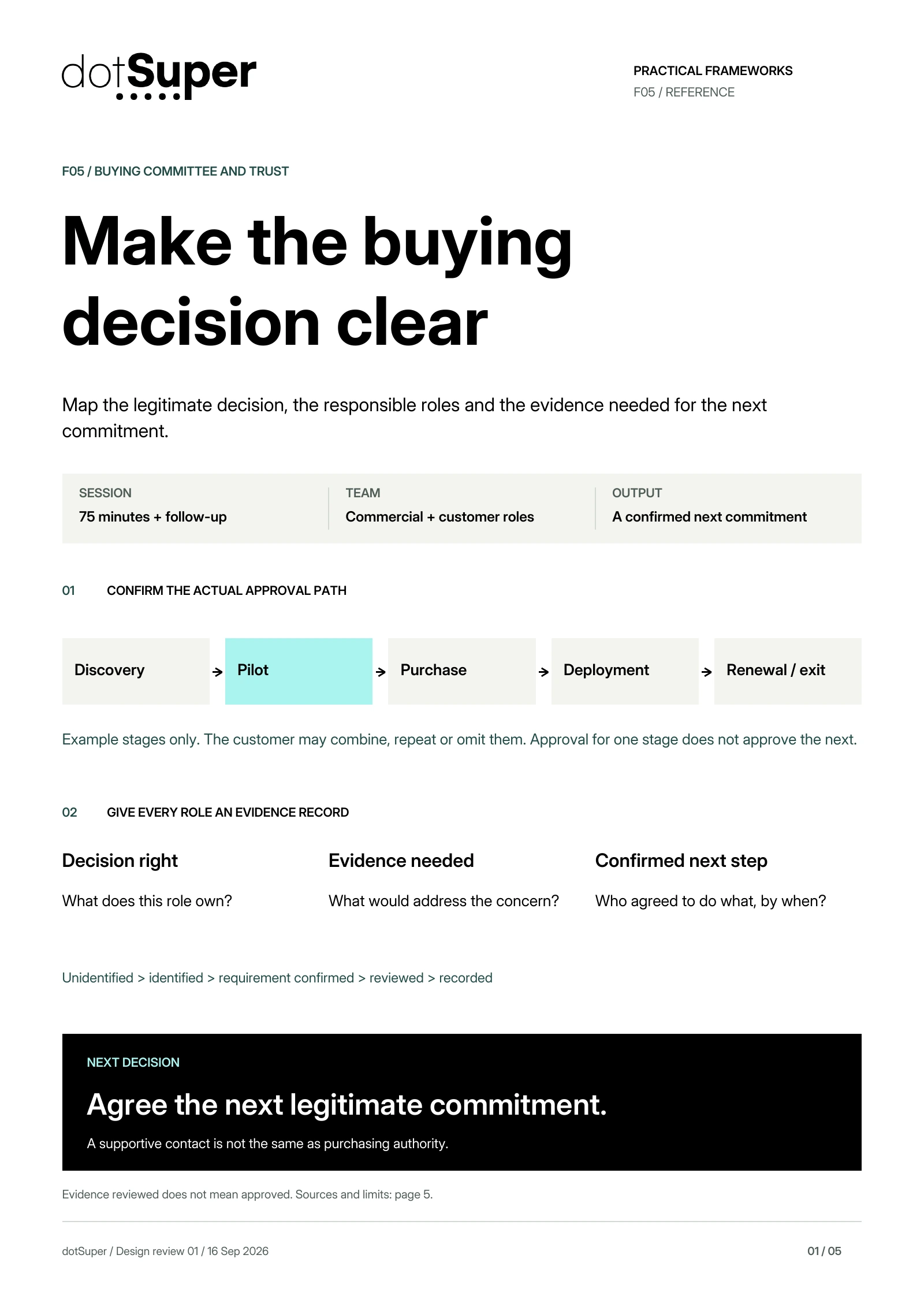
Read the diagram: Buying Committee and Trust. Original dotSuper reference diagram. Multi-person organisational buying is established research. Role labels, evidence states and commitment records here are dotSuper operational choices, not quotations from Webster and Wind.
Discovery, pilot, purchase, deployment and renewal or exit are example stages which the customer may combine, repeat or omit. Approval for one stage does not approve the next. Record each role’s decision right, evidence needed and confirmed next step. Track unidentified, identified, requirement confirmed, evidence reviewed and decision recorded. Reviewed does not mean approved; a supportive contact does not necessarily hold purchasing authority.
Original decision-rights and evidence map, not a sales-performance model. Historical buying research was reviewed through available records, with access limits in the companion. Evidence reviewed does not mean approved. No influence or win-probability score is implied.
Take it into your next working session
Keep the source credits with the file. Check the reuse terms and adapt the method to your context.
Reuse: Original dotSuper material. No public reuse licence has been specified. Contact dotSuper for reuse permissions. Third-party source material retains its own terms.
Reuse: Original dotSuper material. No public reuse licence has been specified. Contact dotSuper for reuse permissions. Third-party source material retains its own terms.
Thumbnail credit and reuse
Reuse: Original dotSuper material. No public reuse licence has been specified. Contact dotSuper for reuse permissions. Third-party source material retains its own terms.
Sources, context and limits
Keep the evidence beside the method.
- Original decision-rights and evidence map, not a sales-performance model. Historical buying research was reviewed through available records, with access limits in the companion. Evidence reviewed does not mean approved. No influence or win-probability score is implied.
- This combined dotSuper method is research-informed and has not been field validated. Workshop agreement and a completed template are not proof of effectiveness.
- Worked examples are hypothetical. Country examples and intended regional audience do not establish country-wide or region-wide effectiveness.
- Source access and adaptation limits are recorded in the source ledger. Attribution does not imply endorsement or a licence to reproduce third-party artwork.
- A General Model for Understanding Organizational Buying Behavior
faculty.wharton.upenn.edu · accessed Sep 16, 2026
- Organizational buying behavior: Toward an integrative framework
sciencedirect.com · accessed Sep 16, 2026
- Define your purchasing strategy
UK Government · accessed Sep 16, 2026
- Saudi public-sector selling
International Trade Administration · accessed Sep 16, 2026
- AI RMF Core
NIST · accessed Sep 16, 2026
/ CITE OR SHARE THIS GUIDE
Make the evidence easy to verify.
When you reference this guide, link to its canonical URL. That gives readers one stable place for the evidence, limitations and future updates.
dotSuper Research Desk. (September 17, 2026). Map the Buying Decision and Its Evidence Requirements. dotSuper. https://dotsuper.net/feeds/market-intelligence/buying-committee-and-trust
Bring it into the work
Start with one real decision
Bring one stalled decision and clarify the owners, evidence and next commitment.
Download the fillable framework