/ THE SHORT ANSWER
- 01Begin with the work behind the price
- 02A worked break-even example
- 03Now test whether the team can deliver it
/ dotSuper point of view
Build the worksheet for one offer, replace assumptions with actual delivery records and review it each month. Look at contribution, capacity, cash collected and customer acceptance together. A sustainable price supports a promise the team can keep repeatedly.
Begin with the work behind the price
Write down what your own offer requires: materials, delivery time, transaction costs, contractors, revisions and support.
Include founder time when testing whether the model can support a paid role.
Separate one-time setup spending from recurring fixed costs and costs that vary with each sale.
This article is a planning worksheet with illustrative numbers, not accounting, investment or tax advice.
Ask a qualified adviser about the obligations that apply to your business.
A worked break-even example
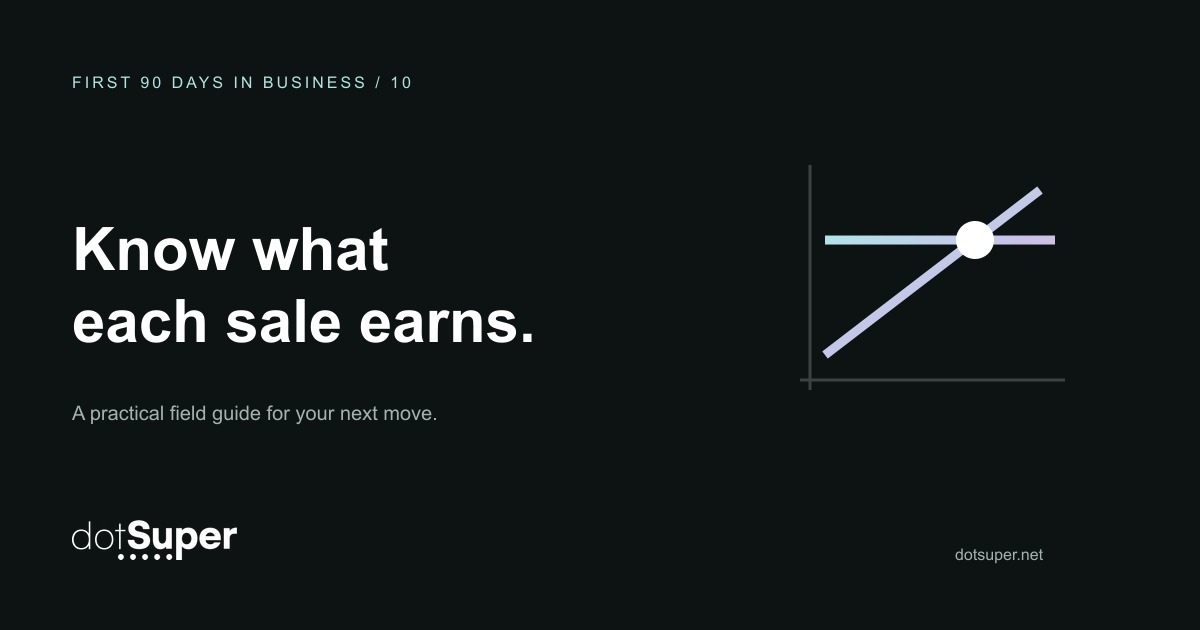
Variable costs are ₹4,000 per package, leaving ₹8,000 contribution before fixed costs.
If monthly fixed costs are ₹80,000, the simple break-even calculation is ₹80,000 divided by ₹8,000, or ten packages.
This example assumes one package type and stable costs.
It excludes tax treatment, financing, working-capital effects and unexpected rework.
The calculation shows the relationship; it does not predict what a real business will sell.
Now test whether the team can deliver it
You need to change the scope, costs, capacity, price or fixed commitments.
More leads alone cannot solve a delivery limit.
Track actual hours against the estimate for the first jobs.
Revisions, travel and support often appear small when considered separately.
Together they can erase the contribution you expected.
Record why the estimate changed before deciding whether to raise prices.
Test cash timing separately
A customer may pay after you have already paid a contractor or bought materials.
Make a simple weekly view of opening cash, expected receipts, committed payments and closing cash.
Mark uncertain receipts as uncertain.
Consider a slower-payment case and a lower-sales case alongside the expected case.
The goal is to identify when a shortfall could occur early enough to change commitments.
Do not treat an unsigned proposal as money available to spend.
Use scope to make price comparisons fair
If two buyers need different amounts of work, a single vague package may create confusion.
Define an entry offer that is useful on its own and specify when a custom quote is necessary.
Discounts reduce contribution unless costs change with them.
In the example, reducing the price to ₹10,000 while keeping variable costs at ₹4,000 leaves ₹6,000 contribution.
Covering ₹80,000 then requires fourteen whole packages, rounded up from 13.33.
Check capacity before using a promotion.
Your next review
Look at contribution, capacity, cash collected and customer acceptance together.
A sustainable price supports a promise the team can keep repeatedly.
What this page cannot conclude
- 01Examples and calculations are illustrative, not dotSuper customer results. Proposed frameworks and schedules are planning methods, not proven guarantees of growth.
- 02Platform requirements can change. Registration, tax, privacy and other obligations vary by location and business activity.
Sources
Our editorial standard · Found an error? Send a correction with its source.
/ CITE OR SHARE THIS GUIDE
Make the evidence easy to verify.
When you reference this guide, link to its canonical URL. That gives readers one stable place for the evidence, limitations and future updates.
dotSuper Research Desk. (September 8, 2026). Pricing a new business: understand costs, capacity and break-even first. dotSuper. https://dotsuper.net/feeds/applied-systems/pricing-startup-costs-break-even-new-business
12 things to do when starting a business: your first 90 days
Continue the series with a practical guide to the next business decision.
Read the next guide