/ THE SHORT ANSWER
See the method. Keep the context.
The visual companion
Reuse: Original artwork created for dotSuper. No public reuse licence has been specified. Attribution to research sources does not grant rights to their artwork or datasets.
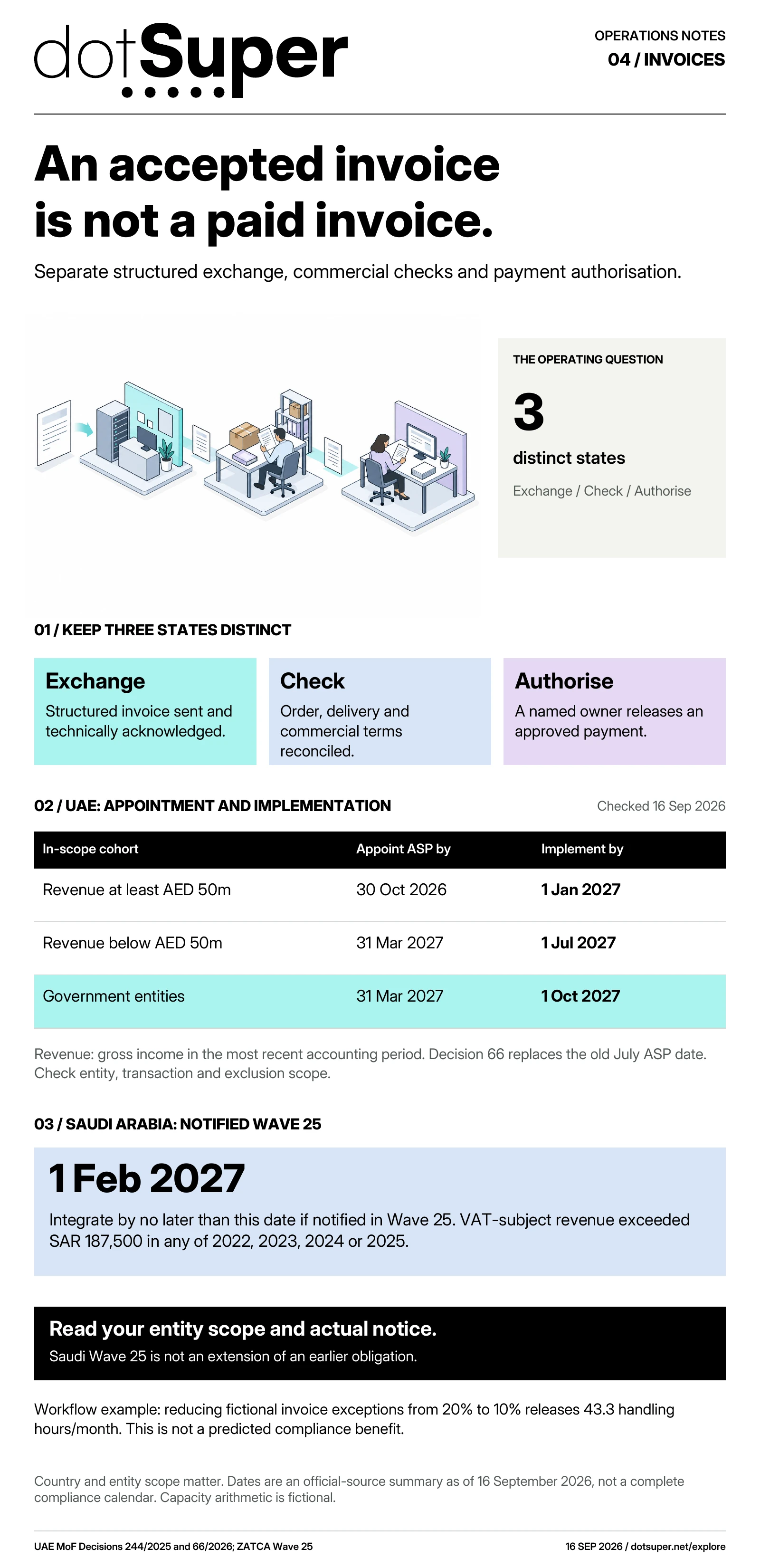
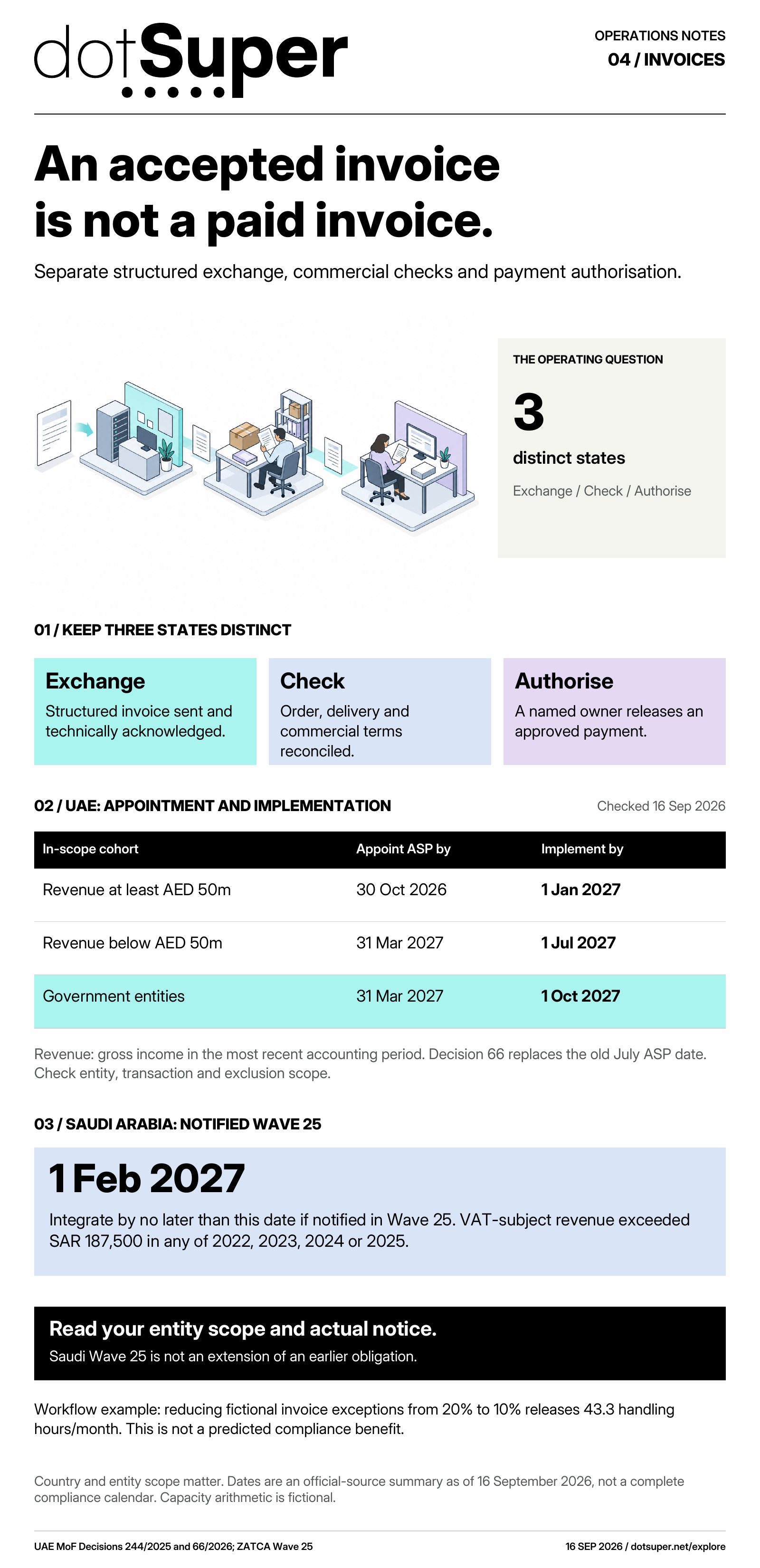
Read the diagram: Separate structured exchange, commercial checks and payment authorisation. Country and entity scope matter. Dates are an official-source summary as of 16 September 2026, not a complete compliance calendar. Capacity arithmetic is fictional.
The workflow separates invoice exchange, commercial checking and payment authorisation. UAE in-scope persons at or above AED 50 million appoint an ASP by 30 October 2026 and implement by 1 January 2027. Below AED 50 million, dates are 31 March and 1 July 2027; government implementation is 1 October 2027. Saudi Wave 25 integration is due no later than 1 February 2027 for notified taxpayers above the stated VAT-subject revenue threshold.
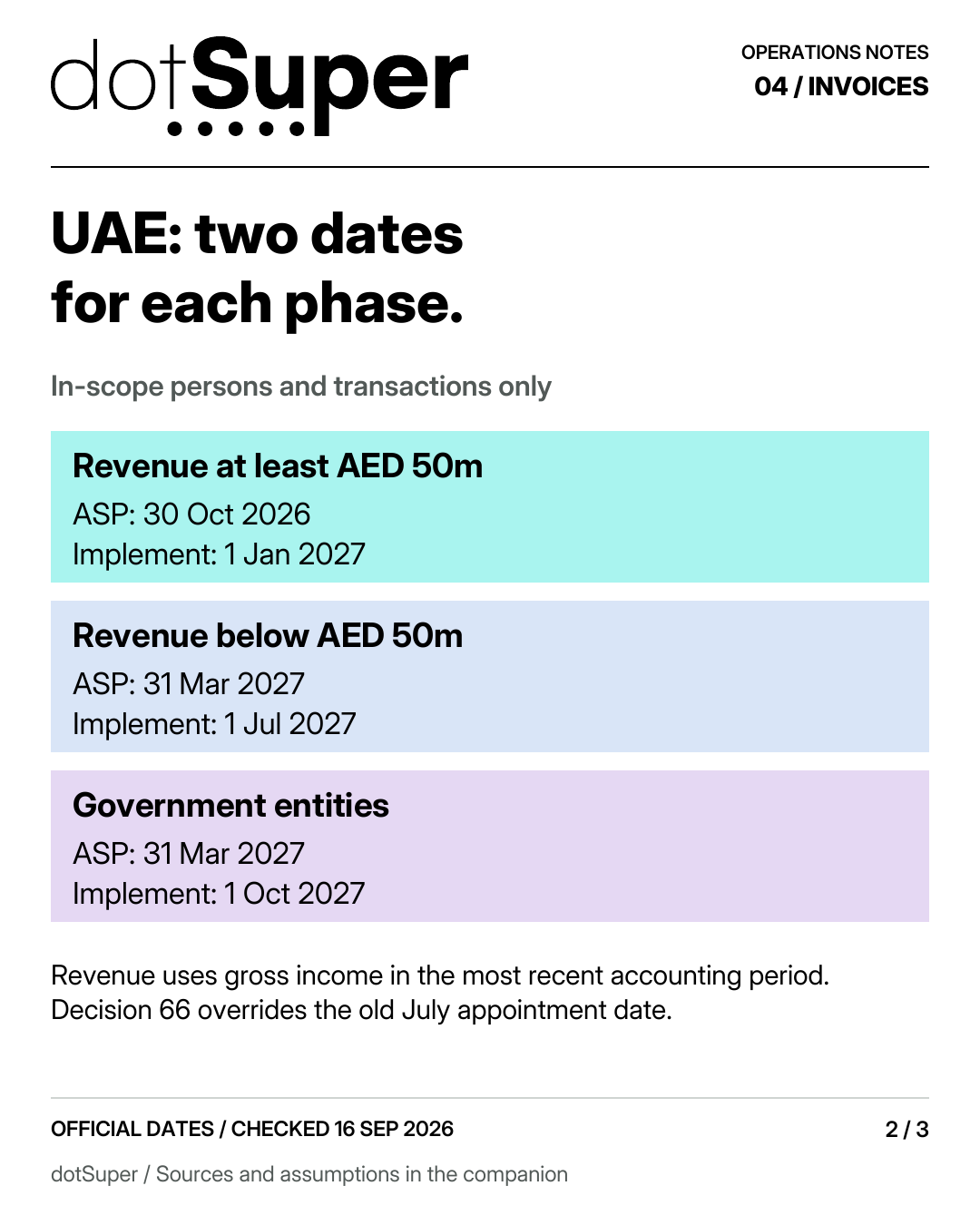
UAE revenue means gross income in the most recent accounting period. Exactly AED 50 million belongs to the earlier cohort. In-scope persons below that threshold appoint an ASP by 31 March 2027 and implement by 1 July 2027. Government entities appoint by 31 March 2027 and implement by 1 October 2027.
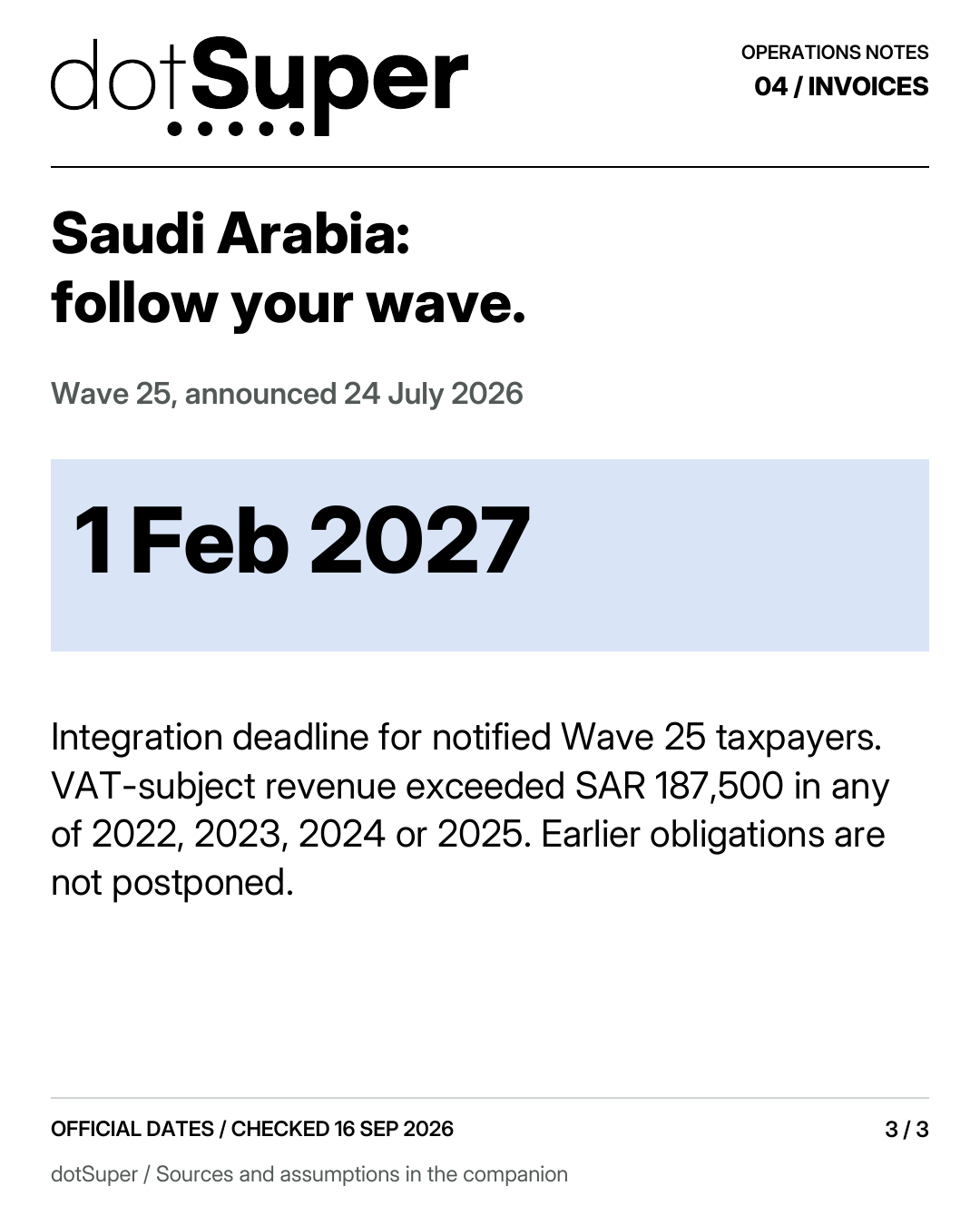
Saudi Wave 25 was announced on 24 July 2026. Notified taxpayers whose VAT-subject revenue exceeded SAR 187,500 in any of 2022, 2023, 2024 or 2025 must integrate no later than 1 February 2027.
Fictional monthly handling: 2,000 invoices, two minutes for clean invoices and 15 total minutes for each exception. At 20% exceptions: 9,200 minutes = 153.3 hours. At 10%: 6,600 minutes = 110 hours. Difference: 43.3 hours of capacity.
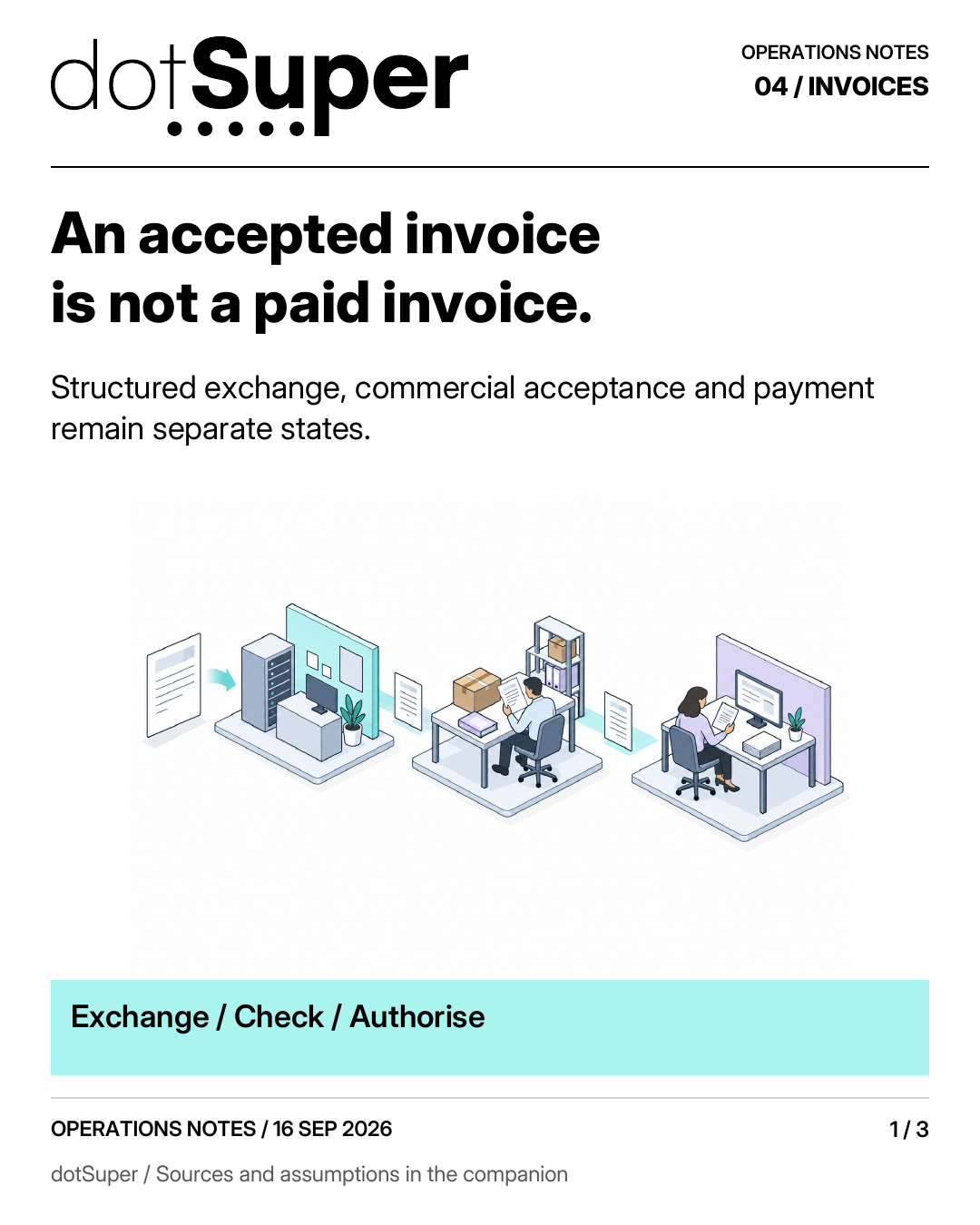
An accepted invoice is not a paid invoice. Structured exchange, commercial acceptance and payment remain separate states. Exchange / Check / Authorise
UAE: two dates for each phase. In-scope persons and transactions only Revenue at least AED 50m / ASP: 30 Oct 2026 / Implement: 1 Jan 2027 Revenue below AED 50m / ASP: 31 Mar 2027 / Implement: 1 Jul 2027 Government entities / ASP: 31 Mar 2027 / Implement: 1 Oct 2027 Revenue uses gross income in the most recent accounting period. Decision 66 overrides the old July appointment date.
Saudi Arabia: follow your wave. Wave 25, announced 24 July 2026 1 Feb 2027 Integration deadline for notified Wave 25 taxpayers. VAT-subject revenue exceeded SAR 187,500 in any of 2022, 2023, 2024 or 2025. Earlier obligations are not postponed.
Official-source snapshot checked on 16 September 2026. Wave 25 is a specifically verified Saudi announcement, not an assertion that no later notice exists.
Decision 66 supersedes the large-entity ASP appointment date printed on page 19 of the June 2026 guide. Its unfilled PDF footer does not establish a publication day.
Relevant guideline sections were read; this is not a complete legal audit or an entity-specific determination. Field, penalty and every exclusion detail are outside scope.
The workload example is fictional. Fifteen minutes is total exception handling, not an additional charge above clean handling. It does not predict payment speed or cash saving.
| Dataset | Observation | Values and conditions |
|---|---|---|
| UAE official-source timeline, checked 16 September 2026; in-scope persons and transactions only. | Pilot and voluntary route | ASP appointment by: Programme conditions; Implementation / start: 1 July 2026; Scope: Programme conditions apply |
| UAE official-source timeline, checked 16 September 2026; in-scope persons and transactions only. | Revenue equal to or above AED 50 million | ASP appointment by: 30 October 2026; Implementation / start: 1 January 2027; Scope: Gross income in most recent accounting period; Decision 66 amendment |
| UAE official-source timeline, checked 16 September 2026; in-scope persons and transactions only. | Revenue below AED 50 million | ASP appointment by: 31 March 2027; Implementation / start: 1 July 2027; Scope: Gross income in most recent accounting period |
| UAE official-source timeline, checked 16 September 2026; in-scope persons and transactions only. | Government entities | ASP appointment by: 31 March 2027; Implementation / start: 1 October 2027; Scope: Separate government phase |
| Saudi Wave 25 official announcement of 24 July 2026, checked 16 September 2026. | Notified Wave 25 taxpayers | Deadline: No later than 1 February 2027; Revenue condition: VAT-subject revenue exceeded SAR 187,500 in any of 2022, 2023, 2024 or 2025; Boundary: Earlier duties are not postponed; actual taxpayer notification matters |
| Fictional example: invoice handling | Baseline | Invoices/month: 2,000; Exception share: 20%; Total handling minutes/month: 9,200; Total handling hours/month: 153.3 |
| Fictional example: invoice handling | Illustrative future | Invoices/month: 2,000; Exception share: 10%; Total handling minutes/month: 6,600; Total handling hours/month: 110 |
Reuse: Original artwork created for dotSuper. No public reuse licence has been specified. Attribution to research sources does not grant rights to their artwork or datasets.
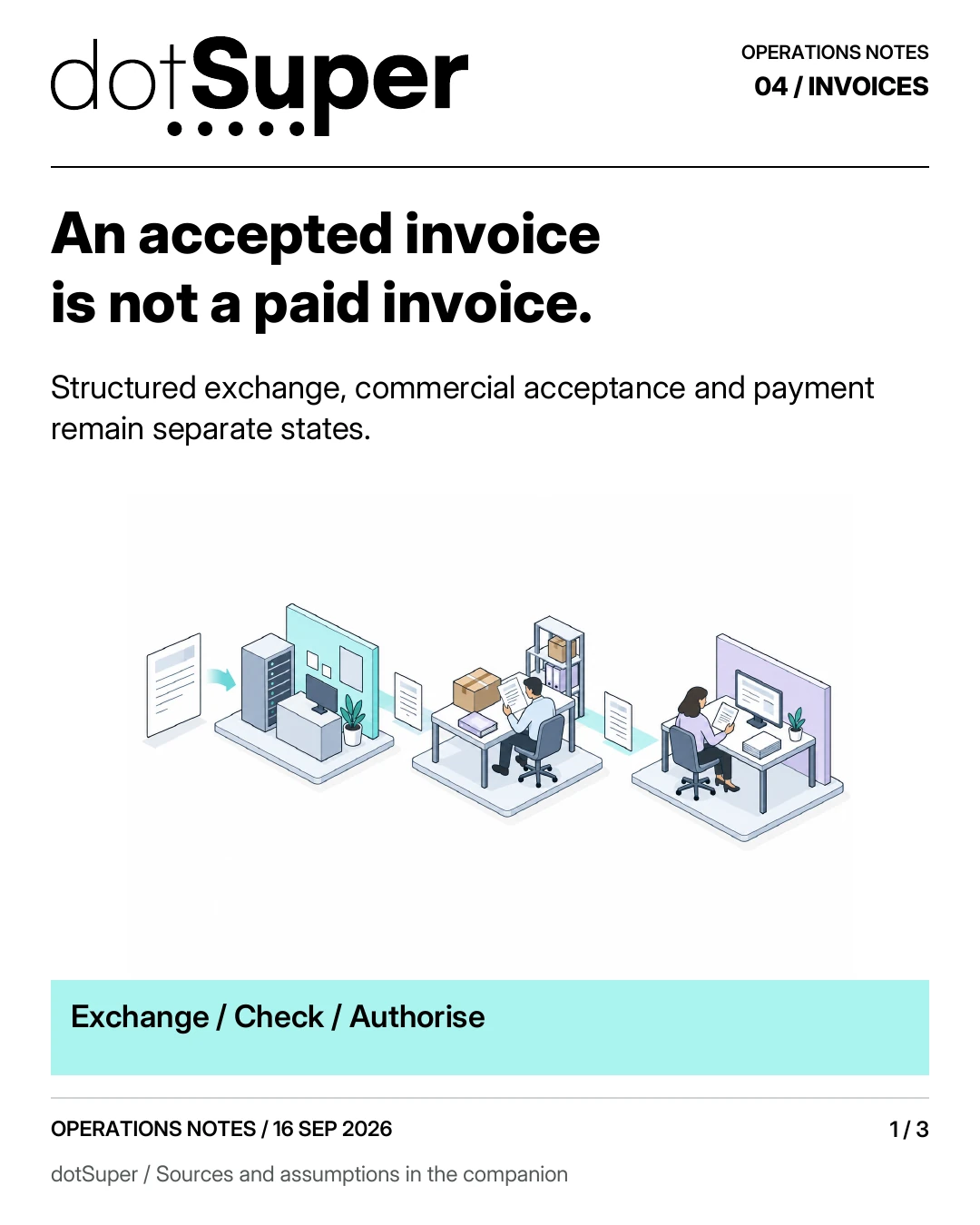
Read the diagram: Panel 1 of 3. An accepted invoice is not a paid invoice.
An accepted invoice is not a paid invoice. Structured exchange, commercial acceptance and payment remain separate states. Exchange / Check / Authorise
Official-source snapshot checked on 16 September 2026. Wave 25 is a specifically verified Saudi announcement, not an assertion that no later notice exists.
Relevant guideline sections were read; this is not a complete legal audit or an entity-specific determination. Field, penalty and every exclusion detail are outside scope.
Reuse: Original artwork created for dotSuper. No public reuse licence has been specified. Attribution to research sources does not grant rights to their artwork or datasets.
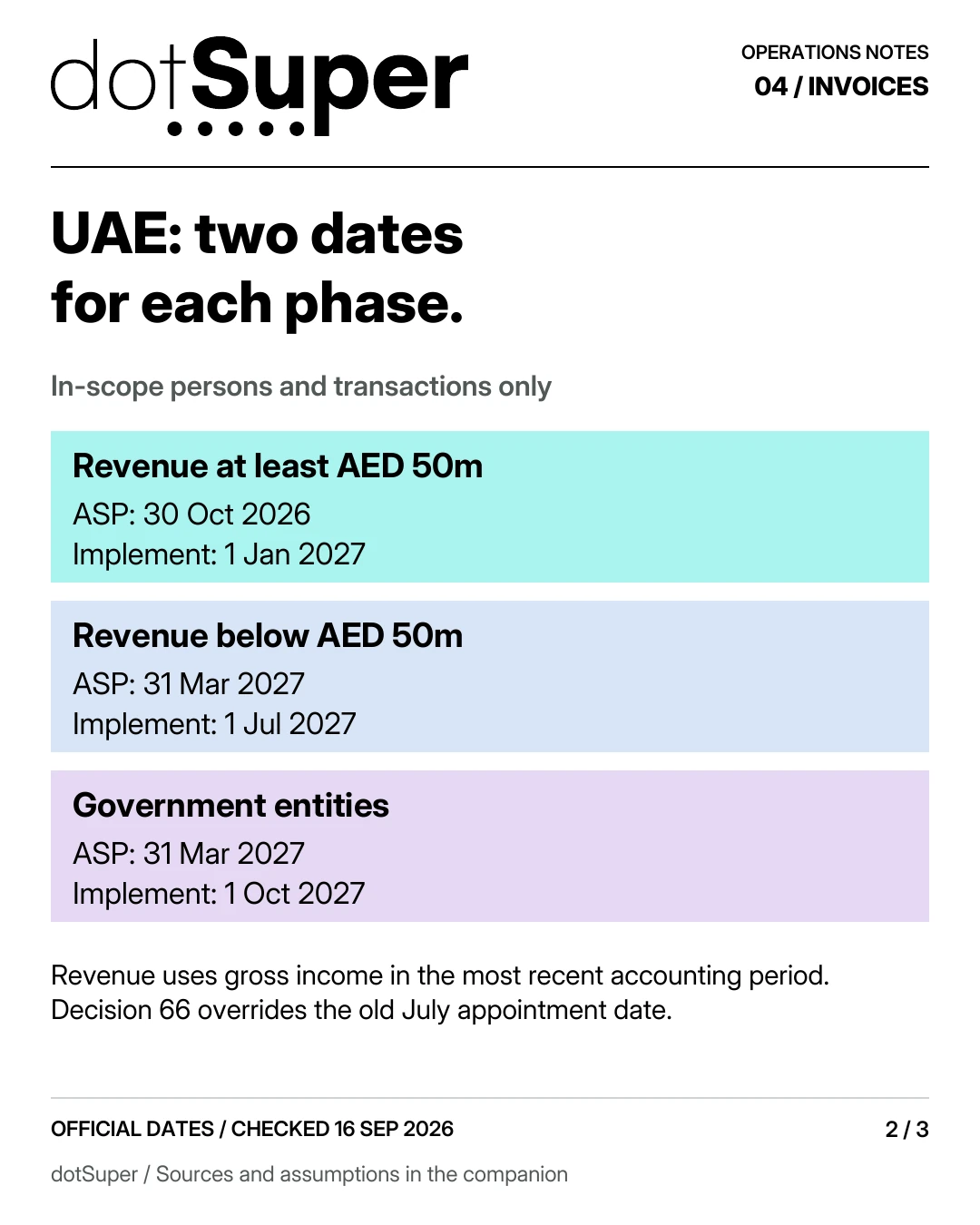
Read the diagram: Panel 2 of 3. UAE: two dates for each phase.
UAE: two dates for each phase. In-scope persons and transactions only Revenue at least AED 50m / ASP: 30 Oct 2026 / Implement: 1 Jan 2027 Revenue below AED 50m / ASP: 31 Mar 2027 / Implement: 1 Jul 2027 Government entities / ASP: 31 Mar 2027 / Implement: 1 Oct 2027 Revenue uses gross income in the most recent accounting period. Decision 66 overrides the old July appointment date.
Official-source snapshot checked on 16 September 2026. Wave 25 is a specifically verified Saudi announcement, not an assertion that no later notice exists.
Relevant guideline sections were read; this is not a complete legal audit or an entity-specific determination. Field, penalty and every exclusion detail are outside scope.
UAE official-source timeline, checked 16 September 2026; in-scope persons and transactions only..
Cohort: Pilot and voluntary route; ASP appointment by: Programme conditions; Implementation / start: 1 July 2026; Scope: Programme conditions apply.
Cohort: Revenue equal to or above AED 50 million; ASP appointment by: 30 October 2026; Implementation / start: 1 January 2027; Scope: Gross income in most recent accounting period; Decision 66 amendment.
Cohort: Revenue below AED 50 million; ASP appointment by: 31 March 2027; Implementation / start: 1 July 2027; Scope: Gross income in most recent accounting period.
Cohort: Government entities; ASP appointment by: 31 March 2027; Implementation / start: 1 October 2027; Scope: Separate government phase.
| Cohort | ASP appointment by | Implementation / start | Scope |
|---|---|---|---|
| Pilot and voluntary route | Programme conditions | 1 July 2026 | Programme conditions apply |
| Revenue equal to or above AED 50 million | 30 October 2026 | 1 January 2027 | Gross income in most recent accounting period; Decision 66 amendment |
| Revenue below AED 50 million | 31 March 2027 | 1 July 2027 | Gross income in most recent accounting period |
| Government entities | 31 March 2027 | 1 October 2027 | Separate government phase |
Reuse: Original artwork created for dotSuper. No public reuse licence has been specified. Attribution to research sources does not grant rights to their artwork or datasets.
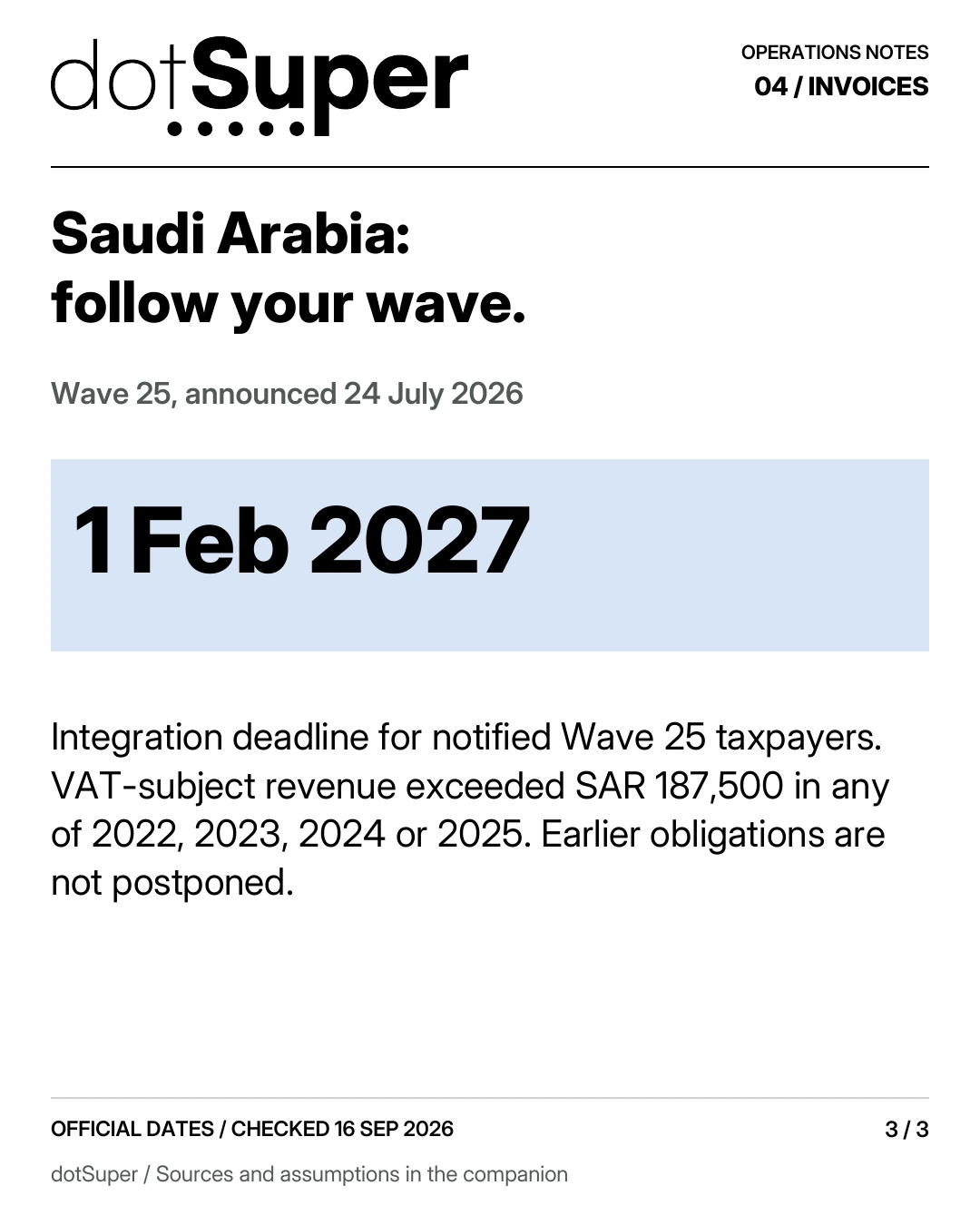
Read the diagram: Panel 3 of 3. Saudi Arabia: follow your wave.
Saudi Arabia: follow your wave. Wave 25, announced 24 July 2026 1 Feb 2027 Integration deadline for notified Wave 25 taxpayers. VAT-subject revenue exceeded SAR 187,500 in any of 2022, 2023, 2024 or 2025. Earlier obligations are not postponed.
Official-source snapshot checked on 16 September 2026. Wave 25 is a specifically verified Saudi announcement, not an assertion that no later notice exists.
Relevant guideline sections were read; this is not a complete legal audit or an entity-specific determination. Field, penalty and every exclusion detail are outside scope.
Saudi Wave 25 official announcement of 24 July 2026, checked 16 September 2026..
Cohort: Notified Wave 25 taxpayers; Deadline: No later than 1 February 2027; Revenue condition: VAT-subject revenue exceeded SAR 187,500 in any of 2022, 2023, 2024 or 2025; Boundary: Earlier duties are not postponed; actual taxpayer notification matters.
| Cohort | Deadline | Revenue condition | Boundary |
|---|---|---|---|
| Notified Wave 25 taxpayers | No later than 1 February 2027 | VAT-subject revenue exceeded SAR 187,500 in any of 2022, 2023, 2024 or 2025 | Earlier duties are not postponed; actual taxpayer notification matters |
Take it into your next working session
Keep the source credits with the file. Check the reuse terms and adapt the method to your context.
Credit: dotSuper original fictional worked-example data.
Reuse: Original illustrative data. No public reuse licence has been specified. These are not client measurements or research results.
Reuse: Original artwork created for dotSuper. No public reuse licence has been specified. Attribution to research sources does not grant rights to their artwork or datasets.
Reuse: Original artwork created for dotSuper. No public reuse licence has been specified. Attribution to research sources does not grant rights to their artwork or datasets.
Reuse: Original artwork created for dotSuper. No public reuse licence has been specified. Attribution to research sources does not grant rights to their artwork or datasets.
Reuse: Original artwork created for dotSuper. No public reuse licence has been specified. Attribution to research sources does not grant rights to their artwork or datasets.
Reuse: Original artwork created for dotSuper. No public reuse licence has been specified. Attribution to research sources does not grant rights to their artwork or datasets.
Reuse: Original artwork created for dotSuper. No public reuse licence has been specified. Attribution to research sources does not grant rights to their artwork or datasets.
Credit: Original dotSuper tabulation of cited UAE Ministry of Finance and Saudi ZATCA sources.
Reuse: No public reuse licence is specified for this tabulation. Official-source attribution does not grant reuse rights to third-party artwork. Dates are a 16 September 2026 snapshot.
Thumbnail credit and reuse
Reuse: Original artwork created for dotSuper. No public reuse licence has been specified. Attribution to research sources does not grant rights to their artwork or datasets.
- 01A PDF alone is not the UAE programme’s structured eInvoice; technical acceptance does not prove payment.
- 02For in-scope UAE persons at or above AED 50 million, Decision 66 sets ASP appointment by 30 October 2026 and implementation by 1 January 2027.
- 03Saudi Wave 25 uses notified taxpayers and historic VAT-subject revenue. Its deadline does not postpone earlier duties.
- 04The fictional reduction from 153.3 to 110 handling hours is capacity arithmetic, not a measured compliance or cash-collection benefit.
/ dotSuper point of view
Structured exchange, commercial acceptance and payment are different states. Jurisdiction-specific milestones should sit beside the operating workflow, with their scope intact.
Audience, question and answer
Treat structured invoice exchange, commercial approval and payment as distinct states.
A technically accepted invoice may still lack a purchase-order match, evidence of delivery or payment authorisation.
Build one traceable workflow around those states, with a separate jurisdiction configuration.
This is general operational research, not legal or tax advice.
The two country timelines have separate labels and sit beside a shared operational checklist.
Do not describe a single MENA deadline or assume that a Saudi-compliant invoice is automatically UAE-compliant.
The revenue concepts, affected entities and integration mechanisms differ.
UAE: current dates and source precedence
Ordinary PDFs, scans and email attachments alone do not satisfy that definition.
The portal links June 2026 guidance.
Its definitions and scope help explain the programme, but its page 19 table still carries the superseded July large-entity provider date.
Use amending Decision 66 for that milestone.
MoF eInvoicing portal, checked 16 September 2026 (source 1).
Ministerial Decision 244 of 2025 establishes phased implementation.
Its original large-entity provider deadline was subsequently amended.
The current table below combines its unaffected provisions with Decision 66 of 2026.
MD 244 of 2025, Articles 1 and 3–5, official PDF, checked 16 September 2026 (source 3).
The amended large-entity clause includes revenue equal to or exceeding AED 50 million.
It replaces the original 31 July 2026 appointment date with 30 October 2026 while retaining implementation by 1 January 2027.
The exact AED 50 million boundary therefore belongs in the earlier cohort.
MD 66 of 2026, replacement Article 5(1)(a), full official PDF read 16 September 2026 (source 4).
The ministry also confirms the extension in its amendment announcement, May 2026, checked 16 September 2026 (source 2).
Some announcement wording says “exceeds”; use the decision's inclusive boundary when writing the table.
The complete one-page decision was retrieved during the design refresh.
Its footer date placeholders do not establish a publication day.
The official indexed announcement was also refreshed; its direct URL timed out.
Revenue here follows MD 244's most-recent-accounting-period definition.
Do not substitute Saudi VAT-subject revenue.
MD 244 also treats B2C transactions separately pending a further ministerial determination.
Do not simplify the schedule into “all VAT-registered businesses” or “all businesses without exception.”
Determine actual scope, exclusions and transaction type using current official material and qualified advice.
The June 2026 guide, sections 3 and 6–9 (source 7) supports the definition of revenue as gross income in the most recent accounting period and explains scope and exclusions.
Its phase table does not override the amendment.
This source snapshot was checked on 16 September 2026.
Source access dates are separate from the article’s eventual publication date.
| UAE cohort or event | Provider appointment | Implementation or start |
|---|---|---|
| Pilot and voluntary participation | Follow programme conditions | 1 July 2026 |
| In-scope person, revenue at least AED 50 million | 30 October 2026 | 1 January 2027 |
| In-scope person, revenue below AED 50 million | 31 March 2027 | 1 July 2027 |
| Government entity | 31 March 2027 | 1 October 2027 |
Saudi Arabia: a separate integration programme
Integration is implemented through notified waves, with additional technical requirements.
The programme's starting dates describe its history, not a fresh grace period for an already covered taxpayer.
ZATCA, e-invoicing regulations and programme, checked 16 September 2026 (source 5).
The latest specific wave verified for this explanation is Wave 25, announced 24 July 2026.
ZATCA states that it covers taxpayers whose revenues subject to VAT exceeded SAR 187,500 in any of 2022, 2023, 2024 or 2025, with notified taxpayers to integrate by no later than 1 February 2027.
ZATCA, Wave 25 announcement, 24 July 2026 (source 6).
That wording is not the UAE's annual accounting revenue test.
Do not change “exceeded” to “at least,” use current-year revenue alone, or assume the wave determines whether someone must register for VAT.
An entity already required to integrate under an earlier notification cannot treat Wave 25 as an extension.
Check the taxpayer's actual notice and current ZATCA requirements.
The operational system behind readiness
Give each state a timestamp and accountable owner.
Preserve rejected invoices and reasons; successful transmission is not evidence of commercial approval or payment.
Start with entity and master data.
Verify legal seller and buyer identifiers, registered addresses, currency, item units and tax treatment with the responsible finance owner.
Then map each required field to its source system.
A field being visible on a PDF does not prove it is stored reliably in the ERP.
Test credit notes, cancellations where applicable, partial deliveries, duplicate submissions, unavailable services and reconciliation after recovery.
Distinguish test records from live tax documents.
Approval to run a pilot is not approval to issue production invoices or make accounting entries automatically.
AI can help classify invoice exceptions and extract information for review.
Arithmetic, schema validation, duplicate detection and posting controls often need deterministic rules.
A model's confidence score should not replace an authoritative invoice status.
Bank-detail changes require verification independent of the invoice's appearance.
Worked example and quantitative context
It falls in the at-least-AED-50-million cohort.
This is a category illustration, not a determination for a real company.
Its provider appointment and implementation dates are separate milestones.
For a fictional month, assume 2,000 incoming invoices.
Eighty percent match approved records and 20% need investigation.
If clean invoices take two minutes and exceptions take 15 minutes, monthly handling is 1,600 × 2 + 400 × 15 = 9,200 minutes, or 153.3 hours.
Suppose better master data reduces the exception share to 10%, without changing invoice volume or handling times.
Handling becomes 1,800 × 2 + 200 × 15 = 6,600 minutes, or 110 hours.
The capacity difference is 43.3 hours.
This is illustrative arithmetic about exception reduction, not an estimated effect of e-invoicing or AI.
The calculation excludes implementation, training and investigation of newly detected errors.
It does not forecast payment speed or cash savings.
To test the business case, collect the real distribution of handling times and distinguish invoice counts from line counts.
Separate corrected errors from merely bypassed controls.
Evidence and boundaries
Each source supports only the scope stated beside the claim.
| Claim | Primary evidence | Release treatment |
|---|---|---|
| A PDF alone is not a structured eInvoice | MoF portal | Definition, not a vendor endorsement |
| UAE large-entity provider date moved to 30 October 2026 | MD 66 plus official announcement | Dated source snapshot; actual entity scope still matters |
| AED 50 million equality is included | MD 66 replacement clause | Preserve inclusive boundary |
| Smaller-person and government dates differ | MD 244 Article 5 | Keep cohorts and two milestone types visible |
| Saudi Wave 25 uses historic VAT-subject revenue | ZATCA 24 July 2026 announcement | Preserve years, currency and strict boundary |
| Technical acceptance differs from payment | dotSuper workflow analysis | Original operating recommendation |
| Example releases 43.3 handling hours | Explicit fictional assumptions above | Illustrative, no savings guarantee |
One practical next step
Then map invoice creation, validation, transmission, commercial checks, exceptions and settlement, with an owner and evidence for every state.
Counterevidence and limitations
Poor purchase-order discipline, disputed quantities and slow approvals can keep payment delays unchanged.
A provider connection also does not fix customer-master quality.
Compliance does not establish an improvement in cash collection.
This is a dated research snapshot.
We verified a specific Saudi wave, not an exhaustive legal history or every subsequent taxpayer notice.
The June guideline PDF was retrieved during design.
Relevant sections were read, not every legal detail audited.
Its old provider appointment date conflicts with Decision 66 and must not be reused.
Detailed field and penalty claims remain outside this graphic's scope.
The official decision and announcement support the dates presented, while application to an actual entity depends on its scope and current obligations.
What this page cannot conclude
- 01Official-source snapshot checked on 16 September 2026. Wave 25 is a specifically verified Saudi announcement, not an assertion that no later notice exists.
- 02Decision 66 supersedes the large-entity ASP appointment date printed on page 19 of the June 2026 guide. Its unfilled PDF footer does not establish a publication day.
- 03Relevant guideline sections were read; this is not a complete legal audit or an entity-specific determination. Field, penalty and every exclusion detail are outside scope.
- 04The workload example is fictional. Fifteen minutes is total exception handling, not an additional charge above clean handling. It does not predict payment speed or cash saving.
Sources
- 01MoF eInvoicing portal, checked 16 September 2026UAE Ministry of Finance · accessed Sep 16, 2026
- 02amendment announcement, May 2026, checked 16 September 2026UAE Ministry of Finance · accessed Sep 16, 2026
- 03MD 244 of 2025, Articles 1 and 3–5, official PDF, checked 16 September 2026UAE Ministry of Finance · accessed Sep 16, 2026
- 04Ministerial Decision No. 66 of 2026, replacement Article 5(1)(a)UAE Ministry of Finance · accessed Sep 16, 2026
- 05ZATCA, e-invoicing regulations and programme, checked 16 September 2026Saudi ZATCA · accessed Sep 16, 2026
- 06ZATCA, Wave 25 announcement, 24 July 2026Saudi ZATCA · accessed Sep 16, 2026
- 07UAE Electronic Invoicing Guidelines, version 1.1, 1 June 2026UAE Ministry of Finance · accessed Sep 16, 2026
Our editorial standard · Found an error? Send a correction with its source.
/ CITE OR SHARE THIS GUIDE
Make the evidence easy to verify.
When you reference this guide, link to its canonical URL. That gives readers one stable place for the evidence, limitations and future updates.
dotSuper Research Desk. (September 17, 2026). An accepted invoice is not a paid invoice.. dotSuper. https://dotsuper.net/feeds/applied-systems/invoice-readiness-and-exceptions