/ THE SHORT ANSWER
See the method. Keep the context.
The visual companion
Reuse: Original artwork created for dotSuper. No public reuse licence has been specified. Attribution to research sources does not grant rights to their artwork or datasets.
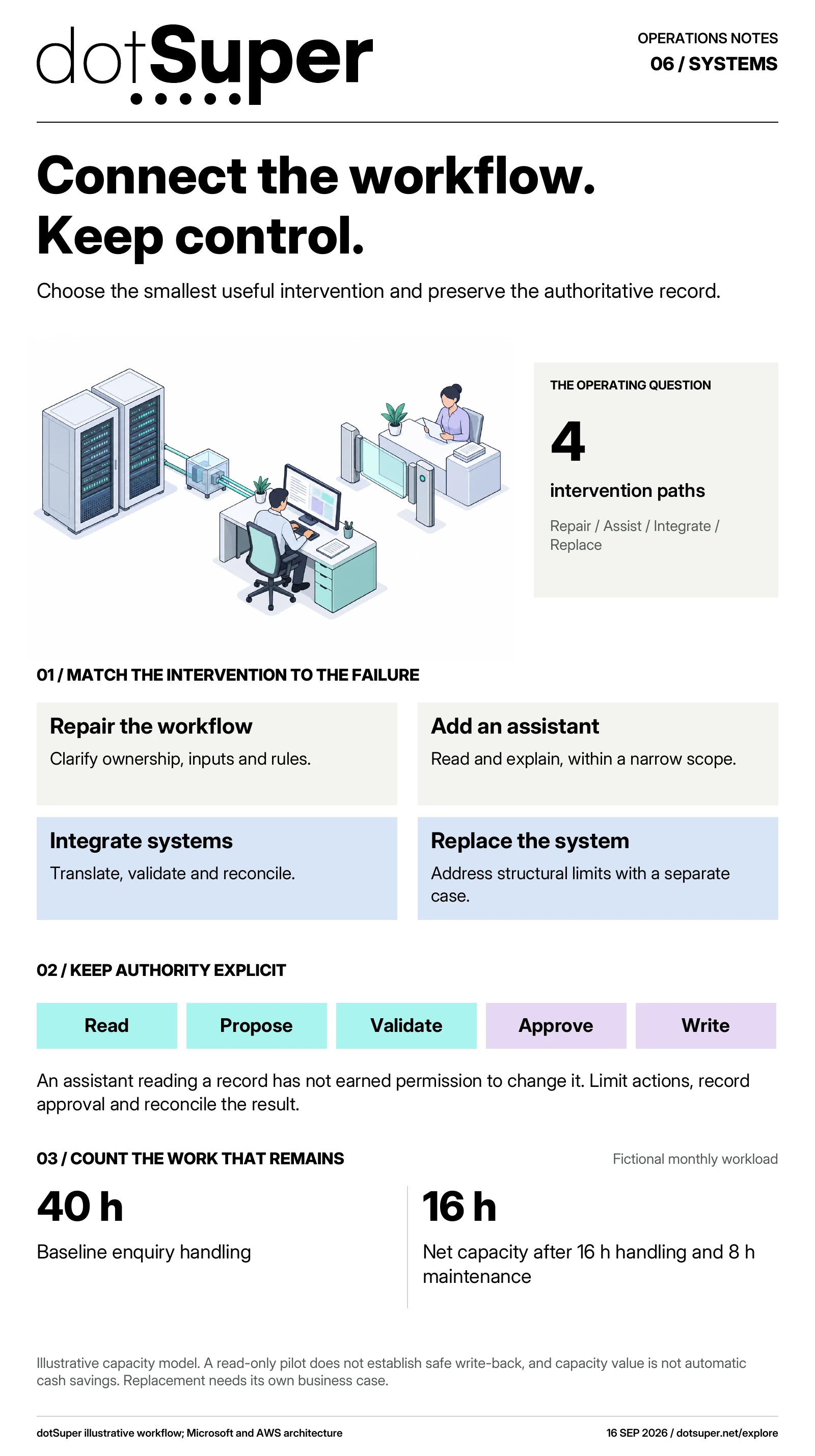
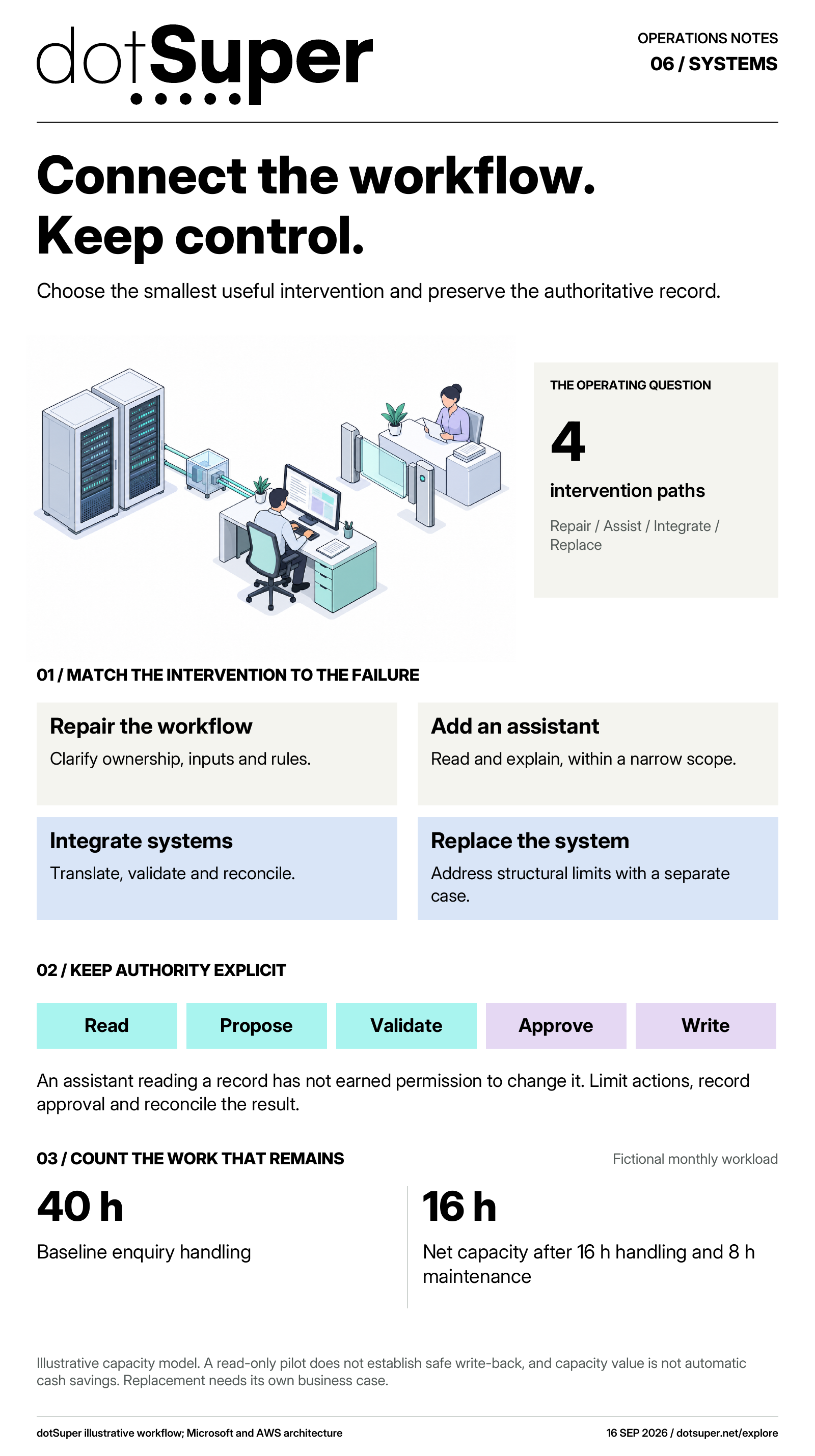
Read the diagram: Choose the smallest useful intervention and preserve the authoritative record. Illustrative capacity model. A read-only pilot does not establish safe write-back, and capacity value is not automatic cash savings. Replacement needs its own business case.
Four intervention paths are workflow repair, an assistant, targeted integration and system replacement. Authority remains explicit from reading through approval and write-back. A fictional enquiry workflow starts at 40 hours, uses 16 hours of assisted handling and eight hours of maintenance, leaving 16 net hours of capacity.
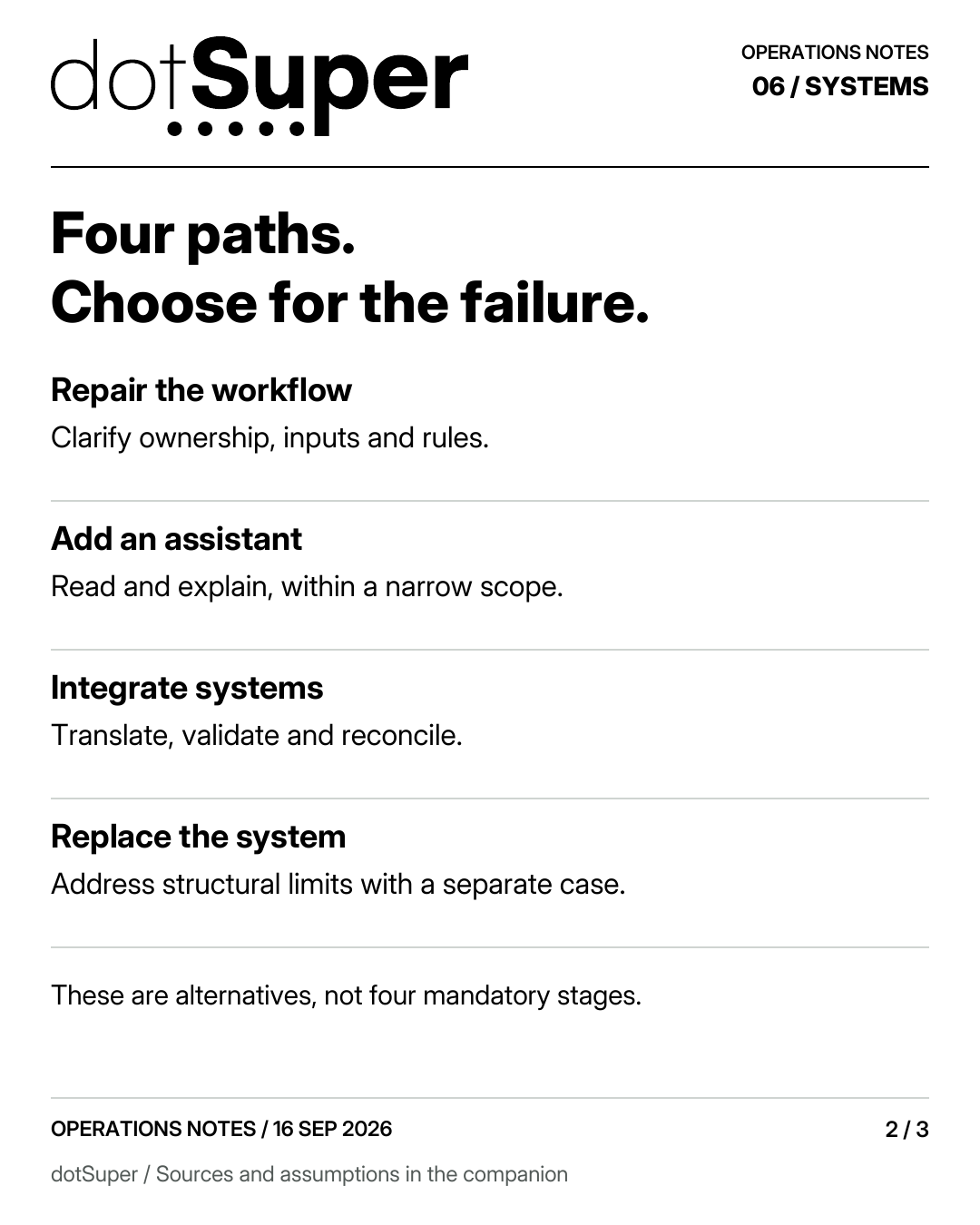
Four paths: repair ownership and rules; add a narrow assistant; integrate through translation, validation and reconciliation; or replace structural limitations with a separate case. These are not four mandatory stages.
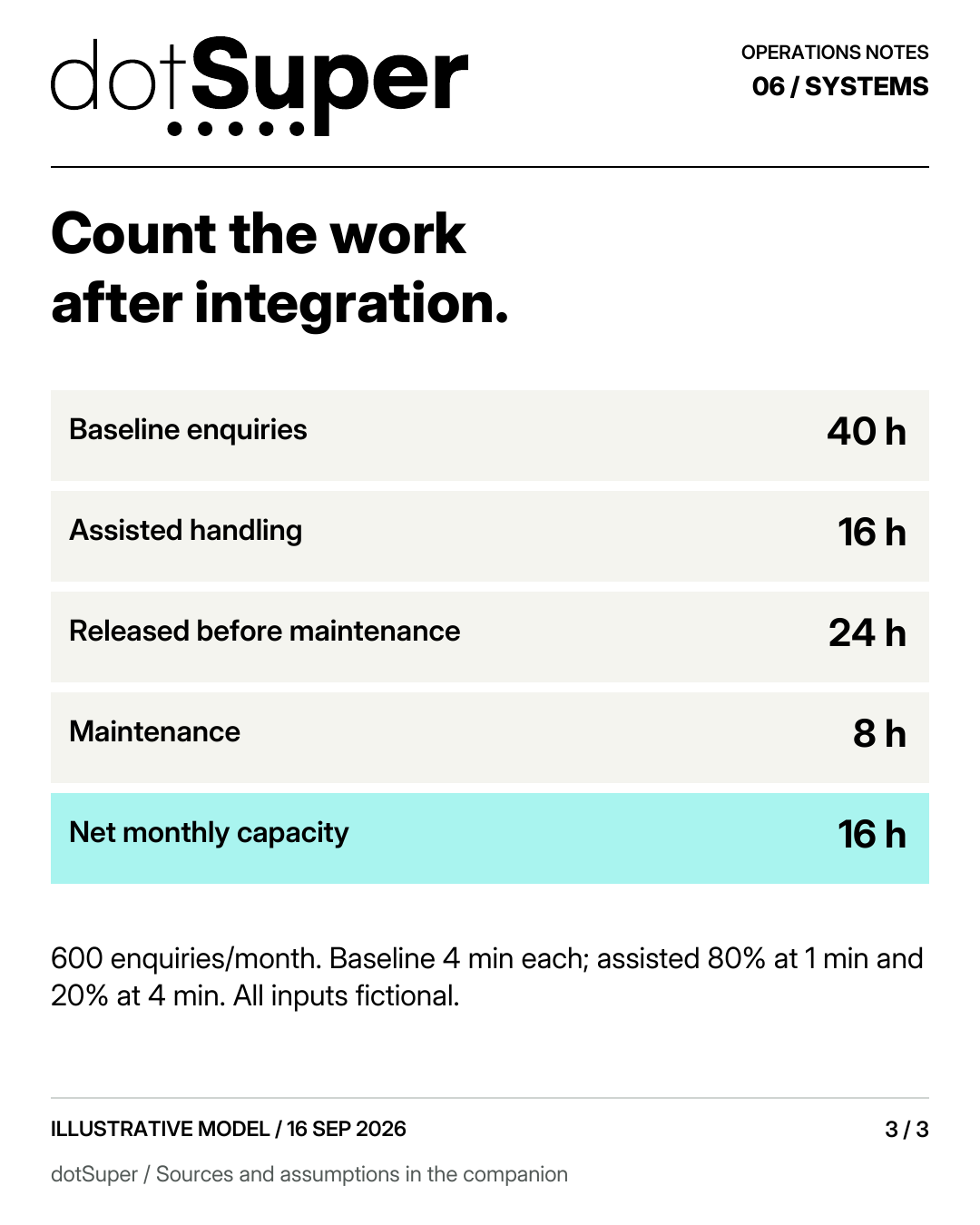
600 monthly enquiries at four baseline minutes require 40 hours. Assisted handling uses one minute for 80% and four minutes for 20%, totalling 16 hours. Release is 24 hours before eight hours of maintenance, leaving 16 net hours.
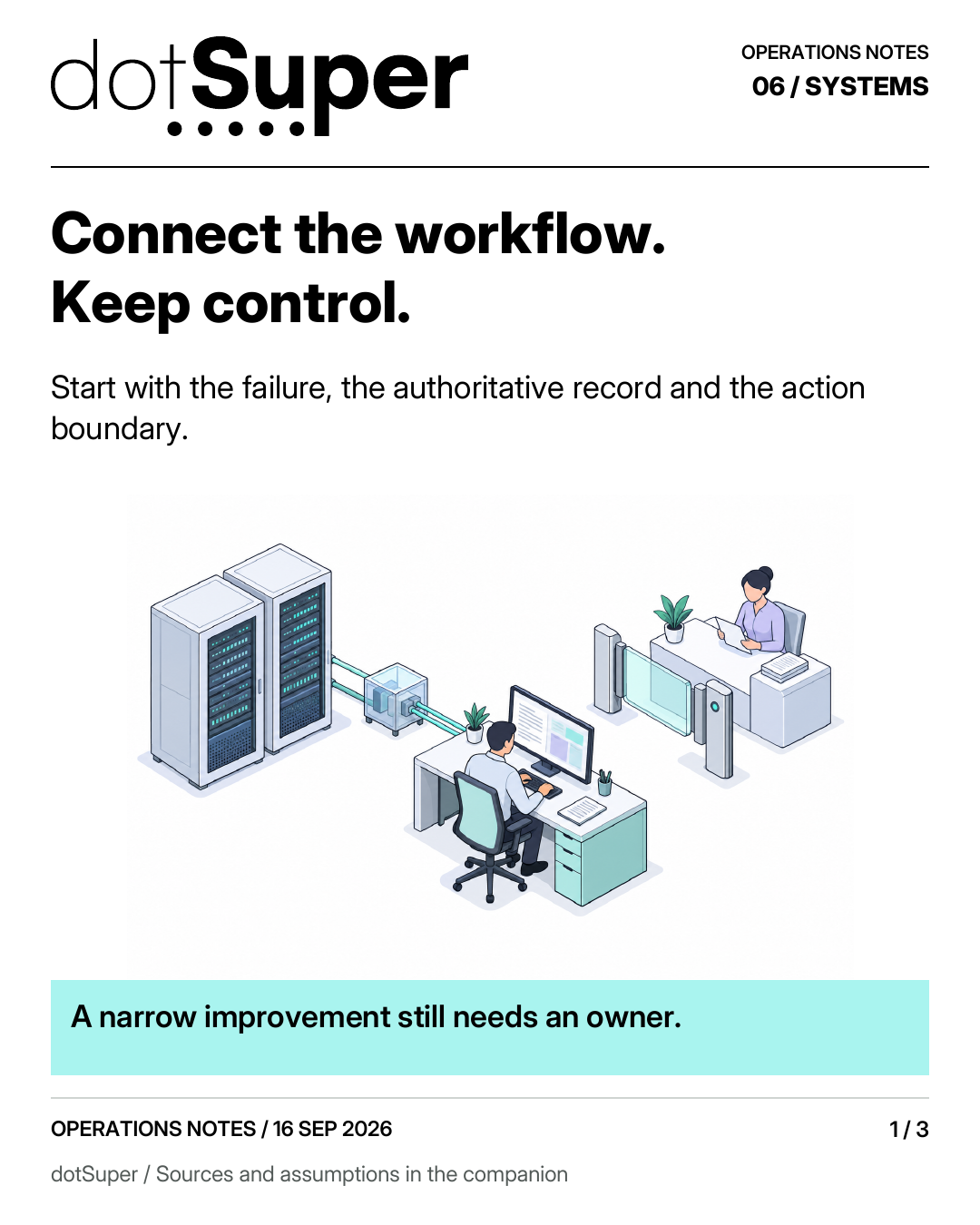
Connect the workflow. Keep control. Start with the failure, the authoritative record and the action boundary. A narrow improvement still needs an owner.
Four paths. Choose for the failure. Repair the workflow / Clarify ownership, inputs and rules. Add an assistant / Read and explain, within a narrow scope. Integrate systems / Translate, validate and reconcile. Replace the system / Address structural limits with a separate case. These are alternatives, not four mandatory stages.
Count the work after integration. Baseline enquiries / 40 h Assisted handling / 16 h Released before maintenance / 24 h Maintenance / 8 h Net monthly capacity / 16 h 600 enquiries/month. Baseline 4 min each; assisted 80% at 1 min and 20% at 4 min. All inputs fictional.
The 600-enquiry example is synthetic. Payroll-valued capacity is not automatic cash saving or a replacement-system business case.
Primary vendor engineering patterns explain options, not typical ERP costs or implementation outcomes.
Read-only success does not establish safe write-back. Actual API scope, licence tier, access boundaries and correction procedures matter.
| Item | Hours/month |
|---|---|
| Baseline | 40 |
| Assisted handling | 16 |
| Released before maintenance | 24 |
| Maintenance | 8 |
| Net capacity | 16 |
Reuse: Original artwork created for dotSuper. No public reuse licence has been specified. Attribution to research sources does not grant rights to their artwork or datasets.
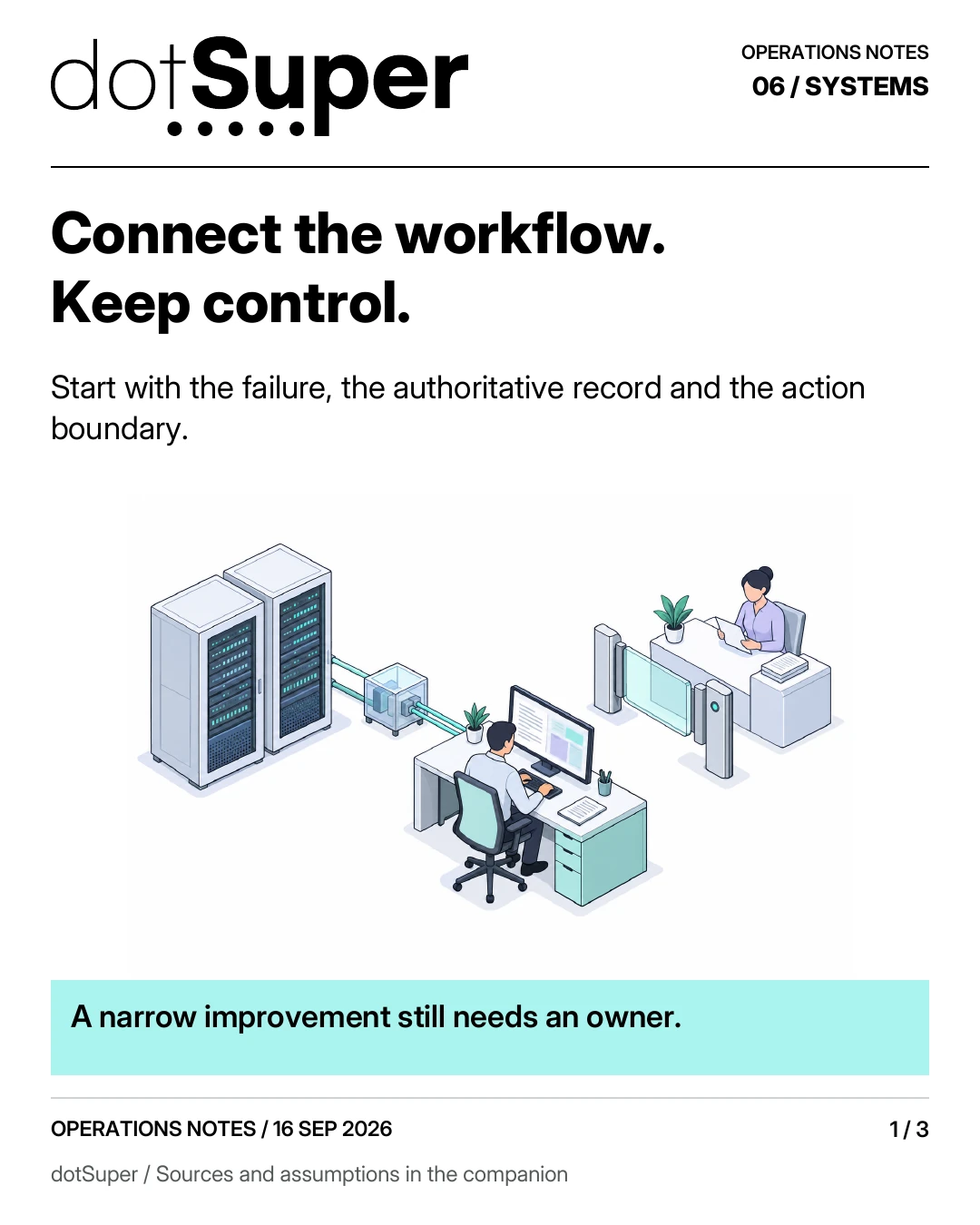
Read the diagram: Panel 1 of 3. Connect the workflow.
Connect the workflow. Keep control. Start with the failure, the authoritative record and the action boundary. A narrow improvement still needs an owner.
The 600-enquiry example is synthetic. Payroll-valued capacity is not automatic cash saving or a replacement-system business case.
Reuse: Original artwork created for dotSuper. No public reuse licence has been specified. Attribution to research sources does not grant rights to their artwork or datasets.
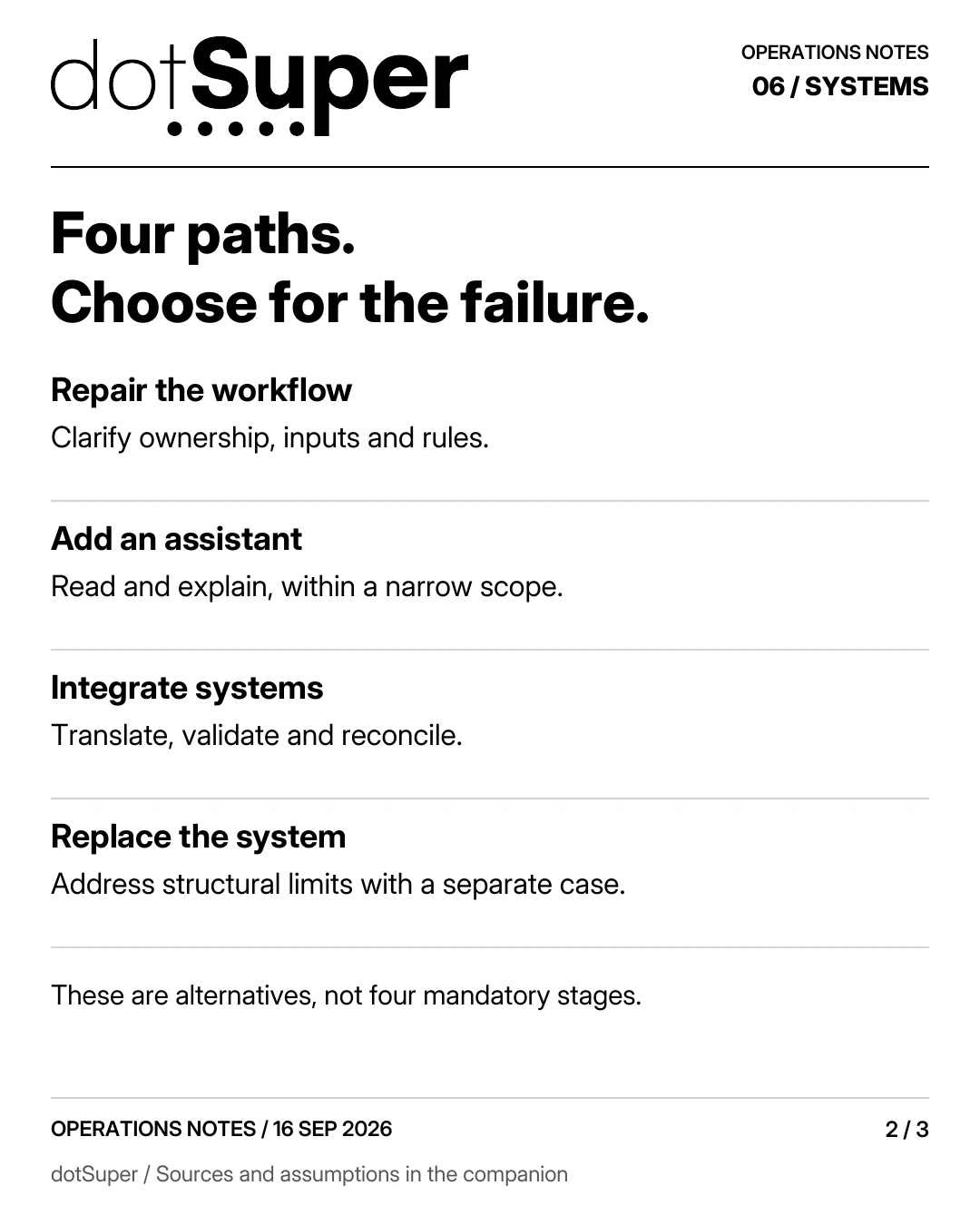
Read the diagram: Panel 2 of 3. Four paths.
Four paths. Choose for the failure. Repair the workflow / Clarify ownership, inputs and rules. Add an assistant / Read and explain, within a narrow scope. Integrate systems / Translate, validate and reconcile. Replace the system / Address structural limits with a separate case. These are alternatives, not four mandatory stages.
The 600-enquiry example is synthetic. Payroll-valued capacity is not automatic cash saving or a replacement-system business case.
Reuse: Original artwork created for dotSuper. No public reuse licence has been specified. Attribution to research sources does not grant rights to their artwork or datasets.
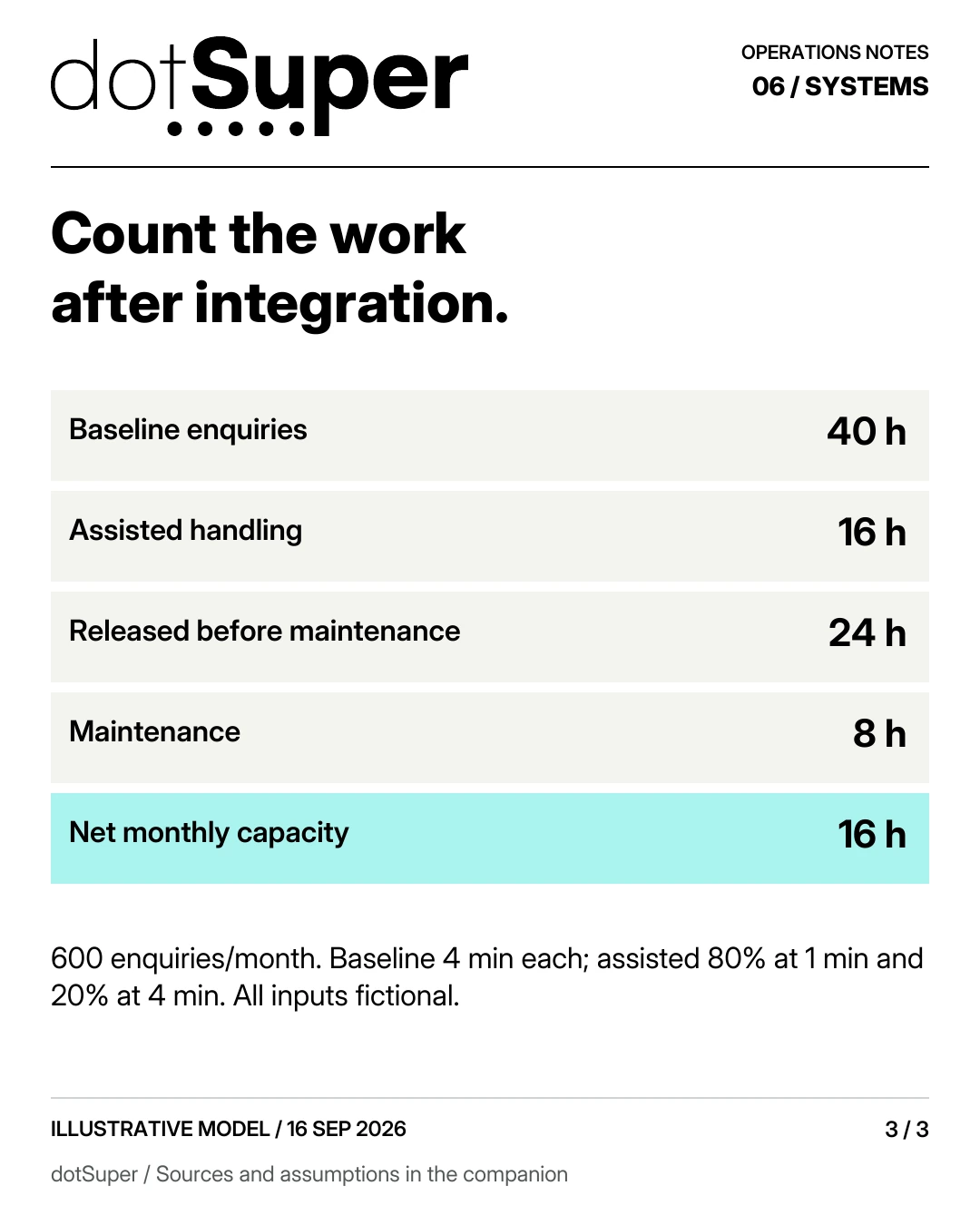
Read the diagram: Panel 3 of 3. Count the work after integration.
Count the work after integration. Baseline enquiries / 40 h Assisted handling / 16 h Released before maintenance / 24 h Maintenance / 8 h Net monthly capacity / 16 h 600 enquiries/month. Baseline 4 min each; assisted 80% at 1 min and 20% at 4 min. All inputs fictional.
The 600-enquiry example is synthetic. Payroll-valued capacity is not automatic cash saving or a replacement-system business case.
Fictional example: integration capacity.
Item: Baseline; Hours/month: 40.
Item: Assisted handling; Hours/month: 16.
Item: Released before maintenance; Hours/month: 24.
Item: Maintenance; Hours/month: 8.
Item: Net capacity; Hours/month: 16.
| Item | Hours/month |
|---|---|
| Baseline | 40 |
| Assisted handling | 16 |
| Released before maintenance | 24 |
| Maintenance | 8 |
| Net capacity | 16 |
Take it into your next working session
Keep the source credits with the file. Check the reuse terms and adapt the method to your context.
Credit: dotSuper original fictional worked-example data.
Reuse: Original illustrative data. No public reuse licence has been specified. These are not client measurements or research results.
Reuse: Original artwork created for dotSuper. No public reuse licence has been specified. Attribution to research sources does not grant rights to their artwork or datasets.
Reuse: Original artwork created for dotSuper. No public reuse licence has been specified. Attribution to research sources does not grant rights to their artwork or datasets.
Reuse: Original artwork created for dotSuper. No public reuse licence has been specified. Attribution to research sources does not grant rights to their artwork or datasets.
Reuse: Original artwork created for dotSuper. No public reuse licence has been specified. Attribution to research sources does not grant rights to their artwork or datasets.
Reuse: Original artwork created for dotSuper. No public reuse licence has been specified. Attribution to research sources does not grant rights to their artwork or datasets.
Reuse: Original artwork created for dotSuper. No public reuse licence has been specified. Attribution to research sources does not grant rights to their artwork or datasets.
Thumbnail credit and reuse
Reuse: Original artwork created for dotSuper. No public reuse licence has been specified. Attribution to research sources does not grant rights to their artwork or datasets.
- 01Repairing a process, adding assistance, integrating and replacing are alternatives that can coexist.
- 02Assign authority for records and business actions before enabling write-back.
- 03A timeout does not prove failure; reconciliation and idempotency prevent duplicate business actions.
- 04The fictional assistant releases 24 hours before maintenance and 16 net hours afterward.
/ dotSuper point of view
The workflow constraint and authoritative records should determine the intervention. Read-only assistance, controlled integration and core replacement require different cases and controls.
Audience, question and answer
Decide from the constraint, supported interfaces and control requirements.
A useful assistant does not automatically require replacing the system of record.
Equally, attaching a model to an unsupported, inconsistent application does not resolve its underlying problems.
Separate the workflow intervention from the core-system decision, then document where each record is authoritative.
The scope is an operational decision framework, not a recommendation for a specific vendor.
It applies to manufacturers and operating businesses across markets.
Saudi and UAE tax or reporting integrations remain jurisdiction-specific and should be evaluated separately from a general ERP modernisation plan.
Findings from engineering sources
The pattern supports a staged option, but assumes that parts of the existing system can remain in operation and be separated.
It is not evidence that every legacy ERP is economical to retain.
Microsoft Azure Architecture Center, Strangler Fig pattern, updated May 2026, checked 16 September 2026 (source 3).
An anti-corruption layer translates between systems whose meanings differ.
Microsoft also warns that such a layer adds operational responsibilities and can become a failure point.
Translating “customer” or “available stock” requires business semantics, not just matching field names.
Microsoft, Anti-Corruption Layer pattern, updated 30 May 2026 (source 2).
Amazon's engineering account explains how idempotent API operations make retries safer.
A request timeout does not necessarily mean the requested action failed.
This matters when creating purchase orders or stock movements: a blind retry can duplicate a business transaction.
Malcolm Featonby, Amazon Builders' Library, Making retries safe with idempotent APIs, introduced January 2021, checked 16 September 2026 (source 1).
These are primary engineering descriptions, not independent comparisons of ERP costs or implementation outcomes.
Their application to a particular factory is a design inference that must be tested against the actual software, contract and operating process.
A four-path decision framework
A new interface can make poor records easier to access without making them correct.
Establish master-data ownership and a baseline before automating the ambiguity.
Add read-only assistance when users need to find, explain or compare records and the ERP can expose authorised data.
Start with clear freshness and source labels.
An answer based on yesterday's stock position should not appear to be a live promise of availability.
Queries must respect the user's permissions, including row or company boundaries.
Integrate controlled write-back when a narrow, repeatable action has reliable validation and rollback or correction procedures.
The assistant can prepare a draft; a separate authorised process can validate and post it.
Identity, approval limits, idempotency and audit history belong to that action path.
Replace or substantially modernise when the core cannot support required controls, integrations or business changes at an acceptable cost.
Evaluate supported export, legal record retention, parallel operation, migration quality, downtime, licensing and training.
Do not use a model demonstration as the sole justification for a core-system programme.
These paths can coexist.
A company can improve product codes now, use read-only assistance next, and replace one unsupported module later.
The decision map should allow this sequence rather than force a binary answer.
Define authority and failure before the happy path
State which system creates each record, which systems may amend it, and how conflicts are resolved.
“Both systems are up to date” is not a conflict-resolution rule.
For every integration, define input validation, authorisation, duplicate handling, acknowledgement and reconciliation.
Record the original request identifier.
If a user repeats a request after a timeout, the system should determine whether the original transaction was posted before creating another one.
Choose an operating response for stale or unavailable data.
A system can decline to answer, return a clearly dated snapshot, or route the request to a person.
It should not quietly invent a current balance.
Recovery must include reconciliation, not merely restarting the connector.
Map permissions at the business-action level.
Reading a supplier address does not imply authority to change its payment account.
A purchasing assistant should not inherit broad administrator credentials simply because that simplifies integration.
Test company separation, revoked access and audit-log completeness as part of the pilot.
Worked example: an inventory enquiry assistant
Staff currently spend four minutes per enquiry checking the ERP and interpreting available, reserved and expected quantities.
Baseline handling is 2,400 minutes, or 40 hours.
All values are illustrative, with no country-specific performance claim.
In a proposed pilot, 80% of enquiries take one minute including review, while 20% still require four minutes.
Handling becomes 480 × 1 + 120 × 4 = 960 minutes, or 16 hours.
The apparent released capacity is 24 hours monthly before connector maintenance, training and error correction.
If maintenance consumes eight hours per month, the net capacity difference is 16 hours.
Valuing that at an assumed AED 100 per hour gives AED 1,600 of monthly capacity value.
It is not cash saved unless spending changes or the capacity is productively used.
It cannot justify an ERP replacement without its own cost and risk analysis.
Now consider a failure: the assistant sees 50 units on hand, 35 reserved and ten already allocated to another company.
If it reports 50 units available, fluent language has produced a wrong operational answer.
The pilot needs an agreed availability definition and entity boundary before any speed measurement is meaningful.
A second phase could draft a stock transfer but should remain behind validation and approval.
The read-only pilot's results do not prove that write-back is safe.
The action scope, permissions and test cases have changed.
Quantitative context and comparison design
Collect actual quotes and internal effort estimates.
Include implementation, licences, interfaces, data cleansing, parallel runs, downtime, support and exit costs.
Separate one-time amounts from recurring amounts.
Compare each option against the same workload and service standard.
A replacement with broader capabilities is not directly comparable to a narrow assistant unless those extra capabilities are valued explicitly.
Show ranges where uncertainty is material and state which inputs are vendor estimates versus observed operating records.
For the pilot, measure answer correctness, data age, permission failures, staff handling time and unresolved exceptions.
For write-back, add duplicate transactions, reconciliation discrepancies and correction effort.
A connector's uptime percentage alone does not prove accurate business records.
Evidence and boundaries
Each source supports only the scope stated beside the claim.
| Claim | Evidence | Boundary |
|---|---|---|
| Incremental migration is a documented architecture option | Microsoft Strangler Fig | Applicability depends on separability and coexistence |
| Translation layers preserve differing system meanings | Microsoft Anti-Corruption Layer | Additional latency and maintenance possible |
| Retried requests can require idempotency | Amazon Builders' Library | Inspect the actual API contract |
| Record authority should be explicit | dotSuper analytical recommendation | No measured implementation effect asserted |
| Example net capacity is 16 hours monthly | 40 minus 16 minus 8 hours | Fictional inputs |
| Read-only success does not validate write-back | Risk and scope analysis | Different action and control boundary |
One practical next step
Start with a bounded pilot whose correctness and handling effort can be measured.
Counterevidence and limitations
Sometimes replacement simplifies the estate.
Conversely, a replacement can reproduce bad data and increase disruption if process design is weak.
Neither path wins on principle.
Vendor documentation describes useful patterns but reflects particular ecosystems.
Confirm equivalent capabilities in the actual ERP and its licence tier.
A claimed API may exclude the fields or actions needed.
Robotic interaction with a changing user interface may introduce different failure modes from supported APIs.
No survey of dotSuper customers, regional ERP market share or typical project duration was conducted.
Search popularity of “replace ERP with AI” is unmeasured.
This explanation supports operating decisions; it does not establish a market trend.
What this page cannot conclude
- 01The 600-enquiry example is synthetic. Payroll-valued capacity is not automatic cash saving or a replacement-system business case.
- 02Primary vendor engineering patterns explain options, not typical ERP costs or implementation outcomes.
- 03Read-only success does not establish safe write-back. Actual API scope, licence tier, access boundaries and correction procedures matter.
Sources
- 01Malcolm Featonby, Amazon Builders' Library, Making retries safe with idempotent APIs, introduced January 2021, checked 16 September 2026Amazon Builders Library; Malcolm Featonby · accessed Sep 16, 2026
- 02Microsoft, Anti-Corruption Layer pattern, updated 30 May 2026Microsoft Azure Architecture Center · accessed Sep 16, 2026
- 03Microsoft Azure Architecture Center, Strangler Fig pattern, updated May 2026, checked 16 September 2026Microsoft Azure Architecture Center · accessed Sep 16, 2026
Our editorial standard · Found an error? Send a correction with its source.
/ CITE OR SHARE THIS GUIDE
Make the evidence easy to verify.
When you reference this guide, link to its canonical URL. That gives readers one stable place for the evidence, limitations and future updates.
dotSuper Research Desk. (September 17, 2026). Connect the workflow. Keep control.. dotSuper. https://dotsuper.net/feeds/applied-systems/integrate-ai-with-operating-systems