LTRLS Learning Through Real-Life Scenarios
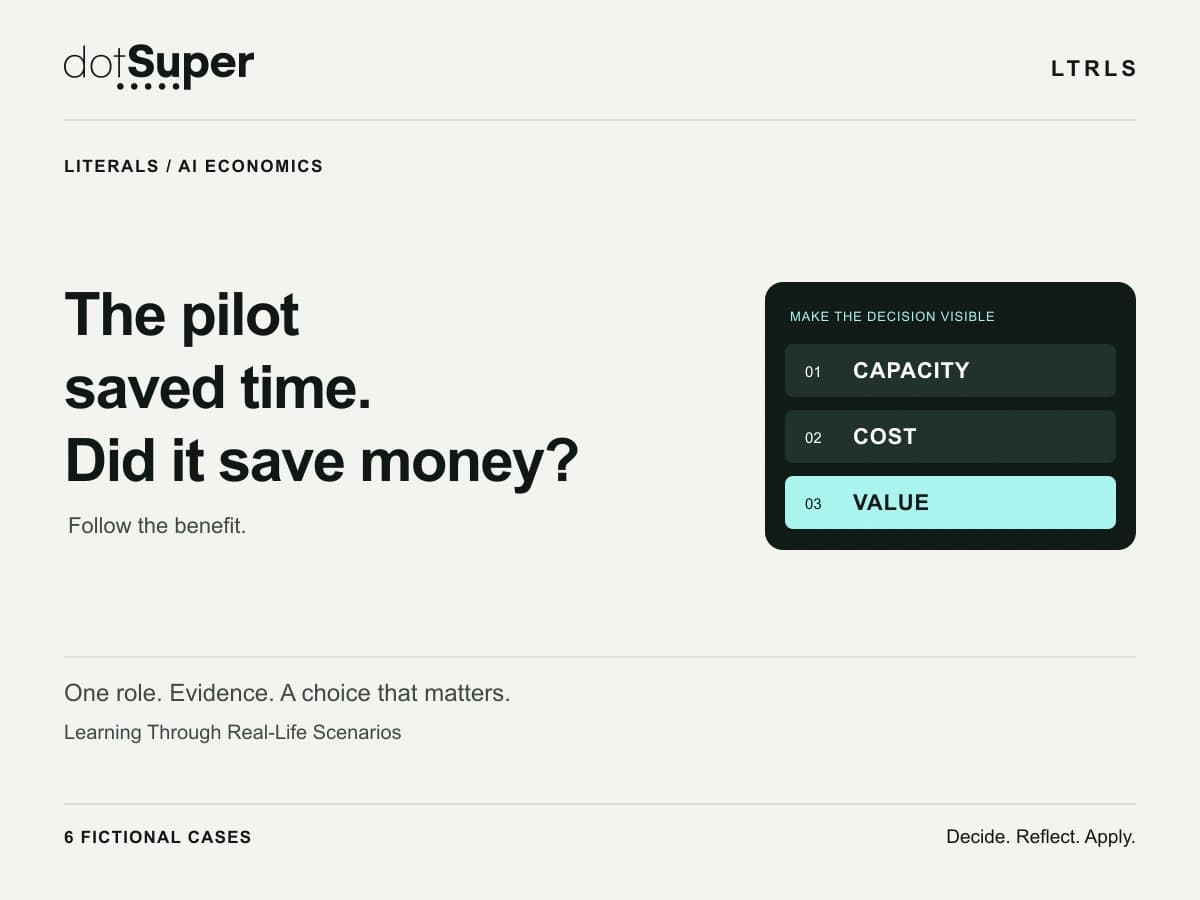
The pilot saved time. Did it save money?
Decide whether an AI pilot deserves more investment. Separate released capacity, cash savings and additional margin across six fictional business decisions.
No account needed. Work alone or discuss with a team.
What you will practise
Make the trade-off visible.
Expand an AI pilot when comparable evidence supports a useful outcome and the full cost is understood. Give each benefit an owner and a route to realisation.
- Distinguish capacity, cash savings and additional contribution.
- Use comparable baselines and include review and exceptions.
- Make a conditional investment decision with a benefit owner.
Built for the people making the call
Original fictional educational cases. All companies, prices, volumes and outcomes are illustrative. Sources support the stated principles, not claimed customer results. Completion is a learning record, not a professional assessment.
From the exercise to the business
What a better decision could change.
What you will learn
Challenge a business case and explain what would make the investment worthwhile.
Potential business value
Improve investment decisions and avoid overstated benefits. Actual value depends on implementation and measured outcomes.
How the value could happen
Comparable process evidence → credible capacity estimate → a funded use of that capacity → measured outcome.
Measures to examine
- All-in staff minutes per comparable completed quotation
- Serious error and rework rates
- Overtime expense actually avoided
- Incremental contribution after additional costs
Keep these limits in view
- Do not count the same released hour as both avoided overtime and extra production.
- Do not treat salary allocation as a cash saving without a spending change.
- Keep quality and service measures alongside speed.
A useful next step: Observe a small representative set of real tasks and write one benefit hypothesis before funding expansion.
Explore the companion method- 01
Read the situation
Identify the purpose, people and consequences.
- 02
Make your choice
Confirm a response before opening the reasoning.
- 03
Question the control
Discuss what would need to change in a real workflow.
- 04
Leave with a card
Record an owner, evidence, approval conditions and a stop point.
LTRLS / Practise before the real decision
A situation. A choice. A better question.
A quotation assistant looks promising. Work through six investment decisions, from a time-saving claim to a measured expansion decision.
Progress and notes stay in this page’s memory. Refreshing, leaving or closing the page loses them. Use anonymous examples and roles.
Running this with a team?
- Ask the operations lead and finance lead to classify the same benefit independently.
- Keep fictional arithmetic separate from evidence available in the learner’s organisation.
- A decision to continue a bounded trial can be valid without a positive cash return yet.
Prefer to read?
The complete case notes.
The same situations and reasoning, without the interactive flow.
Open all 6 cases
Case 01
What did the pilot actually release?
The distributor completes 2,000 quotations monthly. Comparable current work takes 18 minutes each, including checks and exceptions. The pilot takes seven minutes to prepare and four to review. Pilot exception work remains unmeasured. Salaries and staffing are unchanged.
What can the sponsor responsibly claim today?
- About 233 hours of provisional monthly capacity, before unmeasured pilot exceptions.
- About 233 hours multiplied by salary cost as realised monthly cash savings.
- A proven 61% end-to-end improvement, using seven minutes versus eighteen.
- No benefit of any kind because salaries have not fallen.
Recommended response for this scenario
About 233 hours of provisional monthly capacity, before unmeasured pilot exceptions.
The routine difference is seven minutes: 2,000 × 7 / 60 = 233.3 hours monthly. That is provisional capacity. Pilot exceptions could reduce it. A spending change or an additional useful output needs separate evidence.
Why each choice matters
- About 233 hours of provisional monthly capacity, before unmeasured pilot exceptions.
- This uses the observed routine difference while keeping the incomplete evidence visible.
- About 233 hours multiplied by salary cost as realised monthly cash savings.
- Allocated salary cost has not disappeared. This can describe resource value only with an explicit assumption, not realised cash.
- A proven 61% end-to-end improvement, using seven minutes versus eighteen.
- This omits the four-minute review and the unmeasured exception work.
- No benefit of any kind because salaries have not fallen.
- Capacity and service improvements can matter even when cash spending is unchanged.
Practical control: Label every benefit as capacity, spending avoided, contribution or service improvement. Record the calculation and the missing evidence.
Discuss: Who could use the released capacity, and what would change for the customer?
- Guidance on the impact evaluation of AI interventionsUK Evaluation Task Force / Frontier Economics · Accessed 2026-09-17
- The People Factor: a human-centred approach to scaling AI toolsUK Government Communication Service · Accessed 2026-09-17
Case 02
The sample looks unusually easy
The pilot measured 25 simple quotations handled by volunteers. The monthly workload also includes custom specifications and bilingual documents. A sponsor proposes applying the average saving to every quotation.
Which next step most improves the investment evidence?
- Ask the volunteers whether their time savings feel representative.
- Repeat another 25 simple quotations to make the average more precise.
- Compare current and pilot work across the important task types, recording quality and rework.
- Roll out to everyone and use adoption as proof of productivity.
Recommended response for this scenario
Compare current and pilot work across the important task types, recording quality and rework.
The sample supports a claim about those simple quotations only. Build a comparison across the material task types and skill levels. Record complete handling time and errors. Set the decision criteria before seeing the next results.
Why each choice matters
- Ask the volunteers whether their time savings feel representative.
- Perceptions can identify issues but cannot establish how excluded work performs.
- Repeat another 25 simple quotations to make the average more precise.
- More observations of the same narrow segment still leave the other segments untested.
- Compare current and pilot work across the important task types, recording quality and rework.
- This addresses the scope of the claim. Use comparable work and disclose residual uncertainty.
- Roll out to everyone and use adoption as proof of productivity.
- Usage measures exposure to the tool, not the causal effect on completed work.
Practical control: Create a sampling sheet: task type, operator experience, comparison method, complete time, exceptions and quality outcome.
Discuss: Which task type could overturn the current recommendation?
- Guidance on the impact evaluation of AI interventionsUK Evaluation Task Force / Frontier Economics · Accessed 2026-09-17
- The People Factor: a human-centred approach to scaling AI toolsUK Government Communication Service · Accessed 2026-09-17
Case 03
The missing work returns
A broader comparison confirms the same task mix. Pilot exceptions add three minutes per quotation on average. The current 18-minute baseline already includes its exceptions. Pilot preparation and routine review still take eleven minutes combined.
Which capacity estimate should replace the first claim?
- Keep 233.3 hours because exception work is unusual.
- Use 133.3 hours monthly and retain a separate quality comparison.
- Set capacity to zero because any exceptions invalidate the pilot.
- Subtract the three minutes from both the baseline and pilot.
Recommended response for this scenario
Use 133.3 hours monthly and retain a separate quality comparison.
Pilot time is 7 + 4 + 3 = 14 minutes. The four-minute difference releases approximately 133.3 hours monthly. This is an average over comparable work. It does not establish that errors are acceptable or that those hours can all be redeployed.
Why each choice matters
- Keep 233.3 hours because exception work is unusual.
- The average already spreads exception work across all quotations. Excluding it understates labour.
- Use 133.3 hours monthly and retain a separate quality comparison.
- Four minutes per quotation across 2,000 quotations yields 8,000 minutes, or 133.3 hours.
- Set capacity to zero because any exceptions invalidate the pilot.
- The measured pilot still takes less staff time. Exceptions change the result rather than erase every benefit.
- Subtract the three minutes from both the baseline and pilot.
- The baseline already includes current exceptions. Adjusting it again creates an inconsistent comparison.
Practical control: Maintain one reconciled benefit model. Give routine review, exceptions and rework explicit treatment in both alternatives.
Discuss: What evidence would show whether those hours are available when the business needs them?
- Guidance on the impact evaluation of AI interventionsUK Evaluation Task Force / Frontier Economics · Accessed 2026-09-17
- The People Factor: a human-centred approach to scaling AI toolsUK Government Communication Service · Accessed 2026-09-17
Case 04
A modest benefit survives the arithmetic
Assume 60 released hours replace monthly overtime at AED 80 per hour. That reduction is achievable without harming service. Setup costs AED 18,000; recurring costs are AED 36,000 yearly. For this calculation, benefits begin in month one and no other costs apply.
What is the correct first-year cash view under these assumptions?
- AED 57,600 net benefit, because that is the overtime avoided.
- Monetise all 133.3 released hours at AED 80.
- AED 21,600 net benefit, excluding setup as a one-off.
- AED 3,600 first-year net benefit, with the remaining capacity recorded separately.
Recommended response for this scenario
AED 3,600 first-year net benefit, with the remaining capacity recorded separately.
The calculation is 60 × 80 × 12 − 36,000 − 18,000 = AED 3,600. The recurring surplus is AED 1,800 monthly. Setup payback would take ten months under the stated timing assumptions. Small cost changes could erase the first-year surplus.
Why each choice matters
- AED 57,600 net benefit, because that is the overtime avoided.
- AED 57,600 is the gross avoided expense. Setup and recurring costs still need deduction.
- Monetise all 133.3 released hours at AED 80.
- Only 60 hours replace overtime in this scenario. Applying its rate to every hour invents spending reductions.
- AED 21,600 net benefit, excluding setup as a one-off.
- That describes annual recurring benefit before setup, not the requested first-year result.
- AED 3,600 first-year net benefit, with the remaining capacity recorded separately.
- Twelve months of AED 4,800 equals AED 57,600. Deduct AED 54,000 in first-year costs.
Practical control: Show gross benefit, full cost, timing and net benefit separately. Test a downside case before committing.
Discuss: Which assumption would you verify first because it could change the decision?
- Guidance on the impact evaluation of AI interventionsUK Evaluation Task Force / Frontier Economics · Accessed 2026-09-17
- The People Factor: a human-centred approach to scaling AI toolsUK Government Communication Service · Accessed 2026-09-17
Case 05
The same hour has two jobs
After allocating 60 hours to reduced overtime, about 73.3 released hours remain. Sales proposes 200 extra quotations monthly, taking 14 minutes each. It forecasts 20 extra wins at AED 500 contribution each. Demand and downstream delivery capacity have not been verified.
How should the proposed growth benefit enter the business case?
- Add AED 10,000 as proven monthly value alongside the overtime reduction.
- Treat growth as a separate hypothesis using residual capacity, and verify demand, conversion and delivery.
- Allocate all 133.3 hours to growth while keeping the overtime benefit.
- Exclude all growth benefits permanently because only cash cuts count.
Recommended response for this scenario
Treat growth as a separate hypothesis using residual capacity, and verify demand, conversion and delivery.
The extra quotations require about 46.7 hours. That fits the remaining 73.3 hours on paper. Confirm role availability, demand, incremental wins and delivery costs. Count contribution after additional costs, and avoid attributing existing sales to the pilot.
Why each choice matters
- Add AED 10,000 as proven monthly value alongside the overtime reduction.
- The arithmetic describes a forecast. It lacks evidence that the extra wins and contribution will occur.
- Treat growth as a separate hypothesis using residual capacity, and verify demand, conversion and delivery.
- The proposed work requires about 46.7 hours, within the illustrative residual capacity. Commercial outcomes remain uncertain.
- Allocate all 133.3 hours to growth while keeping the overtime benefit.
- This spends the same 60 hours twice.
- Exclude all growth benefits permanently because only cash cuts count.
- Additional contribution can be valuable if it is incremental, feasible and evidenced.
Practical control: Assign each released hour once. Keep prospective growth in a separate evidence register until outcomes are observed.
Discuss: What would distinguish an additional order from one the team would have won anyway?
- Guidance on the impact evaluation of AI interventionsUK Evaluation Task Force / Frontier Economics · Accessed 2026-09-17
- The People Factor: a human-centred approach to scaling AI toolsUK Government Communication Service · Accessed 2026-09-17
Case 06
Expansion meets a different workflow
Simple quotations now show acceptable quality and stable all-in time. A new custom-work team needs 21 minutes with the pilot versus 18 currently. The sponsor wants one company-wide launch date because the software is already purchased.
What is the strongest expansion decision?
- Expand everywhere to recover the money already spent.
- Stop every use because the custom-work team is slower.
- Expand the supported segment and redesign or pause the custom-work segment against explicit criteria.
- Blend all teams into one average and approve if that number improves.
Recommended response for this scenario
Expand the supported segment and redesign or pause the custom-work segment against explicit criteria.
Authorise expansion where the evidence supports it. Give the custom workflow its own decision, owner and improvement condition. Include quality and service effects. The next decision should depend on future costs and benefits, not the desire to justify sunk spending.
Why each choice matters
- Expand everywhere to recover the money already spent.
- Past expenditure does not make an unsuitable workflow more useful.
- Stop every use because the custom-work team is slower.
- The evidence distinguishes segments; one poor fit does not erase a useful fit elsewhere.
- Expand the supported segment and redesign or pause the custom-work segment against explicit criteria.
- This links the scope of expansion to observed outcomes and avoids spreading a negative result.
- Blend all teams into one average and approve if that number improves.
- An aggregate can conceal a harmed or unsupported workflow.
Practical control: Record rollout scope, remaining uncertainty, benefit owner, quality limits and the date for a continue/change/stop decision.
Discuss: What would the custom-work team need to demonstrate before joining the rollout?
- Guidance on the impact evaluation of AI interventionsUK Evaluation Task Force / Frontier Economics · Accessed 2026-09-17
- The People Factor: a human-centred approach to scaling AI toolsUK Government Communication Service · Accessed 2026-09-17
Worked example / Fictional teaching context
AI benefit-evidence card
Illustrative assumptions, not a customer result, forecast or professional assessment. Keep the conditions beside the numbers.
- Volume
- 2,000 comparable quotations per month
- Baseline
- 18 minutes each, including current checks and exceptions
- Pilot after measured exceptions
- 14 minutes each
- Capacity
- 2,000 × (18 − 14) / 60 = 133.3 hours/month
- Potential cash expense avoided
- 60 overtime hours × AED 80 = AED 4,800/month
- Costs
- AED 18,000 setup + AED 36,000 annual recurring
- Illustrative first-year net benefit
- AED 57,600 − AED 54,000 = AED 3,600
- Conditions
- Assumes twelve full months of realised overtime reduction, unchanged quality and no omitted costs
- Other capacity
- 73.3 hours/month remains unmonetised; assign a use and measure its outcome
Try the idea in a different situation
An HR team saves drafting time but adds a longer approval step. Write the evidence you need before claiming a financial benefit.
Prompts for your discussion
- Includes approval and exception work in both baselines.
- Separates released time from a real spending change.
- Names an owner, a quality measure and a review decision.
Use these prompts to examine the reasoning, not to award a score or certify readiness.
Sources and limits
Keep the context with the decision.
Original fictional educational cases. All companies, prices, volumes and outcomes are illustrative. Sources support the stated principles, not claimed customer results. Completion is a learning record, not a professional assessment.
Editorial source review: 2026-09-17. Not legal approval or a verified readiness assessment.
- Guidance on the impact evaluation of AI interventionsUK Evaluation Task Force / Frontier Economics · Accessed 2026-09-17
- The People Factor: a human-centred approach to scaling AI toolsUK Government Communication Service · Accessed 2026-09-17
- All scenario facts and numerical examples are fictional. They are not verified customer results or estimates of a particular business’s performance.
- The stated durations are planning estimates. Learning outcomes and commercial impact have not been validated with intended readers.
- Source guidance is used for the stated principles. It does not establish legal applicability, certification or professional approval.
- Changed-fact prompts support discussion. This is a fixed case sequence, not a branching simulation.
/ CITE OR SHARE THIS GUIDE
Make the evidence easy to verify.
When you reference this guide, link to its canonical URL. That gives readers one stable place for the evidence, limitations and future updates.
dotSuper Research Desk. (September 17, 2026). The pilot saved time. Did it save money?. dotSuper. https://dotsuper.net/feeds/applied-systems/ai-value-decision-lab
Move from practice to your operating context
Put the decision into practice
Observe a small representative set of real tasks and write one benefit hypothesis before funding expansion.
Talk with dotSuper