F07 / AI Opportunity Prioritisation
Choose the next intervention with evidence.
Compare AI with simpler alternatives, resolve the conditions for a useful test and decide what to do next.
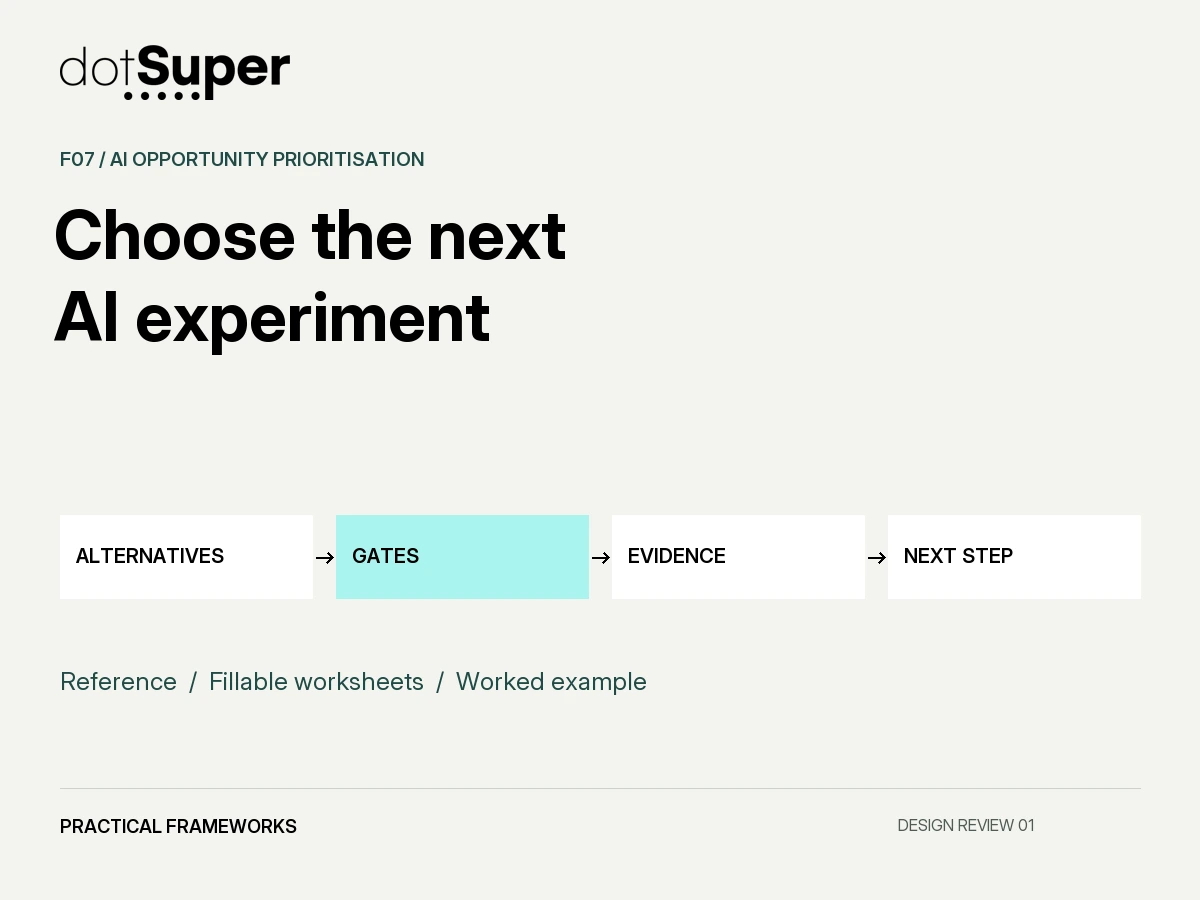
The method, in brief
Which opportunity deserves an experiment, and which needs preparation or a simpler change?
Define the work and alternatives, then check purpose, data, consequences, measurement and ownership. Compare only candidates whose scoped experiments are feasible. Keep unresolved gates visible instead of burying them in a benefit score.
120-minute team session for up to six candidates after preparation. The online flow is a first draft, not a replacement for observation and team review.
Why it matters
A clearer decision, not another document.
Compare the real alternatives
Process changes, ordinary software and leaving the work as it is belong beside an AI proposal.
Keep unmet conditions visible
An attractive saving cannot compensate for missing permission, uncontrolled consequences or absent ownership.
Spend effort on useful evidence
Choose a test that can resolve uncertainty within the team’s actual capacity.
How to use it
From one question to a useful next move.
Define one job and its boundary
Describe the work, expected output, affected people and final decision-maker.
Consider simpler alternatives
Compare process change, conventional software, AI assistance and no change.
Review five readiness conditions
Record purpose, data, consequences, measurement and ownership as pass, unresolved or fail, with evidence.
Choose the next intervention
Improve, prepare, experiment, defer or stop. Record scope, owner and review trigger.
Illustrative example, not a client portfolio
Three ideas lead to three different next steps.
Policy search
Next move: PrepareNo owner for obsolete documents
What to do next
Assign document ownership and resolve outdated guidance.
Supplier quote extraction
Next move: ExperimentPermitted samples, buyer owner, contained offline test
What to do next
Compare with a supplier template and conventional extraction.
Autonomous machine adjustment
Next move: Stop this scopeNo tested containment or domain safety case
What to do next
Requires specialist engineering analysis before reconsideration.
The decision: Sequence work by evidence, containment and operating capacity.
What to measure: The quotation experiment measures quality and total review effort, not drafting speed alone.
These outcomes depend on the hypothetical facts. They are not a universal ranking of AI use cases.
Your context. Your working draft.
Put the framework to work.
One question at a time, with guidance when you need it. Leave with a structured draft you can discuss with your team.
Answers stay in this page’s memory. Refreshing, closing or leaving the page loses your draft. Use anonymous roles and cases, not confidential information.
Why this framework matters
Compare the real alternatives. Process changes, ordinary software and leaving the work as it is belong beside an AI proposal.
Keep unmet conditions visible. An attractive saving cannot compensate for missing permission, uncontrolled consequences or absent ownership.
Spend effort on useful evidence. Choose a test that can resolve uncertainty within the team’s actual capacity.
How to make your first draft
About 15–20 minutes for one candidate. The complete method calls for 120-minute team session for up to six candidates after preparation.
Define one job and its boundary. Describe the work, expected output, affected people and final decision-maker.
Consider simpler alternatives. Compare process change, conventional software, AI assistance and no change.
Review five readiness conditions. Record purpose, data, consequences, measurement and ownership as pass, unresolved or fail, with evidence.
Choose the next intervention. Improve, prepare, experiment, defer or stop. Record scope, owner and review trigger.
Audience and decision
For an operations leader, technology lead, finance partner and people responsible for data and risk. Decide which opportunity deserves a bounded experiment, which needs preparation, which should use a simpler intervention and which should stop. Use this when a company has a long list of AI ideas but limited capacity to evaluate and operate them.
The unit is a work episode and its proposed intervention, not a model or vendor. “Use a language model” is not an opportunity. “Prepare a draft supplier comparison with source links for a buyer to approve” is specific enough to assess. Plan two hours for up to six candidates after workflow discovery.
Research and source ledger
Accessed 16 September 2026.
Lineage: Risk governance and staged testing are established ideas. The intervention family, readiness gates and portfolio sequence are dotSuper synthesis. No NIST or SDAIA certification, endorsement or compliance determination is implied.
| Source and version | Contribution and limit |
|---|---|
| NIST, AI Risk Management Framework 1.0, January 2023 | Establishes lifecycle risk-management functions. It does not supply dotSuper's investment gates or approve any deployment. |
| NIST, AI RMF Playbook, living resource | Suggested actions support contextual assessment. The site says RMF revision is underway; this dossier explicitly uses the published 1.0 baseline. |
| NIST, Generative AI Profile, NIST AI 600-1, July 2024 | Adds generative-AI risk context. Relevant risks must be selected for the actual system, not copied as a generic checklist. |
| UK GDS/CDDO, Technology Code of Practice, updated July 2025 | Supports consideration of user needs, integration and lifecycle choices. Its government obligations are not imported into Gulf private businesses. |
| Brynjolfsson, Li and Raymond, Generative AI at Work, 2023 working paper, 2025 publication | Empirical evidence in customer support cannot establish the expected benefit of a manufacturing opportunity. |
| SDAIA, AI Ethics Principles, official accessible document | Relevant Saudi ethical reference. Exact legal duties and sector requirements need separate current verification. |
Existing approaches and limitations
Impact-versus-effort matrices can help organise discussion but hide uncertainty about both axes. A high benefit estimate can overwhelm a severe harm if all dimensions are combined into one weighted total. Vendor use-case catalogues show possibilities without proving local fit. Maturity surveys can score policies while missing whether a team can safely operate one concrete workflow.
This method evaluates admissibility before preference. It then asks which experiment will produce useful evidence at an acceptable burden. Expected value is only one dimension. A project with a compelling projected saving may remain inappropriate if wrong outputs cannot be detected before consequential action.
Structure and rationale
Use four stages: define alternatives, clear gates, compare evidence, sequence work. For each problem, list process change, conventional software, AI assistance and no change. Define the AI boundary: advice, draft, recommendation or action. “Human in the loop” is insufficient without a named review step, time, information and authority to reject the output.
Five gates test legitimate purpose, acceptable data use, controllable consequences, measurable performance and accountable operation. Gates have pass, unresolved and fail states. Passing permits consideration of a scoped experiment only. Production release requires the pilot and operating checks in later dossiers.
Inputs and preparation
Bring the workflow diagnosis, eligible volumes, baseline quality, cost assumptions, data inventory, known affected groups, deployment constraints and available operational capacity. Include a real example of an error and how it is currently repaired. Ask who bears the burden when the proposed system is wrong.
For UAE or Saudi work, record the relevant entity, sector, data categories and proposed processing locations. Route privacy and cross-border questions to the current applicable authority and accountable adviser. Do not assume that every data flow is lawful because a provider offers a regional hosting option, or that all data must stay in-country without checking the actual requirements.
Facilitation and use
1. Describe the episode, 10 minutes. Name the user, input, output, decision and consequence of error. Identify the current alternative and the person who owns the outcome. 2. Generate alternatives, 20 minutes. Ask whether better inputs, clearer authority, rules or existing software could achieve the outcome. Keep a credible no-change option where disruption exceeds the likely benefit. 3. Apply gates, 25 minutes. Review each candidate with operations, data and risk owners. A failed gate removes the proposed scope. An unresolved gate creates a preparation action; it must not be treated as an implicit pass. 4. Describe evidence profiles, 25 minutes. Compare problem importance, technical feasibility, economic capture, operating burden and informative value of a small test. Use the definitions below and retain disagreement. Do not add unlike ratings into a single number. 5. Check portfolio dependencies, 15 minutes. Two attractive pilots may need the same scarce reviewer or unavailable data engineer. Sequence prerequisite data work and avoid starting experiments that compete for the same operational attention. 6. Choose the next intervention, 15 minutes. Assign each candidate to process improvement, preparation, experiment, defer or stop. Record the reason and the evidence that would change the decision. 7. Write a bounded experiment brief, 10 minutes. Specify scope, cost ceiling, evaluation owner, stopping event and review date. The pilot dossier develops the detailed evaluation before any consequential use.
Gate and scoring definitions
Purpose: a named operational need and affected population exist. Data: the intended data can be accessed and used under appropriate permissions and controls. Consequence: foreseeable harmful outputs can be contained within the proposed test. Measurement: a baseline, relevant evaluation set and quality criterion are available or can be prepared. Ownership: a person has authority, time and resources to operate and stop the system.
For preference profiles use low, medium, high and unknown, with local anchors written before rating. For problem importance, high means the observed problem materially affects a named business objective; it does not mean the idea sounds strategic. For technical feasibility, high means demonstrated performance on representative local examples, not a vendor demo. For operating burden, high means substantial scarce staff or support is required, so it is a disadvantage. Unknown is not medium.
Ratings support a documented judgment; they do not estimate probabilities or calibrated harm severity. Where consequences are severe or specialised, use the organisation's domain risk process and appropriate expertise. A workshop cannot authorise unsafe production control.
Worked example: illustrative, not a client portfolio
A hypothetical manufacturer proposes three projects: an internal policy-search assistant, supplier quote extraction and autonomous adjustment of machine settings. Policy search has accessible documents but no reliable owner for obsolete policies. Quote extraction has a procurement owner, permitted sample documents and a human approval point. Machine adjustment has potential commercial value but no tested containment or domain safety case.
The team classifies policy search as preparation: assign document ownership and remove obsolete guidance before model evaluation. Quote extraction proceeds to a bounded offline experiment, compared with a supplier response template and rules-based extraction. Machine adjustment stops at the proposed scope and requires specialist engineering analysis before any reconsideration.
The quote project does not “win” because it has the highest numerical ROI. It is the current opportunity with a testable problem, accountable operator and containable experiment. If its first sample shows excessive review effort, it may return to process improvement. If the policy team completes its ownership work, search may become the next suitable experiment.
This ordering is contingent on the assumed facts. A different manufacturer with mature engineering controls and weak procurement demand could rationally choose differently. The framework preserves that context instead of publishing a universal list of best AI use cases.
Outputs, failure modes and validation limits
Deliver an opportunity register, gate record, alternatives comparison, dependency sequence and next-test brief. Every deferred or stopped idea should have a reason and reopening condition. “Not now” is a useful decision when the relevant evidence or capacity is absent.
Failures include inflating benefit projections, calling model confidence a safety control, treating human review as free, ignoring those affected by errors and favouring the easiest demo over the most useful operational question. A counterexample is a repetitive task with low volume and little consequence. Technically feasible automation may still be a poor use of maintenance capacity.
The proposed ranking process has not been validated against investment performance. Test whether different facilitators reach understandable decisions from the same evidence and whether later pilot results reveal systematic optimism. Update the anchors when they confuse users. Source frameworks support responsible inquiry, not a claim that dotSuper's gates ensure safety.
Working files and reuse
The five-page PDF includes a visual reference, two fillable worksheet pages, an illustrative worked example and a facilitator/source guide. The method and source notes are available as readable text on this page.
All examples are illustrative, not measured client results. The combined method and its five-gate facilitation rules are not validated risk scores or regulatory approval. Passing gates permits consideration of a bounded experiment only. All three example decisions are illustrative.
Original dotSuper material prepared for review. No public reuse licence has been assigned. Third-party source material retains its own terms.
The PDF is not represented as a tagged PDF/UA document. The text on this page provides a readable alternative to the diagram and method.
See the method. Keep the context.
The visual companion
Reuse: Original dotSuper material. No public reuse licence has been specified. Contact dotSuper for reuse permissions. Third-party source material retains its own terms.
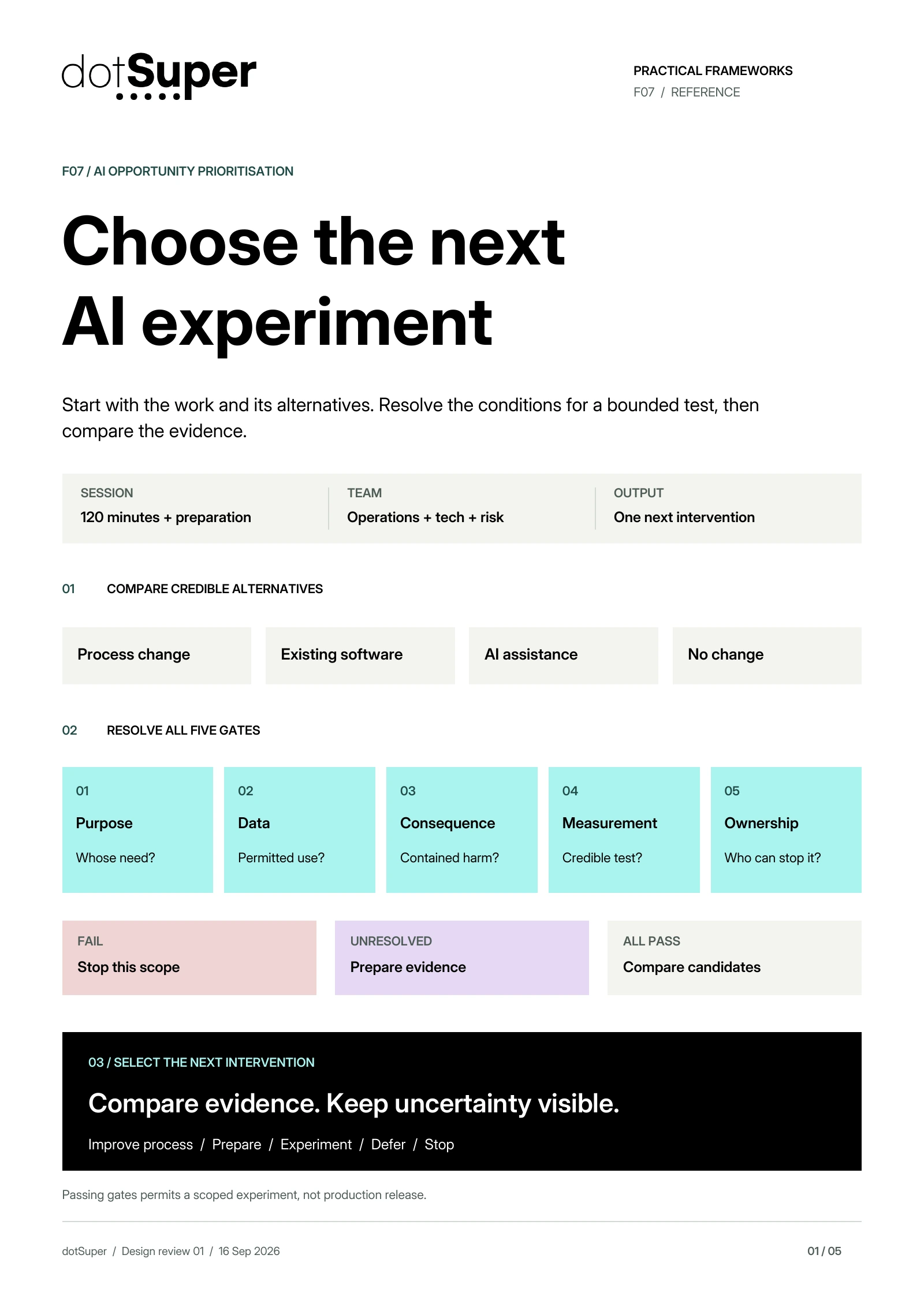
Read the diagram: AI Opportunity Prioritisation. Original dotSuper reference diagram. Original dotSuper synthesis informed by NIST AI RMF, task-level analysis and evidence-led prioritisation. The five gate prompts and decision states are dotSuper facilitation choices, not a NIST certification.
Define the work and compare process change, existing software, AI assistance and no change.
Resolve five gates: legitimate purpose, permitted data use, containable consequences, credible measurement and accountable ownership. Each gate is pass, unresolved or fail.
A failed gate stops the proposed scope. An unresolved gate requires preparation before the dependent test. Passing all gates permits comparison of scoped experiments, not production release.
Choose process improvement, preparation, experiment, defer or stop. Keep evidence, uncertainty and dependencies visible; do not add unlike ratings into a single score. These are proposed facilitation rules, not validated risk scores.
Take it into your next working session
Keep the source credits with the file. Check the reuse terms and adapt the method to your context.
Reuse: Original dotSuper material. No public reuse licence has been specified. Contact dotSuper for reuse permissions. Third-party source material retains its own terms.
Thumbnail credit and reuse
Reuse: Original dotSuper material. No public reuse licence has been specified. Contact dotSuper for reuse permissions. Third-party source material retains its own terms.
Sources, context and limits
Keep the evidence beside the method.
Original dotSuper synthesis informed by the sources listed. No institutional endorsement. Proposed method, not field validated.
- The combined method and its five-gate facilitation rules are not validated risk scores or regulatory approval. Passing gates permits consideration of a bounded experiment only. All three example decisions are illustrative.
- This combined dotSuper method is research-informed and has not been field validated. Workshop agreement and a completed template are not proof of effectiveness.
- Worked examples are hypothetical. Country examples and intended regional audience do not establish country-wide or region-wide effectiveness.
- Source access and adaptation limits are recorded in the source ledger. Attribution does not imply endorsement or a licence to reproduce third-party artwork.
- AI Risk Management Framework 1.0
nvlpubs.nist.gov · accessed Sep 16, 2026
- AI RMF Playbook
NIST · accessed Sep 16, 2026
- Generative AI Profile, NIST AI 600-1
NIST · accessed Sep 16, 2026
- Technology Code of Practice
UK Government · accessed Sep 16, 2026
- Generative AI at Work
nber.org · accessed Sep 16, 2026
- AI Ethics Principles
sdaia.gov.sa · accessed Sep 16, 2026
/ CITE OR SHARE THIS GUIDE
Make the evidence easy to verify.
When you reference this guide, link to its canonical URL. That gives readers one stable place for the evidence, limitations and future updates.
dotSuper Research Desk. (September 17, 2026). Choose the Right AI Opportunity to Test Next. dotSuper. https://dotsuper.net/feeds/applied-systems/ai-opportunity-prioritisation
Bring it into the work
Start with one real decision
Bring your AI idea list and choose what to test, prepare, defer or simplify.
Download the fillable framework