Operating ownership and adoption
Prepare Your Team to Own the New Workflow
Identify barriers to correct use, assign owners and backups, and rehearse normal work, failures and handover before expanding responsibility.
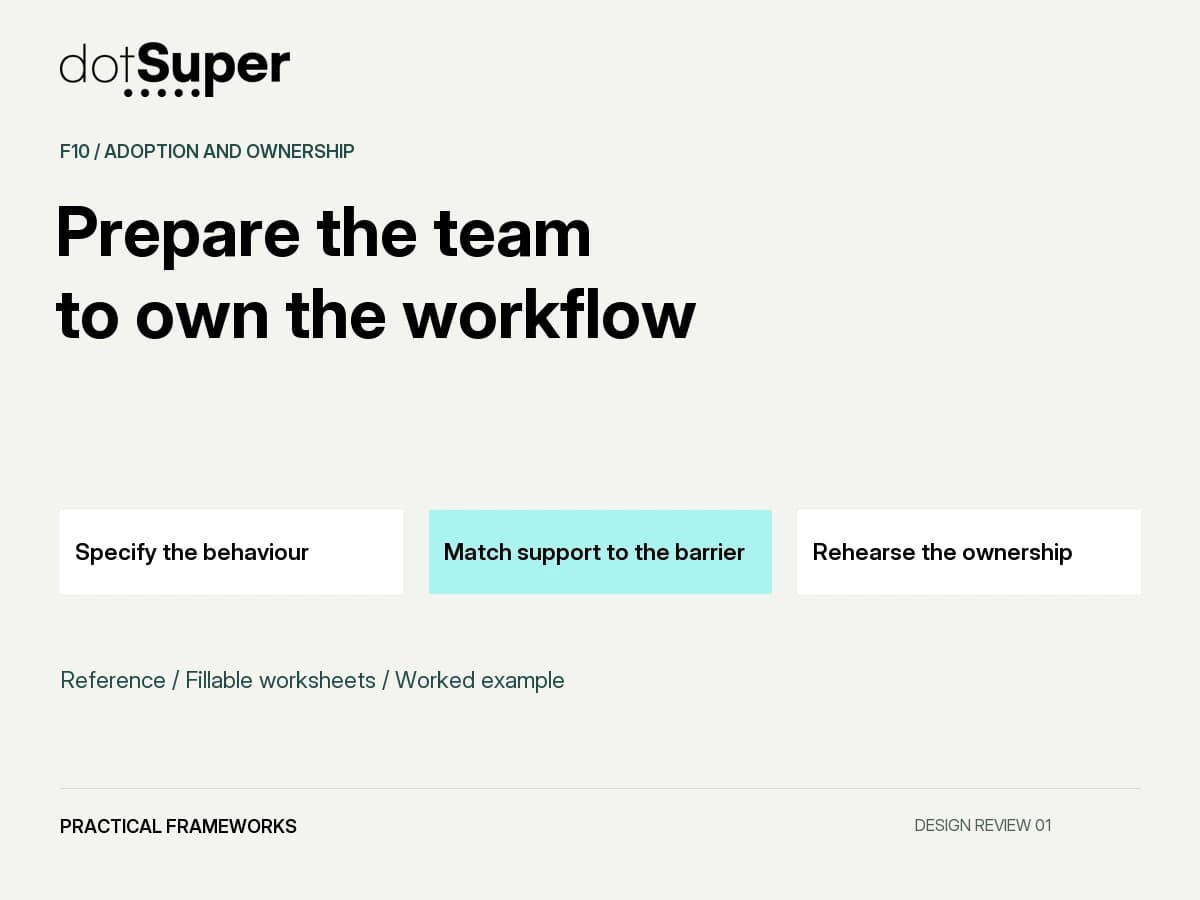
The method, in brief
Can the team operate, recover and stop the workflow in agreed conditions?
Define the target behaviour, investigate capability, opportunity and motivation barriers, and assign responsibilities with resources and authority. Advance through demonstrated rehearsals, including failure recovery, rather than treating training attendance as readiness.
Why this framework matters
Adoption is demonstrated operating capability supported by the right conditions, not a usage target.
Define the target behaviour, investigate capability, opportunity and motivation barriers, and assign responsibilities with resources and authority. Advance through demonstrated rehearsals, including failure recovery, rather than treating training attendance as readiness.
Audience and decision
For a business sponsor, frontline manager, future system owner and implementation partner deciding whether a workflow can move from supported pilot to routine operation. Decide which barriers to address, who owns the service, what must be rehearsed and what evidence permits handover. Use this before launch, not only after low adoption becomes visible.
The unit is a specific behaviour in a specific workflow. “Staff adopt AI” is too vague. “Buyers check the source quotation, correct discrepancies and record approval before sending a comparison” can be observed. Plan a two-hour preparation workshop and staged rehearsals across relevant roles and shifts.
Research and source ledger
Sources accessed 16 September 2026.
Attribution: The COM-B concepts remain the work of Michie, van Stralen and West. dotSuper adapts them to investigate a work behaviour and adds an ownership contract, rehearsal evidence and staged acceptance. If publishing an adapted explanation, credit the article and CC BY 2.0, identify the adaptation and avoid implying author endorsement.
| Source and date | Contribution and limits |
|---|---|
| Susan Michie, Maartje M. van Stralen and Robert West, The behaviour change wheel, 23 April 2011 | COM-B identifies capability, opportunity and motivation as conditions for behaviour. The study examined classification in public-health contexts; it does not validate this AI-adoption roadmap. Article licence is CC BY 2.0. |
| NIST, AI RMF Core, RMF 1.0, 2023 | Supports assigning governance across the system lifecycle. No automatic handover certification follows. |
| UK GDS/CDDO, Define your purchasing strategy, updated 3 September 2026 | Informs practical capability, maintenance and exit questions. Government-specific contracting rules are not treated as general business law. |
| Lean Enterprise Institute, Questions and coaching on A3 thinking, 2019 | Supports dialogue and learning around real problems. The roadmap is not a reproduction of an A3 template. |
Existing approaches and limitations
Training plans can address knowledge while leaving staff without access, time or authority. Communication campaigns can explain benefits while concealing that the new process increases workload. A responsibility chart can name owners who have neither resources nor practical access. Login counts can show activity without demonstrating correct use or a better business result.
The proposed roadmap connects behaviour with its conditions and with observable operating capability. Resistance is treated as information to investigate. A user may reasonably reject an unreliable tool, an unclear liability arrangement or a process that conflicts with their performance target. The solution is not automatically more persuasion.
Structure and rationale
Use four records: target behaviour, barrier evidence, ownership agreement, rehearsal results. For the target behaviour, specify who acts, when, using what information and how completion is recognised. For barrier evidence, ask whether the person can perform it, has the opportunity to do so and has reasons to do so. These questions adapt COM-B without claiming a clinical or psychometric assessment.
The ownership agreement covers outcome, data, access, technical maintenance, evaluation, incidents, budget and exit. The rehearsal tests whether those responsibilities can actually be performed. A roadmap stage advances on demonstrated readiness rather than elapsed calendar time alone.
Inputs and preparation
Bring pilot findings, known errors, operating procedures, staff availability, access requirements, support terms and a draft ownership table. Include people from less visible shifts and roles. Document whether training material needs translation or accessible formats. Test comprehension using actual tasks rather than assuming that attendance means competence.
Ask management how targets and incentives will change. If staff are expected to review AI outputs carefully while being rewarded only for speed, the process contains a conflict. Agree protected time for learning and a way to report faults without blame. Do not require public disclosure of individual anxiety or performance problems in a group workshop.
Facilitation and use
1. Define the target behaviour, 15 minutes. Describe an observable action at a point in the workflow. Separate correct use, appropriate refusal and escalation. A person who correctly rejects an unsafe output is using the process successfully. 2. Gather barrier evidence, 20 minutes. Use short interviews and observation. Distinguish inability, missing access, lack of time, conflicting incentives and low trust based on actual failures. Avoid diagnosing motivation from a manager's interpretation alone. 3. Choose a matching response, 20 minutes. Skill gaps may require practice and feedback. Opportunity gaps may require access, staffing or workflow changes. Motivation concerns may require fixing reliability, clarifying consequences or changing incentives. Record why the response fits the evidence. 4. Assign operating responsibilities, 20 minutes. Name an accountable owner and practical backup for each critical responsibility. Record authority, time allocation, tools and escalation route. A title without these conditions is an unresolved assignment. 5. Design rehearsals, 20 minutes. Include ordinary work, an incorrect output, an unavailable supplier, an absent expert and a request to stop. Use safe test material. Specify what a successful response looks like and who observes it. 6. Set staged acceptance, 15 minutes. Progress from supported practice to supervised use, then limited routine operation and handover. Define evidence required at each stage. Calendar targets can organise work, but missed readiness conditions prevent automatic progression. 7. Review and adjust, 10 minutes. Examine correct completion, avoidable burden, error recovery and unresolved reports. Ask affected staff whether the work is actually better. Change the roadmap when conditions change.
Readiness definitions and assumptions
Use not prepared, supported practice, demonstrated under supervision and demonstrated in agreed conditions for specific tasks. Do not combine these into a workforce maturity percentage. A staff member may perform normal work independently while still requiring support for rare incidents.
Adoption measures should include eligible work completed through the agreed process, correct review behaviour, appropriate overrides, unresolved incidents and time spent obtaining help. Report denominators and role coverage. Daily active users are secondary unless frequent use is necessary for the outcome. High use with frequent unreviewed errors is a failure, not successful adoption.
The proposed stages are facilitation choices. They do not replace competence requirements for regulated or safety-critical roles. Select the level of supervision according to actual consequences and existing organisational controls.
Worked example: illustrative, not a documented client result
A hypothetical UAE distributor has a useful pilot for quotation comparison, but only two enthusiastic buyers use it. Managers propose another training session. Observation shows that evening-shift staff share a workstation without the required permissions and that the approval policy still requires a second spreadsheet. The primary barriers are access and duplicated work, not necessarily knowledge or enthusiasm.
The target behaviour is to review the generated comparison against source quotations and record the final decision in the approved workspace. The response gives each authorised user appropriate access, clarifies which record is authoritative and provides practice on ambiguous freight terms. A manager confirms that time spent correcting errors will not count as poor productivity.
The ownership agreement names procurement as outcome owner, IT as access and integration owner, finance as recurring-cost owner and a nominated administrator as support coordinator. A backup buyer rehearses the workflow while the original champion is absent. The team tests an outage and demonstrates how work continues through the fallback process.
Handover remains conditional because the backup administrator cannot yet revoke a departed user's access. After supervised practice and a successful access-change rehearsal, that condition closes. The result is evidence of capability in this setting, not a claim that all staff are independently proficient or that future incidents are impossible.
Outputs, failure modes and validation limits
Deliver a behaviour specification, barrier-response table, responsibility agreement, training and rehearsal plan, acceptance record and support calendar. Include a retirement or replacement owner. An operating system needs someone responsible for ending its use when it no longer serves the business.
Failures include measuring attendance instead of competence, treating every objection as resistance, requiring staff to use a tool that does not meet their needs, hiding supplier dependence and assigning all ownership to the project's original champion. Another is transferring code while retaining essential credentials or undocumented knowledge elsewhere.
A counterexample is an occasional specialist task. Low daily usage may be appropriate, while the ability to perform the task correctly when it arises is essential. Rehearsal frequency should follow skill decay and consequence, not an arbitrary engagement target. Another counterexample is a workflow that should be retired; increasing adoption would be the wrong goal.
The roadmap has not been evaluated in a controlled organisational study. Validate it first through task observation, staff feedback and successful failure recovery. Longer-term evidence must examine sustained outcomes, workload and ownership after the implementation partner reduces involvement. Attribution to COM-B does not establish that this combined method produces those outcomes.
Working files and reuse
The five-page PDF includes a visual reference, two fillable worksheet pages, an illustrative worked example and a facilitator/source guide. An expandable CSV working log is also available.
All examples are illustrative, not measured client results. COM-B concepts are adapted from Michie, van Stralen and West (2011), CC BY 2.0. Work-setting prompts, ownership and rehearsals are dotSuper additions. No author endorsement is implied. The combined roadmap has not been validated for AI adoption.
Original dotSuper material prepared for review. No public reuse licence has been assigned. Third-party source material retains its own terms. COM-B concepts are adapted from Michie, van Stralen and West (2011), https://link.springer.com/article/10.1186/1748-5908-6-42, under CC BY 2.0: https://creativecommons.org/licenses/by/2.0/. Changes: work-behaviour prompts, ownership agreement, rehearsal evidence and staged acceptance. No author endorsement. This licence statement concerns the adapted source concepts; it does not assign a new licence to the complete dotSuper artwork.
The PDF is not represented as a tagged PDF/UA document. The text on this page provides a readable alternative to the diagram and method.
See the method. Keep the context.
The visual companion
Reuse: Original dotSuper material. No public reuse licence has been specified. Contact dotSuper for reuse permissions. Third-party source material retains its own terms. COM-B concepts are adapted from Michie, van Stralen and West (2011), https://link.springer.com/article/10.1186/1748-5908-6-42, under CC BY 2.0: https://creativecommons.org/licenses/by/2.0/. Changes: work-behaviour prompts, ownership agreement, rehearsal evidence and staged acceptance. No author endorsement. This licence statement concerns the adapted source concepts; it does not assign a new licence to the complete dotSuper artwork.
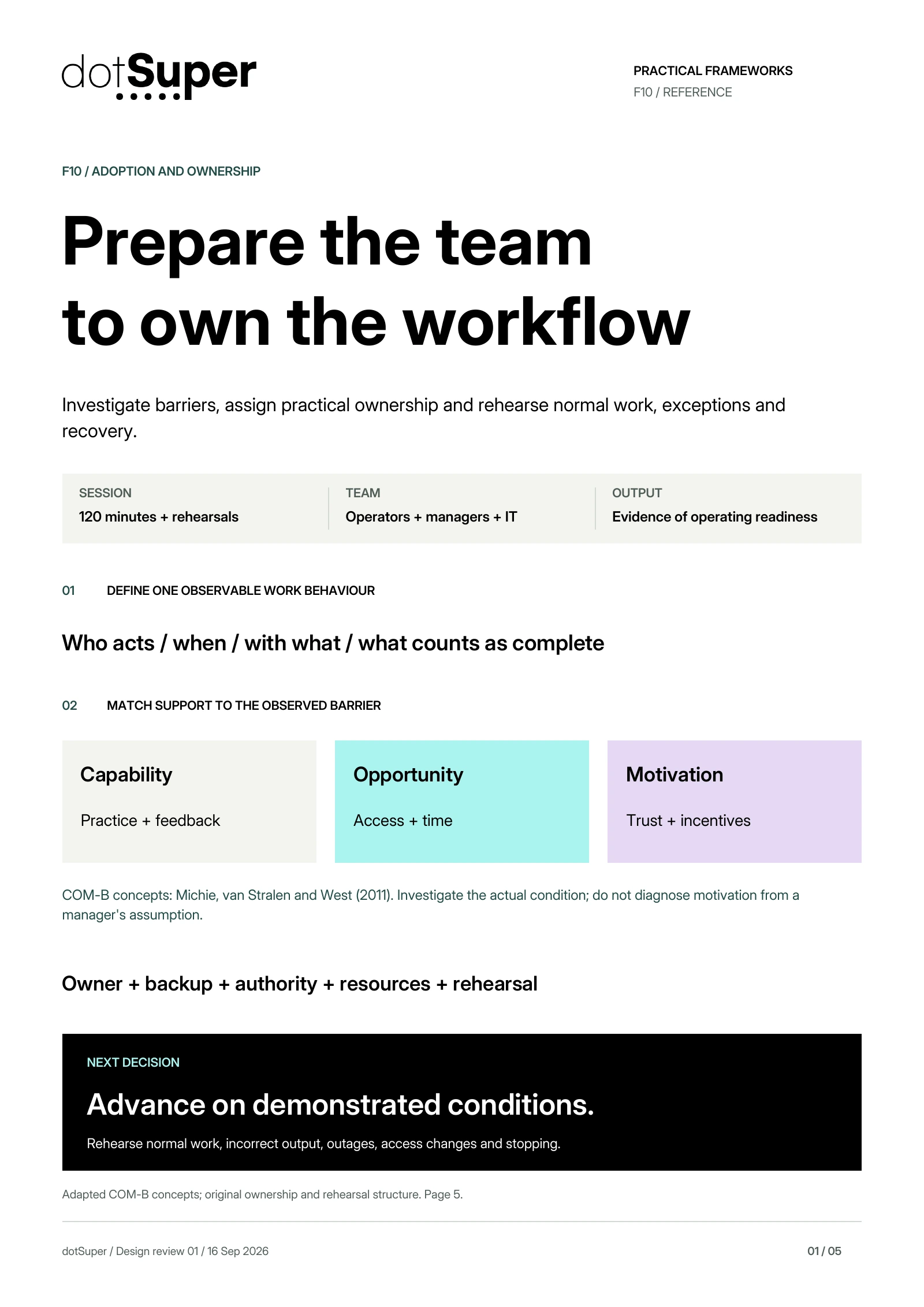
Read the diagram: Adoption and Ownership. Original dotSuper reference diagram. Adapted conceptual explanation of COM-B, credited to Michie, van Stralen and West (2011), CC BY 2.0. Original dotSuper artwork, work-setting prompts, ownership record and rehearsals. No original paper figure is reproduced.
Define who acts, when, with what and what counts as complete. Investigate capability, opportunity and motivation using observed barriers; possible supports include practice and feedback, access and time, or trust and incentives. These COM-B concepts are adapted from Michie, van Stralen and West (2011). Do not infer motivation from a manager’s assumption. Assign an owner, backup, authority and resources, then rehearse normal work, incorrect output, outages, access changes and stopping. Advance only on demonstrated conditions.
COM-B concepts are adapted from Michie, van Stralen and West (2011), CC BY 2.0. Work-setting prompts, ownership and rehearsals are dotSuper additions. No author endorsement is implied. The combined roadmap has not been validated for AI adoption.
Take it into your next working session
Keep the source credits with the file. Check the reuse terms and adapt the method to your context.
Reuse: Original dotSuper material. No public reuse licence has been specified. Contact dotSuper for reuse permissions. Third-party source material retains its own terms. COM-B concepts are adapted from Michie, van Stralen and West (2011), https://link.springer.com/article/10.1186/1748-5908-6-42, under CC BY 2.0: https://creativecommons.org/licenses/by/2.0/. Changes: work-behaviour prompts, ownership agreement, rehearsal evidence and staged acceptance. No author endorsement. This licence statement concerns the adapted source concepts; it does not assign a new licence to the complete dotSuper artwork.
Reuse: Original dotSuper material. No public reuse licence has been specified. Contact dotSuper for reuse permissions. Third-party source material retains its own terms. COM-B concepts are adapted from Michie, van Stralen and West (2011), https://link.springer.com/article/10.1186/1748-5908-6-42, under CC BY 2.0: https://creativecommons.org/licenses/by/2.0/. Changes: work-behaviour prompts, ownership agreement, rehearsal evidence and staged acceptance. No author endorsement. This licence statement concerns the adapted source concepts; it does not assign a new licence to the complete dotSuper artwork.
Thumbnail credit and reuse
Reuse: Original dotSuper material. No public reuse licence has been specified. Contact dotSuper for reuse permissions. Third-party source material retains its own terms. COM-B concepts are adapted from Michie, van Stralen and West (2011), https://link.springer.com/article/10.1186/1748-5908-6-42, under CC BY 2.0: https://creativecommons.org/licenses/by/2.0/. Changes: work-behaviour prompts, ownership agreement, rehearsal evidence and staged acceptance. No author endorsement. This licence statement concerns the adapted source concepts; it does not assign a new licence to the complete dotSuper artwork.
Sources, context and limits
Keep the evidence beside the method.
- COM-B concepts are adapted from Michie, van Stralen and West (2011), CC BY 2.0. Work-setting prompts, ownership and rehearsals are dotSuper additions. No author endorsement is implied. The combined roadmap has not been validated for AI adoption.
- This combined dotSuper method is research-informed and has not been field validated. Workshop agreement and a completed template are not proof of effectiveness.
- Worked examples are hypothetical. Country examples and intended regional audience do not establish country-wide or region-wide effectiveness.
- Source access and adaptation limits are recorded in the source ledger. Attribution does not imply endorsement or a licence to reproduce third-party artwork.
- The behaviour change wheel
Implementation Science / Springer Nature · accessed Sep 16, 2026
- AI RMF Core
NIST · accessed Sep 16, 2026
- Define your purchasing strategy
UK Government · accessed Sep 16, 2026
- Questions and coaching on A3 thinking
Lean Enterprise Institute · accessed Sep 16, 2026
- CC BY 2.0
Creative Commons · accessed Sep 16, 2026
/ CITE OR SHARE THIS GUIDE
Make the evidence easy to verify.
When you reference this guide, link to its canonical URL. That gives readers one stable place for the evidence, limitations and future updates.
dotSuper Research Desk. (September 17, 2026). Prepare Your Team to Own the New Workflow. dotSuper. https://dotsuper.net/feeds/applied-systems/adoption-and-ownership-roadmap
Bring it into the work
Start with one real decision
Bring the workflow your team should own and define the responsibilities and rehearsals for handover.
Download the fillable framework