/ THE SHORT ANSWER
See the method. Keep the context.
The visual companion
Reuse: Original artwork created for dotSuper. No public reuse licence has been specified. Attribution to research sources does not grant rights to their artwork or datasets.
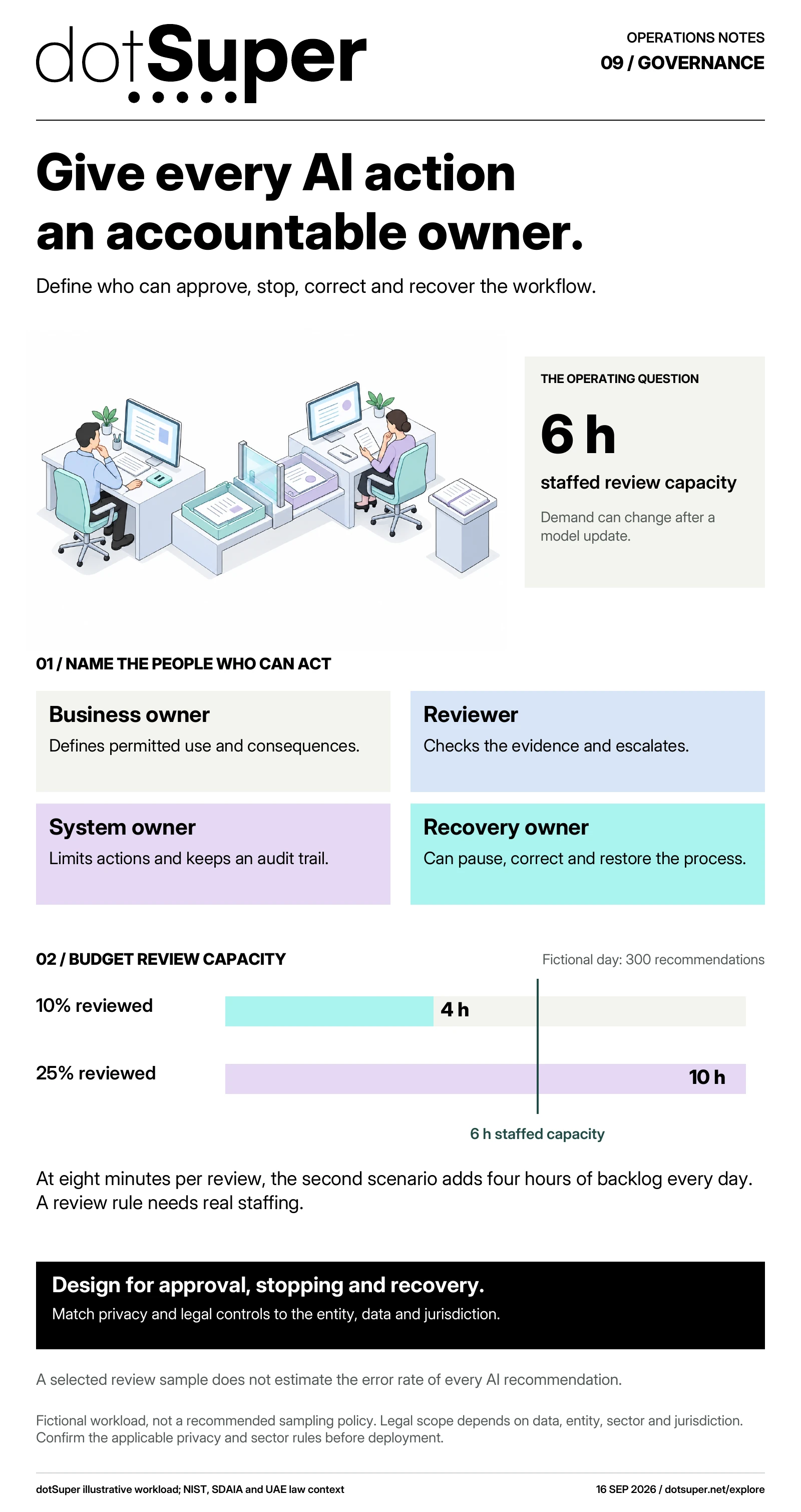
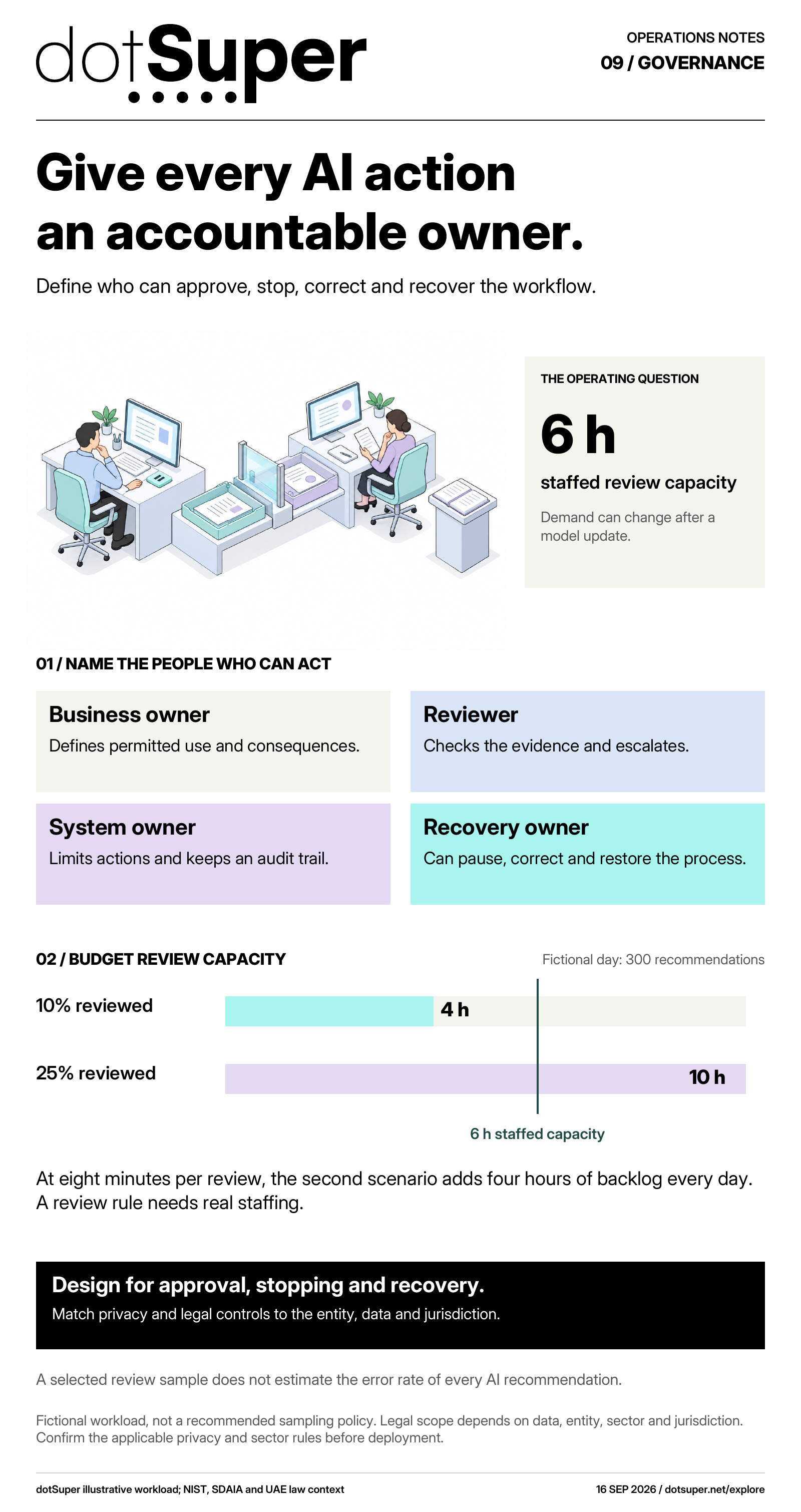
Read the diagram: Define who can approve, stop, correct and recover the workflow. Fictional workload, not a recommended sampling policy. Legal scope depends on data, entity, sector and jurisdiction. Confirm the applicable privacy and sector rules before deployment.
Four roles cover business authority, review, system control and recovery. In a fictional 300-recommendation day, reviewing 10% at eight minutes each takes four hours; reviewing 25% takes ten. Six available hours leave four hours of daily backlog in the second scenario.
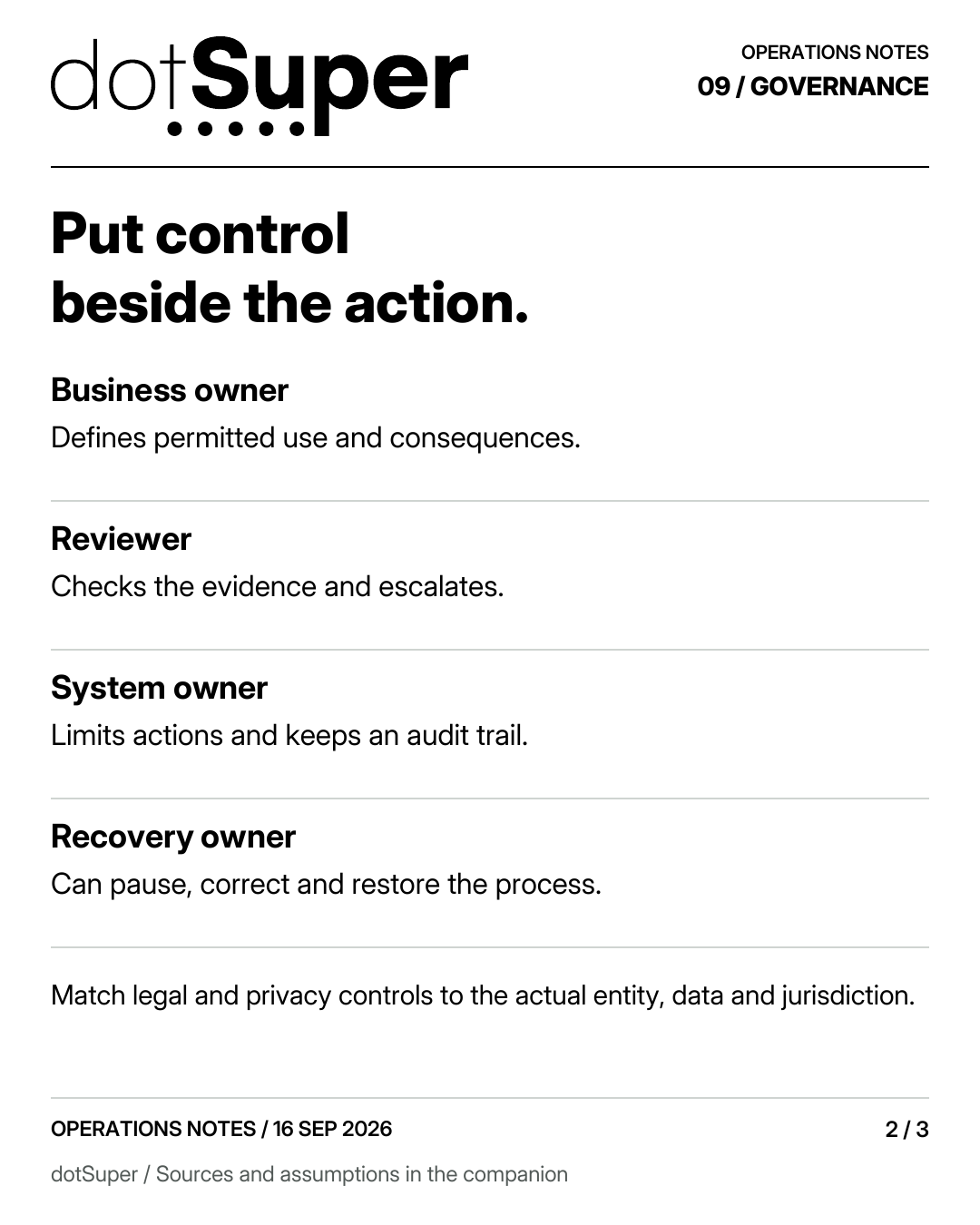
Business owner: permitted use and consequences. Reviewer: source evidence and escalation. System owner: action limits and audit trail. Recovery owner: pause, correction and restoration.
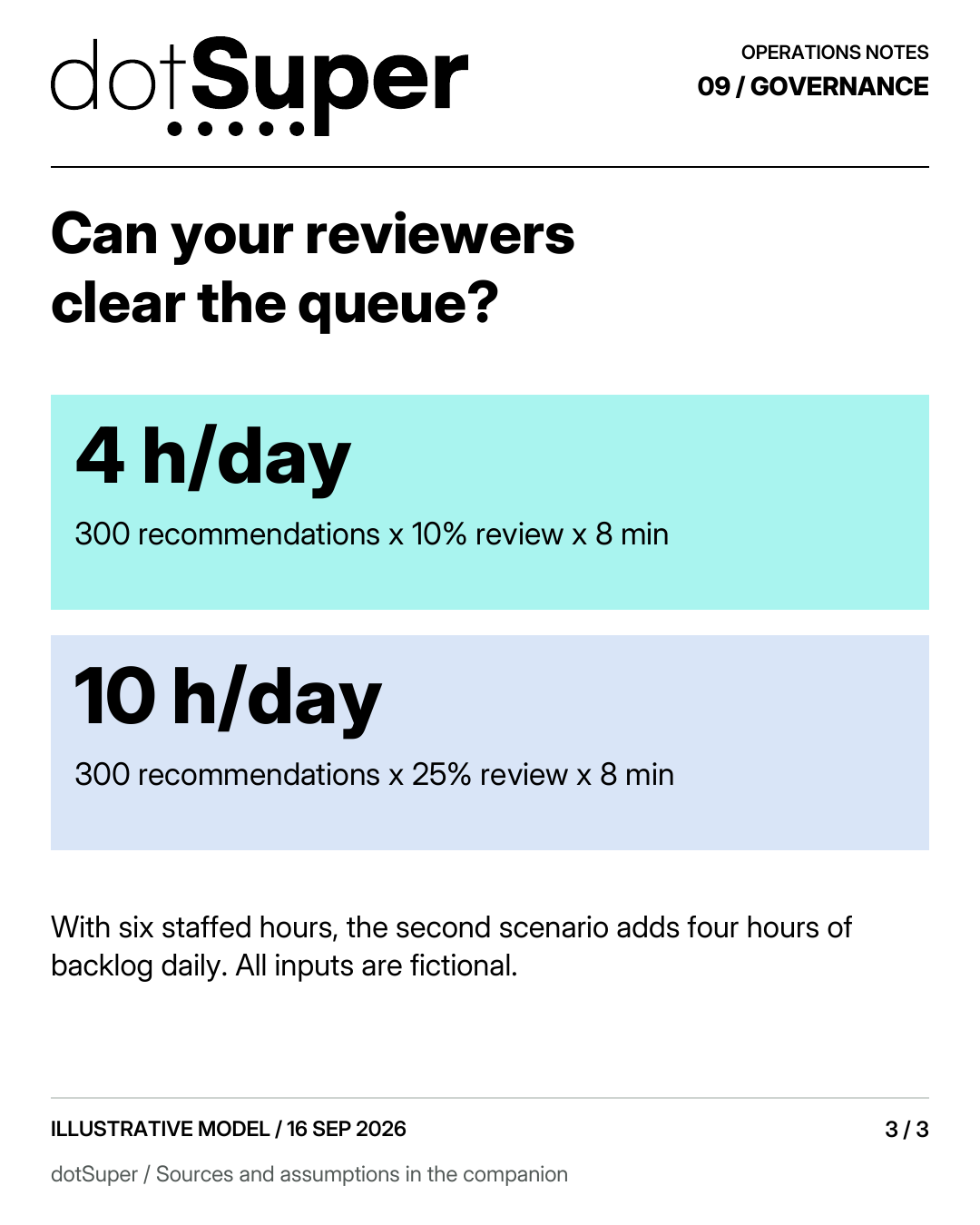
For 300 recommendations per day at eight minutes per detailed review, a 10% review share needs 30 reviews and four hours. A 25% share needs 75 reviews and ten hours. With six staffed hours, the second queue accumulates four hours of backlog daily.
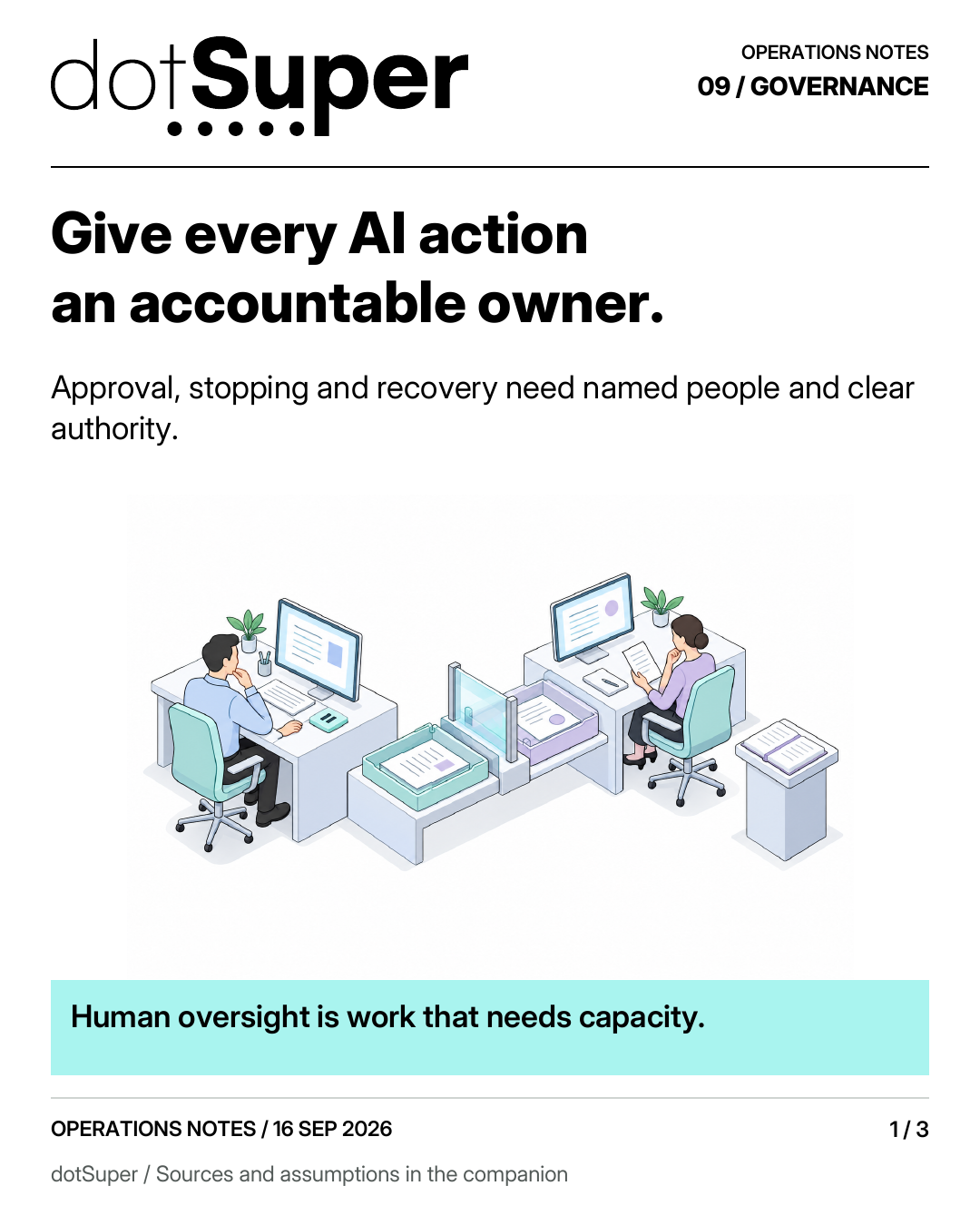
Give every AI action an accountable owner. Approval, stopping and recovery need named people and clear authority. Human oversight is work that needs capacity.
Put control beside the action. Business owner / Defines permitted use and consequences. Reviewer / Checks the evidence and escalates. System owner / Limits actions and keeps an audit trail. Recovery owner / Can pause, correct and restore the process. Match legal and privacy controls to the actual entity, data and jurisdiction.
Can your reviewers clear the queue? 4 h/day / 300 recommendations x 10% review x 8 min 10 h/day / 300 recommendations x 25% review x 8 min With six staffed hours, the second scenario adds four hours of backlog daily. All inputs are fictional.
The workload is synthetic and does not recommend a sampling policy or universal acceptance threshold.
Twelve errors among 75 selected reviews do not establish an unbiased population error rate.
Saudi and UAE regimes require separate applicability assessments. Hosting location alone does not establish compliance.
The UAE law was read during research on 16 September 2026; a later same-day retrieval failed. No fresh legal-scope determination or product certification is claimed.
| Review share | Reviews/day | Required hours/day | Staffed hours/day | Backlog hours/day |
|---|---|---|---|---|
| 10% | 30 | 4 | 6 | 0 |
| 25% | 75 | 10 | 6 | 4 |
Reuse: Original artwork created for dotSuper. No public reuse licence has been specified. Attribution to research sources does not grant rights to their artwork or datasets.
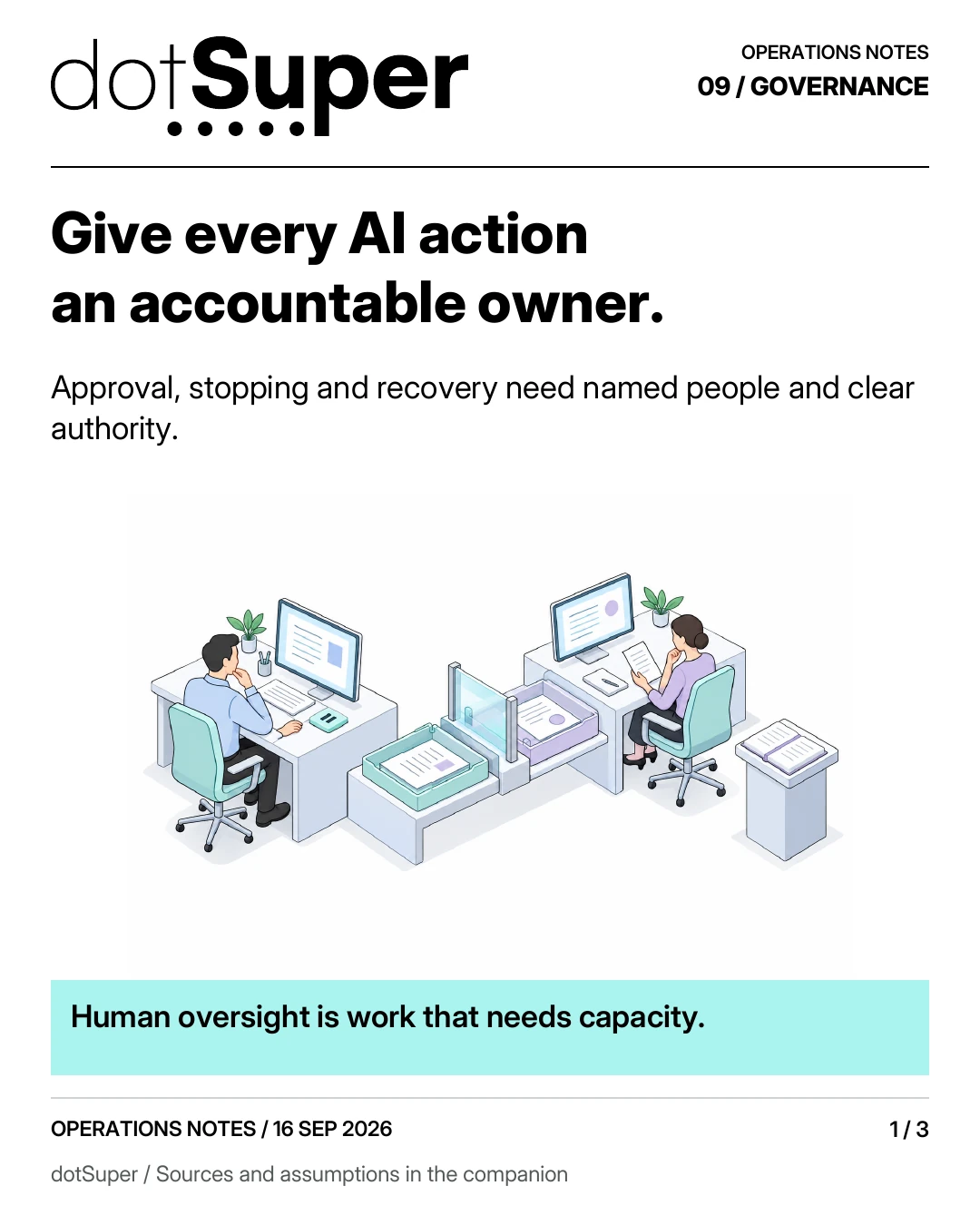
Read the diagram: Panel 1 of 3. Give every AI action an accountable owner.
Give every AI action an accountable owner. Approval, stopping and recovery need named people and clear authority. Human oversight is work that needs capacity.
The workload is synthetic and does not recommend a sampling policy or universal acceptance threshold.
Reuse: Original artwork created for dotSuper. No public reuse licence has been specified. Attribution to research sources does not grant rights to their artwork or datasets.
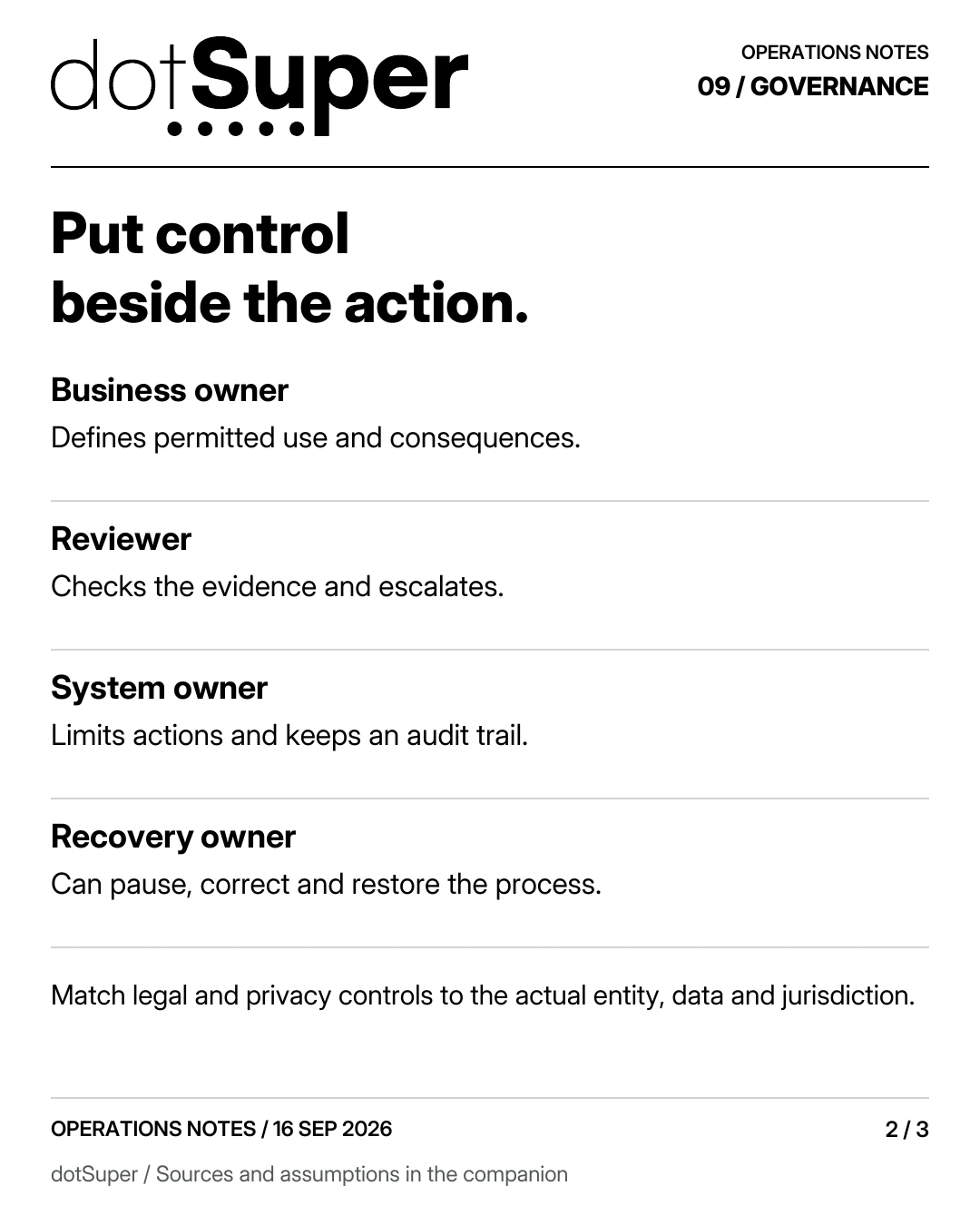
Read the diagram: Panel 2 of 3. Put control beside the action.
Put control beside the action. Business owner / Defines permitted use and consequences. Reviewer / Checks the evidence and escalates. System owner / Limits actions and keeps an audit trail. Recovery owner / Can pause, correct and restore the process. Match legal and privacy controls to the actual entity, data and jurisdiction.
The workload is synthetic and does not recommend a sampling policy or universal acceptance threshold.
Reuse: Original artwork created for dotSuper. No public reuse licence has been specified. Attribution to research sources does not grant rights to their artwork or datasets.
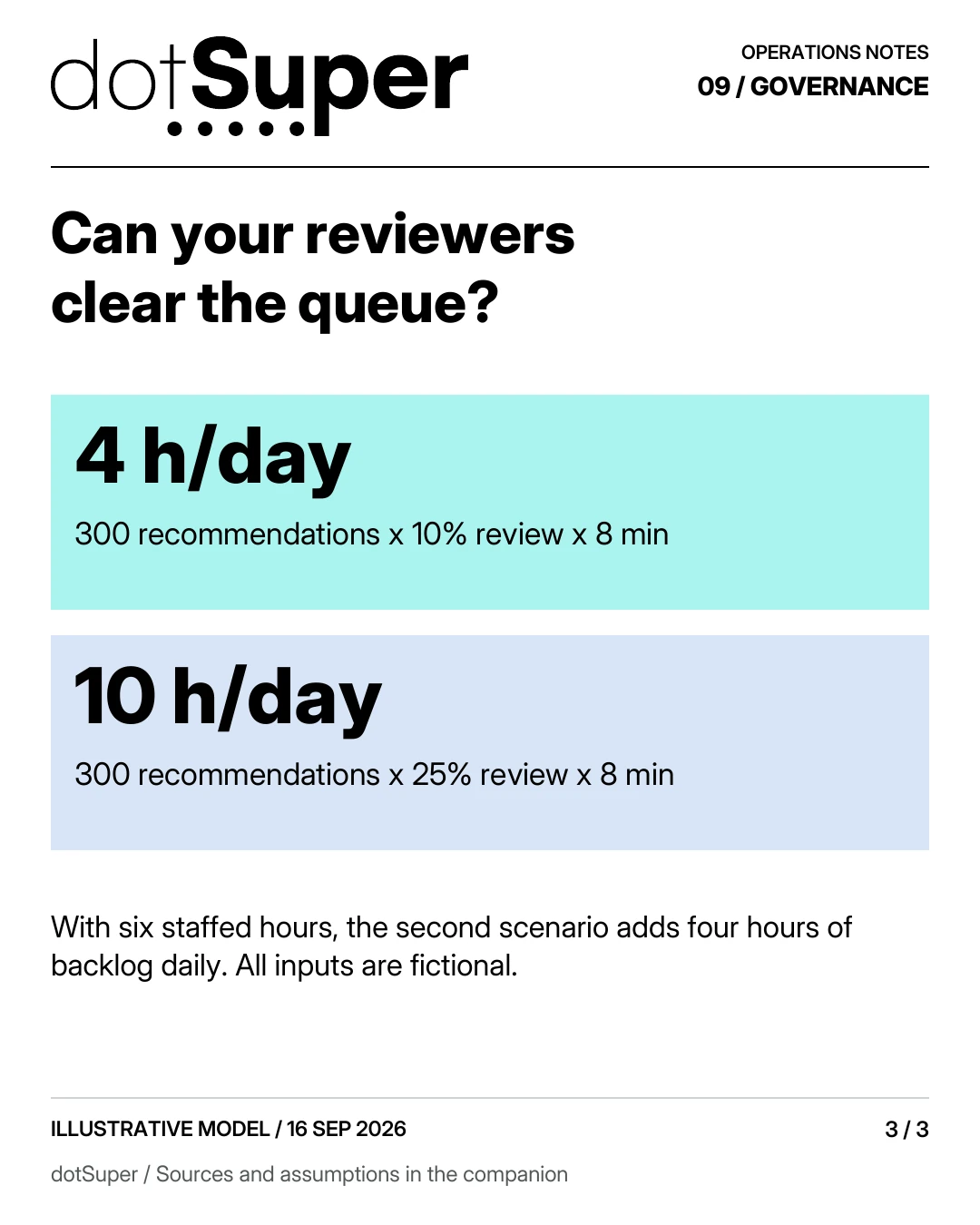
Read the diagram: Panel 3 of 3. Can your reviewers clear the queue? 4 h/day / 300 recommendations x 10% review x 8 min 10 h/day / 300 recommendations x 25% review x 8 min With six staffed hours, the second scenario adds four hours of backlog daily.
Can your reviewers clear the queue? 4 h/day / 300 recommendations x 10% review x 8 min 10 h/day / 300 recommendations x 25% review x 8 min With six staffed hours, the second scenario adds four hours of backlog daily. All inputs are fictional.
The workload is synthetic and does not recommend a sampling policy or universal acceptance threshold.
Fictional example: review capacity.
Review share: 10%; Reviews/day: 30; Required hours/day: 4; Staffed hours/day: 6; Backlog hours/day: 0.
Review share: 25%; Reviews/day: 75; Required hours/day: 10; Staffed hours/day: 6; Backlog hours/day: 4.
| Review share | Reviews/day | Required hours/day | Staffed hours/day | Backlog hours/day |
|---|---|---|---|---|
| 10% | 30 | 4 | 6 | 0 |
| 25% | 75 | 10 | 6 | 4 |
Take it into your next working session
Keep the source credits with the file. Check the reuse terms and adapt the method to your context.
Credit: dotSuper original fictional worked-example data.
Reuse: Original illustrative data. No public reuse licence has been specified. These are not client measurements or research results.
Reuse: Original artwork created for dotSuper. No public reuse licence has been specified. Attribution to research sources does not grant rights to their artwork or datasets.
Reuse: Original artwork created for dotSuper. No public reuse licence has been specified. Attribution to research sources does not grant rights to their artwork or datasets.
Reuse: Original artwork created for dotSuper. No public reuse licence has been specified. Attribution to research sources does not grant rights to their artwork or datasets.
Reuse: Original artwork created for dotSuper. No public reuse licence has been specified. Attribution to research sources does not grant rights to their artwork or datasets.
Reuse: Original artwork created for dotSuper. No public reuse licence has been specified. Attribution to research sources does not grant rights to their artwork or datasets.
Reuse: Original artwork created for dotSuper. No public reuse licence has been specified. Attribution to research sources does not grant rights to their artwork or datasets.
Thumbnail credit and reuse
Reuse: Original artwork created for dotSuper. No public reuse licence has been specified. Attribution to research sources does not grant rights to their artwork or datasets.
- 01Give business authority, review, system control and recovery explicit owners.
- 02The fictional review queue needs four hours at 10% review and ten hours at 25%.
- 03Six staffed hours leave four hours of daily backlog in the higher-review scenario.
- 04A 16% error rate within selected reviews is not automatically the error rate across all recommendations.
/ dotSuper point of view
Human oversight needs evidence, authority, staffing and recovery. A named reviewer is not enough when the queue exceeds the time available to review it.
Audience, question and answer
Define who may use which data, for what purpose, to make which decision, with what evidence and recovery path.
Human oversight needs authority, information, time and the ability to stop or correct an action.
A generic “human in the loop” label supplies none of these by itself.
This explanation concerns operating controls and general regulatory orientation.
It is not legal advice, a complete compliance checklist or a certification of any product.
Saudi and UAE obligations require separate applicability assessments, and sector or special-zone rules can change the analysis.
Research findings and legal boundaries
It is a voluntary framework.
The NIST site states that version 1.0 is being revised, so the version must remain attached to any reference.
NIST, AI RMF overview, checked 16 September 2026 (source 3).
Saudi Arabia's official implementing and transfer regulations distinguish controller responsibilities, processing records and conditions for international transfers.
The transfer provisions describe circumstances and safeguards for transfer; they do not support a blanket claim that every kind of business data must always stay in Saudi Arabia.
SDAIA, official regulations text, implementing regulation and transfer regulation Article 2, checked 16 September 2026 (source 1).
The UAE federal personal-data law has explicit scope exclusions, including certain government, health, banking and free-zone contexts with their own governing provisions.
Articles 22 and 23 address international transfer in different protection circumstances.
Identify the applicable regime before selecting a processing arrangement.
UAE Federal Decree-Law 45 of 2021, Articles 2, 7, 22 and 23, official English text checked in browser 16 September 2026 (source 2).
The UAE portal identifies the law as active, effective 2 January 2022, and states that Arabic prevails for interpretation.
This effective date is not a new AI-project deadline.
No universal retention duration, breach-notification clock or claim about the publication status of all executive rules is made here.
Those details need a current, entity-specific legal review.
The UAE law was read during research on 16 September 2026; a later same-day retrieval failed.
No fresh legal-scope determination or product certification is claimed.
Build an operational control map
Identify source systems, intended users, external providers, storage, logs, backups and support access.
Include the content of prompts and retrieved documents, not only the primary database.
An application can store records locally while transmitting part of them to a remote model or support service.
For each category, record purpose, owner, access basis, retention rule and deletion mechanism.
“Keep everything for model improvement” is not a useful default.
The business should be able to explain why the data is necessary and what happens when its purpose expires, subject to applicable retention obligations.
Separate personal data from other confidential business information.
A supplier quotation can contain a contact person's data as well as commercial terms.
Machinery readings may be non-personal until linked to an identified operator.
Removing names alone may not eliminate identifiability when context remains.
Define action authority independently of data access.
Someone allowed to read an invoice may not be allowed to approve it.
A reviewer able to reject a draft needs a clear route to correction and a record of why the draft failed.
Access should follow roles and operating needs, with a process for changes and departures.
Make oversight a job that can be performed
Do not require a person to approve a conclusion while hiding the document or transaction behind it.
The interface should make material differences visible.
Specify what the reviewer can do: approve, correct, reject, request information, escalate or stop the workflow.
A button labelled “approve” is weak control if declining it simply sends the same request back until someone accepts.
Record the decision and accountable role.
Specify time and capacity.
A queue that arrives faster than people can review it creates pressure to rubber-stamp.
Measure review duration, backlog age and the proportion of reviewed outputs that required correction.
A sudden drop in corrections can indicate improvement or reduced scrutiny; investigate before celebrating it.
Test escalation and recovery.
Include an unavailable owner, a revoked permission, an incorrect answer already used, and an external provider outage.
A runbook must explain how to stop new actions, identify affected records, correct errors and resume safely.
Ownership belongs to the operating organisation, with external support responsibilities defined.
Worked example: oversight capacity can be the bottleneck
A policy sends 10% to detailed review, and each detailed review takes eight minutes.
The queue requires 30 × 8 = 240 minutes, or four staff-hours daily.
These values are illustrative and do not establish an adequate sampling policy.
If a model or supplier-template change raises the review share to 25%, the same volume requires 75 × 8 = 600 minutes, or ten hours.
A single reviewer with six hours available cannot clear the queue daily.
Four hours of backlog accumulates each day unless the team changes staffing, throughput or the workflow.
Reducing review simply to fit capacity may change the risk profile.
A better operating response could be to narrow the automated scope, pause the changed document family or return it to the previous process while investigating.
The business owner chooses a response with the appropriate technical and legal input.
Now assume the reviewer catches 12 material errors in 75 reviewed recommendations.
That is 16% within the selected review queue.
It is not automatically the error rate across all 300 recommendations because the review queue may deliberately contain the hardest cases.
State the selection rule and denominator before publishing a percentage.
Quantitative context and evidence collection
Distinguish cases flagged by a rule from cases sampled randomly.
Track model and policy versions so a change can be connected to the affected work.
Measure access controls with meaningful tests: an unauthorised role attempts to retrieve a restricted record; a former user loses access; one business entity cannot query another's data; a deletion or retention operation has the intended scope.
Avoid a “100% compliant” score that compresses different obligations and untested assumptions.
Use risk severity and evidence quality alongside counts.
One unauthorised disclosure can matter more than many harmless formatting errors.
Do not set an arbitrary universal acceptance threshold in a public infographic.
The useful asset teaches what to measure and who must decide.
Evidence and boundaries
Each source supports only the scope stated beside the claim.
| Claim | Evidence | Scope limit |
|---|---|---|
| AI RMF includes four connected risk functions | NIST overview and AI RMF 1.0 | Voluntary and under revision |
| Saudi transfers are governed by conditions | SDAIA official transfer regulation | Not blanket localisation or automatic permission |
| UAE federal-law scope has exclusions | UAE law Article 2 | Determine the actual regime and sector |
| UAE international transfers have specified routes | UAE law Articles 22–23 | A project needs fact-specific assessment |
| Detailed review requires ten hours in the scenario | 300 × 25% × 8 / 60 | Fictional workload |
| Reviewed-queue error rate is not population error rate | Selected-sample reasoning | Depends on review selection |
One practical next step
Measure queue arrivals and review duration alongside the actual data, entity and jurisdiction boundaries.
Counterevidence and limitations
Fatigue, poor evidence display and incentive pressure can reduce their effectiveness.
Conversely, requiring a person to inspect every low-risk field may create cost without proportionate benefit.
Oversight should match the decision and be evaluated, not assumed effective because a person is present.
Hosting location alone is insufficient to establish compliance.
Contracts, subprocessors, remote access, data categories and purpose can all matter.
Equally, the existence of cross-border rules does not justify claiming that all external processing is prohibited.
This explanation intentionally avoids that simplification.
The official sources establish legal text and framework concepts, not that a given organisation is compliant.
Detailed current obligations, sector rules and special-zone regimes depend on the actual implementation and applicable regime.
Search interest in governance is unmeasured.
What this page cannot conclude
- 01The workload is synthetic and does not recommend a sampling policy or universal acceptance threshold.
- 02Twelve errors among 75 selected reviews do not establish an unbiased population error rate.
- 03Saudi and UAE regimes require separate applicability assessments. Hosting location alone does not establish compliance.
- 04The UAE law was read during research on 16 September 2026; a later same-day retrieval failed. No fresh legal-scope determination or product certification is claimed.
Sources
- 01SDAIA, official regulations text, implementing regulation and transfer regulation Article 2, checked 16 September 2026Saudi Data and AI Authority · accessed Sep 16, 2026
- 02UAE Federal Decree-Law 45 of 2021, Articles 2, 7, 22 and 23, official English text checked in browser 16 September 2026UAE Legislation · accessed Sep 16, 2026
- 03NIST, AI RMF overview, checked 16 September 2026US National Institute of Standards and Technology · accessed Sep 16, 2026
Our editorial standard · Found an error? Send a correction with its source.
/ CITE OR SHARE THIS GUIDE
Make the evidence easy to verify.
When you reference this guide, link to its canonical URL. That gives readers one stable place for the evidence, limitations and future updates.
dotSuper Research Desk. (September 17, 2026). Give every AI action an accountable owner.. dotSuper. https://dotsuper.net/feeds/applied-systems/accountable-ai-and-review-capacity