/ THE SHORT ANSWER
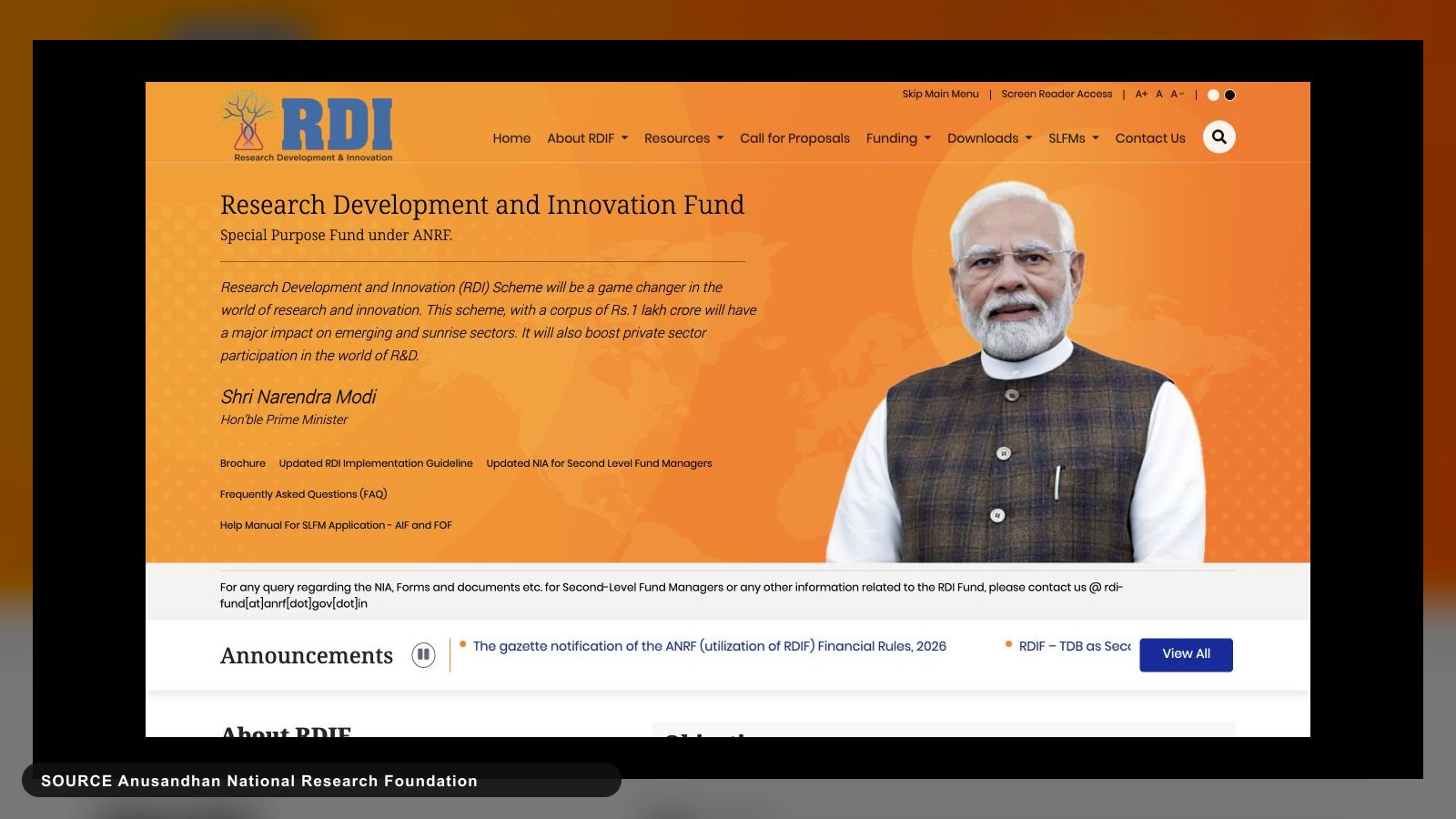
- 01The RDI Fund has an announced corpus of ₹1 lakh crore over six years.
- 02The official mechanism is two-tiered, with capital routed through second-level fund managers.
- 03Support can include long-term low-interest loans, selective startup equity and fund-of-funds contributions.
- 04The official portal points to technology readiness level 4 and above for supported areas.
- 05A company needs a financing and evidence package, not only a technically ambitious idea.
/ dotSuper point of view
Large public pools do not remove investment discipline. They reward teams that translate technical progress into inspectable commercial and execution evidence.
What changed
The official portal describes a corpus of ₹1 lakh crore over six years, including a ₹20,000 crore allocation for 2025-26.
It targets private-sector research and strategic technologies such as AI, robotics, quantum systems, advanced materials, energy and biotechnology.
The fresh practical signal is that the official portal now explains the operating route in greater detail.
Its funding-mechanism page, updated on 7 September 2026, sets out a two-tier structure.
A Special Purpose Fund channels capital through second-level fund managers.
Eligible manager types include development finance institutions, NBFCs, alternative investment funds and focused research organisations.
A July government implementation update reported that the Technology Development Board and BIRAC had each been sanctioned ₹1,000 crore.
It said ₹500 crore had been disbursed to TDB in March 2026, that TDB had approved 22 projects with ₹2,192 crore of support, and that BIRAC had shortlisted eight projects seeking ₹390.35 crore.
These figures show movement, but they do not mean every startup can apply directly to the central pool.
- The portal describes long-term, low-interest financing through a competitive process.
- Selective equity support and fund-of-funds contributions can also be used.
- The two-tier structure makes the identity and criteria of the second-level manager important.
Why it matters to businesses
The constraint is that a technically promising project still needs an investable route.
A manager must be able to understand the technology, assess milestones, manage risk and fit the project within its own mandate.
For established manufacturers and corporate R&D teams, the fund can change build-versus-buy decisions.
A technology programme that was too long for a normal annual budget may become financeable through a partnership, special-purpose project or qualified intermediary.
That still requires clear ownership of IP, procurement, facilities, data, regulatory approvals and commercial adoption.
Technology readiness level 4 is an important dividing line.
It generally indicates validation in a laboratory environment rather than an idea on paper.
Teams should not stretch the label.
They should show the test setup, result, reproducibility, next technical risk and route to a relevant operating environment.
An honest evidence gap is easier to finance than an inflated readiness claim that fails diligence.
| Evidence area | What to prepare | Decision it supports |
|---|---|---|
| Technology | Validation result, readiness level and remaining risks | Can the project advance? |
| Market | User problem, buyer, alternatives and adoption evidence | Will the output be used? |
| Economics | Milestone budget, capital need and unit assumptions | Is the financing structure credible? |
| Rights | IP ownership, licences, data and collaboration terms | Can value be protected and deployed? |
| Execution | Team, partners, governance and reporting cadence | Can milestones be delivered? |
What to do next
Summarise the technical result in language an investment committee can inspect.
Include the test method, benchmark, failure modes and the exact next milestone that new capital would unlock.
Then identify the likely financing route.
Review the mandates of second-level managers and current calls rather than assuming a direct central application.
Ask what instrument fits the project, what security or co-investment is expected, which milestones release funds and how long diligence normally takes.
Build a data room before outreach.
It should include corporate records, cap table, IP chain, contracts, financial model, technical evidence, customer or partner validation, regulatory plan and milestone budget.
Keep a one-page claim register linking every important statement in the pitch to supporting evidence.
- Confirm that the project and applicant fit the current official guidelines.
- Select a second-level manager whose mandate matches the technology and stage.
- Define milestones that connect technical progress to commercial adoption.
- Seek qualified legal and financial advice before accepting a loan, equity or fund structure.
What this page cannot conclude
- 01The RDI Fund itself was approved and launched earlier. This briefing interprets the now-current official portal and implementation material rather than announcing a new fund today.
- 02Eligibility, instruments, rates, timelines and application routes can vary by second-level manager and programme.
- 03Government implementation figures can change as approvals, disbursements and projects progress.
- 04This is operational guidance, not an assurance of funding or financial advice.
Sources
- 01Research Development and Innovation FundAnusandhan National Research Foundation · accessed Sep 7, 2026
- 02Funding MechanismRDI Fund · accessed Sep 7, 2026
- 03Governance StructureRDI Fund · accessed Sep 7, 2026
- 04Implementation status of the RDI FundPress Information Bureau, Government of India · accessed Sep 7, 2026
Our editorial standard · Found an error? Send a correction with its source.
/ CITE OR SHARE THIS GUIDE
Make the evidence easy to verify.
When you reference this guide, link to its canonical URL. That gives readers one stable place for the evidence, limitations and future updates.
dotSuper Research Desk. (September 7, 2026). India's ₹1 lakh crore RDI Fund is becoming operational. Deep-tech teams need the right evidence route.. dotSuper. https://dotsuper.net/feeds/daily-briefing/2026-09-07-india-rdi-fund-access